
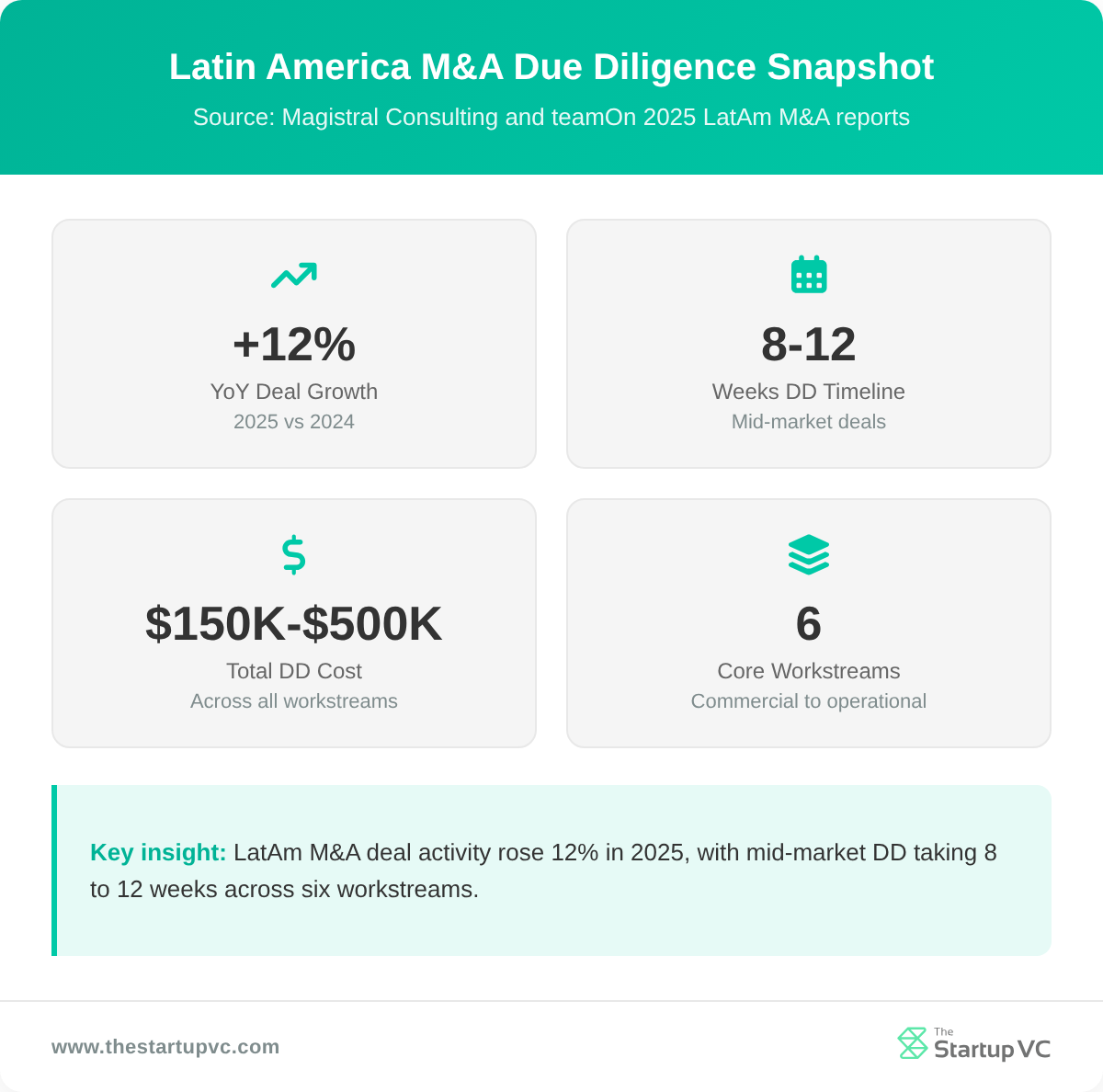
Buy-side due diligence in Latin America runs 8-12 weeks, costs $150K-$500K, and spans six workstreams across hidden risk areas.
Latin America M&A deal count rose 12% year-over-year in 2025. Mid-market diligence covers commercial, financial, tax, legal, labor, and operational risk across complex jurisdictions like Brazil and Mexico. Quality of Earnings reports alone cost $20K to $75K.
The Startup VC is Craig Dempsey’s family office and company builder. Our portfolio spans 17 Latin American countries through Biz Latin Hub. We have run dozens of cross-border DD processes in the region. Below you will find the six-workstream playbook, severance tables, FX protocols, and structural tools to protect against hidden risk.
What Is M&A Due Diligence in Latin America?
M&A due diligence is the structured investigation of a target company before closing. Buy-side due diligence is the version performed by the acquirer. The buyer verifies financial records, legal standing, tax exposure, labor liabilities, and operational fit. The goal is to confirm the seller’s representations and price the deal correctly.
Buy-side due diligence in Latin America adds region-specific work on top of standard global DD. Brazilian and Mexican targets carry complex tax and labor regimes. Many small and mid-sized companies in the region keep undigitized records. Corporate transparency varies sharply by country. Anti-bribery rules under FCPA apply to every US buyer.
Deal activity is rising again. Latin America M&A deal count grew 12% year-over-year in 2025 after three years of decline. Cross-border buyers are returning to Brazil, Mexico, Colombia, and Chile. That demand makes disciplined diligence more valuable, not less.
Local counsel is essential in every LatAm transaction. Remote-only diligence misses paper land titles, regional labor practices, and unwritten compliance norms. A coordinating advisor plus in-country specialists is the standard buy-side team.
What Are the Main Workstreams in a Latin American Due Diligence Process?
The main workstreams in a Latin American due diligence are commercial, financial, tax, legal, labor, and operational. Each workstream covers a different risk area. Each is led by a specialist advisor. The buyer’s lead coordinator integrates findings into a single deal model.
The six workstreams are:
- Commercial DD. Market size, customer concentration, churn, pricing power, competitive position.
- Financial DD. Quality of earnings, working capital, net debt, EBITDA bridge, forecast credibility.
- Tax DD. Tax contingencies, transfer pricing, prior audit history, structural risk.
- Legal DD. Corporate records, contracts, litigation, IP, regulatory permits, asset titling.
- Labor DD. Payroll, social security, severance accruals, union exposure, informal employment.
- Operational and environmental DD. Site inspection, permits, supply chain, IT systems, ESG.
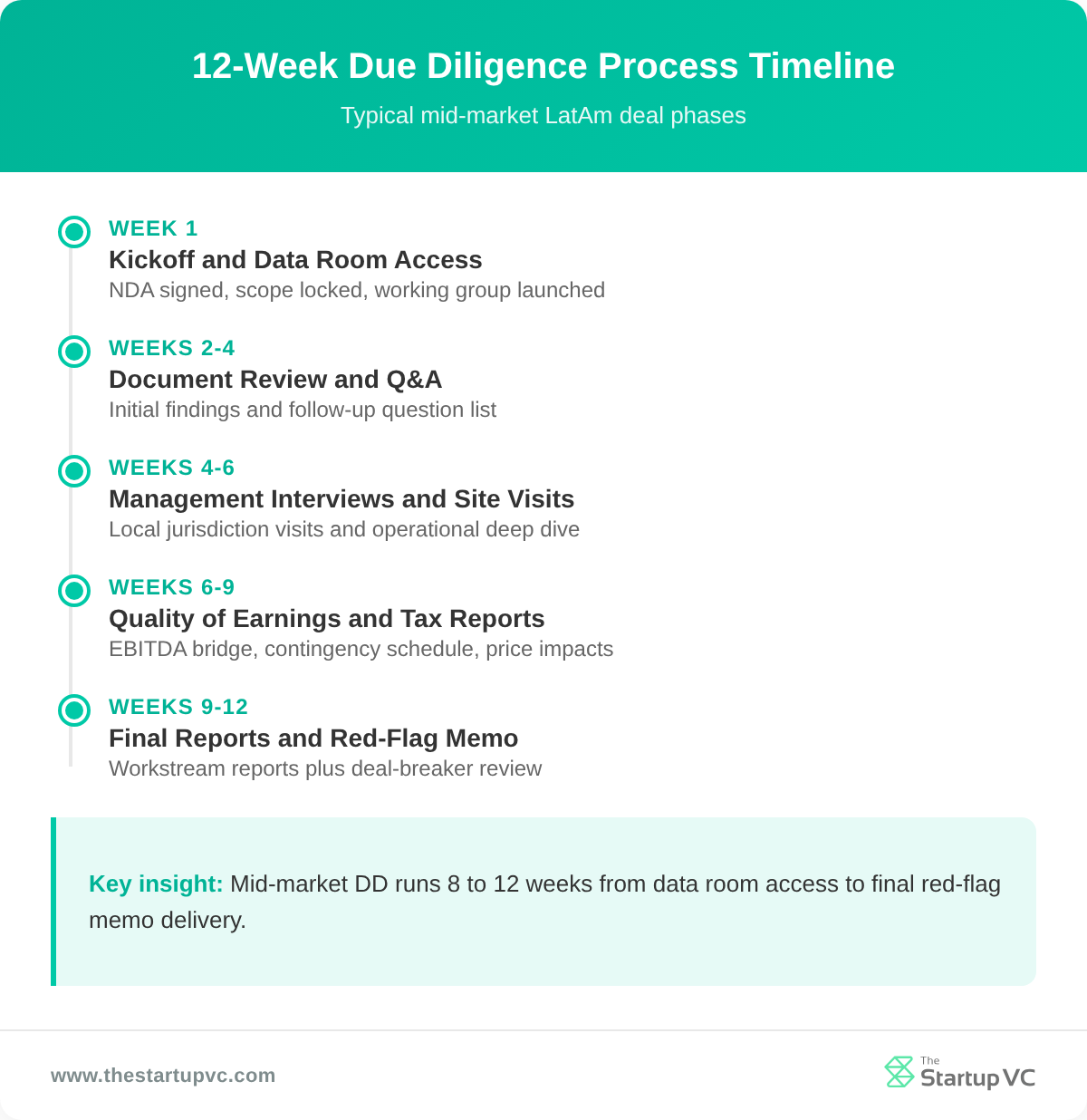
Mid-market DD takes 8 to 12 weeks once the data room opens. The full deal cycle runs 6 to 12 months from launch to close. A Quality of Earnings report alone takes 3 to 6 weeks and anchors the financial workstream. To see how DD fits the wider acquisition process, read our guide to buying a company in Latin America.
The typical week-by-week sequence looks like this:
| Phase | Weeks | Main Outputs |
|---|---|---|
| Kickoff and data room access | 1 | NDA, scope, working group, redacted data room |
| Document review and Q&A round 1 | 2-4 | Initial findings, follow-up question list |
| Management interviews and site visits | 4-6 | Operating insights, local jurisdiction visits |
| Quality of Earnings and tax contingency report | 6-9 | EBITDA bridge, contingency schedule, price adjustments |
| Final reports and red-flag memo | 9-12 | Final DD reports per workstream, deal-breaker review |
Cross-jurisdiction deals add time. A target operating in Brazil, Mexico, and Colombia means three legal teams, three tax teams, and three labor teams. Plan an extra two to four weeks for coordination.
How Do You Conduct Financial and Tax Due Diligence in Latin America?
You conduct financial and tax due diligence by running three core activities. Run a Quality of Earnings analysis, map tax contingencies, and reconcile tax-basis books to IFRS. The output is a clean EBITDA number and a priced-in risk list. Buyers use that EBITDA as the basis for the purchase price.
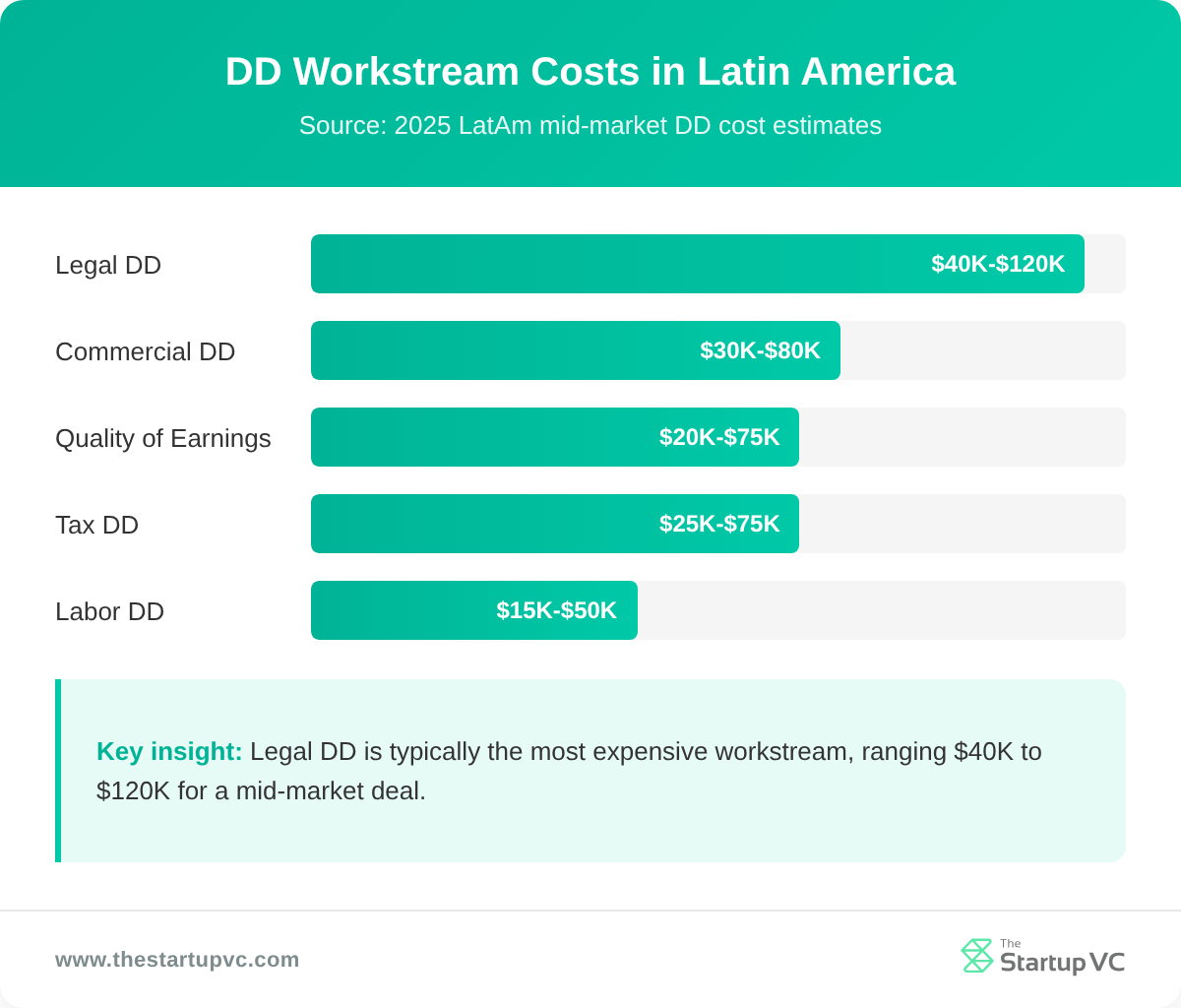
The Quality of Earnings report is the core financial DD deliverable. It costs $20,000 to $75,000 for a mid-market LatAm deal. It takes 3 to 6 weeks. The QoE strips one-time items, owner add-backs, and accounting policy distortions from reported EBITDA. Buyers often begin from the seller’s QoE to save time, then run their own verification round.
Tax DD in Latin America surfaces high-value contingencies. Aggressive tax planning is common across the region. Tax authorities in Brazil, Mexico, Argentina, and Colombia can assess fines and interest going back many years. Each open audit period is a potential price reduction.
The tax contingency review covers these items:
- Income tax positions. Prior audits, open assessments, transfer pricing rulings.
- Indirect taxes. ICMS, IVA, IPI, ISS, withholding tax balances and disputes.
- Social security contributions. Employer payroll taxes and missed filings.
- Customs and import duties. Undeclared imports, misclassified goods, missing duty payments.
- Transfer pricing. Intercompany pricing tested against local rules, related-party royalty flows.
Transfer pricing must be quantified during DD. Non-arm’s length intercompany pricing inflates target EBITDA. A downward adjustment hits the purchase price model directly. In groups with parent-country royalty flows or shared services, transfer pricing reviews often surface 5% to 15% EBITDA adjustments.
IFRS reconciliation matters in Brazil and Mexico. Targets keep parallel tax-basis books that diverge from IFRS. The buyer needs both to model post-closing reporting. Discovering the divergence in Week 9 forces rework. Pull both ledgers in Week 1.
FX exposure changes valuation. Most LatAm targets earn local currency revenue but service USD-denominated debt. A 20% currency move can swap a profitable year for a loss. Model FX scenarios at deal sign and stress test the purchase price.
Financial, tax, and legal advisors must share findings throughout DD. Tax contingencies often surface from legal litigation review, not financial review. A weekly working group call between the three teams prevents siloed misses.
How Do You Perform Legal, Labor, and Regulatory Due Diligence in the Region?
You perform legal, labor, and regulatory due diligence by reviewing seven core areas. Review corporate records, contracts, litigation, real estate titles, employment files, and operating permits. Cover every jurisdiction where the target does business. The output is a risk list with contingent liabilities and any defects in title or licensing.
Legal DD covers six standard areas. Each one carries deal-breaker risk if it surfaces late.
- Corporate records. Bylaws, board resolutions, capitalization, prior share transfers.
- Material contracts. Customer agreements, supplier agreements, change-of-control clauses, exclusivity.
- Litigation. Civil, tax, labor, and administrative claims, both active and threatened.
- Intellectual property. Registered trademarks, patents, software code ownership, domain names.
- Real estate and asset titles. Property registry verification, liens, encumbrances, easements.
- Regulatory permits. Sector licenses, environmental permits, data privacy registration.
Asset titling is a LatAm-specific risk area. Property records are often paper-based and decentralized. Sellers may not realize their land has competing claims or unrecorded easements. Buyers verify every material asset directly at the local registry. Skipping that step costs millions when titles fail after closing.
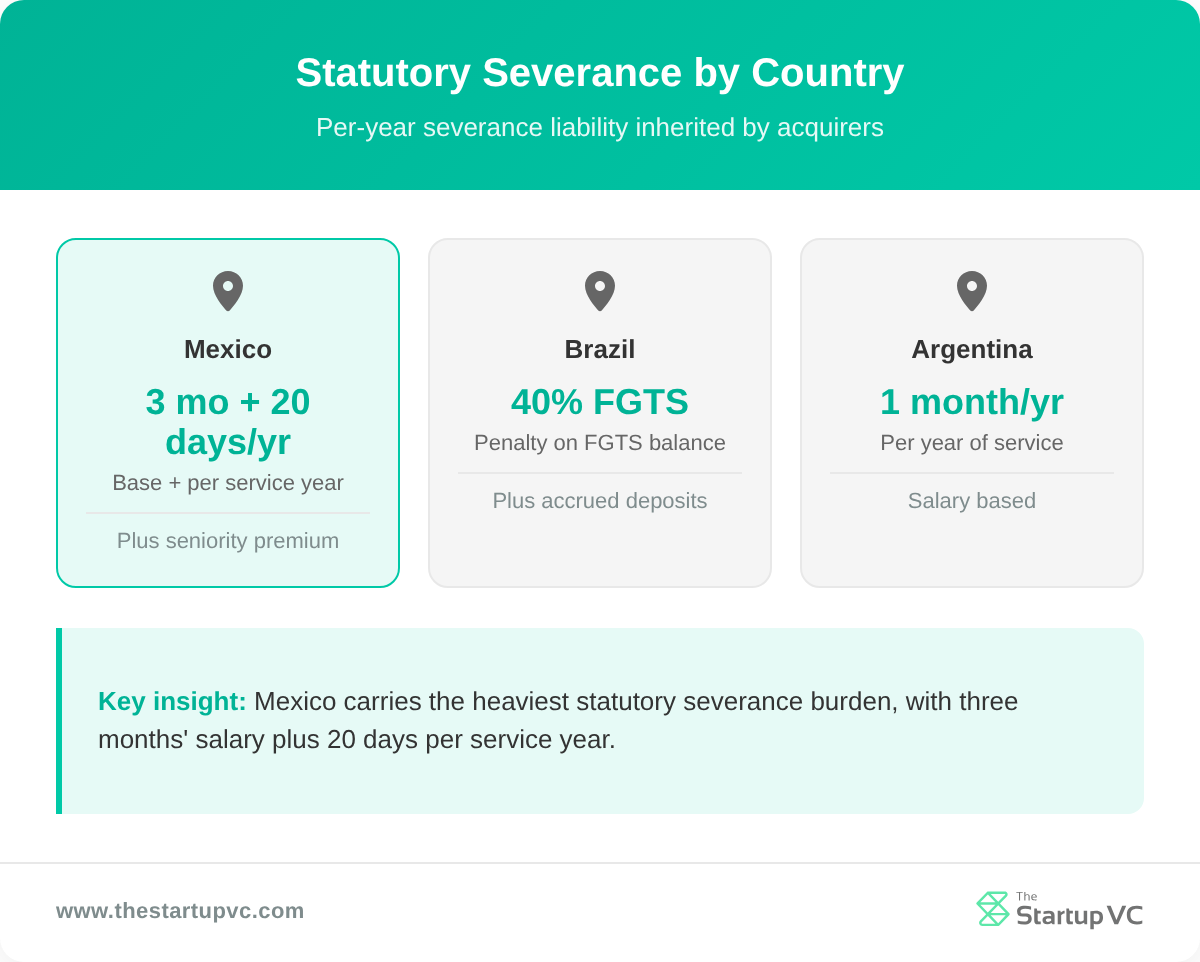
Labor DD has highest exposure in Brazil and Mexico. Each country has a different severance formula. The table below shows the statutory severance liability buyers inherit at close.
| Country | Statutory Severance Formula |
|---|---|
| Brazil | 40% penalty on the worker’s FGTS account balance, plus accrued FGTS deposits |
| Mexico | 3 months’ base salary plus 20 days per year of service plus seniority premium |
| Argentina | 1 month’s salary per year of service |
| Colombia | 30 days for year one plus 20 days per subsequent year |
| Chile | 1 month per year of service, capped at 11 months total |
Brazil’s eSocial system is mandatory. It unifies payroll, tax, labor, and social security reporting into one real-time digital platform. Targets out of eSocial compliance carry blocked downstream filings and inherited successor liability. Verify eSocial status as Week 1 of labor DD.
Informal payroll is common in family-owned SMEs. Cash wages, undeclared workers, and off-the-books bonuses create hidden severance and social security liabilities. Buyers quantify the gap and either price it in or require pre-closing cleanup. Some deals add a labor escrow of 5% to 10% of purchase price to cover this risk.
Regulatory licensing review covers sector permits, FCPA and local anti-bribery compliance, data privacy registration, and environmental approvals. Regulatory risk multiplies for US buyers operating across multiple jurisdictions. Each country has its own permit list, renewal schedule, and inspection regime.
A structured preparation playbook helps both sides. See what a clean data room looks like in our guide on preparing for M&A due diligence in Latin America.
What LatAm-Specific Risks Should Buyers Watch For During Due Diligence?
The most important LatAm-specific risks include FX volatility, regulatory unpredictability, informal payroll, asset titling defects, and institutional trust gaps. Each risk reshapes either valuation or deal structure. Most do not kill the deal. They change the terms.
FX volatility hits valuation first. High inflation and elevated interest rates compound the effect. A deal modeled at one exchange rate can re-price 20% in either direction by closing. Buyers protect themselves with closing-date FX collars, earn-outs in local currency, or USD-denominated equity rolls.
Regulatory and legislative change is the second-largest risk. Recent elections in Argentina, Peru, Colombia, and Mexico produced governments with very different policy priorities. Tax rates change. FX controls tighten or loosen. Labor laws shift. Policy whiplash forces buyers to model multiple scenarios.
Informal payroll and cash transactions appear in many SME targets. The undeclared portion creates inherited liability for the buyer. Standard mitigation tools include:
- Pre-closing cleanup covenant. Seller regularizes payroll and inventory before close.
- Specific indemnity. Seller indemnifies buyer for past informal payroll for a stated period.
- Price adjustment. Buyer reduces purchase price by the quantified informal exposure.
- Escrow. A portion of price held for 18 to 36 months against claims.
Asset titling defects in real estate are jurisdiction-specific. Mexican ejido land, Brazilian rural titles, and Colombian restitution claims each require specialist review. A clean title chain is rarely as clean as the seller represents. Verify at the local property registry, not from seller-provided summaries.
Falling institutional trust in some LatAm courts weakens contractual recourse. A clean indemnity clause is worth less if enforcement takes seven years. Buyers compensate with W&I insurance, third-party escrows, and stronger pre-closing covenants.
LatAm risk typically reshapes deal structure rather than ending the deal. Buyers add earn-outs, MAC clauses, indemnity escrows of 10% to 20% of purchase price, and W&I insurance. Cross-border structuring tools matter just as much as DD findings. Our guide to cross-border acquisition structures in Latin America walks through the standard options.
What Questions Do Buyers Ask Most Often About Due Diligence in Latin America?
How much does buy-side due diligence cost in Latin America?
Buy-side DD costs $150,000 to $500,000 for a typical LatAm mid-market deal. The total splits across financial, legal, tax, labor, and commercial advisors. Cost scales with deal size, number of jurisdictions, and complexity of the target’s tax position.
How long does the due diligence process take?
Due diligence takes 8 to 12 weeks once the data room opens. The full deal cycle runs 6 to 12 months from launch to close. Cross-jurisdiction deals need an extra 2 to 4 weeks for coordination among local advisor teams.
What are the most common deal-breakers found during DD?
The most common deal-breakers are large undisclosed tax contingencies, labor litigation, asset titling defects, and FCPA gaps. Each can re-price or end the deal. Most other findings reshape structure rather than killing the transaction.
Should buyers hire local counsel in every country?
Yes, buyers should hire local counsel in every jurisdiction where the target operates. Cross-jurisdiction LatAm deals usually need separate Brazilian, Mexican, Colombian, or Chilean legal teams plus a coordinating lead advisor. Remote-only diligence misses jurisdiction-specific risks like asset titling and severance rules.
How do buyers protect against undiscovered DD risks?
Buyers protect against undiscovered DD risks with four main tools. These are indemnity escrows of 10% to 20%, W&I insurance, specific indemnities, and post-closing earn-outs. The right combination depends on deal size and DD risk profile.
Can DD be done remotely or do you need on-the-ground visits?
DD cannot be done fully remotely in Latin America. Buyers must conduct on-site visits for management interviews, asset inspections, and local registry checks. Remote-only DD misses paper titles, cash transactions, and unwritten compliance norms common in regional targets.
Ready to Perform Due Diligence on Your Next Latin American Acquisition?
The Startup VC is Craig Dempsey’s family office and company builder. We help buyers run disciplined due diligence on Latin American targets across 17 countries. Our team brings hands-on operational experience and regional advisor networks. We have built and scaled portfolio companies like Biz Latin Hub. If you are evaluating a LatAm acquisition, we can support your DD strategy. Contact us today to discuss your transaction. Learn more about our investment focus.