
Latin America’s SaaS market reached USD 21.4 billion in 2024 and grew 23%, the fastest of any region.
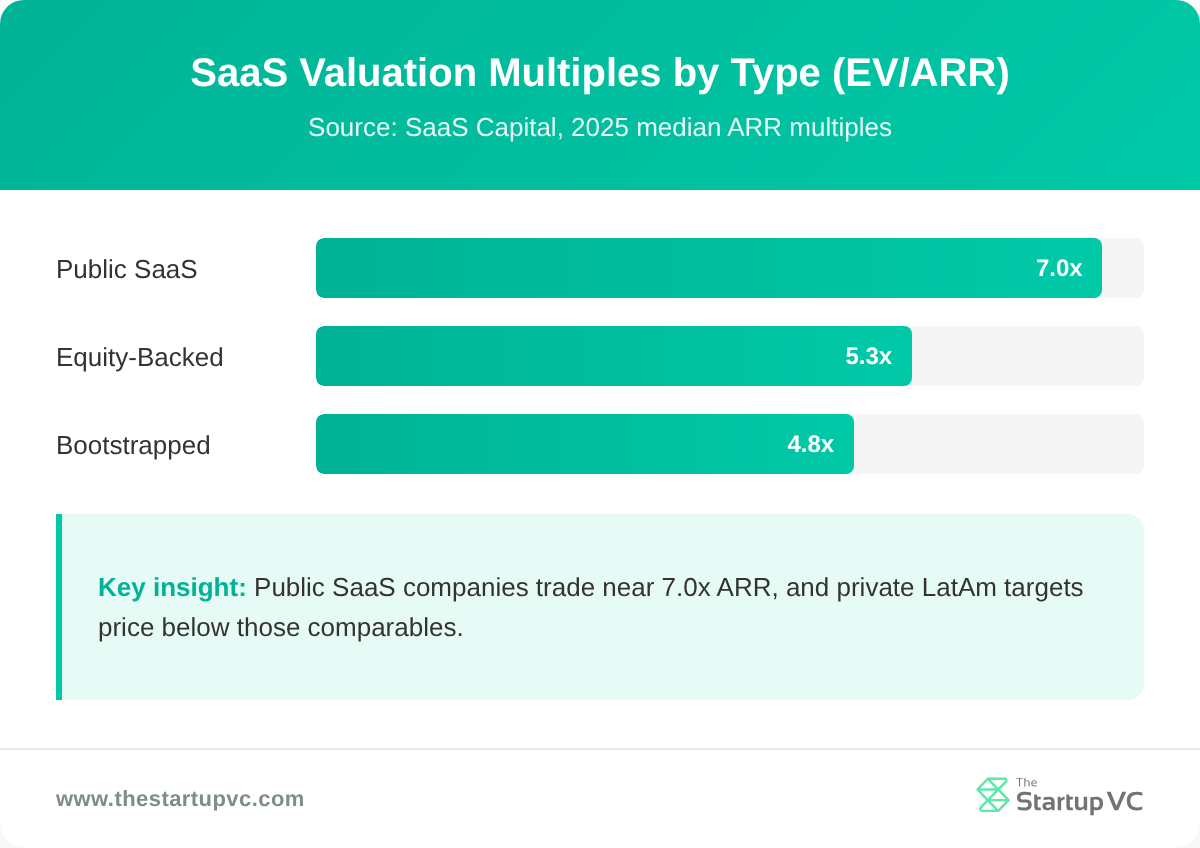
The region recorded 219 tech M&A deals in 2025, up 25% from 2024, with software leading. Private SaaS companies trade near 4.8x to 5.3x ARR, while strong retention and growth can push multiples to 12x.
The Startup VC is Craig Dempsey’s family office and company builder. It has scaled ventures like Biz Latin Hub across 17 Latin American countries. This guide shows buyers how to value ARR, check churn, audit source code, and structure a cross-border deal.
Why Should You Buy a SaaS or Software Company in Latin America?
You should buy a SaaS or software company in Latin America because the market grows fast and costs stay low.
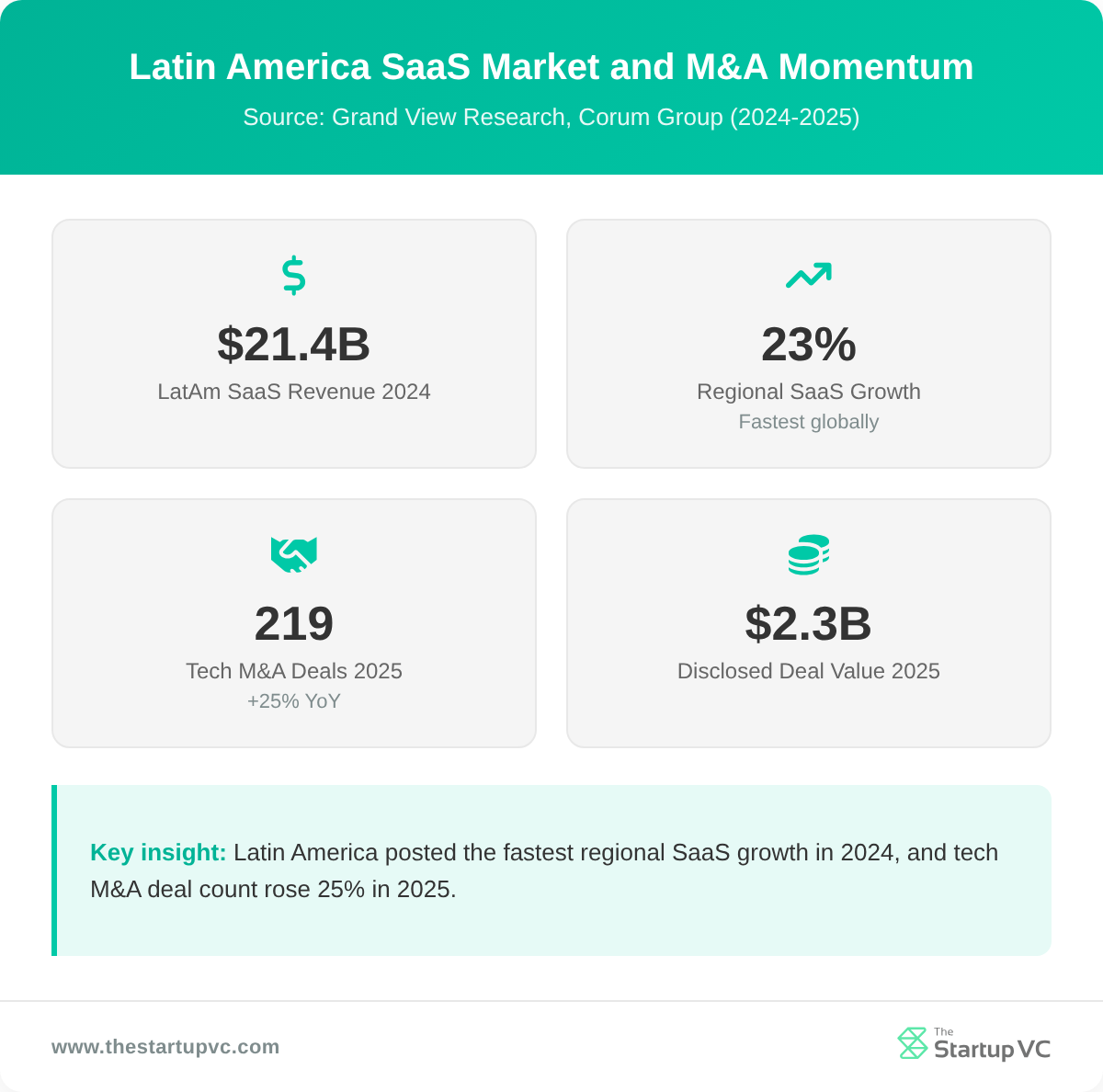
The region’s SaaS market reached about USD 21.4 billion in 2024. It grew 23% that year, the fastest rate of any region. EBANX projects the market will roughly double to about USD 46 billion by 2027. Brazil is the largest market at about 45% of regional revenue. Mexico ranks second near 20%.
Buyers target Latin American software for four main reasons:
- Fast market growth. LatAm SaaS grew 23% in 2024, ahead of North America at 17%.
- Rising deal supply. The region recorded 219 tech M&A deals in 2025, up 25% from 2024.
- Lower build cost. The average LatAm developer earns about 43% of a US developer’s salary.
- Active consolidation. Strategic buyers like Vesta Software Group are rolling up platforms such as Colombia’s Suplos.
Acquiring often beats building when speed matters. A mid-level engineer who costs USD 120,000 in the US can cost about USD 40,000 in Brazil. You buy recurring revenue, a working product, and a trained team at once. Software led regional deal flow, with 40 software deals in the first ten months of 2025. Our complete guide breaks down how to buy a company in Latin America from search to close.
How Do You Value a SaaS Company in Latin America?
You value a SaaS company in Latin America by applying a multiple to its annual recurring revenue (ARR). This ARR multiple is the core of SaaS pricing. Growth rate, retention, and gross margin then move it up or down.
What ARR Multiples Do LatAm SaaS Companies Trade At?
LatAm SaaS companies usually trade below the global private SaaS median of about 5x ARR. In 2025 the median private SaaS company traded near 4.8x ARR if bootstrapped and 5.3x if equity-backed. Public SaaS set the ceiling at about 7x run-rate ARR. Multiples climb with faster growth, as the table shows:
| Annual growth rate | Typical EV/ARR multiple |
|---|---|
| 20-50% | 4-7x |
| 50-100% | 7-12x |
| 100%+ | 12-18x |
Net revenue retention above 120% adds roughly 1x to 2x on top. The Rule of 40 also drives price. It adds growth rate to profit margin. Each 10-point gain lifted the revenue multiple by about 1.1x in late 2025.
Why Do Latin American Multiples Sit Below US Comparables?
Latin American multiples sit below US comparables because of country risk and currency risk. Damodaran estimates the average LatAm country risk premium near 3.5%. It ranges from about 1.1% in Chile to about 3.24% in Brazil. So identical financials earn a lower price in Bogota than in the US. Our guide details how to value a company in Latin America step by step.
Recurring revenue still pays off. In LatAm software M&A, a strong recurring base lifts the EBITDA multiple by about 1.5x to 3x. Firms with 70% or more recurring revenue trade near 7x to 12x EBITDA. See the latest EBITDA multiples in Latin American M&A for 2026.
Which Retention and Churn Metrics Should Buyers Check First?
The retention and churn metrics buyers should check first are net revenue retention, gross revenue retention, and logo churn. These numbers prove how sticky the recurring revenue really is. Weak retention can cut the purchase price in half.
What Are Healthy NRR and GRR Benchmarks?
Healthy net revenue retention sits above 100%, and strong gross revenue retention clears 90%. Benchmarks shift by contract size, so compare the target against its own tier. Enterprise deals retain far better than SMB accounts.
| Segment (ACV) | Median NRR | GRR floor | Healthy monthly churn |
|---|---|---|---|
| Enterprise (over $100K) | ~118% | over 90% | 1-2% |
| Mid-market ($25K-$100K) | ~108% | ~88% | 1.5-3% |
| SMB (under $25K) | ~97% | ~85% | 3-5% |
Median private B2B SaaS NRR softened to about 101% in 2024. Best-in-class NRR still clears 130%. Below 100% NRR signals that revenue is shrinking.
How Does Churn Affect the Acquisition Price?
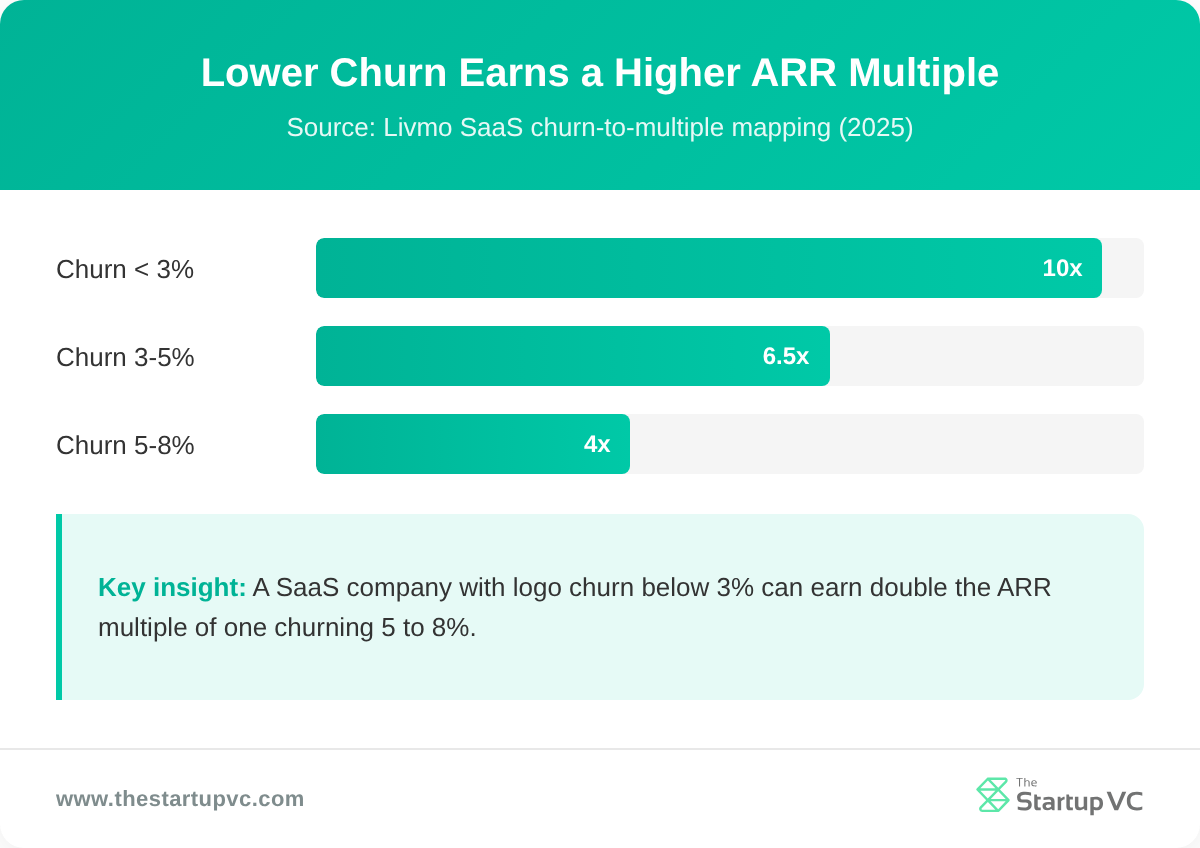
Churn affects the acquisition price by setting the ARR multiple a buyer will pay. Two $6M ARR companies both grew 25% but sold at very different prices. The one with 2% logo churn and 118% NRR closed at 9x ARR. The one with 8% churn and 94% NRR settled at 4.5x ARR. That gap shows how directly churn maps to value:
- Below 3% churn. Earns roughly 8-12x ARR.
- 3-5% churn. Earns roughly 5-8x ARR.
- 5-8% churn. Earns roughly 3-5x ARR.
- Above 10% churn. Often a no-deal.
Watch involuntary churn in Latin America. Failed-payment churn makes up 20-40% of total SaaS churn and runs higher here. Lower card acceptance pushes users toward Pix in Brazil and OXXO in Mexico. Treat a payment decline rate above 10% as real revenue leakage.
How Do You Diligence Hosting Infrastructure and Source Code?
You diligence hosting infrastructure and source code by auditing the cloud setup, the codebase, and who owns the IP. This technical due diligence protects the value in any software acquisition. Audits often surface hidden defects in code, licenses, and data practices.
What Should You Check in the Hosting Setup?
You should check where the product is hosted, how it scales, and what it costs to run. Confirm whether the target runs single-cloud or multi-cloud across AWS, Azure, or GCP. Check where customer data physically sits. The Latin America cloud market reached about USD 46.7 billion in 2024. AWS opened its first Mexico region in January 2025 and a Chile data center in 2024. Local regions can cut latency and ease data-residency rules.
How Do You Verify Source Code and IP Ownership?
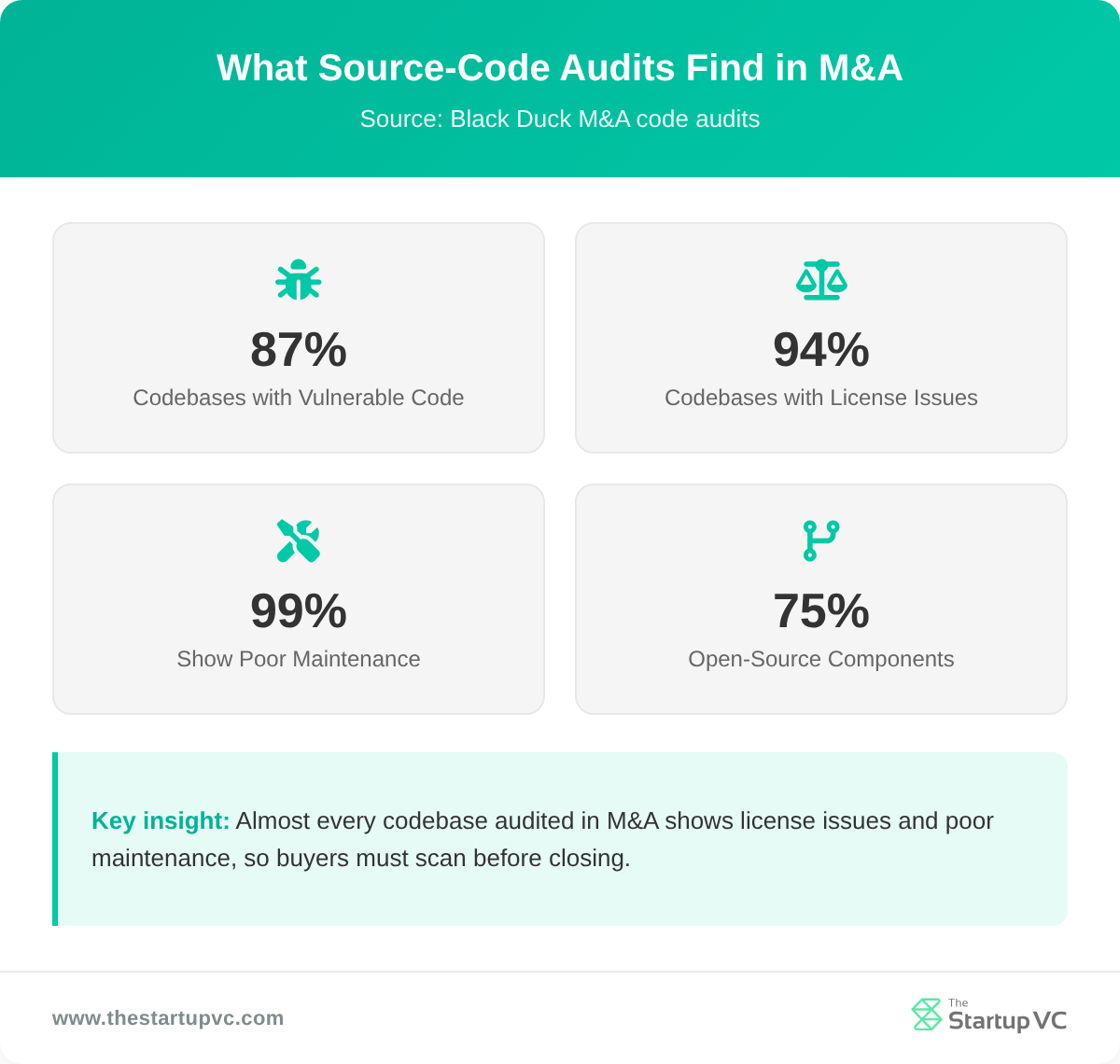
You verify source code and IP ownership by running a third-party code audit and reviewing every assignment contract. Code audits expose serious risk. Across Black Duck M&A audits, 87% of codebases held vulnerable code and 94% had license issues. Open-source parts make up about 75% of a typical codebase. One audit found a “proprietary” AI platform built on GPL libraries the buyer could not monetize.
Ownership is a sharp risk in Latin America. Much regional code comes from contractors, not employees. In Brazil, IP must be assigned to the company in writing. US-standard assignment templates often fail in Brazilian or Mexican courts.
A SaaS source-code escrow should hold more than the code:
- The full source code and build scripts.
- The hosting environment and system configurations.
- Database structures and credentials.
- Release triggers like bankruptcy or SLA failure.
Which Data Privacy Rules Must You Confirm?
The main data privacy rules buyers must confirm are Brazil’s LGPD and Mexico’s LFPDPPP. Brazil’s regulator can fine up to 2% of local revenue, capped near BRL 50 million. It issued about BRL 98 million in fines from 2023 to 2025. Mexico passed a new LFPDPPP in 2025 with fines up to roughly USD 3.86 million. The new law also makes data processors directly liable. Ask for a SOC 2 report, an appointed DPO, and breach-notification procedures.
How Do You Structure a Cross-Border SaaS Acquisition?
You structure a cross-border SaaS acquisition by choosing an asset or share deal, then adding escrow, earnouts, and FX protection. Each choice shifts tax, risk, and how much you pay at closing. Cross-border rules in Brazil and Mexico make structure especially important. Explore our Latin America investment focus to see the deals we back.
Should You Buy Assets or Shares?
You should weigh tax cost against liability, because asset and share deals differ on both. A share deal and an asset deal split the risk differently.
| Factor | Asset deal | Share deal |
|---|---|---|
| Mexico VAT | 16% on assets | No VAT |
| Liabilities assumed | Only those tied to assets | The entire company |
| Tax basis | Step-up available | Carryover |
| IP transfer | Asset by asset | Moves with the entity |
In a share deal you inherit the company’s full liability. In an asset deal you mostly take on liabilities tied to the assets.
How Do Escrow and Earnouts Protect the Buyer?
Escrow and earnouts protect the buyer by holding back cash until the seller’s promises prove true. About 90% of private deals now use an escrow. The median indemnity escrow rose to about 9% of purchase price. Earnouts appear in roughly one in three private deals. The median earnout period runs 24 months. In SaaS, earnouts usually tie to ARR or net revenue retention targets. On average, earnouts pay out only 21 cents on the dollar. Reps-and-warranties insurance is spreading into Latin America as an escrow alternative.
How Do Taxes and Currency Affect the Deal?
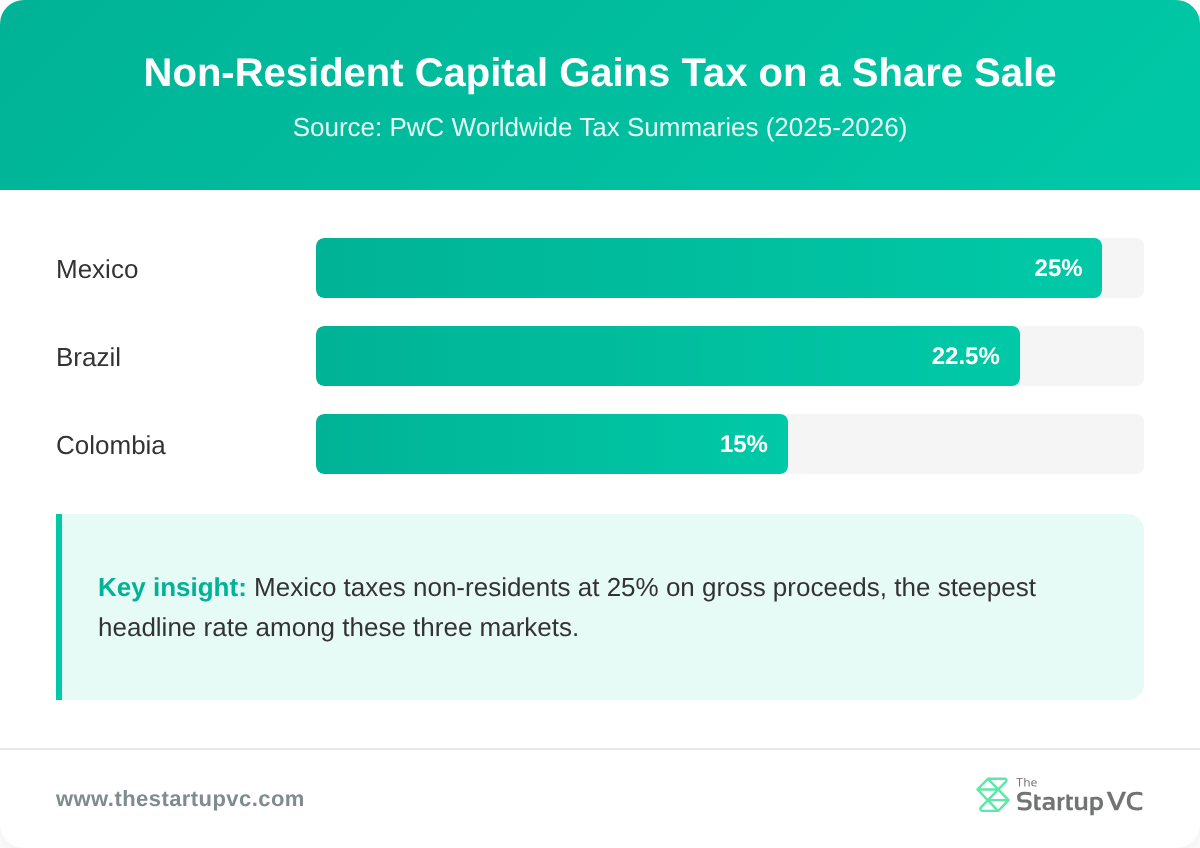
Taxes and currency affect the deal by changing the net price the seller keeps and the buyer pays. Non-resident capital gains tax varies widely across the region. Brazil withholds 15% to 22.5% on share-sale gains. Mexico taxes non-residents at 25% on gross proceeds or 35% on the net gain. Colombia applies a 15% flat rate, and Chile uses its corporate rate. Brazil also treats software distribution payments as royalties with 15% withholding tax. Currency risk shapes how you pay. Brazil routes most cross-border wires through US dollars and limits onshore FX. Buyers usually price deals in USD and use forward contracts to lock the rate.
What Questions Do Buyers Ask Most Often About Buying a SaaS Company in Latin America?
How Much Does It Cost to Buy a SaaS Company in Latin America?
A LatAm SaaS company costs roughly 4x to 7x its ARR at 20-50% growth. Faster growth and strong retention push the multiple higher. LatAm deals usually price below US peers because of country risk.
Should You Buy or Build a Software Company in Latin America?
You should buy when speed matters and build when you need full control. Buying gives you revenue, a product, and a team at once. Building costs less per engineer, since LatAm developers earn about 43% of US pay.
How Long Does a LatAm SaaS Acquisition Take?
A LatAm SaaS acquisition often takes a few months to close. Source-code, retention, and legal due diligence drive most of the timeline. Earnouts then run a median of 24 months after the deal closes.
What Retention Rate Should a Target Have?
A healthy target shows net revenue retention above 100% and gross retention above 90%. Enterprise products often reach 118% NRR. Anything below 100% NRR means the revenue base is shrinking.
Which Taxes Apply When Buying a Brazilian Software Company?
The main taxes are capital gains withholding and software royalty withholding. Brazil withholds 15% to 22.5% on a non-resident’s share-sale gain. It also treats software distribution payments as royalties with 15% withholding tax.
Do You Need a Source-Code Escrow?
Yes, a source-code escrow protects the product if the seller disappears. A neutral agent holds the code, configurations, and credentials. Release triggers include bankruptcy or failure to meet support duties.
Ready to Acquire a SaaS Company in Latin America?
The Startup VC helps you find, value, and close software deals across Latin America. Craig Dempsey built this family office and company builder to create, back, and guide scalable ventures in the region. Our team brings operational playbooks, regional networks, and compliance know-how from companies like Biz Latin Hub, active in 17 countries. We help you diligence ARR, retention, and IP before you sign. Contact us today to plan your Latin American software acquisition.