Colombia closed 161 M&A deals in 2024, up 18% year over year, with disclosed value above US$5.9 billion.
M&A in Colombia spans share and asset deals across banking, energy, software, and infrastructure. Foreign buyers can own 100% of a Colombian SAS. Deals above roughly US$22.8 million need antitrust clearance from the SIC before closing.
The Startup VC is Craig Dempsey’s family office and company builder, rooted in Colombia. Our team has closed buy-side and sell-side deals across Latin America through Biz Latin Hub. This guide covers the market, buying, selling, deal structures, taxes, and SIC approvals.
What Does the M&A Market in Colombia Look Like?
Colombia’s M&A market is mid-sized, active, and growing fast. The country recorded 161 deals in 2024. That marked an 18% jump over 2023. Disclosed deal value rose 32% to more than US$5.9 billion. Colombia now ranks fourth in Latin America by deal volume. Only larger markets like Brazil and Mexico move more deals.
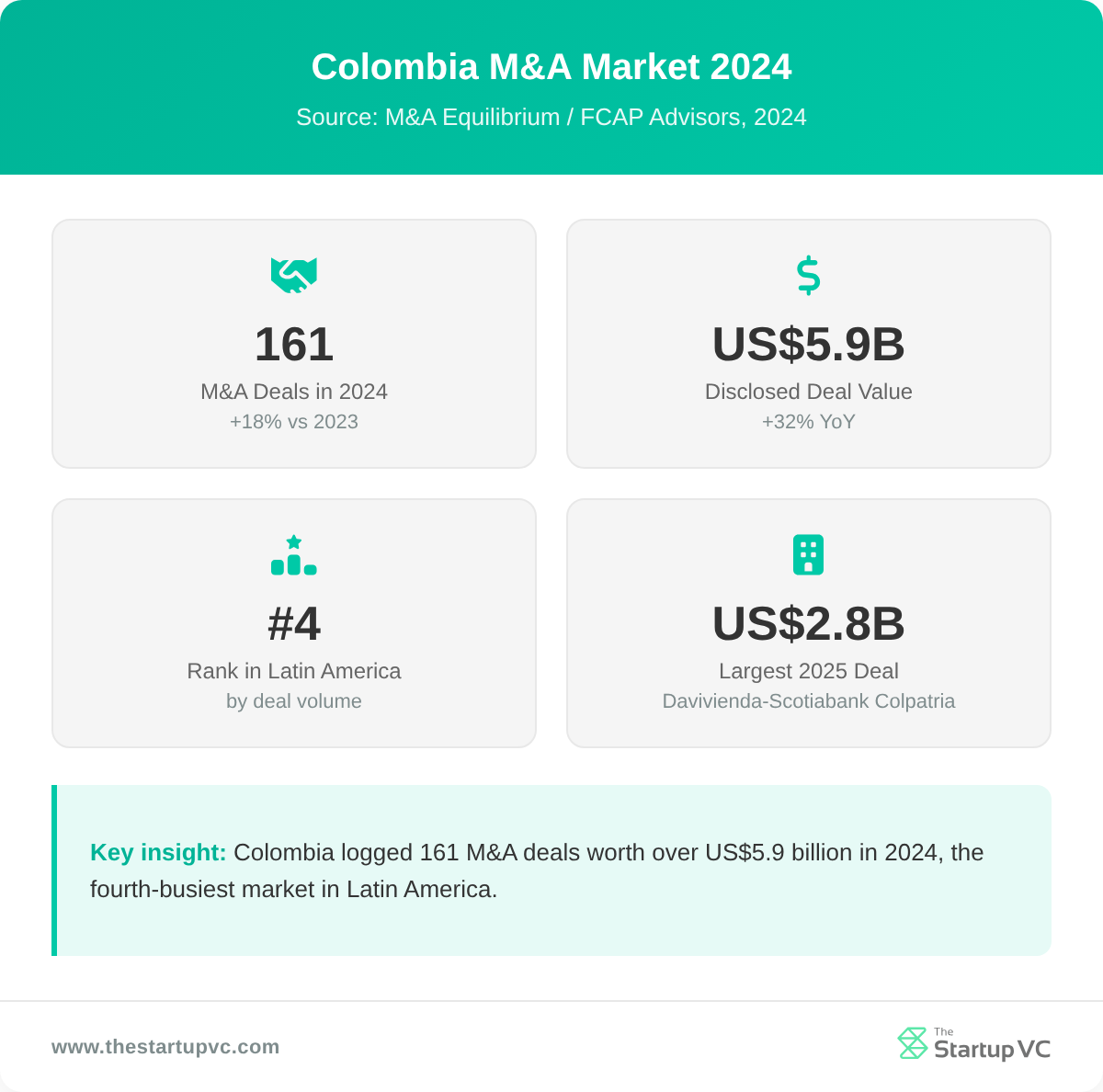
| Market snapshot | 2024-2025 figure |
|---|---|
| Deals closed (2024) | 161, up 18% from 2023 |
| Disclosed deal value | US$5.9 billion+, up 32% |
| Rank in Latin America | 4th by deal volume |
| Largest 2025 deal | Davivienda buys Scotiabank Colpatria, ~US$2.8 billion |
Several sectors drive most of the deal flow. The hottest areas in 2025 and 2026 include:
- Banking and financial services. Consolidation continues after the Davivienda and Scotiabank Colpatria deal.
- Infrastructure. Toll-road and concession deals draw global funds like Actis.
- Energy. Ecopetrol bought Enerfín Colombia for US$157.5 million in renewables.
- Software and technology. Industry-specific software leads by raw deal count.
- Healthcare and retail. Both saw steady consolidation through 2025.
Two features make Colombian M&A distinct. First, family-owned firms dominate the target pool. Family enterprises make up about 60% of Latin America’s GDP. Fewer than 30% survive into the second generation. Only 12% reach the third. This makes succession a top reason owners sell.
Second, foreign buyers lead inbound deals in infrastructure, finance, and natural resources. They are drawn to Colombia’s broader business and startup landscape. Colombia’s domestic buyer pool is narrower than Brazil’s. It centers on financial services and consumer companies. A weaker Colombian peso (COP) has made local assets cheaper for dollar-based buyers.
How Do You Buy a Company in Colombia?
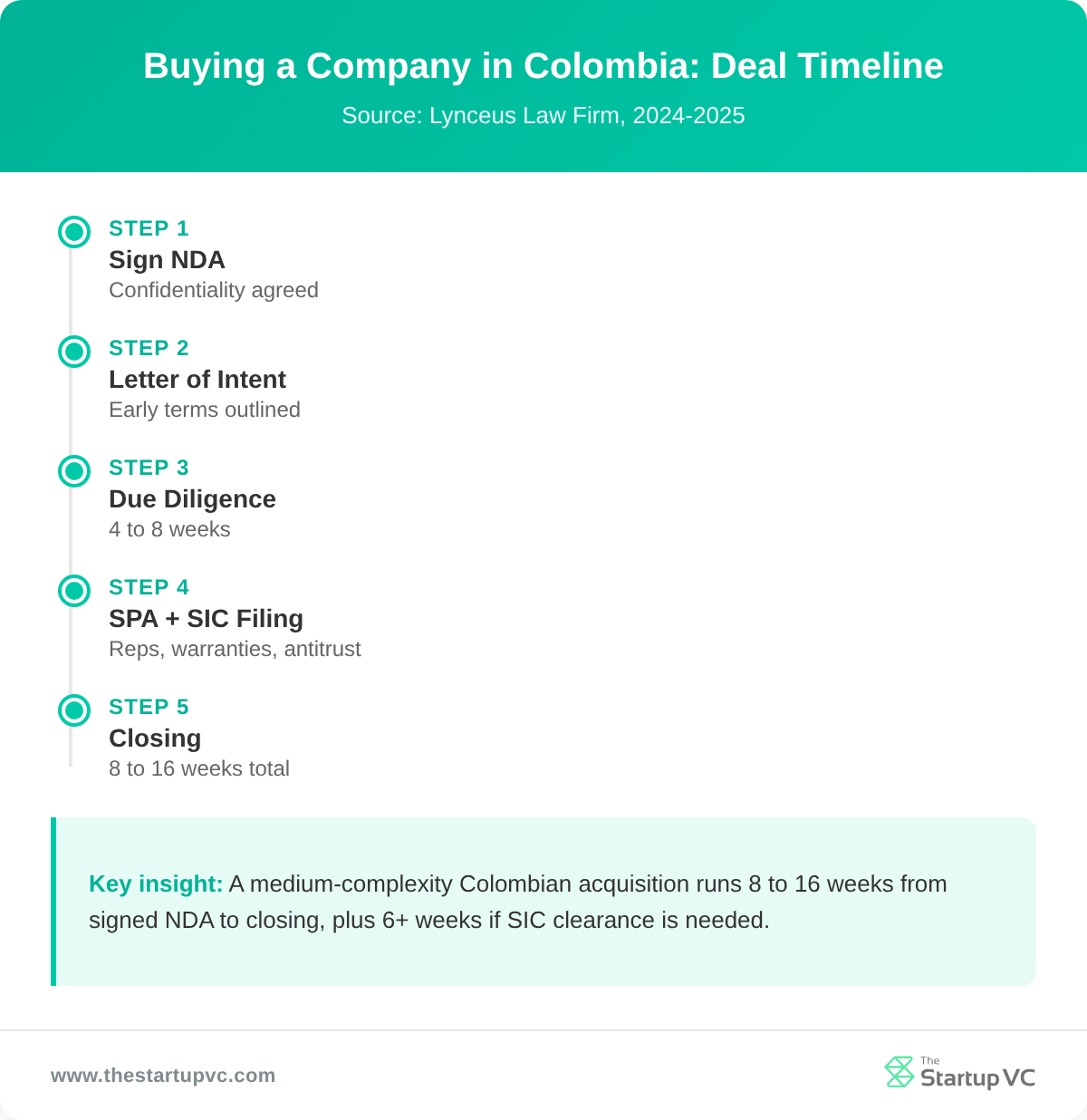
You can buy a company in Colombia by following a structured, five-step process. Most acquisitions follow the same path from first contact to closing:
- Sign an NDA and Letter of Intent (LOI). The LOI sets early price and key terms.
- Run due diligence. Legal, financial, tax, and labor reviews take 4 to 8 weeks.
- Negotiate the Share Purchase Agreement (SPA). This sets representations, warranties, and indemnities.
- File with the SIC if required. Merger control clearance must come before closing.
- Close and transition. Sign, pay, and report the change of control.
A medium-complexity deal runs about 8 to 16 weeks from signed NDA to closing. A SIC Phase I filing adds at least six weeks. These steps mirror the wider process for buying a company across Latin America.
Colombian deals are priced with discounted cash flow, EV/EBITDA multiples, and comparable transactions. Buyers add a Colombia country-risk premium of about 2.85%. Controlling-stake deals must be reported to the Chamber of Commerce within 30 days.
What Due Diligence Do Buyers Run in Colombia?
Buyers in Colombia run due diligence across six core areas. These workstreams cover the main deal risks:
- Corporate structure. Ownership, the share registry, and governance.
- Contracts. Key commercial agreements and change-of-control clauses.
- Labor. Payroll, severance, and contractor classification.
- Tax. DIAN filings, open liabilities, and transfer-pricing files.
- Litigation. Lawsuits, claims, and regulatory status.
- Licenses. Whether permits transfer on a change of ownership.
A buy-side review usually runs 8 to 12 weeks and costs US$150,000 to US$500,000. A Quality of Earnings report adds US$20,000 to US$75,000.
Foreign buyers should watch three Colombia-specific red flags. Informal payroll hides severance costs, since cash wages still trigger statutory severance. Real-estate titles often sit in paper-based local registries. Related-party charges can inflate a target’s EBITDA by 5% to 15%. Buyers manage these risks with indemnity escrows of 10% to 20% of the price. Warranty and indemnity insurance and earn-outs are also common.
How Do You Sell a Business in Colombia?
You can sell a business in Colombia by running a structured, six-phase process. A clean, well-prepared company sells faster and for a higher price. The standard sell-side phases are:
- Prepare. Clean the financials, fix legal gaps, and set a valuation.
- Market. Approach buyers with a Confidential Information Memorandum.
- Negotiate LOIs. Collect and compare buyer offers.
- Diligence. Open a data room and answer buyer questions.
- Close. Sign the definitive SPA and transfer the shares.
- Transition. Hand over operations after closing.
Full readiness takes 12 to 18 months, or a 3 to 6 month sprint with audited financials ready. The sale process itself then runs 6 to 12 months. The same playbook guides selling a company in Latin America. Sellers usually hire an investment bank, plus legal and tax advisors with Colombia experience.
Most Colombian sellers are founder-led or family-owned firms. Micro and small businesses are 99.5% of formal companies and about 40% of GDP. Formalization is the key value driver, so enroll in the commercial registry and keep IFRS-compliant accounts. Recurring revenue can lift a valuation by 1.5x to 3x on the EBITDA multiple. Off-market deals close at lower multiples than competitive, advisor-led auctions.
How Much Is a Colombian Business Worth?
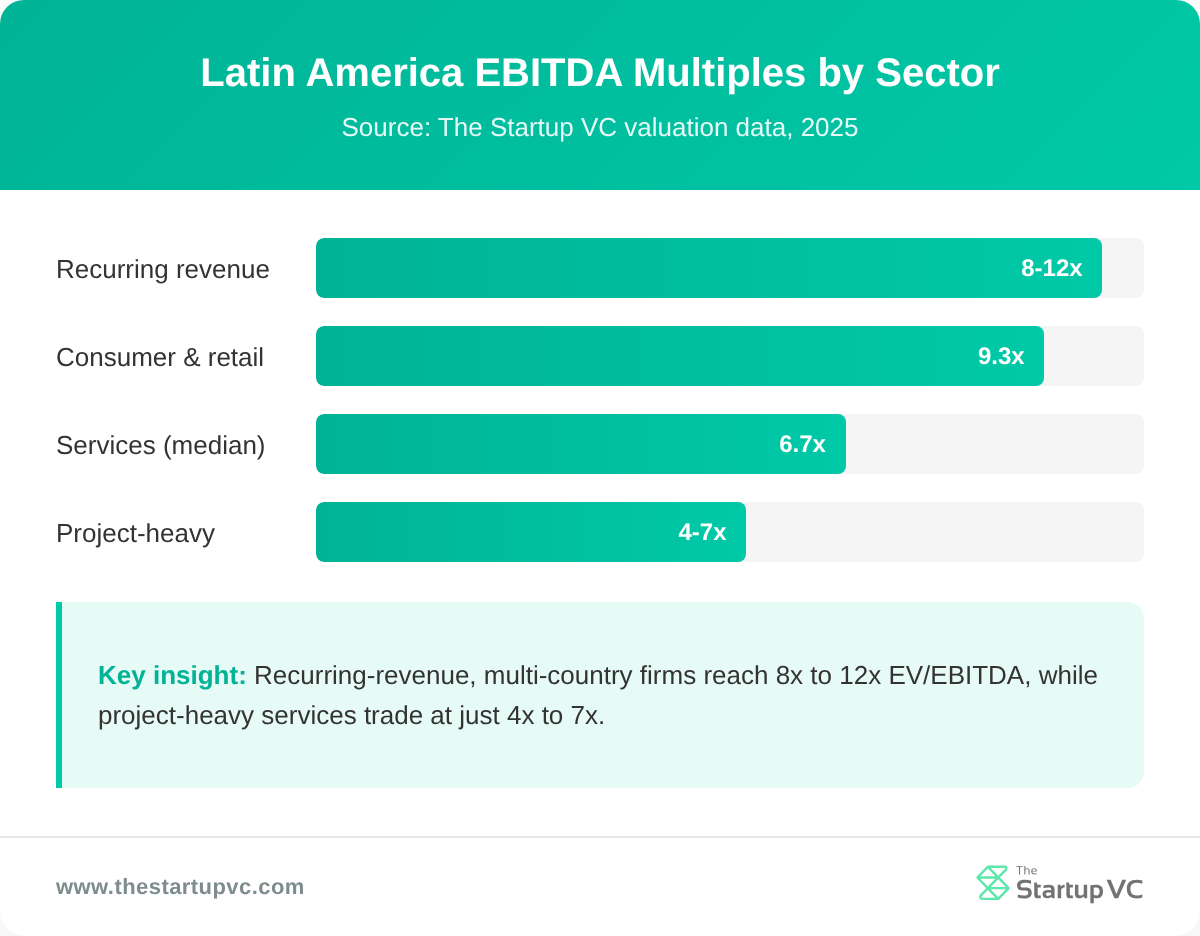
A Colombian business is worth a multiple of its yearly EBITDA, set by sector and growth. Latin American services firms traded at a median 6.7x EV/EBITDA in 2025. That fell from 8.5x at the end of 2024. The figures below show the typical 2025 ranges:
| Business type | Typical EV/EBITDA multiple |
|---|---|
| Project-heavy services | 4x to 7x |
| Services (LatAm median, 2025) | 6.7x |
| Consumer and retail | ~9.3x |
| Recurring-revenue, multi-country | 8x to 12x |
Buyers fall into two groups. Strategic buyers are sector companies seeking market entry or scale. Financial buyers are private-equity and investment funds that buy, improve, then exit.
What Deal Structures and Taxes Apply to Colombian Acquisitions?
Colombian acquisitions use two main structures and face several specific taxes. The structure you pick shapes both risk and tax cost.
What Is the Difference Between a Share Deal and an Asset Deal?
The main difference is what the buyer acquires and which liabilities it inherits. A share deal buys the company’s shares, usually a Sociedad por Acciones Simplificada (SAS). It offers simple transfer mechanics and business continuity. The buyer inherits all historical liabilities. An asset deal buys selected assets or a going concern. It gives a cleaner risk profile and limited liabilities. It also needs asset-by-asset formalization, creditor notice, and more transfer taxes.
| Factor | Share deal | Asset deal |
|---|---|---|
| What you buy | The company’s shares | Selected assets or a going concern |
| Liabilities | Buyer inherits all history | Limited, defined liabilities |
| Transfer work | Simple share transfer | Asset-by-asset formalization |
| Taxes | No VAT on share sales | VAT and more transfer taxes |
| Common use | Most inbound deals (SAS) | Carve-outs and clean exits |
The SAS is the dominant vehicle, and foreign buyers can own 100% of one. The share purchase of an SAS is the most common inbound structure, used in high-profile regional exits. Mergers (fusión) and spin-offs (escisión) stay tax-neutral when legal conditions are met.
What Taxes Apply to a Colombian Acquisition?
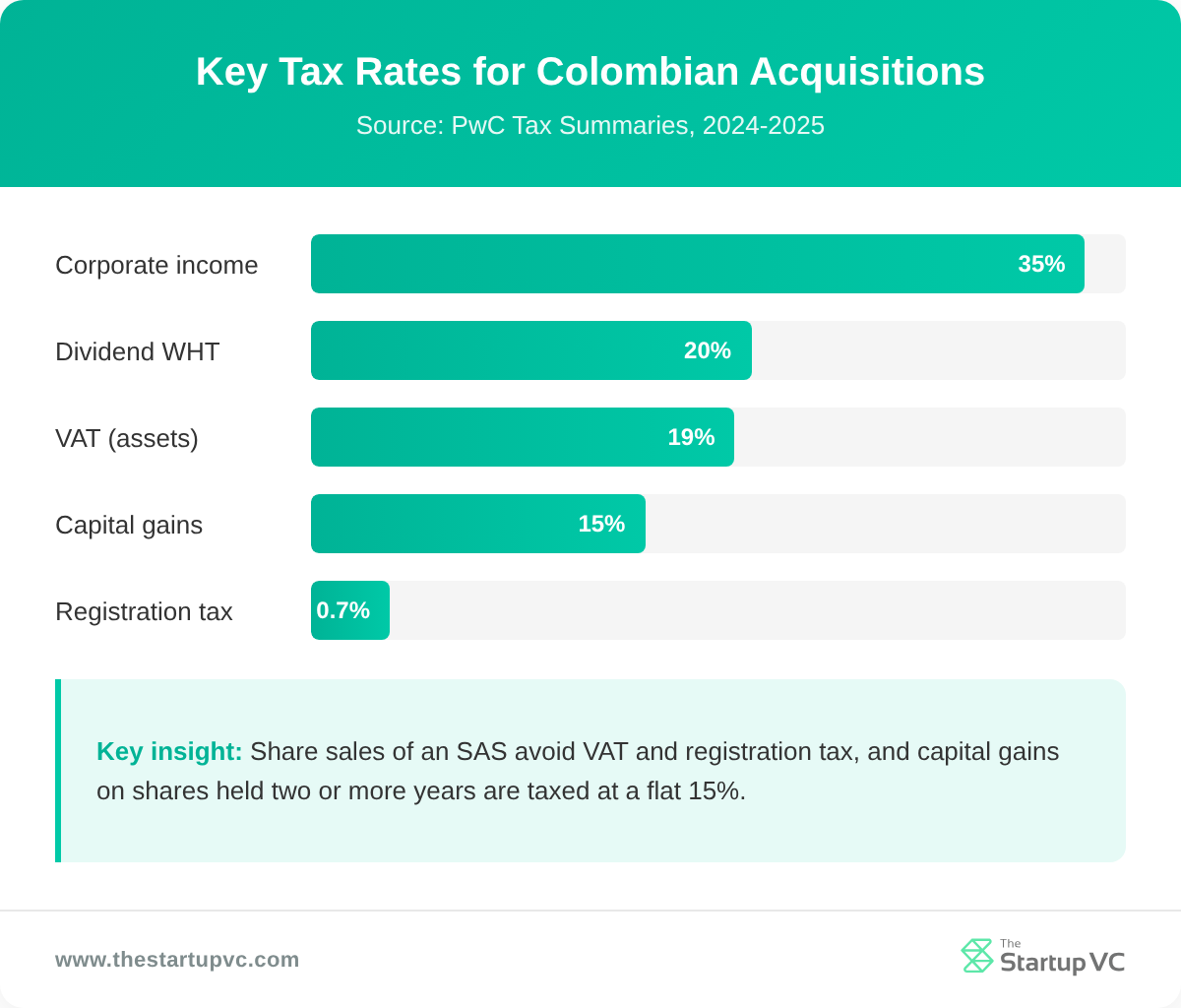
Several taxes apply, and the rate depends on the holding period and deal type. Gains on shares held two years or more pay a flat 15% occasional gains tax. Gains on assets held under two years are taxed as ordinary income. The main rates are below:
| Tax | Rate | Applies to |
|---|---|---|
| Occasional gains (capital gains) | 15% | Shares or assets held 2+ years |
| Ordinary income on gains | Up to 35% (companies) | Assets held under 2 years |
| Corporate income (renta) | 35% (40% for banks) | Company profits |
| Dividend withholding (foreign) | 20%, up to ~41.5% | Profits paid abroad |
| VAT (IVA) | 19% | Asset deals, not share deals |
Share sales avoid VAT, stamp tax, and registration tax. Foreign sellers should check Colombia’s tax treaties with more than 15 countries. These treaties can lower the dividend withholding rate.
What Regulatory Approvals Does M&A in Colombia Require?
M&A in Colombia requires antitrust clearance whenever a deal crosses set size and market-share limits. The regime is mandatory and suspensory under Law 1340 of 2009. Clearance from the Superintendencia de Industria y Comercio (SIC) must come before closing. The 2026 threshold is about COP 85.67 billion, or roughly US$22.8 million, in combined assets or operating income. Filings then follow one of two tracks:
| Filing track | When it applies | SIC timeline |
|---|---|---|
| Simplified notification | Combined market share below 20% | 10 business days to acknowledge |
| Pre-evaluation, Phase I | Combined share 20% or more | 30 business days |
| Pre-evaluation, Phase II | In-depth review opened | 3 months (silence means approved) |
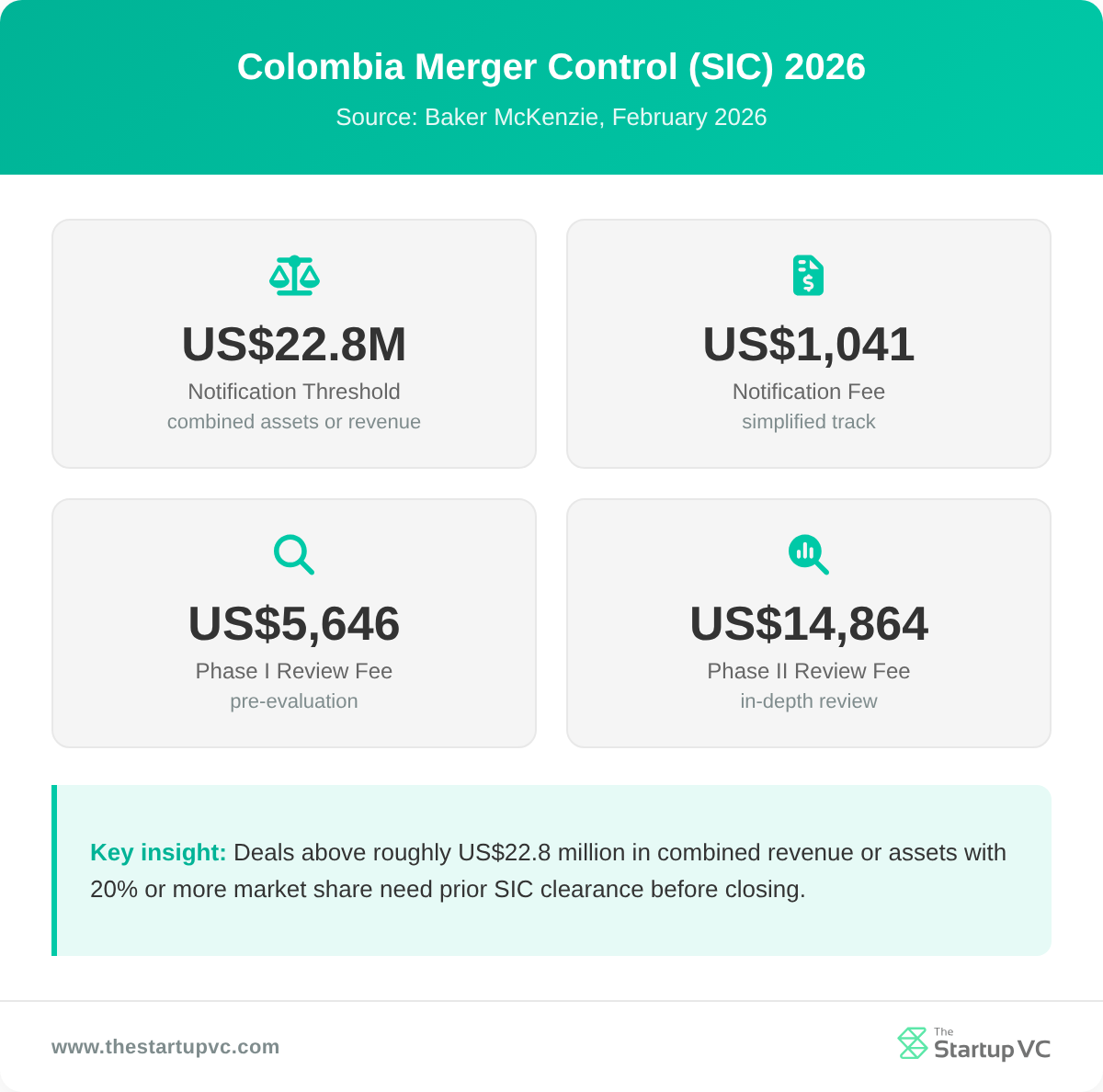
Filing fees scale with the size of the parties. A notification costs about US$1,041, a Phase I review about US$5,646. A full Phase II review can reach about US$14,864. Some deals also need approvals beyond the SIC:
- Financial regulator. Banks, insurers, and brokers need Superintendencia Financiera approval.
- Central bank. Foreign investment must be registered with the Banco de la República.
- Chamber of Commerce. Controlling-stake deals must be reported within 30 days.
What Questions Do Investors Ask Most Often About M&A in Colombia?
How Much Does It Cost to Buy a Company in Colombia?
Buying a company in Colombia costs far more than the purchase price alone. Due diligence runs US$150,000 to US$500,000 for a mid-market deal. A Quality of Earnings report adds US$20,000 to US$75,000. SIC filing fees start near US$1,041 for a simple notification.
How Long Does It Take to Buy or Sell a Company in Colombia?
A purchase takes about 8 to 16 weeks from signed NDA to closing. A SIC review can add six weeks or more. Selling takes longer, since full preparation runs 12 to 18 months. The sale process itself then runs 6 to 12 months.
Can Foreigners Buy 100% of a Colombian Company?
Yes, foreigners can own 100% of a Colombian SAS with the same rights as nationals. There is no minimum local-ownership rule for most sectors. Buyers must register the foreign investment with the Banco de la República. This protects the right to repatriate dividends and sale proceeds.
What Taxes Do Sellers Pay in Colombia?
Sellers pay a 15% occasional gains tax on shares held two years or more. Gains on assets held under two years are taxed as ordinary income. That rate reaches up to 35% for companies and 39% for individuals. Foreign owners also face dividend withholding of 20% or more.
Do All Deals Need SIC Approval?
No, only deals above the size and market-share limits need full SIC clearance. The 2026 threshold is about US$22.8 million in combined assets or income. Deals with under 20% combined market share file a simplified notification. Smaller deals may need no filing at all.
What Multiples Do Colombian Companies Sell For?
Colombian and regional companies sell for roughly 4x to 12x EBITDA by sector. Latin American services firms traded at a median 6.7x in 2025. Consumer and retail businesses reached about 9.3x. Recurring-revenue, multi-country firms can reach 8x to 12x.
Ready to Buy or Sell a Company in Colombia?
The Startup VC is Craig Dempsey’s family office and company builder in Latin America. We create, back, and scale ventures across many Latin American markets, with deep roots in Colombia. Our team has run buy-side and sell-side deals firsthand, from due diligence to closing. We help founders and investors price targets, manage SIC filings, and structure clean transactions. If you plan to buy or sell a company in Colombia, work with operators who have done it. Contact us today to start the conversation.