Chile is Latin America’s third largest M&A market, with 367 deals worth US$13.3 billion in 2024.
Chile recorded 367 M&A deals worth about US$13.3 billion in 2024, behind only Brazil and Mexico. The country holds Latin America’s deepest private equity market, anchored by AFP pension funds and the state agency CORFO.
The Startup VC builds and backs companies across Latin America, including Biz Latin Hub in 17 countries. This guide explains how to buy and sell companies in Chile end to end. You will learn deal structures, FNE antitrust review, taxes, and the role of local private equity.
What Does Chile’s M&A Market Look Like?
Chile’s M&A market is the third largest in Latin America by deal value and volume. Only Brazil and Mexico rank higher. Brazil alone drives more than 60% of regional deal value. Chile sits just behind Mexico in the second tier.
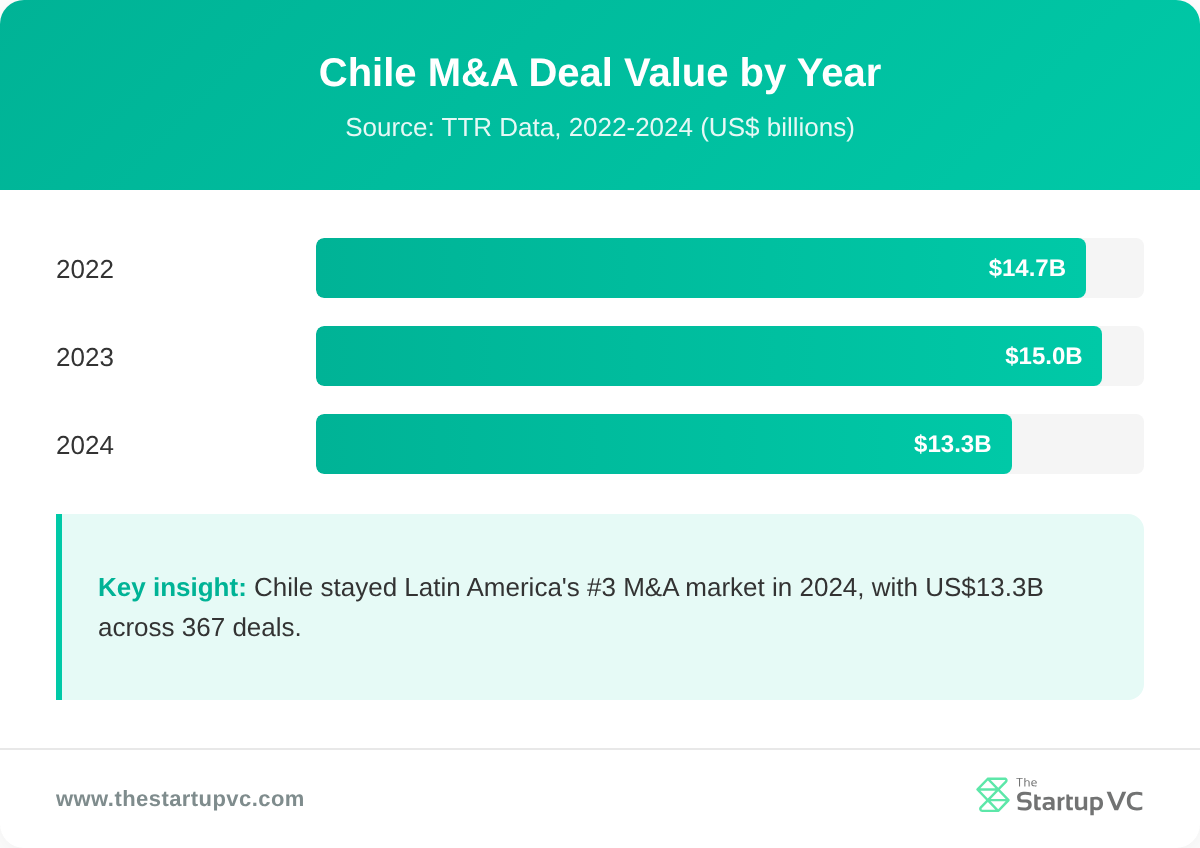
Chilean M&A activity has stayed strong but cooled recently. The table below shows recent transaction counts and values.
| Year | Deals | Total Value |
|---|---|---|
| 2022 | 314 | US$14.7 billion |
| 2023 | 384 | US$15.0 billion |
| 2024 | 367 | US$13.3 billion |
| Q1 2025 | 60 | US$1.05 billion |
The market opened 2025 slowly. Q1 2025 saw just 60 deals worth US$1.05 billion. Deal count fell 34% year over year. Political and economic uncertainty drove the drop.
Deal activity clusters in a few key sectors. These sectors lead Chilean M&A:
- Technology and software. SaaS firms see the highest deal frequency.
- Financial services. Finance leads the market by deal volume.
- Energy, mining, and infrastructure. These drive the largest-value deals.
- Utilities. This sector attracts heavy foreign investment.
Cross-border buyers dominate the biggest deals. In 2025, Norway’s Visma bought three Chilean SaaS firms. Brazil’s Patria Investments and Chile’s Linzor Capital acquired healthcare group Banmédica for about US$1 billion.
How Do You Buy a Company in Chile?
You can buy a company in Chile by signing a share purchase agreement and clearing due diligence. Most buyers acquire shares rather than assets. Foreign buyers can own 100% of a Chilean company. Chile has no foreign-investment screening for most sectors. For the wider regional picture, read our guide on how to buy a company in Latin America.
What Deal Structures Can Buyers Use?
Buyers can use one of three structures: a merger, a share purchase, or an asset purchase. Share purchases (compraventa de acciones) are the most common. Asset deals appear mainly for carve-outs, tax-driven deals, or distressed targets.
The table below compares the two main deal structures:
| Feature | Share Purchase | Asset Purchase |
|---|---|---|
| Frequency | Most common | Less common |
| What transfers | The whole company | Selected assets |
| VAT / transfer tax | None | 19% VAT can apply |
| Approval needed | Standard | Two-thirds vote if over 50% of assets |
| Best for | Clean targets | Carve-outs, distressed deals |
Most targets are an SpA (Sociedad por Acciones) or an S.A. (Sociedad Anónima). Transferring SpA or S.A. shares needs only a signed transfer form and registration in the shareholders’ registry. The SpA is the preferred vehicle for private equity and venture capital.
How Long Does Buy-Side Due Diligence Take?
Buy-side due diligence takes 4 to 8 weeks for standard deals. Regulated sectors push that to 10 to 12 weeks. Due diligence covers about eight workstreams:
- Corporate and ownership records
- Regulatory permits and licences
- Tax and accounting
- Employment and severance
- Commercial contracts
- Real estate
- Intellectual property
- Closing-conditions report
Buyers often underestimate Chile’s mandatory severance, the indemnización por años de servicio. Treat it as a real cost in your budget. Buyers usually pay cash with a locked-box or post-closing price adjustment. Escrow accounts secure the buyer against specific risks, while earn-outs stay less common in Chile.
How Do You Sell a Business in Chile?
You can sell a business in Chile by running a competitive auction or a bilateral negotiated sale. Experienced sellers favor auctions to control the process and lift the price. Smaller deals often use a direct, negotiated sale.
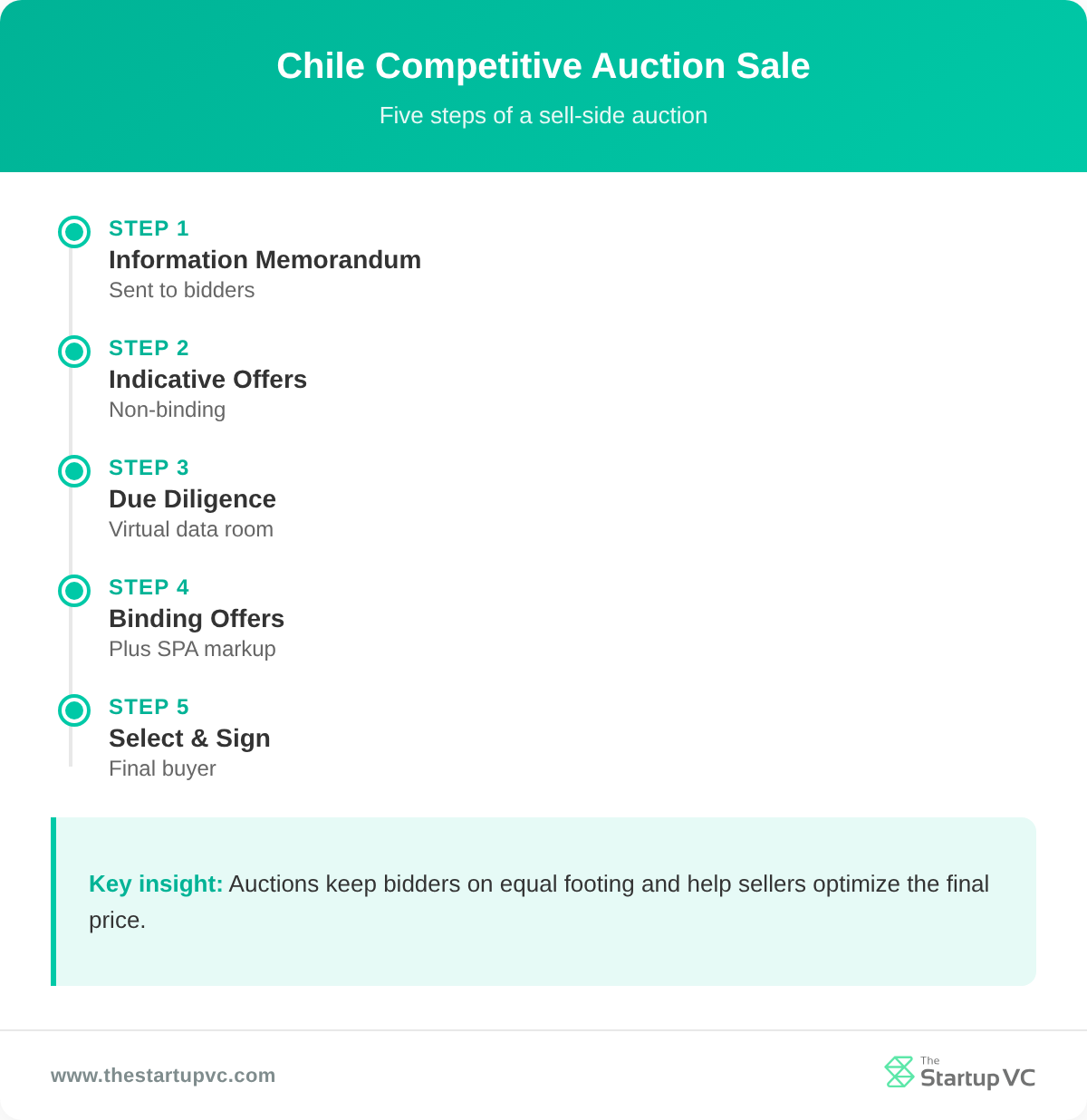
A competitive auction follows a clear sequence:
- The seller’s banker sends an information memorandum to potential bidders.
- Bidders submit non-binding indicative offers.
- The best bidders run due diligence in a virtual data room.
- Those bidders submit binding offers and a marked-up purchase agreement.
- The seller picks the final buyer and signs.
Vendor due diligence is standard in larger auctions. The seller orders its own report so all bidders share one information base. Chilean targets do not always keep tidy data rooms. Sellers should add at least five business days to gather documents. They also prepare a disclosure letter (carta de revelaciones) against the buyer’s warranties.
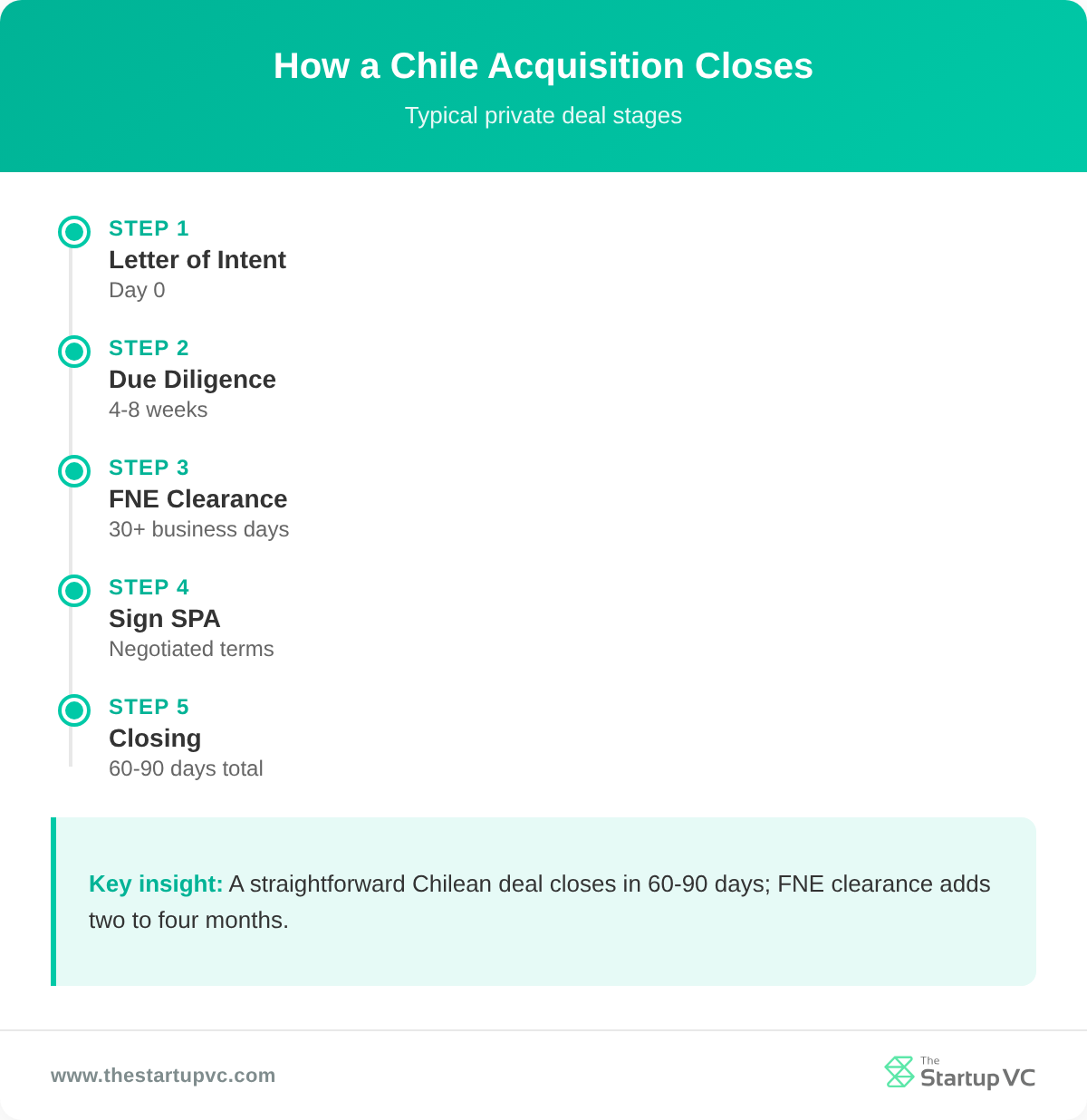
A straightforward sale closes in 60 to 90 days after the letter of intent. Deals needing FNE or sector approval add 30-plus business days. Escrow accounts (cuentas de garantía) usually run 12 to 24 months. Selling a listed company triggers a mandatory tender offer once a buyer reaches two-thirds of voting shares. Our regional guide on how to sell a company in Latin America covers cross-border exits.
What Regulatory and Tax Rules Shape Chilean M&A Deals?
The main rules are FNE antitrust review and Chile’s capital gains, VAT, and stamp taxes. Both can change deal structure and timing. Plan for them early.
How Does FNE Antitrust Review Work?
FNE antitrust review works by checking whether a deal will reduce competition before it closes. The FNE is Chile’s National Economic Prosecutor’s Office. Notification is mandatory and suspensory under Law 20.945. Qualifying deals cannot close until the FNE clears them.
Filing is required when the parties cross two sales thresholds in Chile. Sales are measured in UF, an inflation-indexed Chilean unit. Both tests below must be met:
- Combined Chilean sales above UF 2.5 million (about US$102 million in 2025).
- At least two parties each above UF 450,000 (about US$18 million).
Review runs in two phases. Phase I lasts 30 working days. Phase II adds up to 90 working days for risky deals. The FNE can approve, approve with remedies, or block the deal.
Blocked parties can appeal to the TDLC competition court within 10 days. Some Chile acquisitions need extra approval too. Bank deals need CMF authorization, and a 10% stake in an AFP pension fund needs Pension Superintendency approval.
What Taxes Apply When You Buy or Sell a Company?
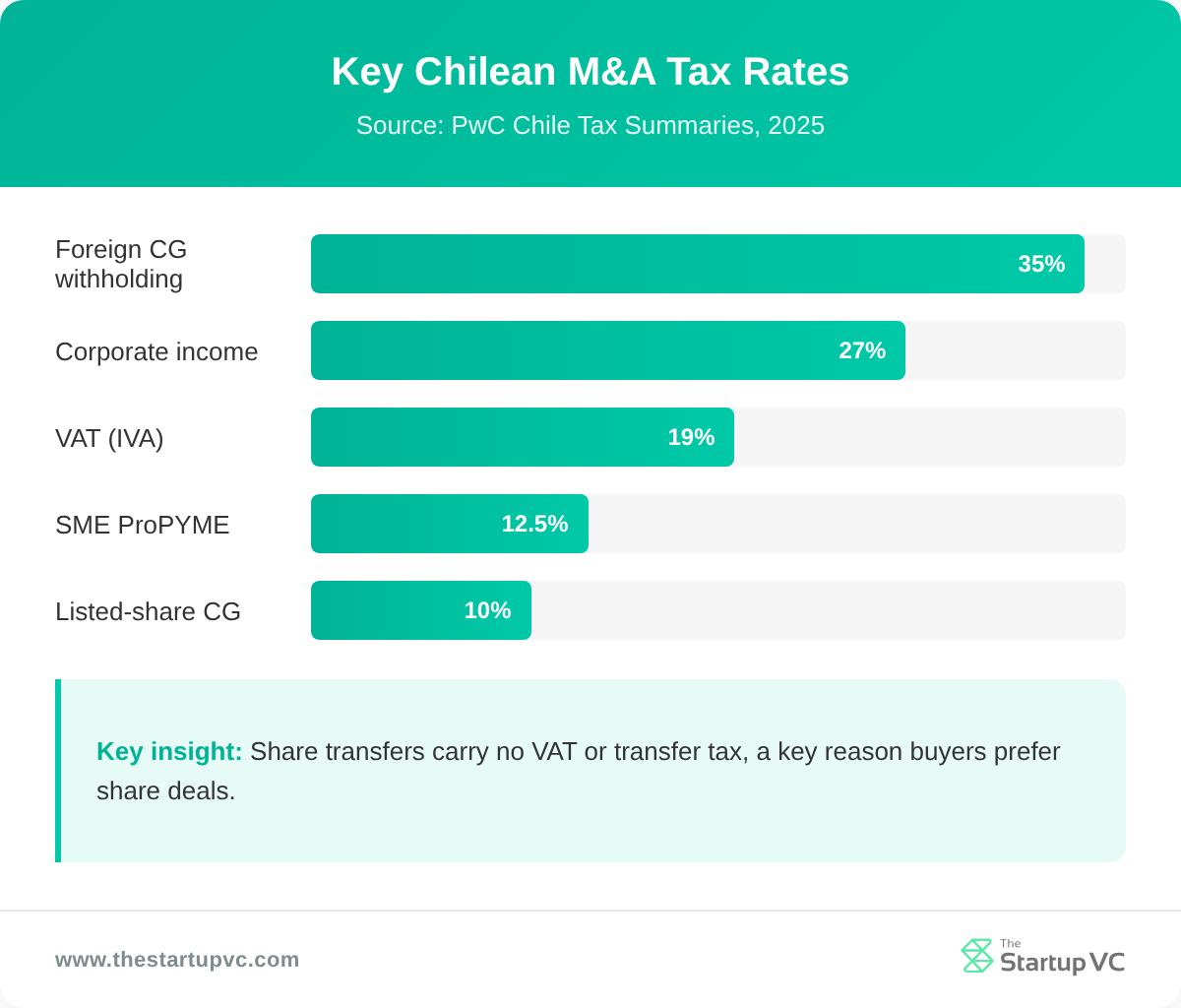
The taxes that apply include corporate income tax, capital gains tax, VAT, and stamp tax. Share deals carry a lighter tax load than asset deals. The table below shows the main taxes.
| Tax | Rate | Applies to |
|---|---|---|
| Corporate income (First Category) | 27% | Company profits |
| Capital gains (foreign seller) | 35% | Share sale gains |
| Listed-share capital gains | 10% | Qualifying public shares |
| VAT (IVA) | 19% | Asset deals, not share deals |
| Stamp tax | up to 0.8% | Debt financing |
Share transfers face no VAT and no transfer tax in Chile. This is a key reason buyers and sellers prefer share deals. Asset deals can trigger 19% VAT on inventory and fixed assets, and that VAT is not always recoverable.
Qualifying SMEs pay a reduced 12.5% corporate rate through 2027. Stamp tax hits debt-financed deals at up to 0.8% of the loan.
How Does Private Equity Power Chile’s M&A Market?
Private equity powers Chile’s M&A market by supplying deep local capital and active buyers and sellers. Chile has the most developed private equity market in Latin America. Local funds drive both acquisitions and exits.
Several capital sources feed Chile’s private equity market:
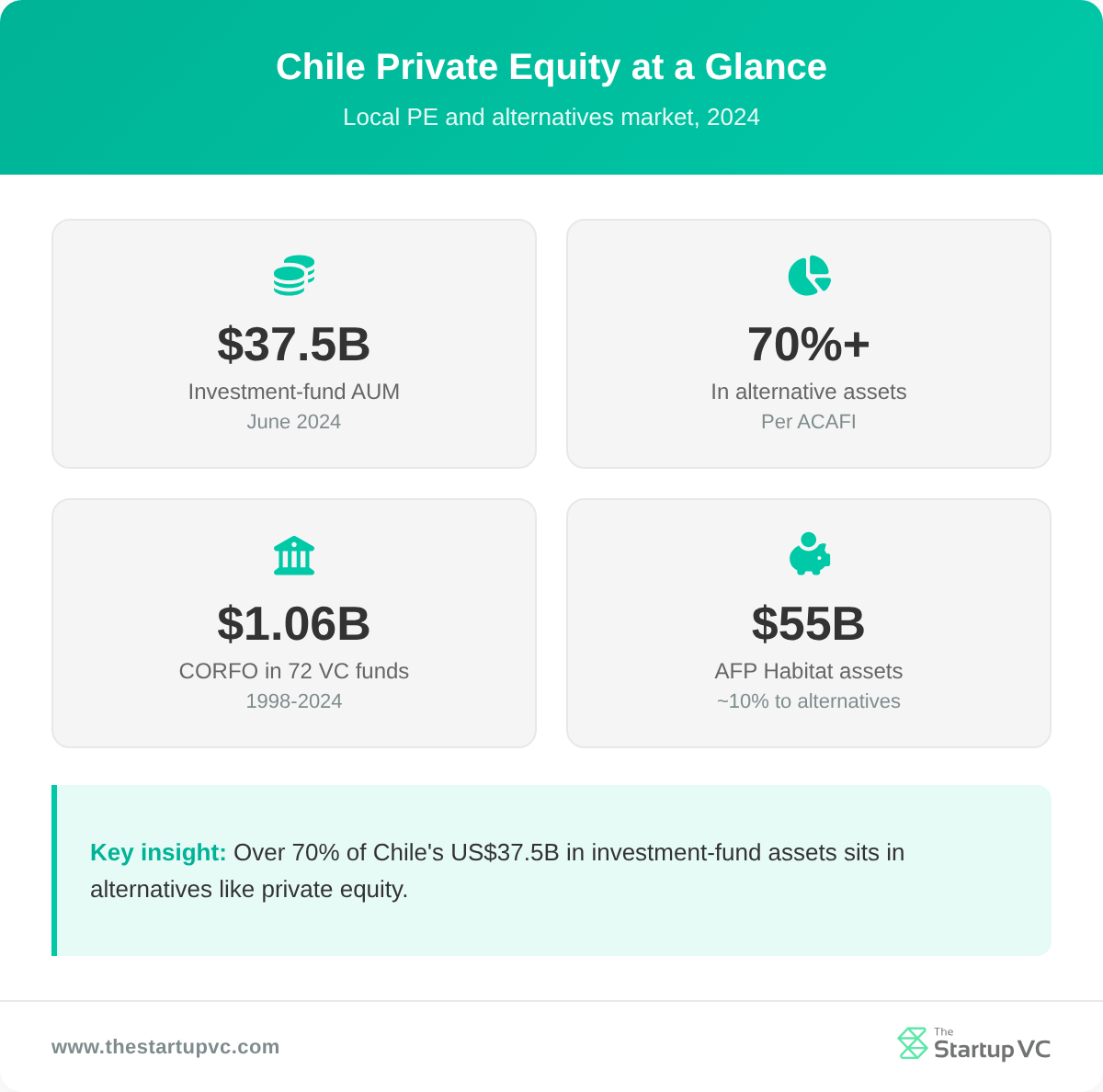
- Local investment funds. They held US$37.5 billion in mid-2024, with over 70% in alternatives.
- AFP pension funds. AFP Habitat alone manages about US$55 billion and puts roughly 10% in alternatives.
- CORFO. The state agency has invested US$1.06 billion across 72 venture funds since 1998.
Private equity firms act as major buyers and sellers in Chilean deals. Linzor Capital Partners and Brazil’s Patria Investments agreed to buy Banmédica for about US$1 billion in 2025. Linzor has done 25 deals worth US$1.2 billion across Latin America. CORFO matches private money roughly two to one to grow the market. Learn more about our investment focus across Latin America.
What Questions Do Founders Ask Most Often About M&A in Chile?
Can Foreign Buyers Own 100% of a Chilean Company?
Yes, foreign buyers can own 100% of a Chilean company. Chile does not screen foreign investment in most sectors. A few reserved areas, such as coastal fishing, carry limits. Buyers may request a Foreign Investor Certificate after the deal.
How Long Does It Take to Close an M&A Deal in Chile?
A straightforward deal closes in 60 to 90 days from the letter of intent. Deals needing FNE clearance add two to four months. Sector approvals in banking or energy add more time.
Do You Pay Tax When You Sell Shares in Chile?
Yes. A foreign seller usually pays a 35% capital gains tax on share sale gains. Qualifying listed shares may instead get a reduced 10% rate. Share transfers face no VAT or transfer tax.
When Must You Notify the FNE?
You must notify the FNE when combined Chilean sales pass UF 2.5 million. At least two parties must each pass UF 450,000. The deal cannot close until the FNE clears it.
Is a Share Deal or an Asset Deal Better in Chile?
A share deal is usually better in Chile because it avoids VAT and transfer tax. Asset deals can trigger 19% VAT and need extra approvals. Buyers pick asset deals mainly for carve-outs or distressed targets.
What Is the Most Common Way to Buy a Company in Chile?
The most common way to buy a company in Chile is a share purchase. Buyers acquire the target’s shares and the whole business transfers. Mergers and asset deals are used less often.
Ready to Buy or Sell a Company in Chile?
The Startup VC is Craig Dempsey’s family office and company builder in Latin America. We create, back, and guide scalable ventures across Latin America, including Biz Latin Hub in 17 countries. Our team brings hands-on deal experience to buyers and sellers in Chile. We help you structure transactions, run due diligence, and close with confidence. Contact us today to plan your next acquisition or exit.