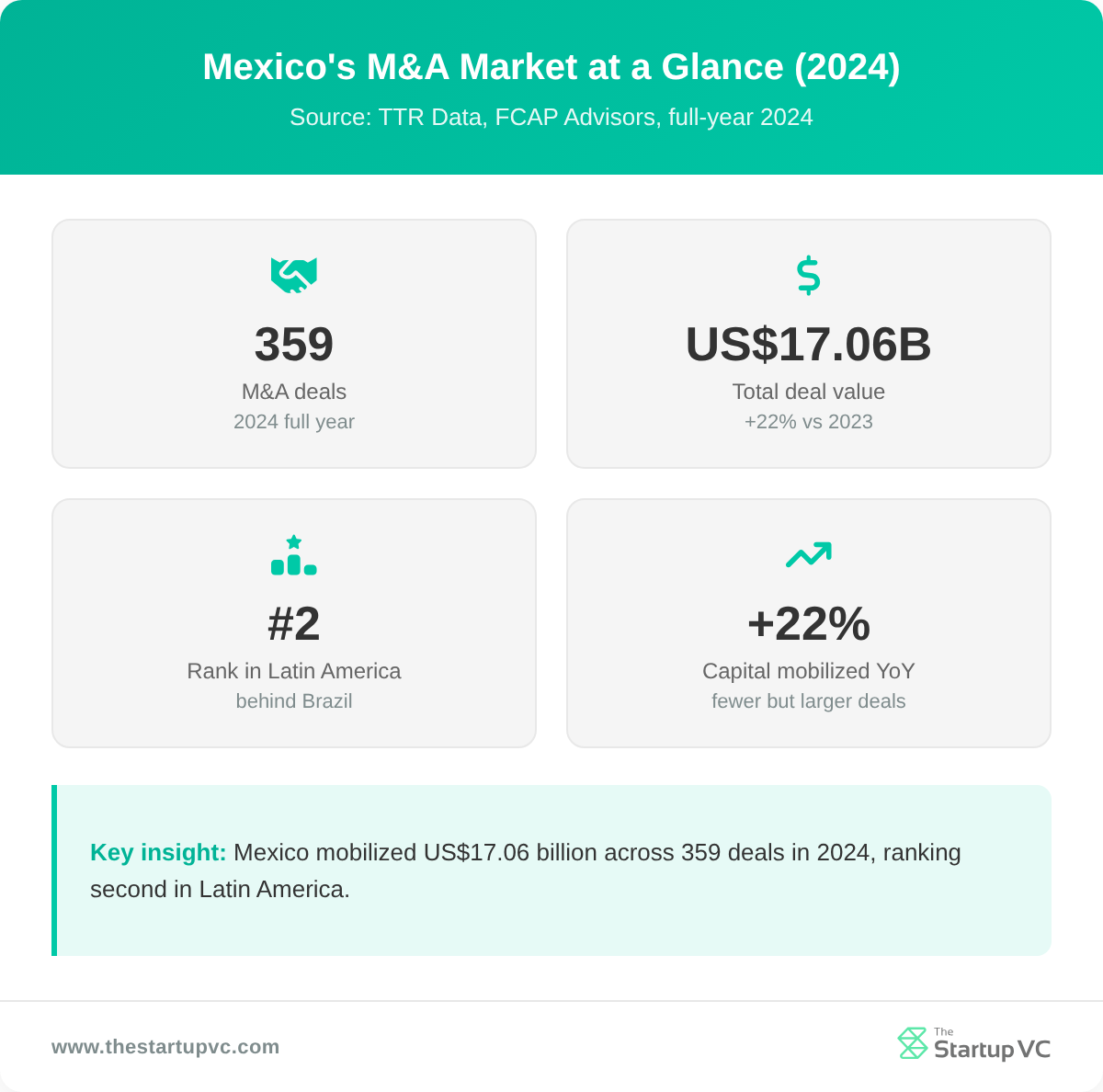
Mexico is Latin America’s second-largest M&A market, with 359 deals worth US$17.06 billion recorded in 2024.
Buyers and sellers complete Mexican deals using share or asset purchases. The CNA reviews large mergers, replacing COFECE in 2025. Foreign investors may own 100% of most companies and pay 25% or 35% capital gains tax.
The Startup VC builds and backs companies across Latin America, including Biz Latin Hub in 17 countries. This guide covers Mexico’s deal landscape from start to finish. You will learn how to buy, how to sell, which structures work, and which regulators and taxes apply.
How Big Is the Mexican M&A Market?
Mexico’s M&A market is Latin America’s second largest, behind only Brazil. In 2024, Mexico recorded 359 deals worth US$17.06 billion. That was a 22% rise in deal value over 2023. The market is now shifting toward fewer but larger deals.
These deals sit within Mexico’s wider startup and business landscape. In the first seven months of 2025, deal value rose 46% to US$14.58 billion. Deal count fell 36% over the same period.
| Period | Deals | Disclosed value |
|---|---|---|
| 2024 (full year) | 359 | US$17.06 billion |
| 2025 (Jan-Jul) | 149 | US$14.58 billion |
Activity concentrates in a few key sectors. Software led by deal count with 58 deals in 2024. Real estate followed with 45 deals that year. The biggest sectors by value are energy, financial services, and manufacturing.
The most active sectors for buyers and sellers are:
- Software and IT services. These led by deal count in both 2024 and 2025.
- Energy. GE Vernova bought Prolec for US$5.3 billion in 2025.
- Financial services. Citigroup sold Banamex to a Mexican buyer group in 2025.
- Real estate and manufacturing. These rounded out the most active sectors.
Cross-border deals are heavily US-linked. US firms made 85 acquisitions in Mexico during 2024. Those deals were worth US$1.851 billion in total. Mexican companies also invested US$2.272 billion into the United States across 17 deals.
Financial services drove headline deals too. The Citigroup sale of Banamex ended years of uncertainty in Mexico’s banking sector. The largest deals tend to land in energy and infrastructure. In 2024, Mexico Infrastructure Partners bought 8.5 GW of gas plants from Iberdrola México. That single deal was worth US$6.2 billion. Big-ticket transactions like this explain why deal value keeps rising as deal count falls.
How Do You Buy a Company in Mexico?
You can buy a company in Mexico by signing a letter of intent, running due diligence, and closing the deal. Mexico follows the same buy-side playbook used across Latin America. Most acquisitions move through five clear steps.
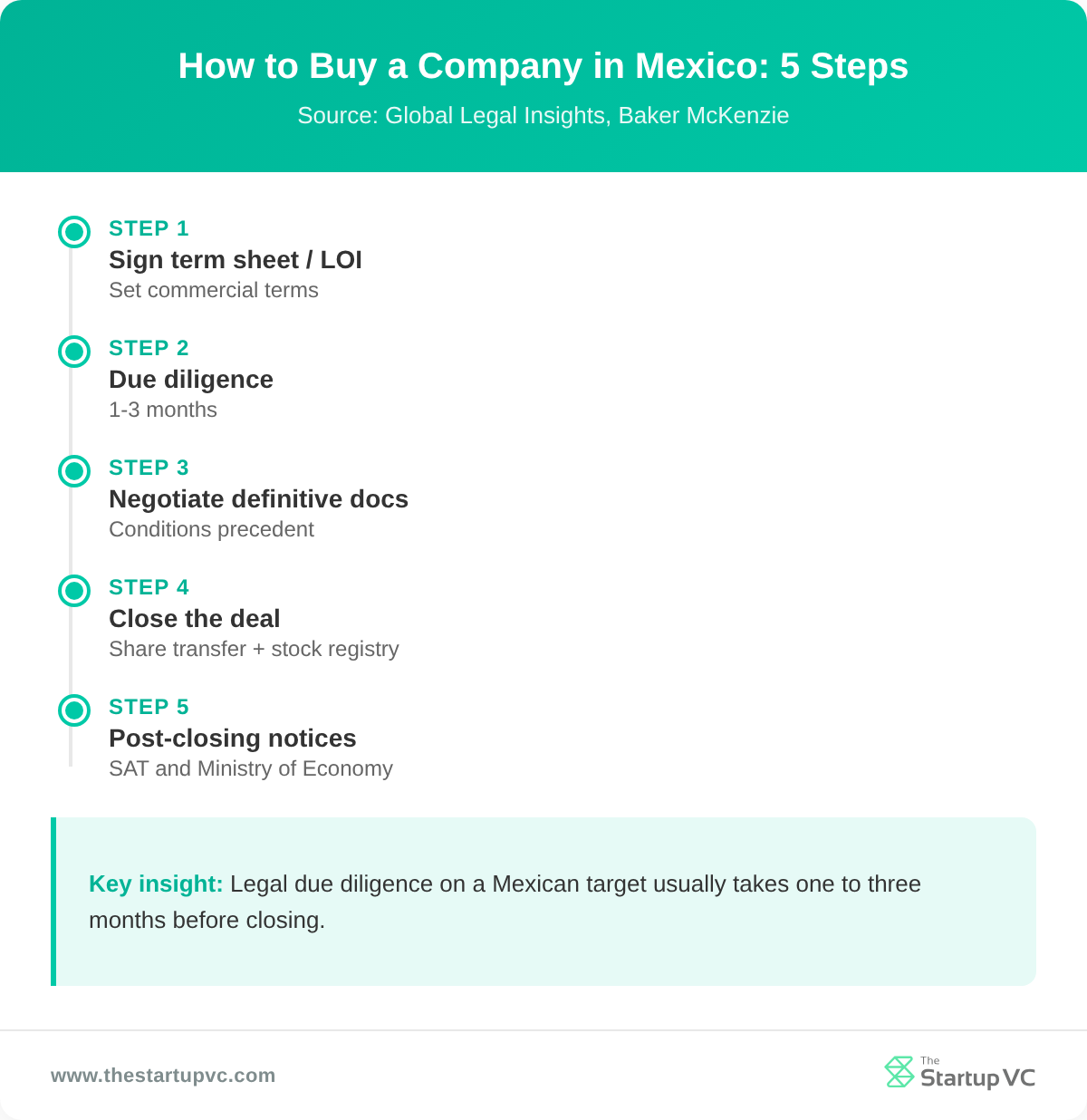
Most Mexican acquisitions follow these five steps:
- Sign preliminary documents. These set price and terms in a letter of intent.
- Run due diligence. Advisors review the target for one to three months.
- Negotiate definitive agreements. These include the purchase agreement and closing conditions.
- Get approvals. Large deals need antitrust clearance before closing.
- Close and transfer. A notary records the share transfer as a public deed.
What Should Buyers Check in Due Diligence?
Buyers should check labor, tax, and social-security records most closely. Mexican employers must share 10% of annual profits with staff as PTU. Unregistered workers expose buyers to back-payments to IMSS, the social-security agency. The IMSS statute of limitations runs five years.
In an asset deal, the seller stays jointly liable for labor claims for six months. Buyers usually hold part of the price in escrow to cover hidden liabilities. Representation-and-warranty insurance is still rare in Mexico.
The definitive agreements lock in the final terms. They include the purchase price and conditions to close. They also set representations, warranties, and indemnities from the seller. These clauses let the buyer claim money back if a problem appears later.
A notary public, called a fedatario público, plays a central role at closing. The shareholder meeting that approves a deal must be recorded as a public deed. This deed lets the buyer register the new ownership with government agencies. The buyer then notifies the Ministry of Economy and the tax authority, SAT. These post-closing filings make the change of control official.
How Do You Sell a Business in Mexico?
You can sell a business in Mexico by preparing the company, marketing it to buyers, and closing a deal. A full sale usually takes 6 to 12 months. Preparation alone can take 12 to 18 months without audited financials. Buyer due diligence then runs 8 to 12 weeks.
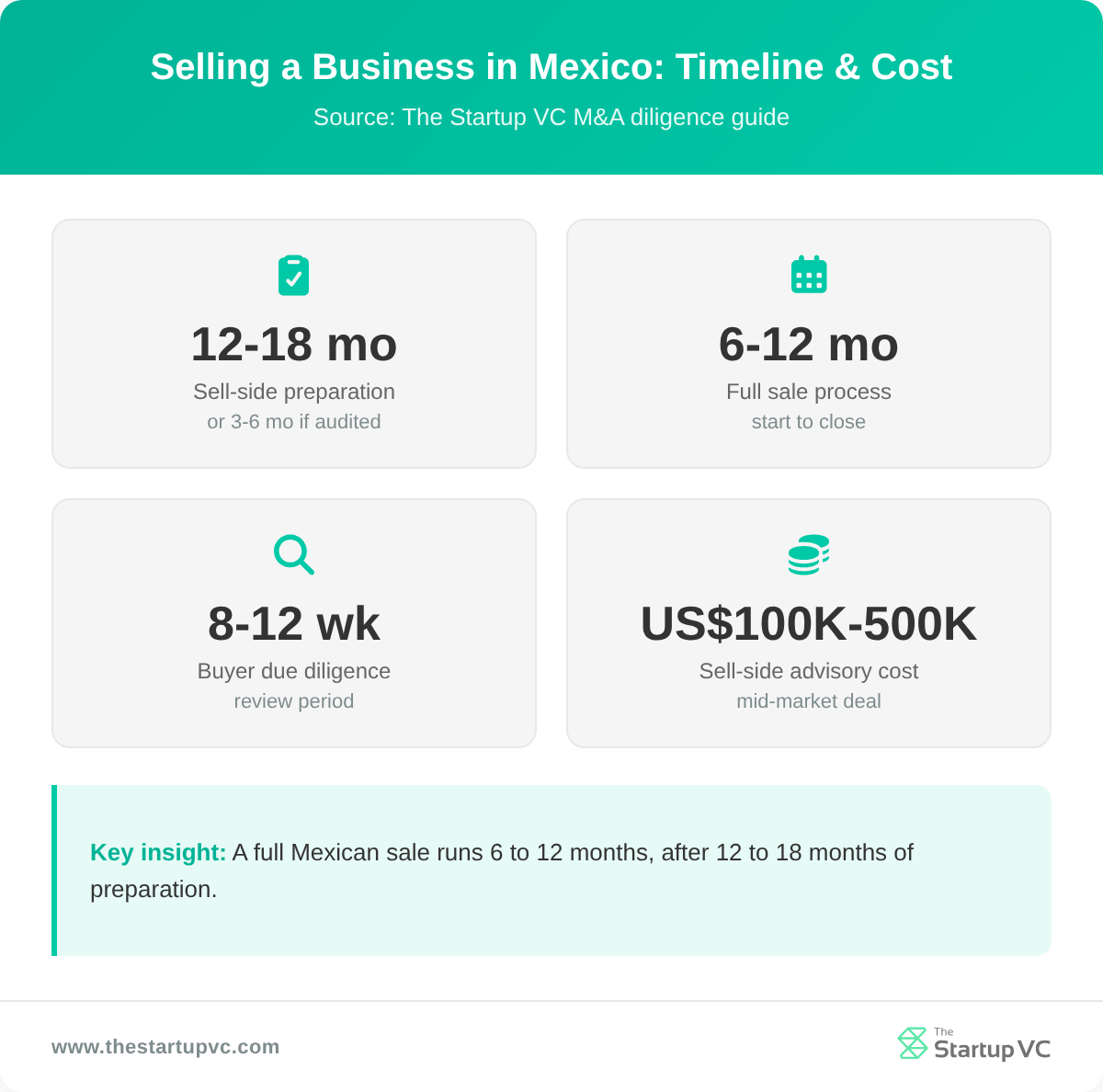
The process mirrors selling a company anywhere in Latin America. Good preparation is what protects the price. Sell-side advisory costs often run US$100,000 to US$500,000 for a mid-market deal. That spend pays off by reducing surprises during buyer review.
Strong sellers prepare four things before going to market:
- Audited financials. Have 3 to 5 years ready for buyers.
- A Quality of Earnings report. This costs US$20,000 to US$75,000.
- A data room. Organize 200 to 500 documents for review.
- Clean records. Fix labor and tax red flags early.
What Deal Breakers Should Sellers Fix First?
The biggest deal breakers are unregistered workers and unpaid tax liabilities. Missing transfer-pricing studies trigger tax reassessments that cut the price. Assets parked in related companies must be merged back before closing.
Buyers often hold back 10% to 30% of the price as security. The Mexican tax statute of limitations runs five years. It can extend to ten years where authorities find deliberate non-compliance. Sellers who clean these issues early protect their final price.
Two types of buyers compete for Mexican companies. Strategic firms buy to expand their market or product line. Private equity funds buy to grow a company and resell it later. AMEXCAP groups more than 80 such funds with over US$71 billion committed. Mid-market sponsors include Alta Growth Capital, which writes US$10 to US$20 million equity checks, and Nexxus Capital. Recent buyers include Saint-Gobain, Mill Point Capital, and TransUnion.
What Deal Structures Are Used in Mexican Acquisitions?
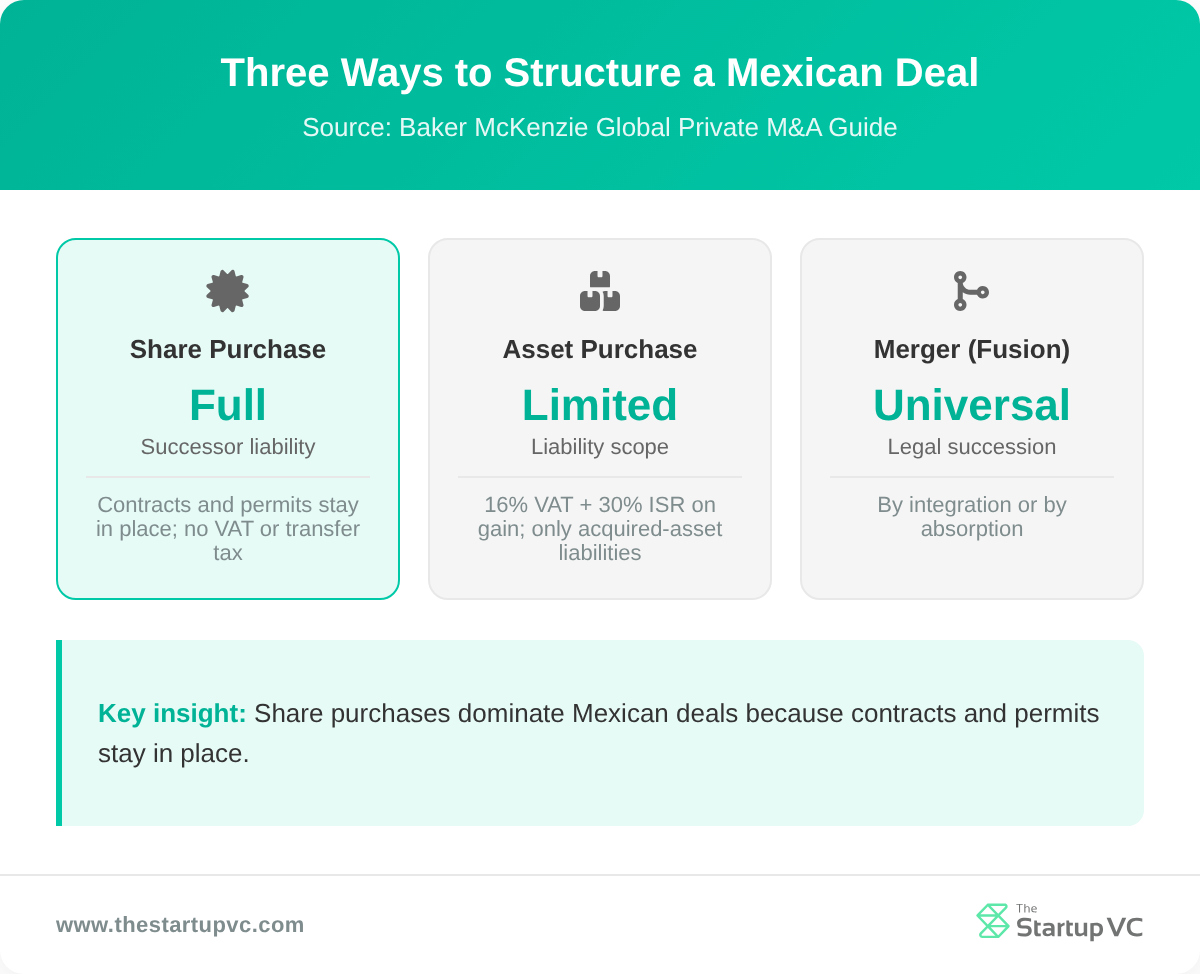
Mexican acquisitions use three main structures: share purchases, asset purchases, and mergers. The share purchase is the most common route in Mexico. It keeps the target’s contracts, licenses, and permits in place. A share buyer assumes all of the company’s liabilities. An asset buyer takes on only the liabilities tied to the assets bought.
| Structure | What transfers | Tax notes |
|---|---|---|
| Share purchase | Shares in the company | No VAT; foreign seller taxed 25% gross or 35% net |
| Asset purchase | Selected assets and liabilities | 16% VAT plus 30% income tax on the gain |
| Merger (fusión) | Two firms combine into one | By integration or by absorption |
The best structure depends on tax, liability, and how you value the target. A merger, called a fusión, runs in one of two ways. By integration, the combining companies dissolve into a brand-new entity. By absorption, one surviving company takes over the others.
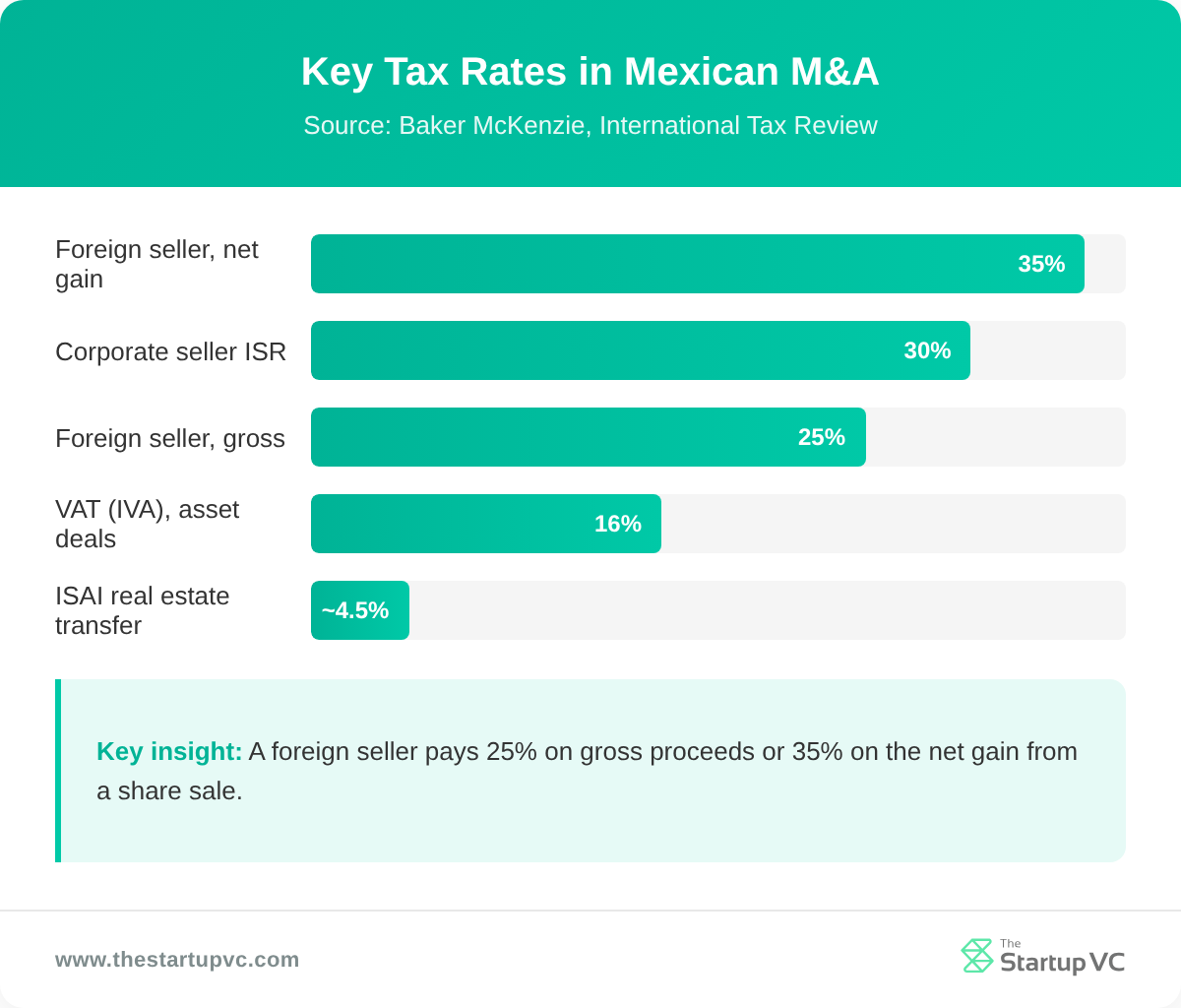
Asset deals carry extra tax cost on top of income tax. They trigger 16% VAT on the transfer of assets. They can also add a local real estate transfer tax, the ISAI, of about 2% to 4.5%. In an asset deal, the buyer can also inherit the seller’s past tax debts. For this reason, many buyers and funds acquire through a holding company or SPV.
Which Entity Types Appear in Mexican Deals?
The most common entities are the S.A. de C.V. and the S. de R.L. de C.V. The S. de R.L. de C.V. gives US investors pass-through tax treatment. Private equity and family offices favor the SAPI de C.V.
Its bylaws allow drag-along rights, tag-along rights, and veto rights. A SAPI can later convert into an S.A.B. for a public listing. This makes it a flexible base for venture-backed companies.
A share transfer is recorded in the company’s share registry book. The company recognizes only the shareholder listed in that book. That registry entry is what proves legal ownership.
What Regulatory and Tax Rules Govern M&A in Mexico?
M&A in Mexico is governed by antitrust rules, foreign investment limits, and tax law. Three areas decide whether a deal can close. Each one carries its own approval or filing.
What Antitrust Approval Does Mexico Require?
Mexico requires antitrust clearance from the Comisión Nacional Antimonopolio (CNA). The CNA replaced COFECE in October 2025 under a competition law reform. It reviews mergers that pass set value or market-share thresholds.
One threshold is a deal value above 16 million UMA, near US$96 million. Another is the purchase of 30% or more of a large agent’s shares or assets. The CNA must clear these deals before they close.
The 2025 reform cut the standard review from 100 to 50 business days. It also doubled the maximum cartel fine to 20% of annual net revenue. The merger filing fee was a flat MXN 247,820 in mid-2025. The CNA later moved to a tiered fee that scales with deal value. Some regulated deals need extra sign-off. The CNBV reviews banks and brokerages, while the new Comisión Nacional de Energía (CNE) reviews energy deals.
Can Foreigners Own a Mexican Company?
Yes, foreigners can own up to 100% of most Mexican companies. A 49% cap applies to a few reserved sectors. These include firearms manufacturing and domestic newspaper publishing.
Foreign buyers must register with the RNIE within 40 business days. Since January 2025, all RNIE filings use a new digital platform.
What Taxes Apply to a Mexican Deal?
The main taxes are income tax, VAT, and capital gains tax. A foreign seller of shares pays 25% on gross proceeds or 35% on the net gain. Mexican corporate sellers pay 30% income tax (ISR) on the gain. Asset sales add 16% VAT (IVA) on the transfer.
| Tax | Rate | When it applies |
|---|---|---|
| Income tax (ISR) | 30% | Mexican seller’s gain |
| Capital gains (foreign seller) | 25% gross or 35% net | Share sale by a non-resident |
| VAT (IVA) | 16% | Asset transfers |
A tax treaty can lower or remove the gains tax. Mexico has signed many treaties with major economies, including the United States. Foreign sellers should check the right treaty before they sign. The choice of share or asset deal also changes the final tax bill.
What Questions Do Founders Ask Most Often About M&A in Mexico?
How Long Does an M&A Deal in Mexico Take?
An M&A deal in Mexico takes about 6 to 12 months. Due diligence runs one to three months on the buy side. Large deals take longer because of antitrust review.
Can a Foreign Company Buy a Business in Mexico?
Yes, a foreign company can buy most businesses in Mexico. Foreigners may own up to 100% of companies in open sectors. A 49% cap applies only to a few reserved activities. Buyers must register the deal with the RNIE.
How Much Tax Does a Seller Pay in Mexico?
A Mexican corporate seller pays 30% income tax on the gain. A foreign share seller pays 25% on gross proceeds or 35% on the net gain. A tax treaty can reduce this amount.
Do You Need Antitrust Approval to Buy a Company in Mexico?
Yes, large deals need antitrust approval in Mexico. The CNA reviews deals above set value or market-share thresholds. It replaced COFECE as the competition regulator in October 2025. Small deals below the thresholds do not need a filing.
What Is the Most Common Deal Structure in Mexico?
The most common structure is the share purchase. It keeps the target’s contracts and permits in place. Asset deals are used when buyers want to avoid hidden liabilities.
Who Buys Companies in Mexico?
Buyers include strategic firms and private equity funds. AMEXCAP groups more than 80 funds with over US$71 billion committed. Recent buyers include Saint-Gobain, Mill Point Capital, and TransUnion.
Ready to Buy or Sell a Company in Mexico?
M&A in Mexico rewards teams that know the ground. The Startup VC is Craig Dempsey’s family office and company builder. We create, back, and guide scalable ventures across Latin America. Our team has run deals, built companies like Biz Latin Hub, and managed compliance in 17 countries. We help buyers and sellers move with confidence in Mexico. Contact us today to plan your next deal.