
Earnouts tie 10%-31% of a Latin America M&A price to post-closing performance, bridging buyer-seller valuation gaps.
Latin America’s M&A market reached $40.6 billion across 600 deals in 2025. Earnouts typically span 12 to 36 months. They appear in about 24% of private deals in Mexico, Brazil, Colombia, and Argentina.
The Startup VC structures cross-border acquisitions across Latin America. Its network draws on Biz Latin Hub’s presence in 17 countries and direct experience with founder-led exits. This guide covers earnout structures, payment formulas, dispute risks, and tax treatment across Mexico, Colombia, Brazil, Chile, and Argentina.
What Is an Earnout in Latin America M&A?
An earnout is a contingent payment. It lets a buyer pay part of the purchase price only if the acquired business hits specific targets after closing. Buyers and sellers use it instead of paying the full price in cash at signing.
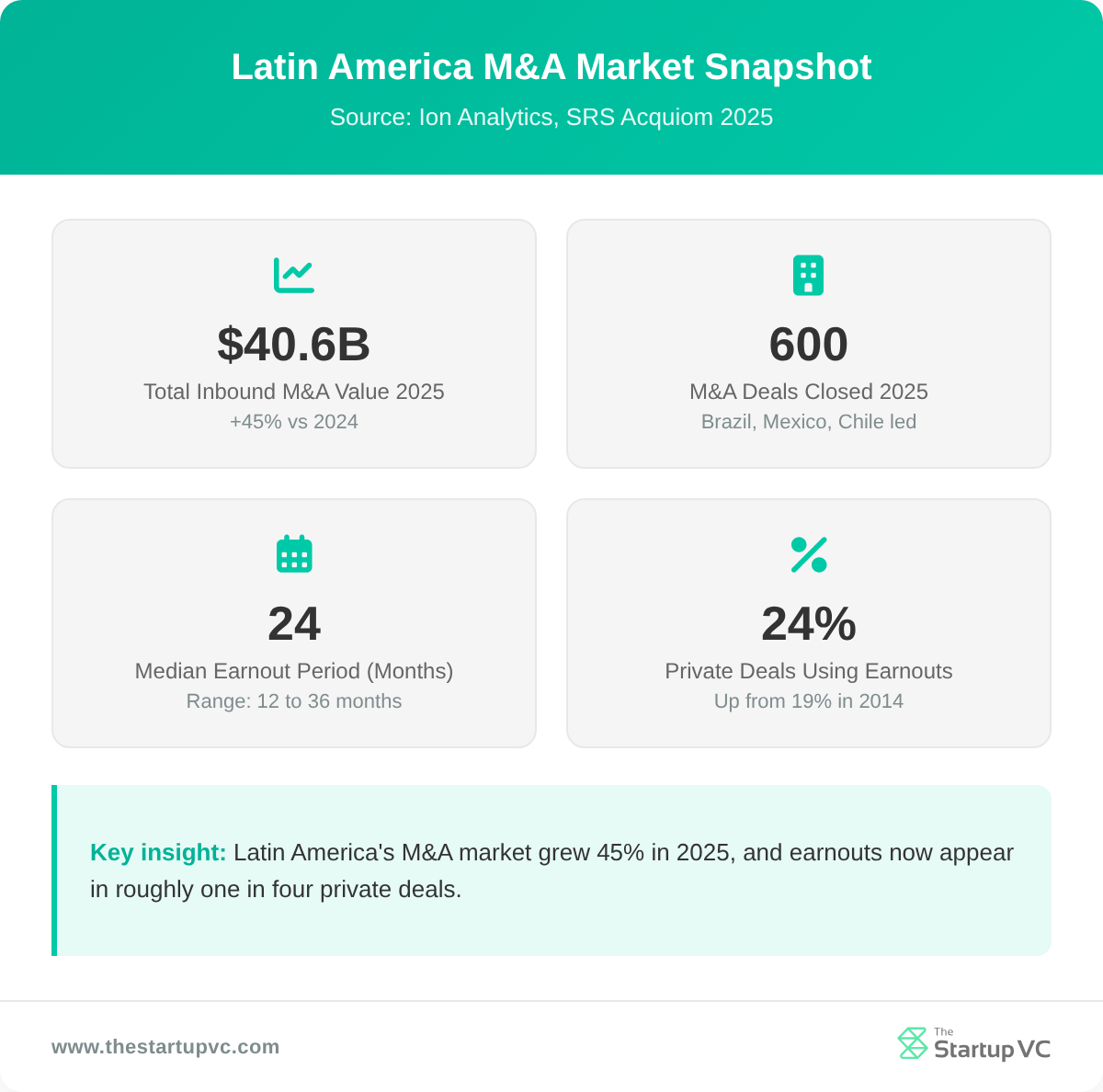
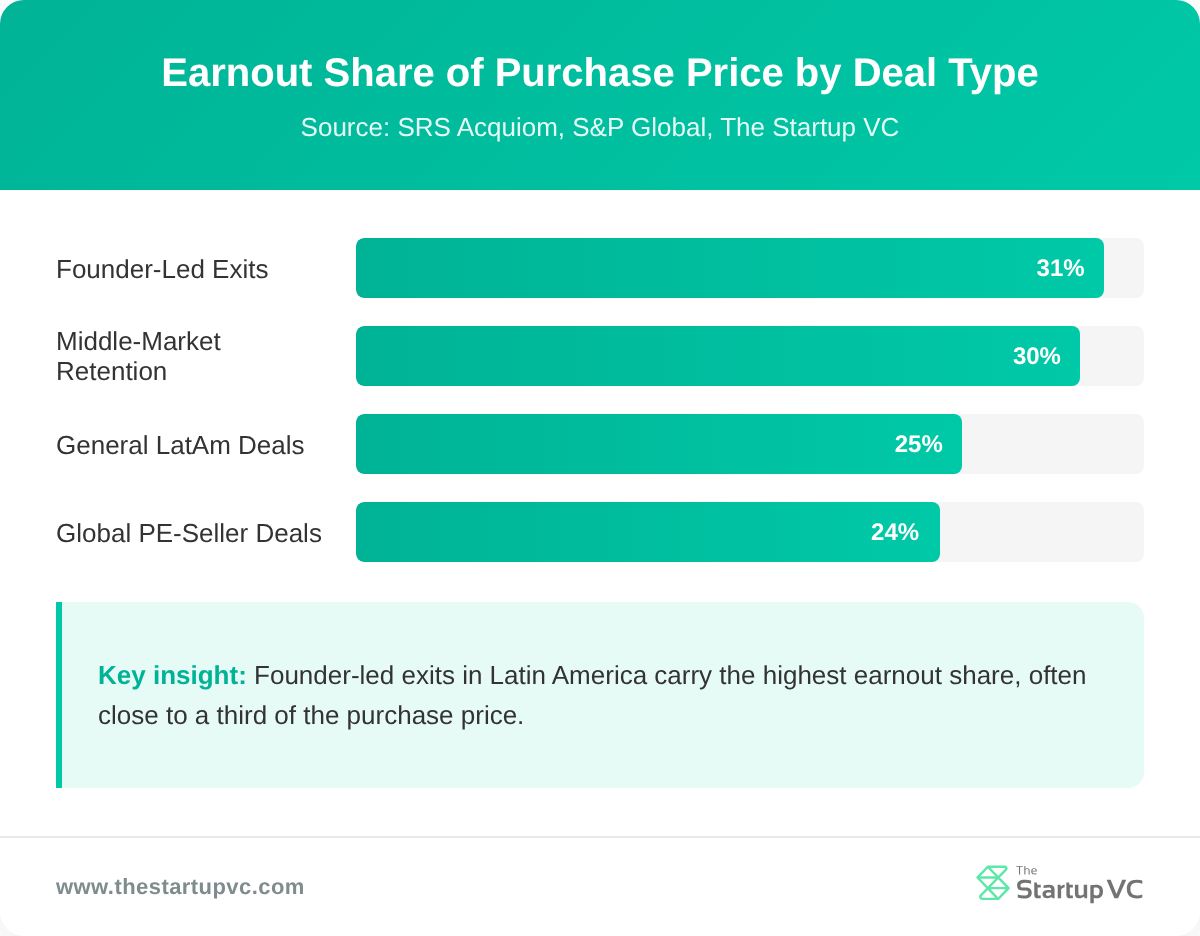
Across Latin American deals, earnouts typically make up 10% to 25% of total purchase price. Sometimes they reach as much as 40%. The earnout period most commonly runs 12 to 36 months, with a median of 24 months. In founder-led business sales, roughly 31% of the purchase price is often deferred through an earnout.
A typical Latin American deal structure stacks several payment layers together:
- Cash at close. The portion paid immediately when the deal signs.
- Seller note. A loan from the seller to the buyer, repaid over time.
- Earnout. Contingent payments tied to post-closing performance.
- Mezzanine or bank debt. Added on larger deals to fund the cash portion.
Regulatory clearance also shapes deal timing. Brazil’s CADE, Mexico’s COFECE, and Chile’s FNE all review qualifying mergers before contingent payments can close. Latin America’s inbound M&A market reached $40.6 billion across roughly 600 deals in 2025, a 45% jump from 2024. Brazil, Mexico, Chile, Argentina, and Colombia led that recovery, and earnout structures are increasingly common across all five markets.
Why Do Buyers and Sellers Use Earnouts in Latin America Deals?
Buyers and sellers use earnouts because they bridge the valuation gap between seller and buyer price expectations. Sellers price the business on momentum and future potential. Buyers price in integration cost and the risk that projections fall short. An earnout lets both sides agree to disagree. Part of the price depends on who turns out to be right.
Latin American dealmakers use earnouts for four main reasons:
- Bridging valuation gaps. The earnout closes the distance between seller expectations and buyer offers without either side backing down.
- Allocating performance risk. The seller earns more if targets are met, and the buyer’s downside is capped if they are not.
- Retaining founders. In LatAm middle-market deals, 20% to 30% of purchase price is often tied to milestones. These milestones keep the founder running the business through the transition.
- Preventing disputes. Clear, written metrics reduce the chance of disagreement over what the business actually earned.
The shift toward earnouts is part of a broader global trend. Globally, 24% of private-target deals used an earnout in 2025, up from 19% in 2014. For private-equity sellers, the jump is even sharper. Earnouts appeared in about 24% of PE-seller deals in the most recent study year, compared to just 8% in 2019. That trend matters directly for Latin America, where PE exits are picking up across Brazil, Mexico, and Colombia.
How Does an Earnout Structure Work in a Cross-Border Latin America Deal?
A cross-border earnout structure works by setting a post-closing metric, a measurement date, and a payment mechanism at signing. The buyer and seller agree on how the target’s performance will be measured. They also set when it will be checked and how the payout will be delivered.
What Payment Schedules Are Used for Earnouts?
Dealmakers generally choose between two payment schedules. The first is a single lump-sum payment measured at the end of the earnout period. The second is multiple staged payments measured annually. Staged annual payouts can create recurring tension between buyer and seller, since each measurement date reopens the conversation about performance. Some advisors prefer a single measurement date for this reason.
Escrow accounts often accompany earnouts in seller-financed, cross-border deals. The funds are set aside to cover liabilities that surface during the earnout period. This gives both sides a buffer before the final payment changes hands.
Learn more about structuring a cross-border acquisition in Latin America.
How Do Country-Specific Rules Affect Earnout Structures?
Earnout practices vary by country across Latin America. In Mexico, deferred payment and earnout structures now appear across most deal types, not only private equity transactions. In Colombia, dealmakers report using more price adjustments and earnouts than at any point in their careers. In Brazil, earnouts, vendor financing, and carve-outs bridge valuation gaps between buyers and sellers. In Argentina, foreign exchange controls complicate earnout payments. Some dealmakers use payment-in-kind structures with listed equity shares instead of cash.
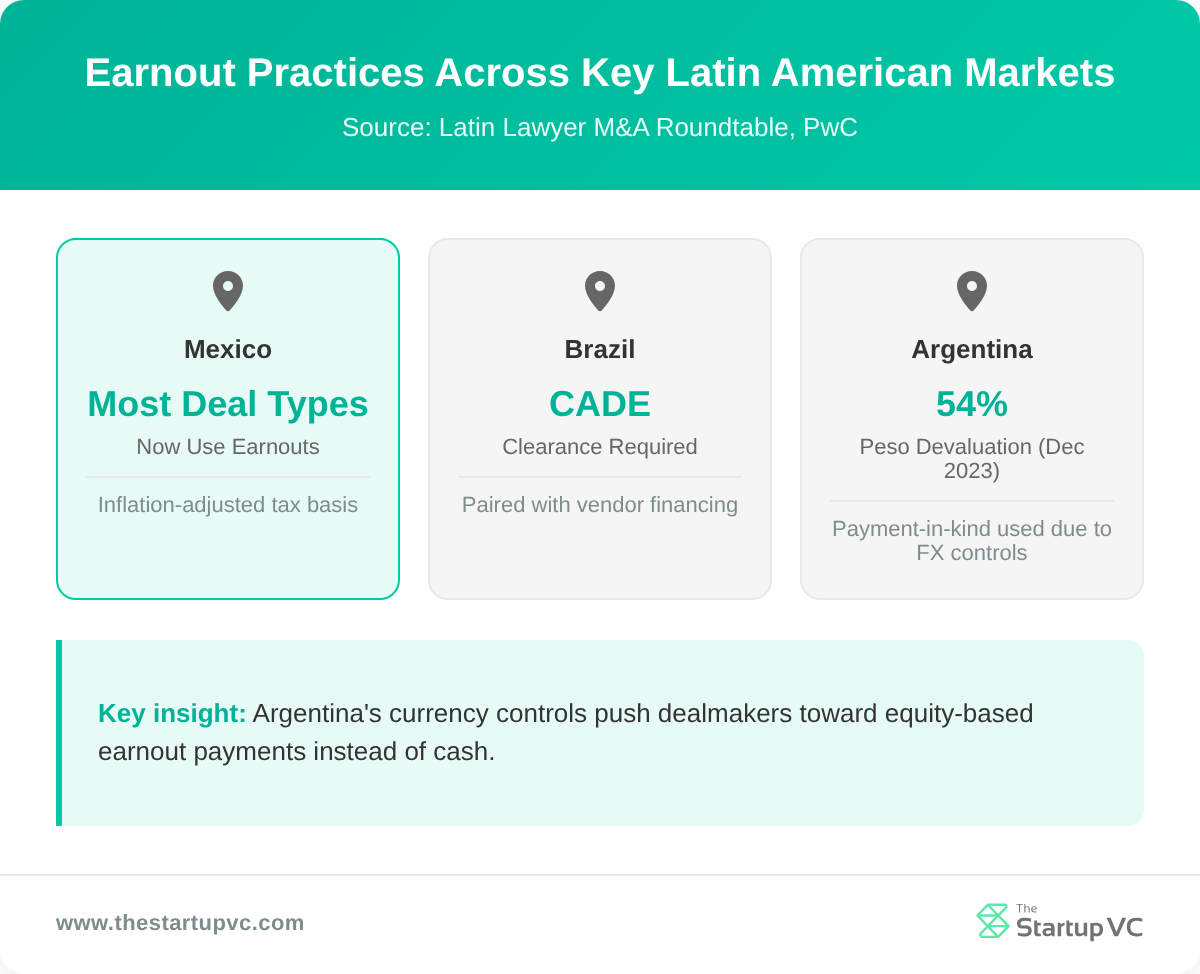
| Country | Common Earnout Practice | Key Structural Risk |
|---|---|---|
| Mexico | Deferred payments and earnouts across most deal types | Inflation-linked tax basis complicates payout calculations |
| Colombia | Rising use of price adjustments and earnouts | Disputes often require neutral-accountant review |
| Brazil | Earnouts paired with vendor financing and carve-outs | CADE clearance timing can delay payment schedules |
| Argentina | Payment-in-kind with listed shares to work around FX controls | Currency controls limit cash repatriation |
US private-target deals show a smaller share using earnouts than Latin American practitioners report locally. Only 18% of US deals used an earnout in the 2025 ABA Private Target Deal Points Study. That is down from 26% in 2022-23. Just 14% of those deals required the buyer to operate the business consistent with past practice during the earnout period. Cross-border LatAm sellers need to negotiate operating protections directly, since buyers otherwise retain wide discretion.
What Metrics and Formulas Determine Earnout Payments?
The metrics that determine earnout payments include revenue, EBITDA, gross profit, and specific operational milestones. Which metric applies usually depends on how the buyer plans to run the business after closing.
What Financial and Operational Metrics Are Used?
Earnout metrics fall into two categories. Financial metrics include revenue, EBITDA, and gross profit. Operational metrics include customer retention, regulatory approvals, and contract milestones. Revenue-based earnouts are typically used when the target will be fully folded into the buyer’s operations. EBITDA-based earnouts are typically used when the business keeps operating on a standalone basis.
Industry also shapes which metric gets negotiated. Healthcare deals often use provider productivity and regulatory milestones. Consumer and food and beverage deals more often use net sales, gross margin, or successful product launches.
What Formulas Determine the Payout Amount?
Four formula types recur most often in earnout agreements.
| Formula Type | How It Works | Example Use Case |
|---|---|---|
| Threshold | Fixed payment triggers once a baseline is reached | Simple pass-fail EBITDA target |
| Tiered | Different payout percentages apply at different performance bands | Rewarding performance above and below plan |
| Linear | Payment scales proportionally above a baseline | EBITDA cap-and-collar structures |
| Milestone | Payment triggered by a defined non-financial event | Regulatory approval or contract signing |
A common cap-and-collar formula pays out on a pro-rata basis between an EBITDA threshold and an EBITDA cap. In one illustrative contract, EBITDA reached $12,250,000 against a threshold of $11,175,000 and a cap of $14,100,000. That produced a payout of $9,188,034 on a $25,000,000 maximum. Revenue-based formulas work similarly. A deal might pay 10% of revenue above a $22 million threshold, capped at $5 million. That means $25 million in revenue yields a $300,000 payment.
See our guide to EBITDA multiples in Latin American M&A for sector benchmarks.
Earnouts commonly represent 15% to 25% of total stated deal consideration in middle-market transactions. Earnout periods most often run one to three years, though complex deals can extend the measurement window to five years.
What Are the Most Common Earnout Disputes and Risks in Latin America?
The most common earnout disputes and risks in Latin America include vague metric definitions and limited seller control. Currency volatility adds another layer of risk. Analysts expect M&A disputes across Latin America to rise in 2025, concentrated in deals under €40 million.
What Causes Most Earnout Disputes?
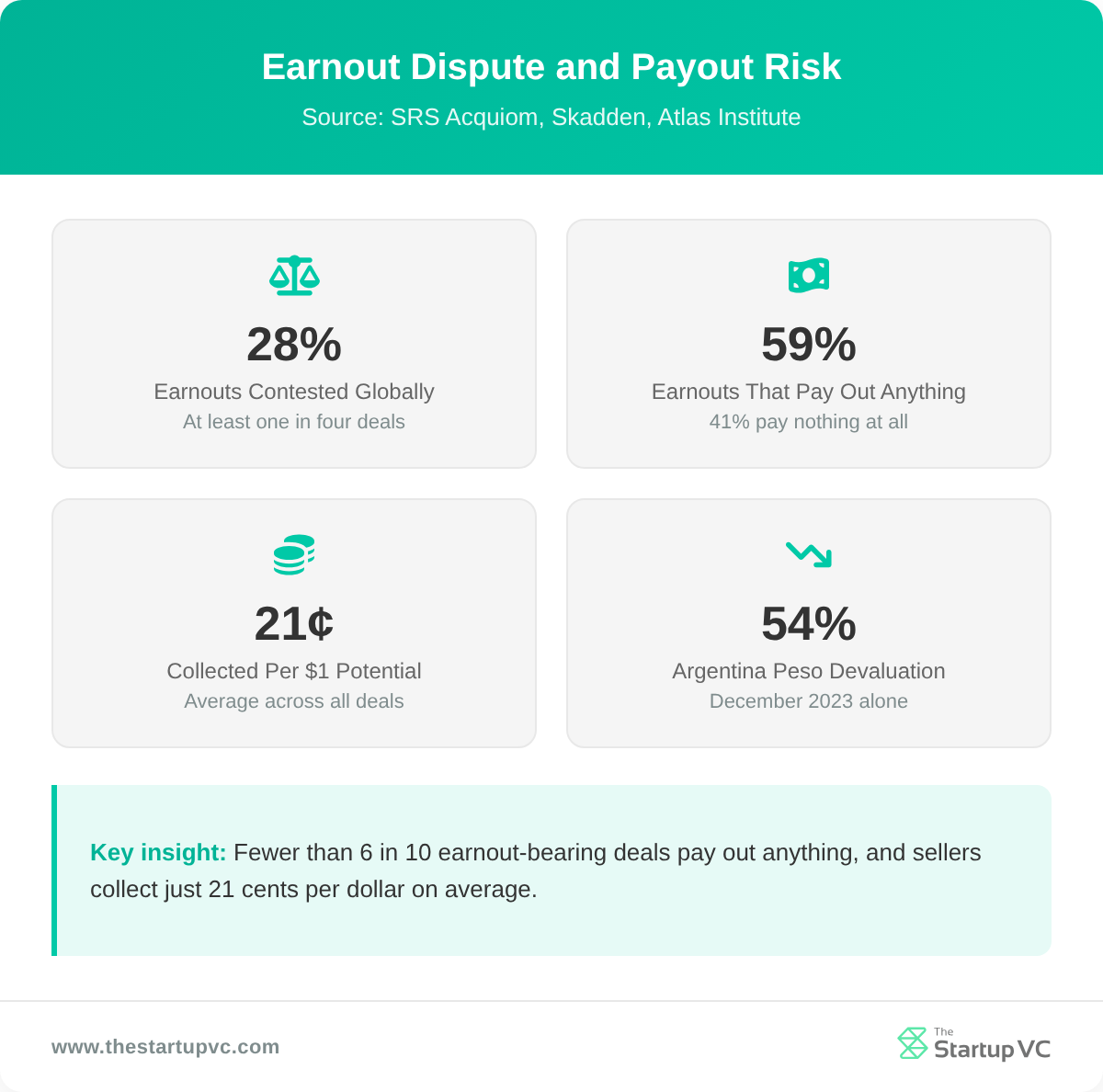
Financial and operational performance disagreements drive most earnout disputes, followed by currency volatility. Globally, earnouts are contested in at least 28% of deals. Only 59% of earnout-bearing deals pay out anything at all. Sellers collect on average just 21 cents on the dollar of potential earnout value. Ambiguous or poorly drafted metric definitions cause most of these disputes.
Where Are Cross-Border Earnout Disputes Resolved?
Cross-border earnout disputes between US and Latin American parties most often go to international arbitration. The International Chamber of Commerce, the American Arbitration Association’s ICDR, and JAMS International are the venues chosen most frequently.
| Institution | Regional Role | Notable Data Point |
|---|---|---|
| ICC | Leading venue for US-LatAm cross-border disputes | Mexican party representation rose 110% in 2023 |
| AAA/ICDR | Common choice for US-Latin America commercial disputes | Ranks among top three venues regionally |
| CAM-CCBC (Brazil) | Regional arbitration center in Brazil | International caseload more than doubled by 2025 |
How Does Currency Risk Affect Earnout Payouts?
Currency risk erodes the real value of earnout payouts denominated in local currency. Argentina’s peso devalued 54% in December 2023 alone. A seller expecting a fixed local-currency payout can see its dollar value collapse before the earnout period even ends.
Sellers can reduce dispute risk with three contract protections:
- Operating covenants. Require the buyer to run the business in the ordinary course, consistent with past practice.
- Separate books and records. Require the buyer to track the acquired business’s financials independently during the earnout period.
- Information rights. Give the seller access to financial records to verify earnout calculations directly.
What Questions Do Founders Ask Most Often About Earnouts in Latin America M&A?
What Percentage of the Purchase Price Is Typically an Earnout?
Earnouts typically make up 10% to 31% of the purchase price in Latin American acquisitions. They are often stacked alongside seller notes at 6% to 10% interest. Larger deals may add mezzanine debt or US-dollar financing. Learn more about financing an acquisition in Latin America.
How Long Does an Earnout Period Usually Last?
Earnout periods typically run 12 to 36 months, with a median of about 24 months. Complex integrations or highly regulated sectors sometimes stretch the earnout window to three to five years.
How Are Earnouts Taxed in Latin America?
Earnout tax treatment varies sharply by country. Mexico lets sellers adjust historical cost for inflation based on holding period. Colombia taxes share-sale gains at a flat 10% if held two years or more. Shorter holdings face ordinary rates up to 37%. Chile has offered a reduced 10% capital-gains rate on qualifying share sales since September 2022. Brazil withholds tax on non-resident sellers at progressive rates of 15% to 22.5%.
Can Founders Negotiate Earnout Terms?
Yes, founders can and should negotiate earnout terms. Advisors flag three red flags. More than 50% of deal value tied to an earnout is one. Undefined performance metrics and no post-closing operational control for the seller are others. Founders should push for metrics they can directly influence, like revenue or product milestones.
What Happens If the Buyer Misses Earnout Targets?
Courts generally hold that buyers cannot deliberately act to frustrate an agreed earnout target. Sellers face a high evidentiary bar to prove intent, so contracts should include liquidated damages or acceleration clauses upfront. These clauses make the full earnout payable if the buyer breaches its obligations.
Do Earnout Payments Get Capital Gains or Ordinary Income Treatment?
It depends on how the deal is structured. An earnout tied to the seller’s continued employment is typically taxed as ordinary income. An earnout structured as deferred purchase price is typically taxed at capital gains rates.
Ready to Structure an Earnout in Your Latin America Exit?
The Startup VC is Craig Dempsey’s family office and company builder, backing founder-led ventures across Latin America. The team has structured cross-border deals through Biz Latin Hub’s network in 17 countries. This combines hands-on deal experience with regional compliance and tax expertise. Whether you are buying or selling, getting the earnout terms right protects your outcome long after closing. Contact us today to structure your next Latin America transaction.