
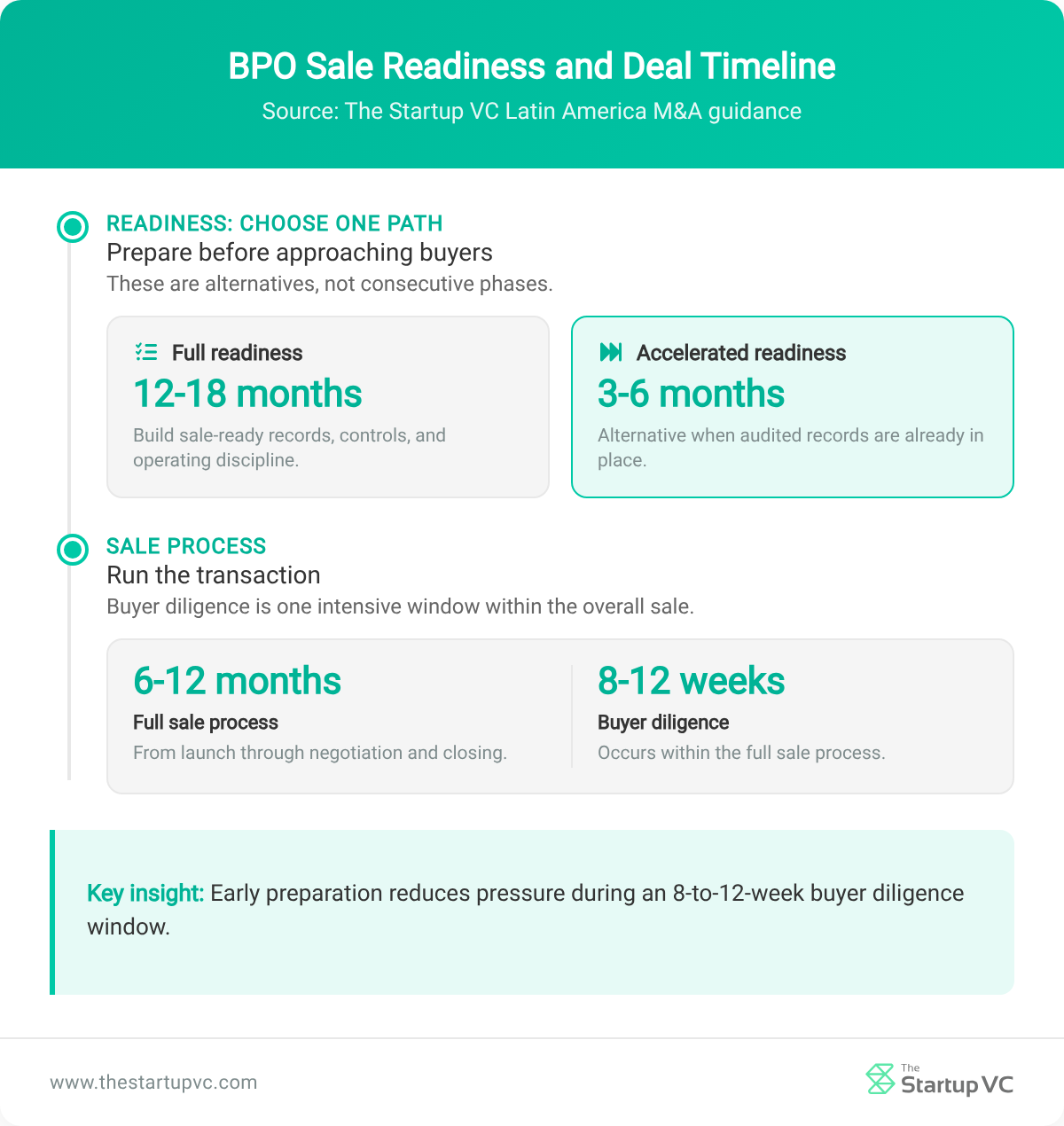
A Latin American BPO sale can take 6-12 months, while buyer diligence often lasts 8-12 weeks.
Buyers assess normalized EBITDA, contracts, concentration, program margins, technology, security, and management. Capstone Partners’ 2025 report covered disclosed 2022-2024 BPO deals. The sample averaged 2.0 times revenue and 8.8 times EBITDA.
The Startup VC uses operating and exit experience from Latin America, including Craig Dempsey’s Biz Latin Hub journey. This guide explains valuation, buyer fit, preparation, sale structure, and the evidence owners need before outreach.
How Do Buyers Value a BPO or Contact Center in Latin America?
Buyers value a Latin American BPO by normalizing earnings, testing revenue durability, and pricing operating and country risk. They then convert enterprise value into expected seller proceeds under the proposed terms.
A buyer normally answers three questions:
- What earnings transfer? Reconcile reported EBITDA with recurring client and program profit after the founder leaves.
- Which valuation method fits? Compare EBITDA, revenue, cash-flow, and transaction evidence without treating one range as a promise.
- What will the seller receive? Model debt, working capital, escrows, earnouts, taxes, and any rollover equity.
The sections below explain each step, from the earnings base to the final proceeds bridge.
Which Valuation Methods Do Buyers Use?
The main valuation methods are EBITDA multiples, revenue multiples, discounted cash flow, and comparable transactions. Buyers often use several methods together.
| Method | Best Fit | Evidence Buyers Need |
|---|---|---|
| Normalized EBITDA | Profitable, contract-based BPOs | Adjusted earnings, program margins, and owner-cost adjustments |
| Revenue multiple | Fast-growing or technology-led providers | Contract term, pricing power, retention, and gross margin |
| Discounted cash flow | Businesses with predictable forecasts | Cash-flow forecasts, country risk, currency assumptions, and capital needs |
| Comparable transactions | BPOs with relevant disclosed deals | Similar size, services, geography, growth, and client mix |
Normalized EBITDA removes unusual expenses and owner-specific costs. Buyers will reject adjustments that lack invoices, contracts, or clear business reasons.
The earnings bridge should connect reported EBITDA to every accepted adjustment. Buyers also compare those adjustments with payroll, invoices, contracts, and program-level margins. Revenue multiples work best as a cross-check for technology-led growth. DCF and comparable deals must use realistic retention, wage, currency, and country-risk assumptions.
What Do Current BPO Multiples Show?
Current BPO multiples show a wide range because business quality varies. They provide reference points, not promised sale prices.
- Disclosed deals. Capstone Partners’ 2022-2024 sample averaged 2.0 times revenue and 8.8 times EBITDA.
- Public companies. Its 2024 index averaged 1.5 times revenue and 10.1 times EBITDA, with wide variation among companies.
- Private companies. Capstone’s matrix ranged from 4 to 10 times EBITDA for companies with roughly US$2 million to US$12 million of EBITDA.
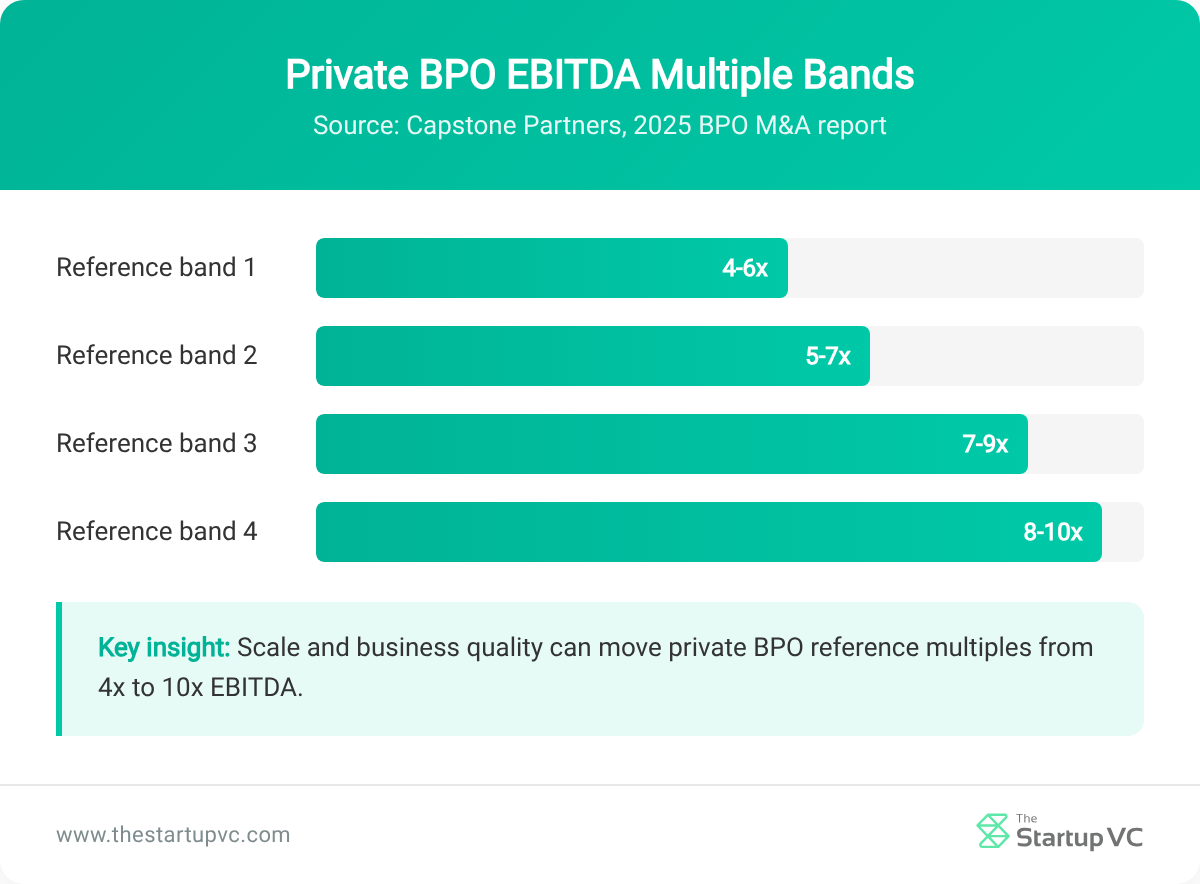
Higher bands required greater scale, specialization, stronger margins, larger clients, and lower concentration. A Latin American business may fall outside every band.
A Latin American company valuation should also reflect country, currency, inflation, and company-specific risk.
Why Can Headline Value Differ From Cash at Closing?
Headline value can differ from cash at closing because offers may include earnouts, debt adjustments, escrows, or working-capital changes.
A seller proceeds bridge normally includes:
- Enterprise value offered for the operating business.
- Cash added and debt or debt-like items deducted at closing.
- Working-capital adjustments against the agreed target.
- Escrows, holdbacks, fees, and taxes deducted from immediate proceeds.
- Earnouts or rollover equity shown separately from cash at closing.
The announced Netcom transaction shows this difference. Its US$33.37 million headline value included US$25.41 million upfront. The offer also included an estimated US$8.25 million earnout plus EBITDA and excess working-capital adjustments.
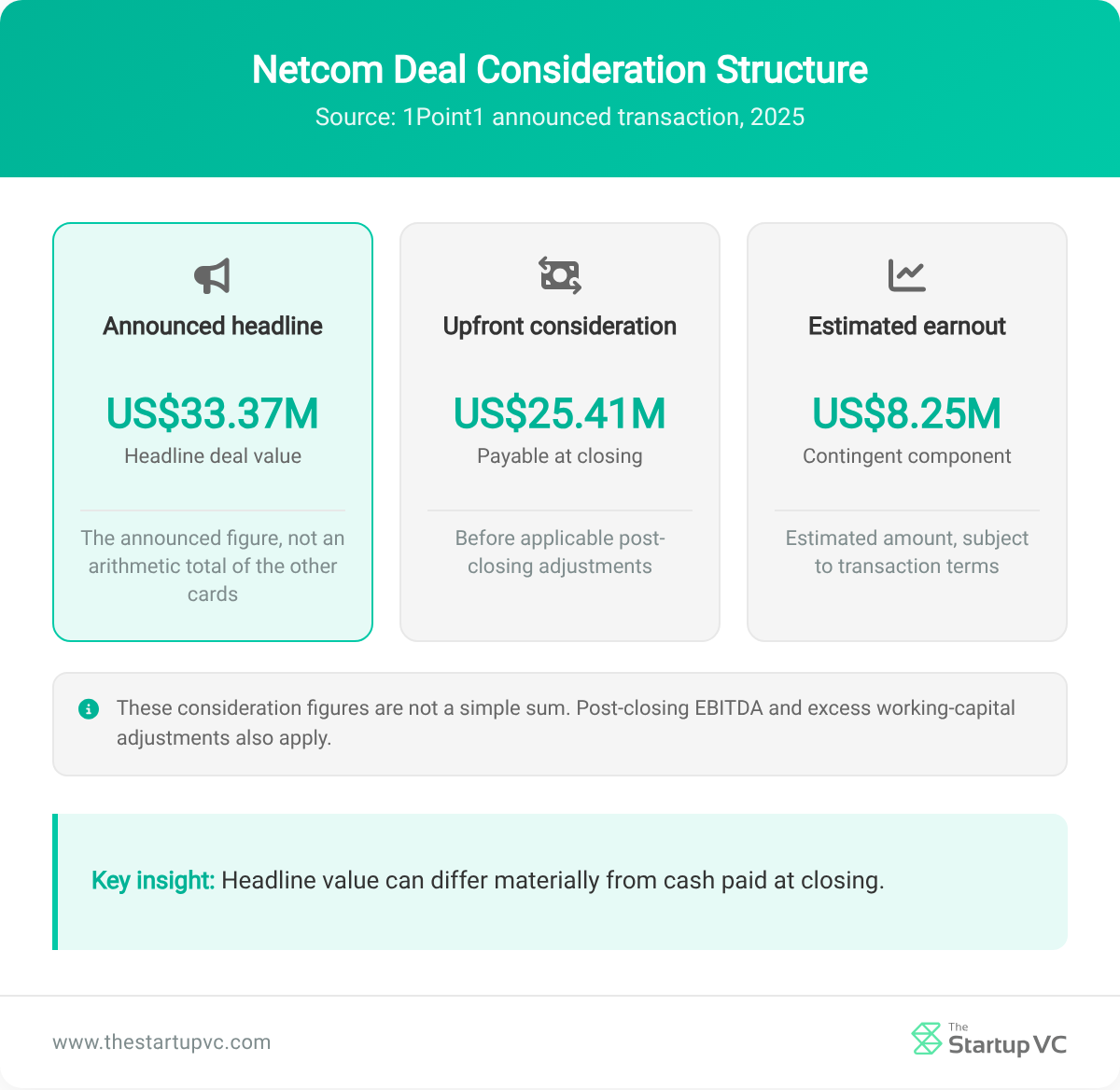
Owners should compare expected proceeds under downside, base, and upside cases. A larger headline offer can produce less certain cash than a lower fixed offer.
What Makes a Latin American BPO Attractive to Buyers?
Contract quality, stable program margins, capable managers, and reliable delivery make a Latin American BPO attractive to buyers. The business must keep serving clients after ownership changes.
Buyers test three connected layers:
- Commercial quality. Contract terms, retention, concentration, pricing, and cross-selling support future revenue.
- Operating quality. Program margins, staffing, service levels, technology, and security support delivery.
- Organizational quality. Managers, client ownership, and documented processes reduce dependence on the founder.
The following sections show the evidence sellers need at each layer.
Which Value Drivers Matter Most?
The strongest value drivers connect customer demand to dependable profit. Each driver needs proof at the client and program levels.
| Value Driver | Positive Evidence | Common Concern |
|---|---|---|
| Contracts | Multi-year terms, renewal history, and clear price changes | Easy termination, weak volume commitments, or pending renewals |
| Client mix | Several profitable clients across industries | One client controls revenue, profit, or management attention |
| Program economics | Stable gross profit and measured staffing needs | Unpriced wage increases or weak program-level reporting |
| Service mix | Digital, non-voice, and specialized workflows | Commodity voice work with limited cross-selling |
| Delivery model | Tested sites, remote controls, and nearshore coverage | One site, weak recovery plans, or unstable connectivity |
| Management | Leaders own clients, operations, technology, and sales | The founder controls every major relationship |
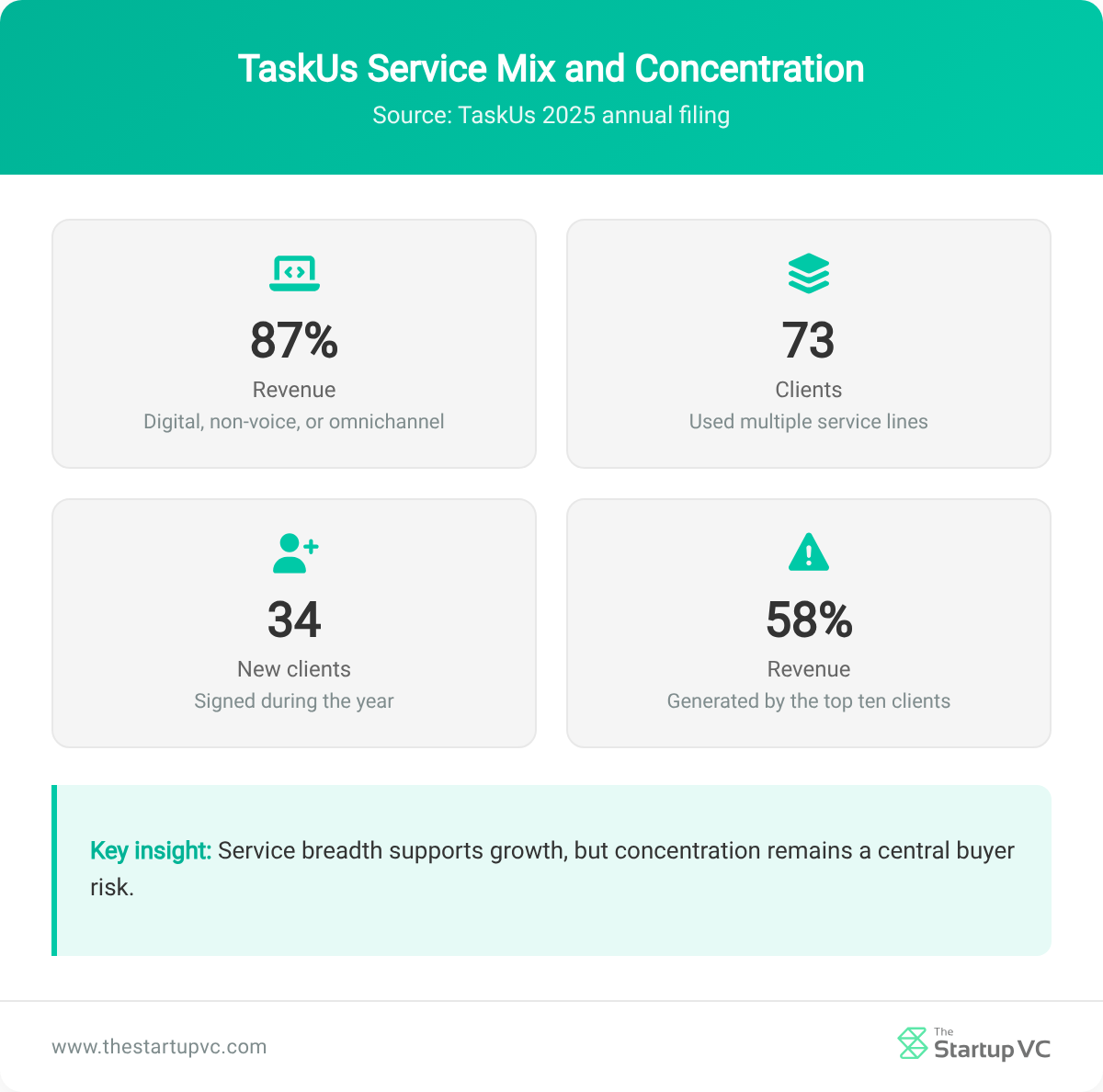
TaskUs reported that 87% of its 2025 revenue came from digital, non-voice, or omnichannel services. That mix shows how channel breadth can support growth.
Its concentration figures also show the opposite risk. Meta generated 26% of revenue, while the ten largest clients generated 58%.
Which Operating Metrics Should Sellers Prepare?
Sellers should prepare metrics that explain service quality, labor use, and profit by program. Buyers will test definitions across sites and periods.
The core operating pack should include:
- Commercial performance. Revenue, gross profit, renewal dates, pipeline, and cross-selling by client.
- Service quality. Service levels, average handle time, first-contact resolution, customer satisfaction, and quality scores.
- Workforce performance. Headcount, attrition, absence, occupancy, utilization, training time, and overtime.
- Technology performance. Platform costs, outages, automation results, security incidents, and recovery tests.
- Delivery resilience. Site capacity, remote-work controls, language coverage, and tested business-continuity plans.
These measures should reconcile with invoices, payroll, contracts, and financial statements. Conflicting definitions reduce buyer confidence.
Why Does Latin American Delivery Create Strategic Value?
Latin American delivery creates strategic value because it combines nearshore time zones, skilled teams, and access to growing service markets.
Deloitte placed Mexico among its three preferred global-services locations in 2025, citing technology, talent, scale, and cost. Grant Thornton highlighted similar strengths when it acquired Auxis. The deal added more than 1,400 professionals across Costa Rica, Colombia, and the United States. Auxis also operated supporting hubs in Mexico and Guatemala across finance, IT, HR, customer experience, AI, and automation.
Which Buyers Acquire BPO and Contact Center Companies?
The main BPO buyers are strategic operators, private equity firms, search funds, and family offices. Each group may offer a different mix of price, certainty, control, and post-sale involvement.
Strategic buyers focus on integration benefits. Financial buyers focus on cash flow, management depth, and a credible growth plan. Owners should screen both fit and funding before comparing headline offers.
| Buyer Type | Main Rationale | Seller Consideration |
|---|---|---|
| Strategic operator | Add clients, locations, services, talent, or technology | Strong fit can support value, but integration may move quickly |
| Private equity | Build a platform or add a company to an existing group | Management may stay and reinvest part of the proceeds |
| Search fund | Acquire one established company and operate it directly | Fit depends on business size and leadership transition |
| Family office | Hold quality cash-flow businesses for longer periods | Mandates, control needs, and investment timing vary widely |
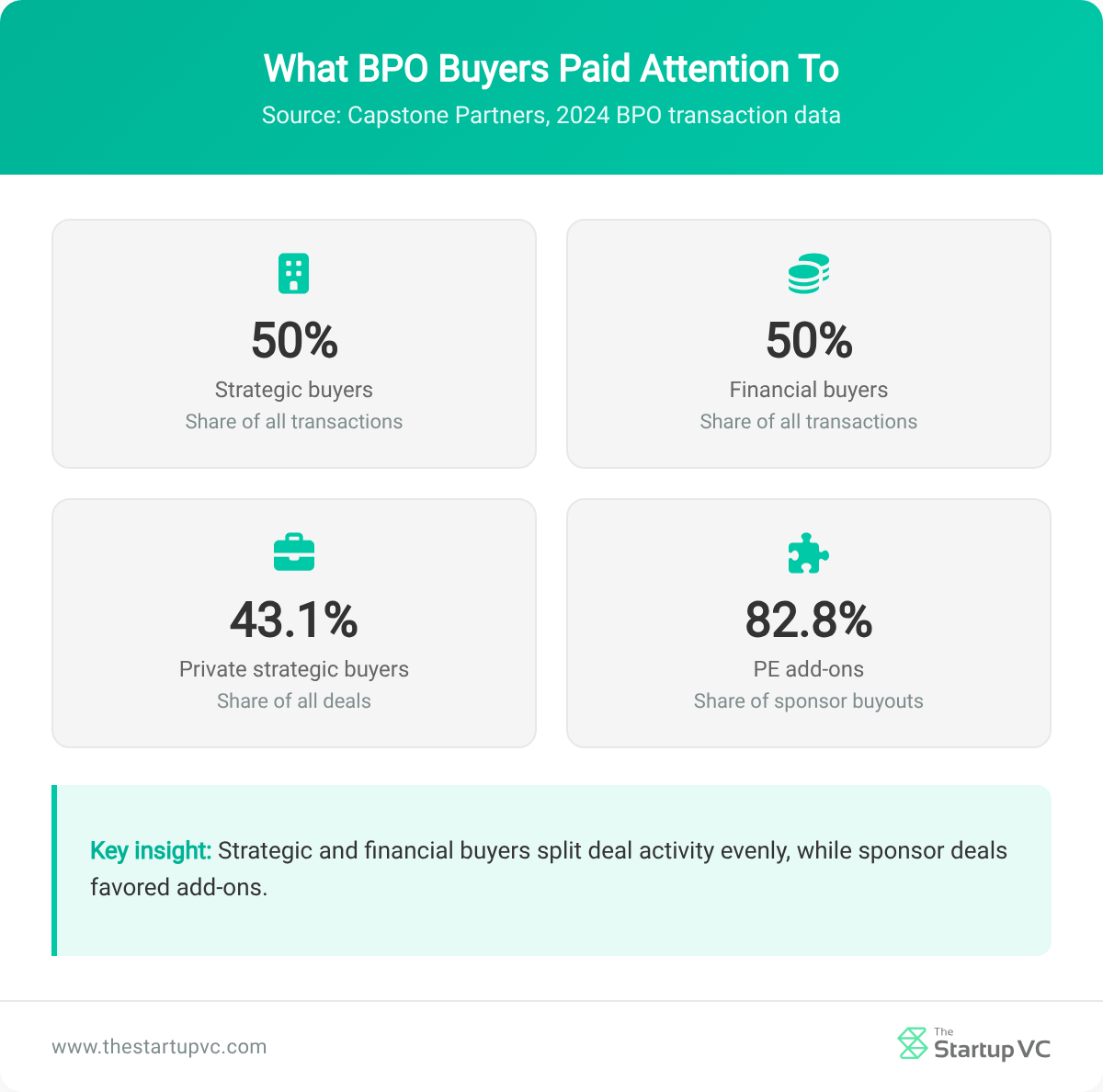
Capstone’s 2024 data split BPO transactions evenly between strategic and financial buyers. Private strategic buyers represented 43.1% of all deals.
Private-equity add-ons represented 82.8% of sponsor buyouts. This pattern shows why existing platforms can be important bidders.
What Do Recent Transactions Reveal About Strategic Buyers?
Recent transactions reveal that strategic buyers seek delivery access, skilled teams, technology, and new industry capabilities.
Grant Thornton used Auxis to expand technology-led shared services and nearshore delivery across finance, HR, IT, and customer experience. India-based 1Point1 announced Netcom’s acquisition to enter Latin America and add banking expertise and nearshore capacity. Neither example sets a market price for another company, but both show how buyer-specific benefits can support interest.
Can Search Funds and Family Offices Buy BPOs?
Yes, search funds and family offices can buy BPOs when company size, cash flow, and leadership needs match their mandates.
IESE studied 320 international search funds across 40 countries. The median acquired company generated US$7.8 million of revenue. UBS reported that Latin American family offices allocated 17% of portfolios to private equity during 2024. That allocation indicates available private capital, but it does not prove that family offices target every BPO. Owners should verify each buyer’s sector experience, funding, and decision process.
How Do You Prepare a BPO or Contact Center for Sale?
You can prepare a BPO for sale by building auditable earnings, transferable client relationships, and independent management. The team must operate without the founder.
Preparation has three goals:
- Remove financial and legal surprises before buyers find them.
- Prove revenue, margins, service quality, and security with consistent records.
- Give qualified buyers staged access without disrupting clients or employees.
The Startup VC recommends a 12-to-18-month preparation window. A 3-to-6-month sprint works only when audited records already exist.
What Should Be Fixed Before Buyer Outreach?
You should fix financial, commercial, operational, legal, and security gaps before buyer outreach. Unresolved issues can reduce value or delay closing.
Start with these priorities:
- Reconcile monthly revenue and gross profit by client, program, service, and site.
- Document every EBITDA adjustment with contracts, invoices, payroll records, or clear schedules.
- Review major contracts for renewal, termination, assignment, pricing, service credits, and change-of-control clauses.
- Reduce dependence on the founder for sales, pricing, operations, and major client relationships.
- Test cybersecurity, privacy, business continuity, and disaster recovery across sites and remote teams.
- Resolve tax, labor, licensing, corporate, and intellectual-property gaps in each operating country.
Preparation should improve the underlying company. Cosmetic reporting changes will not survive buyer diligence.
What Should a BPO Data Room Contain?
A BPO data room should contain organized evidence across eight main folders. Access should increase only as buyers become more serious.
- Corporate. Ownership, subsidiaries, board records, and authority documents.
- Financial. Statements, ledgers, forecasts, debt, working capital, and EBITDA support.
- Legal. Client contracts, supplier terms, disputes, insurance, and regulatory records.
- Tax. Returns, audits, transfer pricing, payroll taxes, and open assessments.
- People. Employment terms, compensation, benefits, turnover, and key-person plans.
- Technology and IP. Platforms, licenses, integrations, code ownership, incidents, and security tests.
- Commercial. Client cohorts, pipeline, pricing, renewals, service levels, and concentration.
- Bidder materials. NDAs, questions, responses, access logs, offers, and process instructions.
Large buyer requests can cover hundreds of documents. Clear ownership and file naming can shorten response times.
How Should You Protect Confidential Information?
You should protect confidential information by using NDAs, staged access, watermarks, download limits, and activity logs.
Release summary financial and corporate records first, then reserve identifiable client contracts, employee data, and technical details for finalists. Deloitte reported a critical cyber issue at 53% of surveyed organizations after announcing a deal. Sellers should test controls before outreach.
How Do You Run and Structure a BPO Sale Process?
You can run a BPO sale process by preparing evidence, contacting qualified buyers, managing diligence, and negotiating complete economic terms.
A controlled process protects confidentiality and creates comparable offers. It also keeps management focused on current client delivery.
What Are the Main Sale Phases?
The main sale phases are preparation, marketing, diligence, and closing. Each phase needs clear owners, deadlines, and decision rules.
- Preparation. Build the valuation, buyer list, confidential materials, data room, and management presentation.
- Marketing. Contact buyers under an NDA, share approved information, and request comparable initial offers.
- Diligence. Test financial, tax, legal, commercial, people, technology, and operational claims.
- Closing. Negotiate the purchase agreement, funding, approvals, adjustments, transition, and final payments.
Buyer diligence often takes 8 to 12 weeks. The full process commonly takes 6 to 12 months.
Which Deal Terms Change What the Seller Receives?
The main economic terms include cash at closing, earnouts, rollover equity, working-capital adjustments, debt, escrows, and taxes.
| Term | What It Does | Seller Question |
|---|---|---|
| Cash at closing | Pays fixed consideration when ownership transfers | Is funding committed and immediately available? |
| Earnout | Delays payment until future targets are achieved | Can the buyer change costs, clients, or operations? |
| Rollover equity | Reinvests part of the proceeds into the buyer’s group | What rights, dilution rules, and exit path apply? |
| Working-capital adjustment | Changes price against an agreed closing target | Which accounts, policies, and seasonal periods apply? |
| Escrow or holdback | Reserves proceeds for claims or adjustments | How much, for how long, and under which release rules? |
SRS Acquiom found earnouts in 22% of its 2024 non-life-sciences deals. That dataset is broad and does not measure Latin America alone.
Its 2026 analysis found purchase-price adjustments in 93% of the private-target sample. Definitions deserve the same attention as headline value.
How Should You Compare Competing Offers?
You should compare offers by modeling expected cash, risk, control, taxes, timing, and obligations under several outcomes.
A useful comparison includes:
- Cash available at closing after debt, expenses, taxes, and adjustments.
- Earnout proceeds under downside, base, and upside cases.
- Rollover value, governance rights, dilution protection, and expected exit timing.
- Employment duties, transition length, non-compete terms, and personal guarantees.
- Buyer funding, approval needs, transaction history, and closing certainty.
An attractive price can lose value through uncertain conditions. A clear proceeds bridge makes competing offers easier to compare.
What Questions Do BPO Owners Ask Most Often About Selling Their Companies?
BPO owners most often ask about value, timing, confidentiality, concentration, retained ownership, and buyer diligence.
How Long Does It Take to Sell a BPO in Latin America?
A BPO sale commonly takes 6 to 12 months after preparation begins. Readiness work may require another 12 to 18 months.
Companies with audited records can sometimes prepare within three to six months. Buyer financing, approvals, and contract consents can extend the schedule.
How Much Is a BPO or Contact Center Worth?
A BPO may be assessed against EBITDA bands ranging from 4 to 10 times in Capstone’s matrix. That range is not a quote.
Actual value depends on earnings, scale, client mix, contracts, margins, geography, technology, management, and deal structure.
Can You Sell a BPO With One Large Client?
Yes, you can sell a BPO with one large client. The concentration will affect value, conditions, and payment structure.
Buyers may require a renewal, consent, earnout, or lower upfront payment. Strong service history and switching costs can reduce concern.
When Should You Tell Clients and Employees?
You should tell clients and employees only under a planned communication process. Timing depends on contracts, law, risk, and buyer requirements.
Premature disclosure can unsettle teams and clients. Late disclosure can damage trust or delay required consents.
Can an Owner Keep Equity After the Sale?
Yes, an owner can keep equity after the sale by accepting rollover equity in the buyer’s group.
The owner should review voting rights, dilution, information rights, transfer limits, and the expected second exit.
What Documents Will BPO Buyers Request?
The main documents include financial statements, tax returns, client contracts, employee records, service metrics, and technology controls.
Buyers also request forecasts, working-capital schedules, litigation records, licenses, security tests, and ownership documents.
Ready to Sell Your BPO or Contact Center?
The Startup VC is Craig Dempsey’s family office and company builder in Latin America. Craig built Biz Latin Hub before Vistra acquired it in 2025. Our approach combines operating experience with practical sale preparation and buyer positioning. Contact us today to discuss a confidential partial or full exit.