
Selling a Latin American accounting firm requires 3-12 months of preparation before buyer outreach.
Buyers value accounting firms using revenue, SDE, normalized EBITDA, and cash flow. Current advisor ranges vary widely. TMF Group and Vistra show active demand for accounting, tax, payroll, and cross-border client platforms.
The Startup VC draws on Craig Dempsey’s experience building Biz Latin Hub before its 2025 acquisition by Vistra. This guide covers valuation, buyers, diligence, professional rules, deal terms, and client transition.
How Do Buyers Value an Accounting Firm in Latin America?
Buyers value a Latin American accounting firm by measuring transferable earnings, recurring client revenue, and retention risk. Firm size and owner dependence determine which method receives the most weight.
A buyer normally answers three questions:
- What earnings transfer? Normalize owner compensation, personal expenses, collections, staffing, and recurring service margins.
- Which method fits the firm? Use revenue or SDE for smaller practices and normalized EBITDA for larger firms.
- What can survive the transition? Test client retention, partner dependence, employee continuity, licensing, and payment terms.
The sections below explain the methods, directional benchmarks, profit drivers, and limits of disclosed transaction data.
Which Valuation Methods Apply to Accounting Firms?
The main accounting-firm valuation methods are revenue multiples, SDE multiples, normalized EBITDA, discounted cash flow, and comparable transactions.
| Method | Best Fit | Main Limitation |
|---|---|---|
| Revenue multiple | Small practices with transferable client books | Revenue can hide weak margins or poor collections |
| SDE multiple | Owner-operated practices | Owner compensation and personal expenses require careful adjustment |
| Normalized EBITDA | Larger firms with management teams | Unsupported adjustments can overstate sustainable earnings |
| Discounted cash flow | Firms with reliable forecasts | Country, currency, and retention assumptions can change value |
| Comparable transactions | Firms with relevant disclosed deals | Private transaction data is often incomplete or unavailable |
Buyers may calculate several values before setting an offer. They will also compare price with the proposed payment terms.
A revenue multiple cannot show whether two equal-size firms produce the same cash flow. SDE and normalized EBITDA expose differences in owner pay, staffing, margins, and collections. DCF and comparable transactions provide cross-checks. Their assumptions must reflect client retention, country risk, currency, professional rules, and the proposed transition.
What Do Current Accounting-Firm Benchmarks Show?
Current accounting-firm benchmarks show directional ranges, not verified Latin American market prices. Most published data comes from North American advisors.
- Small owner-dependent practices. Auxo places these firms near 0.6 to 1.1 times revenue or 1.8 to 3.2 times SDE.
- Traditional local firms. Published advisor ranges place these firms near 0.8 to 1.3 times revenue or 3 to 5 times normalized EBITDA.
- Larger firms. Auxo places multi-partner firms near 4 to 6.5 times EBITDA and scalable outsourced-accounting firms near 4.5 to 8 times.
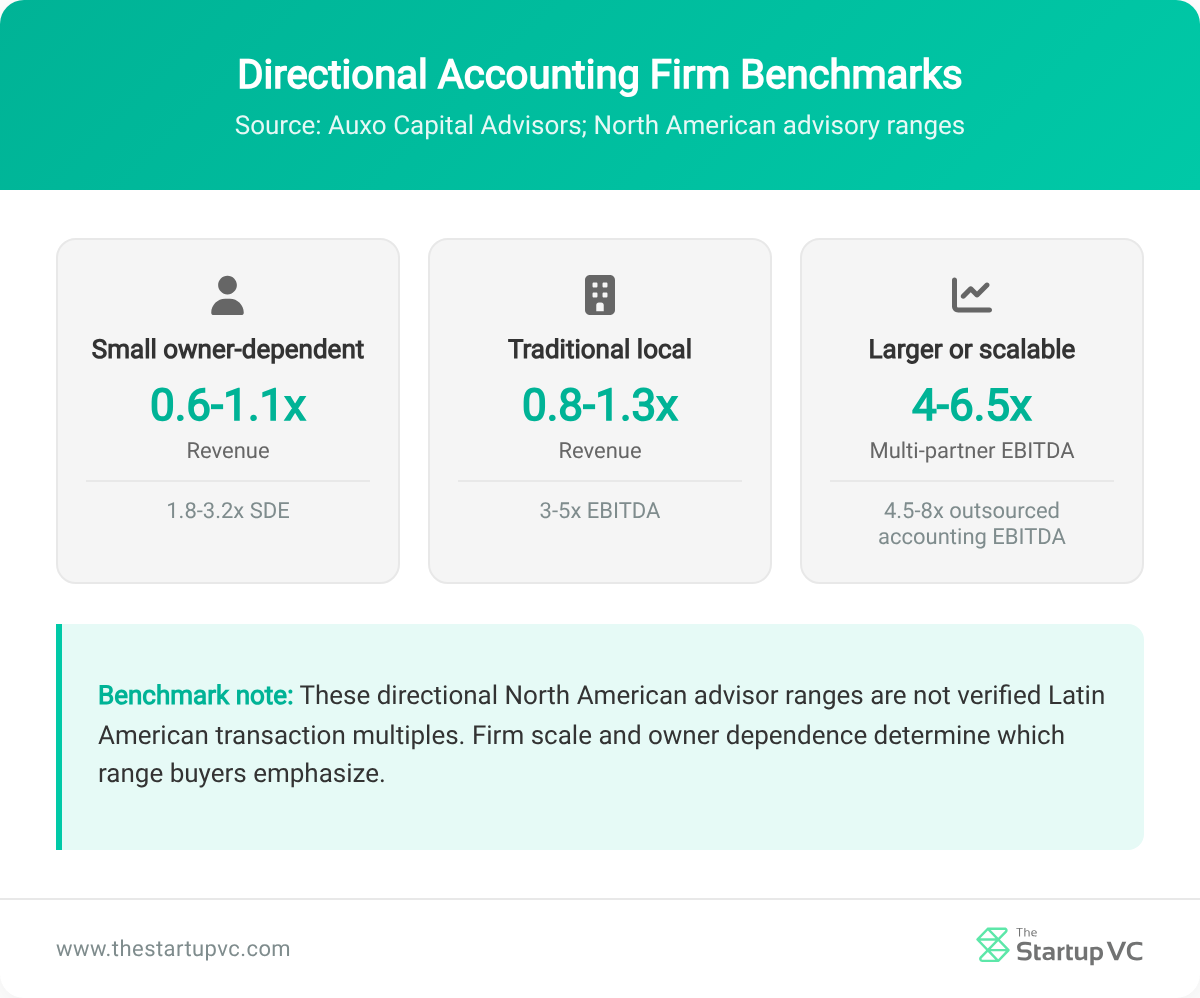
They cannot replace a valuation based on the firm’s country, services, clients, and transaction terms.
A Latin American company valuation should reflect currency, inflation, and country risk. It should also account for the firm’s financial reporting.
Why Do Profitability and Retention Affect the Multiple?
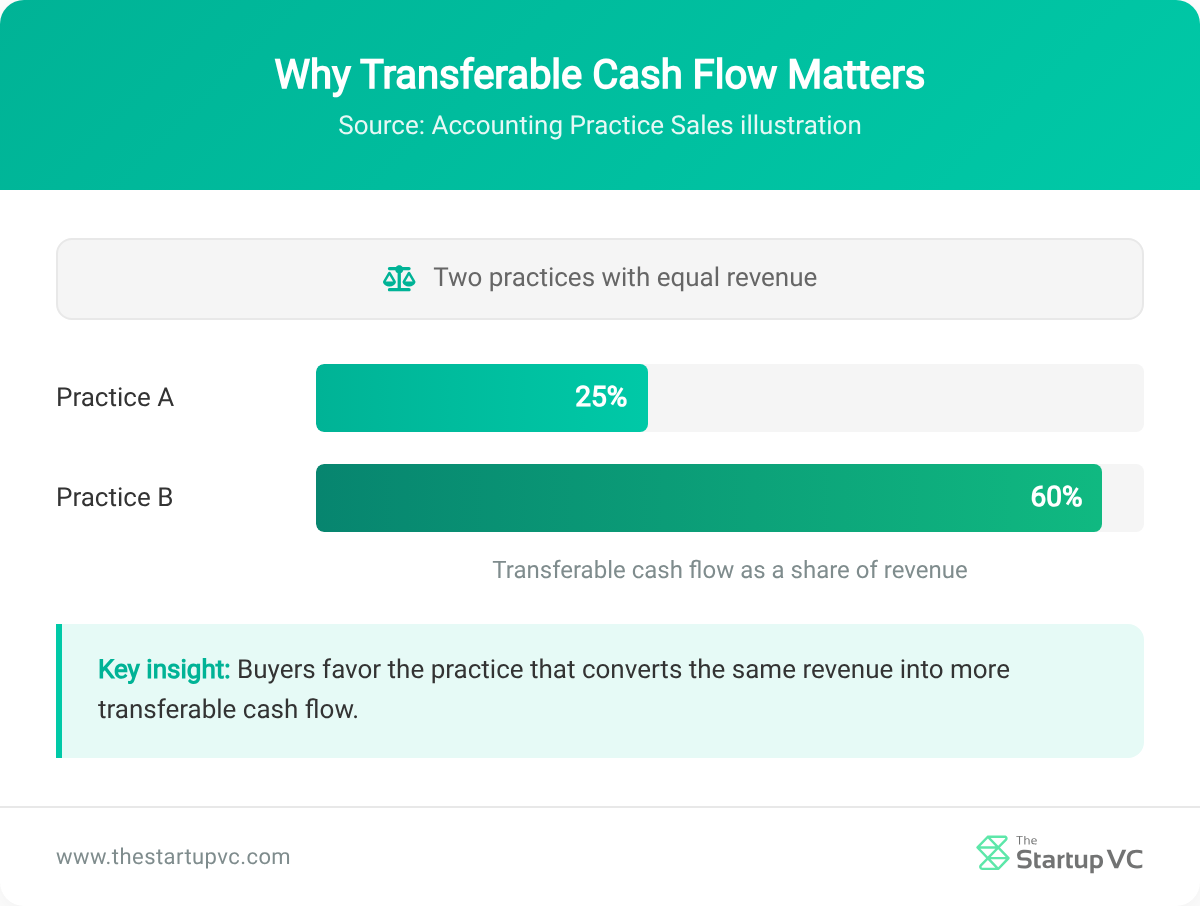
Profitability and retention affect the multiple because buyers need enough cash flow to fund operations, debt, and the transition.
Accounting Practice Sales compares practices with equal revenue but different cash flow. Buyers favor the practice producing stronger transferable cash flow. Retention matters because much of an accounting firm’s value sits in client relationships. Owner-led relationships create more transition risk. Monthly bookkeeping, payroll, tax compliance, and outsourced finance work can also produce different renewal and margin patterns.
What Can Latin American Transactions Prove?
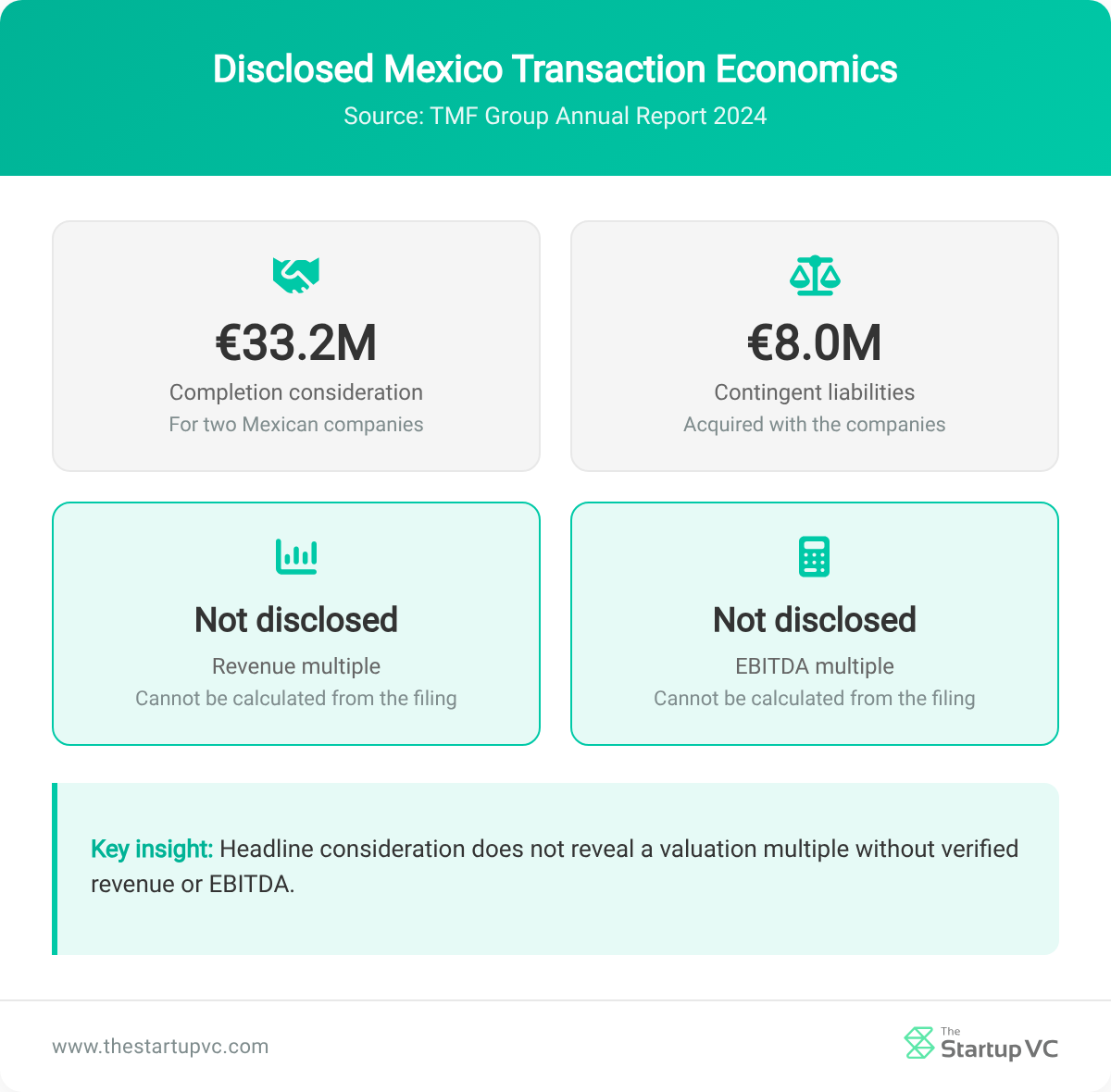
Latin American transactions can prove buyer demand and strategic rationale. They rarely provide enough public data to calculate a comparable multiple.
TMF Group paid €33.2 million at completion for two Mexican service companies in 2024. It recorded €8 million of acquired contingent liabilities. Those companies provided accounting, tax, payroll, and fund services, but TMF did not disclose their revenue or EBITDA multiples. Sellers should never divide a public price by an estimated financial figure because a credible comparison needs verified deal data.
What Makes a Latin American Accounting Firm Attractive to Buyers?
Recurring work, stable cash flow, loyal clients, trained staff, and transferable leadership make a Latin American accounting firm attractive. Buyers need evidence that those strengths will remain after the owner leaves.
They test three connected layers:
- Revenue quality. Recurring engagements, retention, pricing, collections, and diversification support predictable cash flow.
- Delivery quality. Qualified teams, standard workflows, secure systems, and measured capacity support client continuity.
- Transferability. Shared relationships, documented knowledge, compliant structures, and successor leadership reduce transition risk.
The following sections show how buyers test each layer and where professional rules can limit a transaction.
Which Value Drivers Matter Most?
The main value drivers are revenue quality, profitability, retention, diversification, people, technology, and regulatory strength.
| Value Driver | Positive Evidence | Common Concern |
|---|---|---|
| Recurring revenue | Monthly or annual work with clear engagement terms | One-time projects dominate reported growth |
| Client retention | Long relationships and measured renewal history | Loyalty depends on one retiring partner |
| Profitability | Consistent margins and disciplined collections | Personal costs or underpaid owners distort earnings |
| Client mix | Diverse industries, sizes, and countries | One client controls a large share of revenue |
| Service mix | Compliance work plus advisory and outsourced finance | Low-value work with weak pricing power |
| People | Qualified managers and stable delivery teams | Key staff may leave after the owner exits |
| Technology | Standard workflows, secure systems, and clean data | Separate tools, weak access controls, or manual processes |
Karbon says buyers commonly review three to five years of financial statements. They compare those figures with retention, churn, and margin trends.
Why Do Regional Coverage and Client Relationships Matter?
Regional coverage and client relationships matter because buyers can add markets, services, and cross-border work faster through an acquisition.
Vistra completed its Biz Latin Hub acquisition in December 2025 and highlighted local knowledge, client relationships, and an 18-market footprint. TMF Group also expanded through acquisitions in Mexico, Uruguay, and Brazil to pursue service growth and client-platform benefits. Neither buyer disclosed a valuation multiple for these businesses, but their announcements reveal what strategic buyers wanted.
How Do Independence and Compliance Affect Buyer Interest?
Independence and compliance affect buyer interest by limiting ownership, services, governance, and client relationships in some countries.
Audit and assurance work may require a separate licensed entity, while investor-owned advisory services may sit in a different business. IESBA warns that private-equity investment can affect independence, confidentiality, conflicts, governance, and firm culture. Rules differ across Latin America, so sellers need local advice before presenting a proposed structure to buyers.
Which Buyers Acquire Accounting Firms in Latin America?
The main accounting-firm buyers are global groups, regional consolidators, private equity firms, search funds, and internal successors. Their goals, funding, and permitted structures differ.
Global and regional buyers often seek country coverage or client portfolios. Financial buyers focus on recurring cash flow and expansion. Internal successors may protect continuity but offer less upfront funding. Owners should compare client fit, employee plans, licensing, funding certainty, and the required post-sale role before choosing a buyer.
| Buyer Type | Main Rationale | Seller Consideration |
|---|---|---|
| Global services group | Add countries, clients, licenses, and service capacity | Integration standards and brand changes may be extensive |
| Regional consolidator | Build a wider Latin American platform | Local leadership may remain during expansion |
| Private equity | Create a platform or complete add-on acquisitions | Rollover equity and management retention may be requested |
| Search fund | Acquire and operate one established company | Company size and owner transition must fit the mandate |
| Internal successor | Preserve culture and client continuity | Funding capacity may limit upfront proceeds |
What Do Recent Strategic Acquisitions Show?
Recent strategic acquisitions show demand for local teams, recurring compliance work, client portfolios, and multi-country reach.
TMF acquired RSM Brasil BPS’s Alphaville accounting, tax, and payroll unit in January 2025 after purchases in Uruguay and Mexico. Vistra acquired Biz Latin Hub after a longstanding affiliate relationship that reduced uncertainty around capabilities and commercial fit. Owners can build similar credibility through partnerships, referrals, and shared clients that may create informed future buyers.
How Active Is Private Equity in Accounting Services?
Private equity is highly active in accounting services because recurring work and fragmented markets support consolidation strategies.
IFAC reported about 200 direct investments by mid-2026 that had enabled nearly 1,200 follow-on transactions. It calculated 7.3 roll-up deals for each direct investment during 2025.
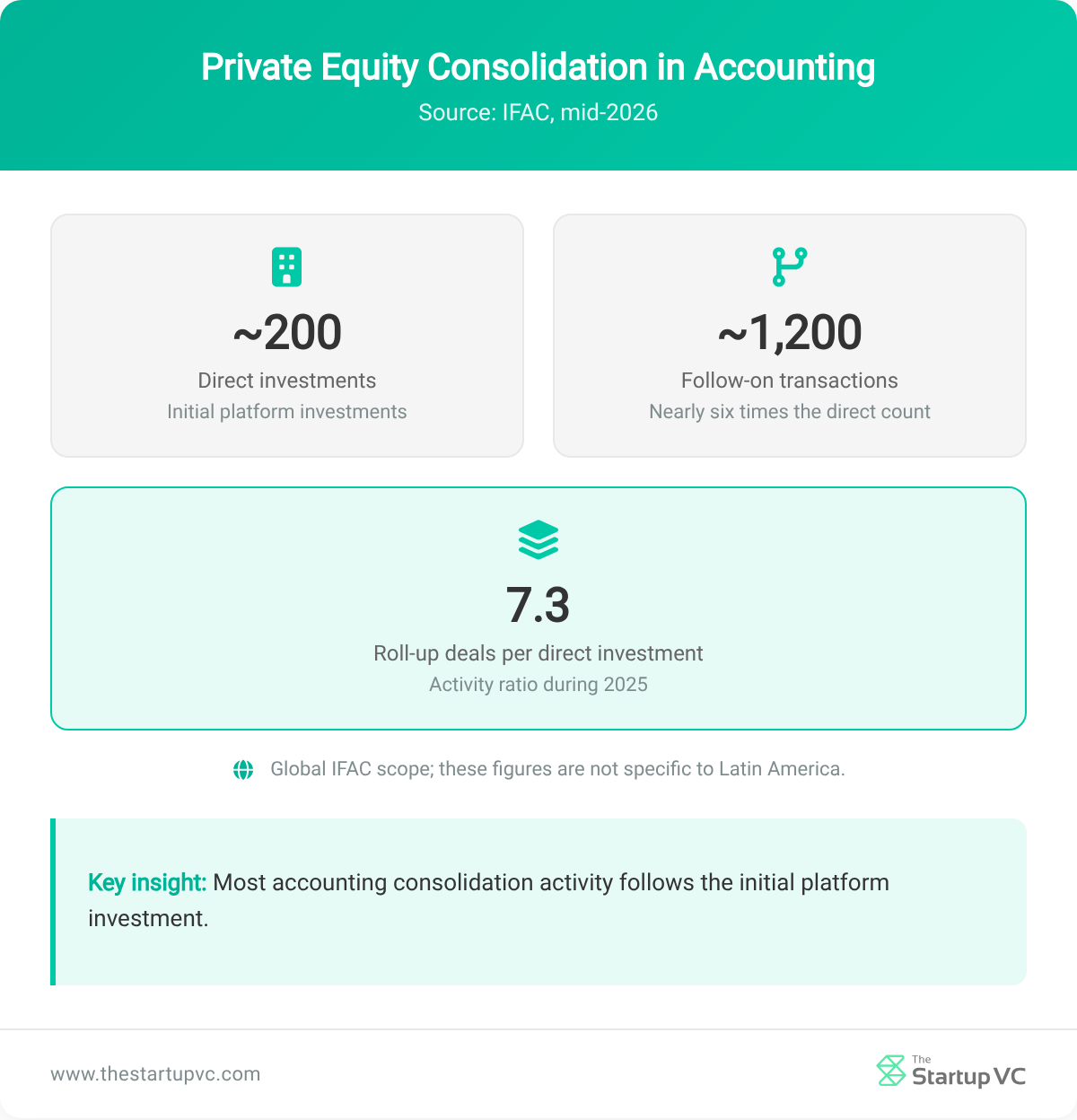
That global activity does not measure Latin America alone. PE buyers may separate attest and non-attest services, but the structure must protect professional independence in every relevant country.
Can Search Funds Buy Latin American Accounting Firms?
Yes, search funds can buy Latin American accounting firms when size, earnings, and leadership needs fit their acquisition model.
IESE recorded 54 search-fund acquisitions through 2023 across eight Latin American countries, including Mexico, Brazil, Colombia, and Chile. Search-fund buyers usually plan to operate one business directly, so owners should assess experience, funding certainty, and professional licensing needs.
How Do You Prepare an Accounting Firm for Sale?
You can prepare an accounting firm for sale by improving records, transferring client relationships, and resolving professional risks before outreach.
Preparation has three goals:
- Prove recurring revenue, margins, collections, and normalized earnings with consistent records.
- Reduce dependence on the owner for clients, technical decisions, pricing, and delivery.
- Resolve licensing, independence, confidentiality, employment, tax, and data issues by country.
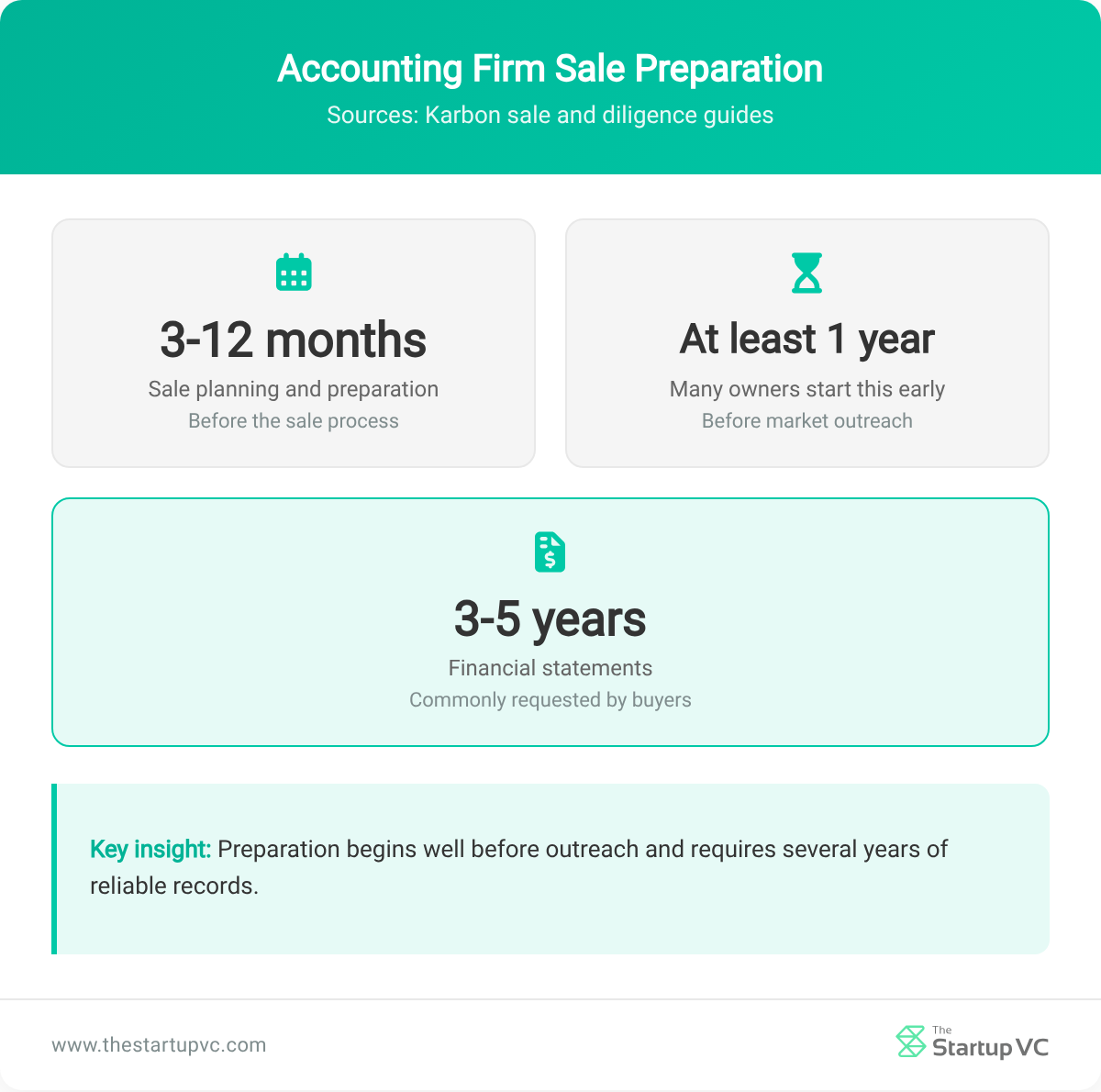
Karbon estimates three to 12 months for planning and preparation. Many owners begin at least one year before contacting buyers.
What Should Be Fixed Before Going to Market?
You should fix reporting, collections, contracts, staffing, technology, and compliance gaps before going to market.
Prioritize these actions:
- Reconcile revenue, margins, receivables, and cash flow by service, client, partner, and country.
- Normalize owner compensation and remove personal or one-time expenses with complete support.
- Measure recurring revenue, client tenure, concentration, churn, pricing, and collection performance.
- Transfer major relationships from the owner to partners, managers, and delivery teams.
- Standardize engagement letters, workflows, data ownership, security, and access controls.
- Review licenses, independence, tax, labor, privacy, litigation, and regulatory matters by country.
These changes should improve daily operations. Buyers will test whether the results existed before the sale process.
What Should an Accounting-Firm Data Room Contain?
An accounting-firm data room should contain organized financial, client, people, technology, legal, and regulatory evidence.
The main folders should include:
- Financial. Statements, ledgers, tax filings, receivables, forecasts, debt, and normalized earnings support.
- Clients. Engagement letters, service mix, tenure, pricing, collections, concentration, and consent requirements.
- People. Partner agreements, employment terms, compensation, qualifications, turnover, and succession plans.
- Operations. Workflows, capacity, quality controls, realization, deadlines, and service performance.
- Technology. Software, licenses, integrations, data locations, security controls, and incident records.
- Corporate and legal. Ownership, subsidiaries, disputes, insurance, intellectual property, and contracts.
- Professional compliance. Licenses, inspections, independence records, audit files, and regulator communications.
Client data needs strict access controls. Sellers should share identifiable records only when law, contract, and process stage permit.
How Can Owners Reduce Partner Dependence?
Owners can reduce partner dependence by distributing relationships, decisions, and technical knowledge across a capable management team.
Managers should lead client meetings before outreach begins, while teams document engagement history, pricing logic, and technical positions. Key employees also need clear retention plans. Buyers may reduce price or delay payments when delivery depends on departing staff.
What Professional Rules Need Review?
The professional rules needing review include ownership, licensing, independence, confidentiality, client records, and engagement transfer requirements.
A permitted structure in one country may fail in another, so cross-border firms need a country-by-country legal and ethics review. IESBA guidance provides an international starting point, but local boards, laws, contracts, and professional codes control the final answer.
How Do You Run and Structure an Accounting Firm Sale Process?
You can run an accounting-firm sale by screening buyers, protecting information, managing diligence, and negotiating price with transition terms.
A structured process creates comparable offers and reduces rumors. It also lets the firm protect clients during negotiations.
What Are the Main Sale Steps?
The main sale steps are buyer selection, confidentiality, initial offers, diligence, final agreements, and closing.
- Define objectives. Set timing, minimum proceeds, buyer fit, staff goals, and the owner’s preferred future role.
- Prepare materials. Build the valuation, buyer list, information memorandum, data room, and management presentation.
- Protect confidentiality. Sign NDAs and release information in stages based on buyer seriousness.
- Compare initial offers. Review price, structure, funding, conditions, transition needs, and regulatory fit.
- Complete diligence. Answer financial, client, tax, legal, people, technology, and professional questions.
- Negotiate and close. Finalize agreements, approvals, payments, client communications, and transition plans.
The cheapest buyer to manage may not offer the best outcome. Owners should compare certainty and fit alongside price.
Which Deal Terms Change the Seller’s Outcome?
The main deal terms include upfront cash, retention adjustments, earnouts, rollover equity, working capital, debt, and transition duties.
| Term | What It Does | Seller Risk |
|---|---|---|
| Cash at closing | Pays fixed proceeds when ownership transfers | Funding or approval conditions may delay payment |
| Retention adjustment | Changes price when clients or fees leave | Buyer service changes may affect the calculation |
| Earnout | Pays later after revenue or earnings targets | Buyer decisions can change measured performance |
| Rollover equity | Reinvests proceeds in the buyer’s group | Future value depends on governance and a later exit |
| Working-capital adjustment | Compares closing balances with an agreed target | Definitions can reduce proceeds after closing |
| Seller financing | Delays part of the price as buyer debt | Repayment depends on buyer credit and operations |
SRS Acquiom found that non-life-sciences earnouts paid about 21 cents per maximum dollar in its dataset. That is not a Latin American rate.
The figure still shows why sellers should model downside outcomes. Every metric, accounting rule, and buyer duty should be defined.
How Should the Seller’s Transition Be Planned?
The seller’s transition should be planned around client trust, staff stability, professional responsibility, and the buyer’s operating capacity.
The plan should name responsibilities, milestones, compensation, authority, and end dates. It should address one complete filing or reporting cycle. Client communications need careful timing because engagement letters, privacy rules, and local professional guidance may require specific steps.
How Should Owners Compare Competing Offers?
Owners should compare offers by modeling fixed proceeds, contingent proceeds, taxes, control, obligations, and closing risk.
A complete comparison should test:
- Cash available after debt, expenses, taxes, working capital, and escrows.
- Retention or earnout proceeds under several client-loss and earnings cases.
- Rollover rights, dilution, governance, information access, and expected exit timing.
- Required employment, transition, non-compete, and client-introduction duties.
- Buyer funding, licensing, approvals, integration plan, and transaction history.
Headline price answers only one question. The agreement determines when proceeds arrive and which risks remain with the seller.
What Questions Do Accounting Firm Owners Ask Most Often About Selling Their Companies?
Accounting-firm owners most often ask about value, timing, confidentiality, clients, employees, and their future role.
How Long Does It Take to Sell an Accounting Firm?
An accounting-firm sale requires three to 12 months of planning in Karbon’s estimate. Many owners start at least one year early.
Buyer diligence, financing, licensing, client issues, and negotiations can extend the transaction. Cross-border structures may need more time.
Is One Revenue Multiple Enough to Value the Firm?
No, one revenue multiple is not enough to value an accounting firm. Revenue does not reveal margins, retention, or payment terms.
Buyers also measure SDE or normalized EBITDA. They then test service mix, staff continuity, concentration, and owner dependence.
How Can You Protect Confidentiality During a Sale?
You can protect confidentiality by requiring NDAs, screening buyers, staging access, and controlling identifiable client information.
The Journal of Accountancy documents damage caused by sharing information without a signed NDA. Access should follow a written process.
Do Client Records Transfer Automatically?
No, client records do not always transfer automatically. Engagement terms, privacy law, professional rules, and local requirements control access.
Sellers should identify consent and notice requirements before closing. Local advice is essential for every country involved.
Will Employees Learn About the Sale Before Closing?
Employees may learn about the sale before closing when diligence, consent, or retention planning requires their involvement.
The timing should balance confidentiality with honest workforce planning. Key leaders may need controlled discussions earlier than other employees.
How Long Must the Owner Stay After Closing?
The owner may stay for several weeks, one reporting cycle, or longer. The correct period depends on relationships and the deal structure.
The agreement should define duties, authority, hours, compensation, and an end date. Rollover equity can create longer involvement.
Ready to Sell Your Accounting Firm?
The Startup VC is Craig Dempsey’s family office and company builder in Latin America. Craig built Biz Latin Hub before Vistra acquired it in 2025. Our approach combines operating experience with practical preparation and buyer positioning. Contact us today to discuss a confidential partial or full exit.