
M&A advisory for strategic acquirers helps corporate buyers close Latin American deals worth $49.11 billion in 2026.
Latin America’s M&A market saw 1,062 deals worth $49.11 billion in the first half of 2026, as strategic acquirers like Mercado Libre, Vale, and Cemex closed fewer, larger transactions across Mexico, Brazil, and Chile.
The Startup VC works with strategic acquirers and founders across Latin America. Our portfolio company Biz Latin Hub operates in 17 countries. This guide covers how strategic buyers differ from financial buyers, the advisory process, deal costs, and the biggest regional risks. You will also find a step-by-step acquisition timeline and answers to common buyer questions.
What Is M&A Advisory for Strategic Acquirers?
M&A advisory for strategic acquirers is professional guidance for corporate buyers. It helps them find, value, and close acquisitions that fit their long-term strategy. A strategic acquirer operates in the same industry as the target company. It plans to integrate the target into its existing operations.
This differs from a financial buyer, such as a private equity fund. A financial buyer values a business on its standalone cash flow. A strategic acquirer values a target on what the combined company can produce, including cost and revenue synergies. Historically, strategic buyers pay premiums of 1 to 3 EBITDA turns above financial buyers for similar assets.
| Attribute | Strategic Buyer | Financial Buyer |
|---|---|---|
| Valuation basis | Combined entity value plus synergies | Standalone cash flow |
| Typical premium | 1-3 EBITDA turns higher | Lower, return-driven |
| Hold period | Permanent, integrates the business | 3-7 years, then exit |
| Primary goal | Strategic fit and synergies | Financial return |
M&A advisory teams support strategic acquirers by identifying targets, negotiating terms, and structuring agreements that protect the buyer’s interests. In Latin America, this role also covers cross-border structuring and local regulatory navigation.
Why Do Strategic Acquirers Target Latin America for M&A?
Strategic acquirers target Latin America because deal values stayed strong even as deal counts fell, signaling stronger, larger targets. Latin America recorded 1,062 announced and completed M&A deals in the first half of 2026. That is down 30% from a year earlier. Total deal value fell only 6% to $49.11 billion, showing average deal size grew sharply.
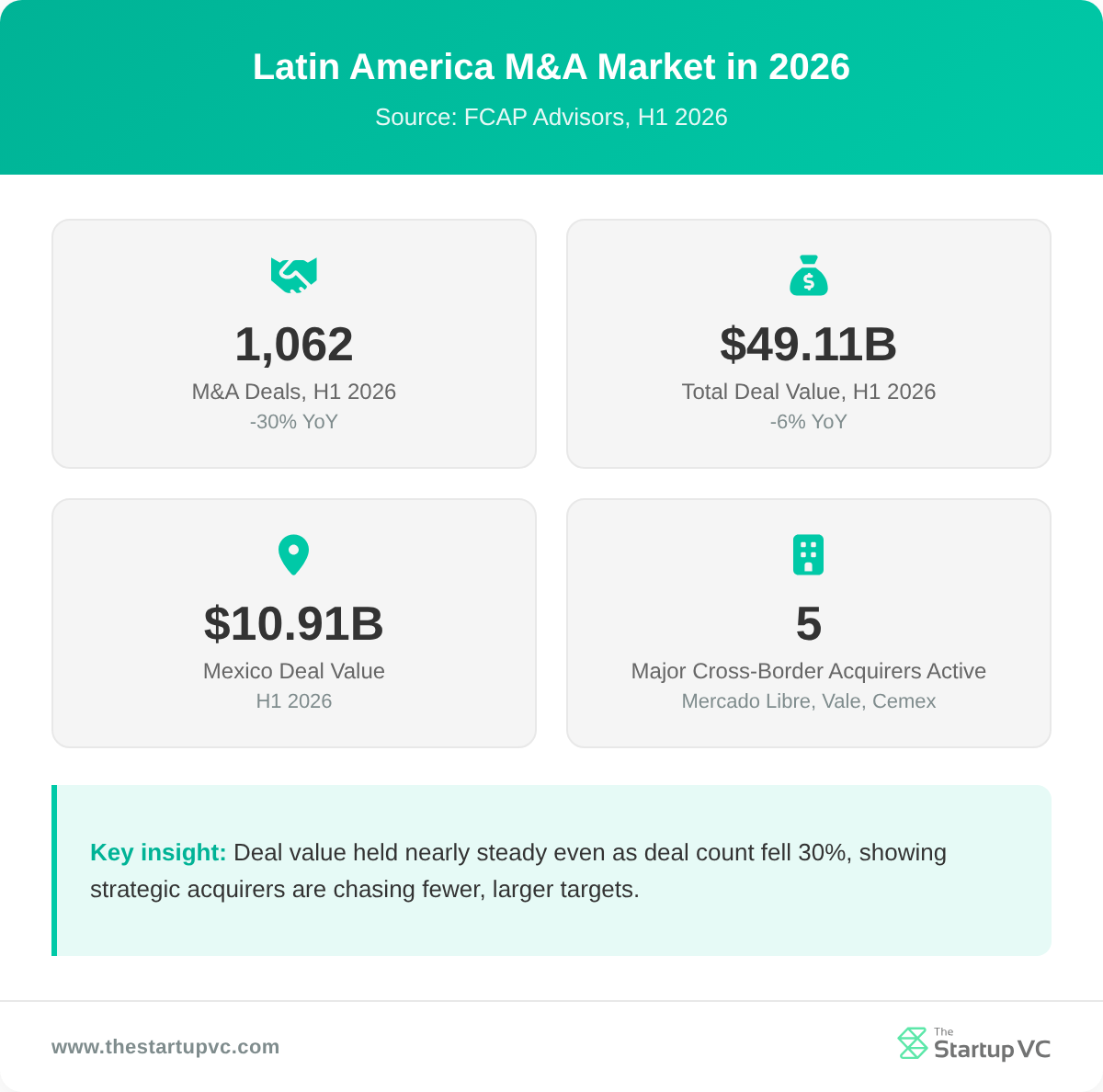
Mexico’s M&A market alone reached $10.91 billion in deal value in the first half of 2026. Companies such as Mercado Libre, America Movil, Vale, Grupo Bimbo, and Cemex are active cross-border acquirers across the region. Many large local groups are also dissolving joint ventures to regain full control and move faster on strategic decisions.
Strategic acquirers concentrate their deals in three main areas:
- Technology and fintech. E-commerce, payments, and software companies draw the most acquisition interest.
- Energy and infrastructure. Renewable energy projects, ports, highways, and data centers attract strategic capital.
- Nearshoring assets. Data centers and industrial real estate in Mexico, Brazil, and Chile support supply chains moving closer to the US.
How Does the M&A Advisory Process Work for Strategic Acquirers?
The M&A advisory process works by guiding a strategic acquirer through structured stages, from target identification to closing support. An advisor first helps define acquisition criteria. It then sources and screens targets that match the buyer’s strategy.
Once a target is selected, the advisor supports valuation, negotiates preliminary terms, and coordinates due diligence. The advisor also drafts and negotiates the purchase agreement to protect the buyer through closing.
What Due Diligence Workstreams Does the Advisor Manage?
The due diligence workstreams include commercial, financial, tax, legal, labor, and operational review. Each workstream carries a different risk area and needs a specialist advisor. Buy-side due diligence costs $150,000 to $500,000 for a typical mid-market deal in the region.
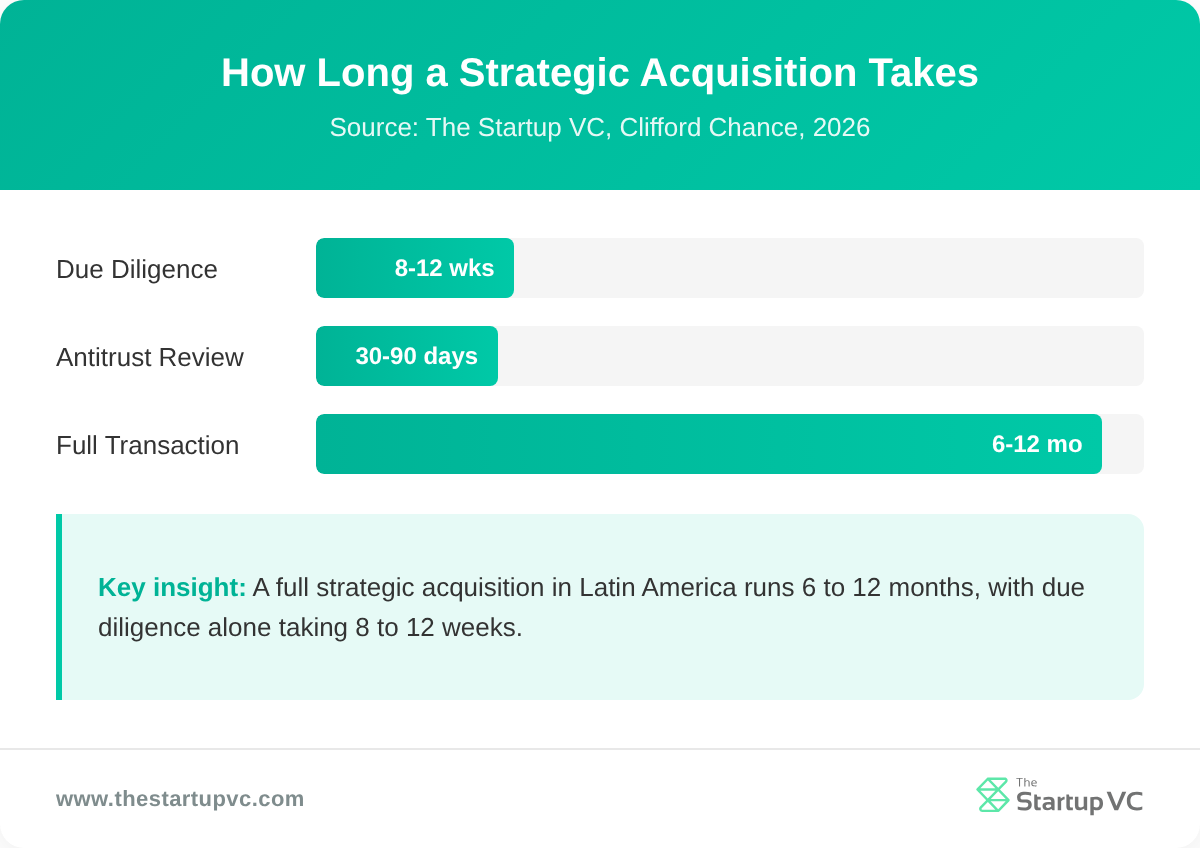
Due diligence takes 8 to 12 weeks once the data room opens. A full transaction runs 6 to 12 months from kickoff to closing.
What Happens Before Closing?
Pre-close steps often include carving out non-core assets and pushing down acquisition debt. The advisor also helps structure the buyer’s holding company and clears required antitrust filings. These steps are frequently conditions the buyer must meet before the deal can close.
What Are the Main Steps to Complete a Strategic Acquisition in Latin America?
The main steps to complete a strategic acquisition include target screening, due diligence, negotiation, closing, and integration. Each phase builds on the work done in the phase before it.
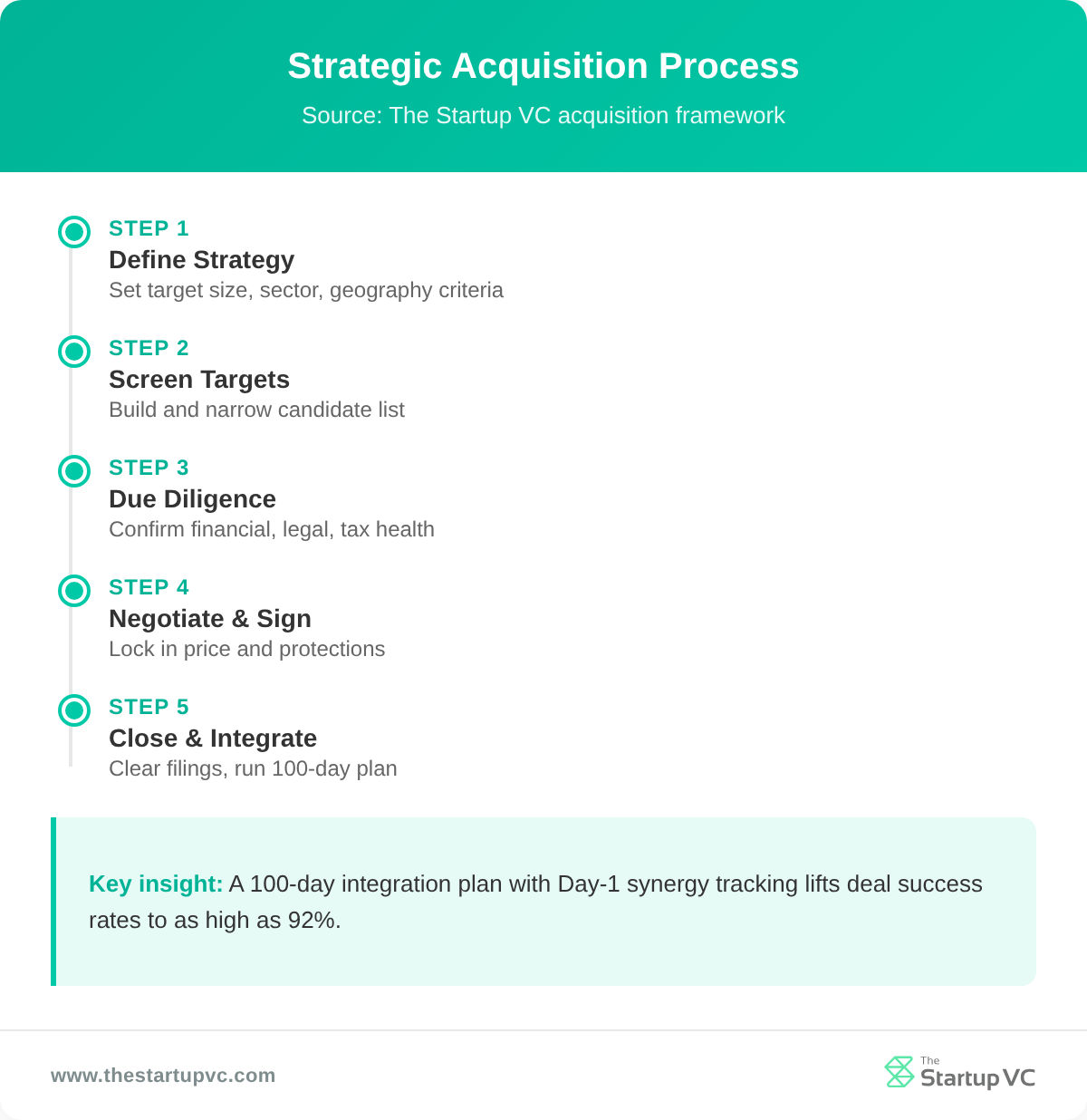
- Define strategy and criteria. Set clear rules for target size, sector, and geography before searching.
- Source and screen targets. Build a list of candidates and narrow it using financial and strategic fit.
- Perform valuation and due diligence. Confirm the target’s financial, legal, tax, and operational health.
- Negotiate and sign the purchase agreement. Lock in price, terms, and protections for the buyer.
- Close the transaction. Clear antitrust filings and complete required regulatory approvals.
- Integrate the acquired company. Run a 100-day plan to combine operations and track synergies.
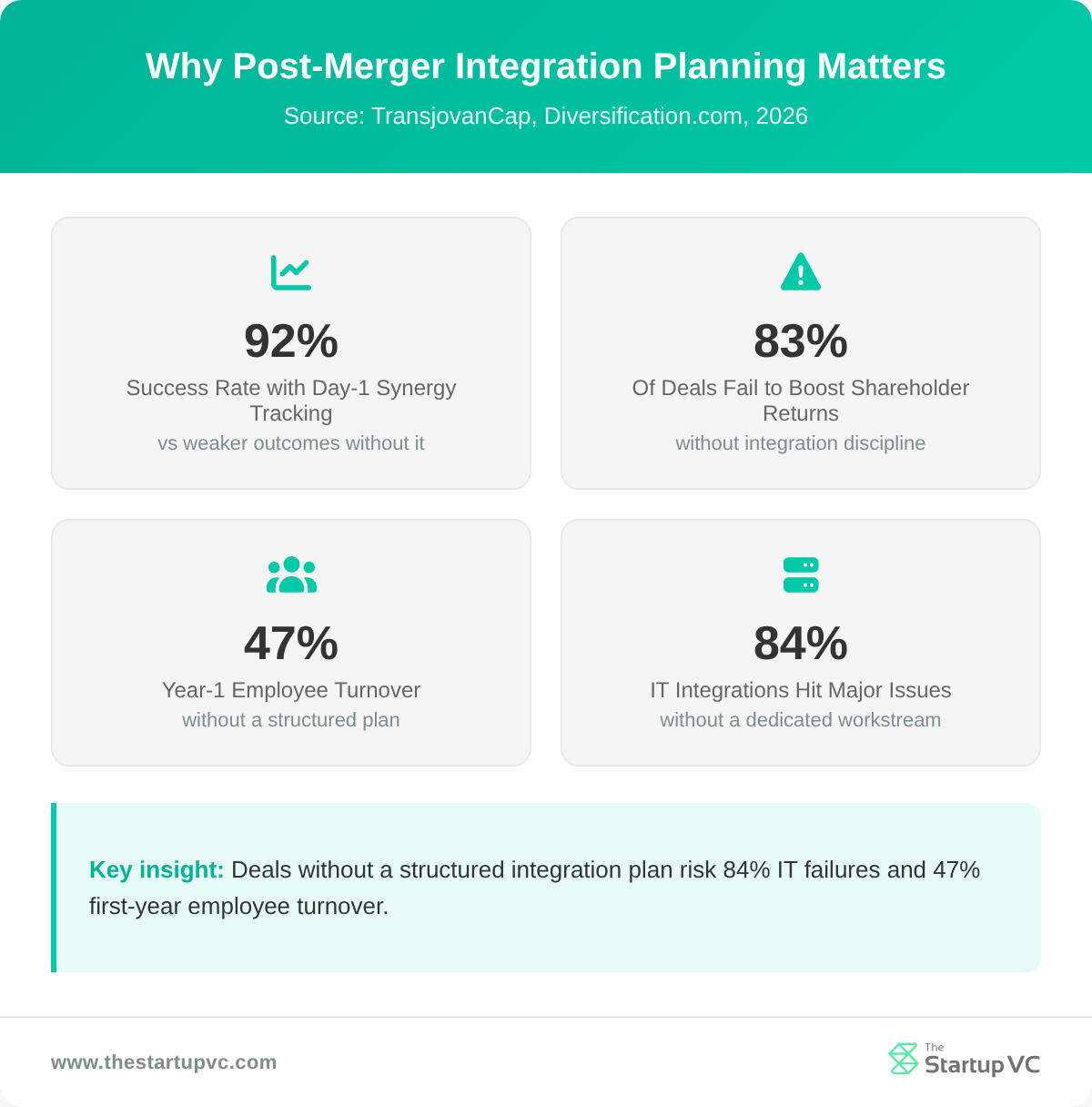
A 100-day integration plan matters most for the final step. Day-1 synergy tracking drives success rates as high as 92%. Without it, deals fall into a wider trend, where up to 90% of acquisitions fail to meet their goals.
What Challenges Do Strategic Acquirers Face in Latin American M&A?
The challenges strategic acquirers face include antitrust review, sector regulation, cultural gaps, and integration risk. Regulatory review varies widely by country and sector.
Brazil’s antitrust authority CADE requires notification for deals that meet revenue thresholds. Sector regulators like the Central Bank and ANATEL may also require separate approval. Mexico’s competition law requires pre-merger notification once deal thresholds are met. Regulators there can challenge a merger that creates market dominance.
| Challenge | Region-Specific Detail |
|---|---|
| Antitrust review | Brazil’s CADE and Mexico’s competition authority both require pre-merger notification above set thresholds |
| Sector regulation | Brazilian financial, telecom, and securities regulators can require separate approval alongside CADE |
| Cultural and language gaps | Local negotiation norms and communication styles differ by country |
| Post-closing integration | Employee turnover hits 47% in Year 1 without a structured plan |
Mid-market cross-border deals run 45 to 90 days of due diligence. Antitrust review adds another 30 to 90 days before closing. IT systems fail or hit major issues in 84% of integrations that skip a structured integration plan.
How Much Does M&A Advisory Cost for Strategic Acquirers in Latin America?
M&A advisory costs for strategic acquirers typically range from 1% to 6% of deal value, based on deal size. Smaller deals carry higher percentage fees than larger ones.
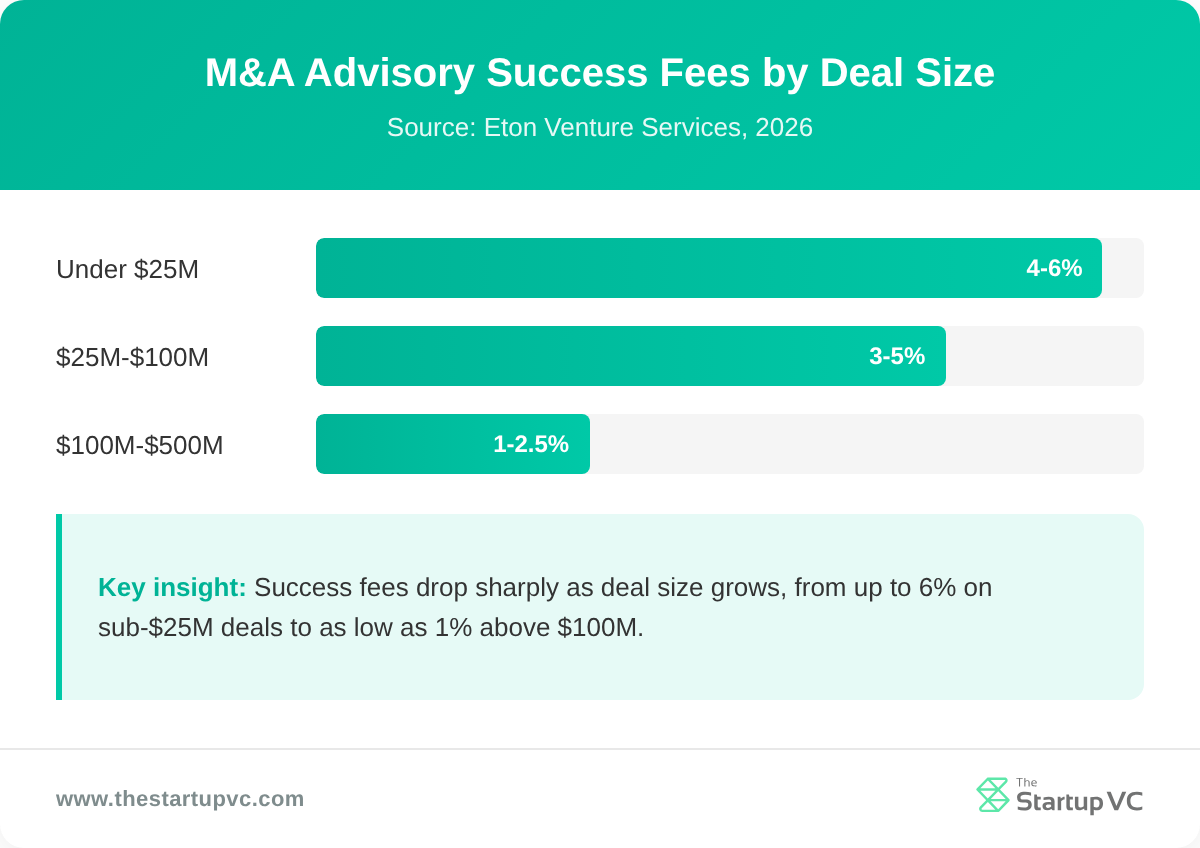
| Deal Size | Typical Success Fee |
|---|---|
| Under $25 million | 4% to 6% |
| $25 million to $100 million | 3% to 5% |
| $100 million to $500 million | 1% to 2.5% |
Advisor fee structures usually combine several parts:
- Retainer. A fixed monthly fee paid during the engagement.
- Work fee. Covers early-stage research and target screening.
- Success fee. The largest component, paid only if the deal closes.
- Expense reimbursement. Covers travel, data room, and third-party report costs.
A minimum fee near $150,000 is common on transactions under $10 million. Buy-side due diligence adds another $150,000 to $500,000 in specialist advisor costs for a typical mid-market deal in Latin America.
What Questions Do Strategic Acquirers Ask Most Often About M&A Advisory in Latin America?
How Long Does a Strategic Acquisition Take in Latin America?
A strategic acquisition takes 6 to 12 months from kickoff to closing. Due diligence alone takes 8 to 12 weeks once the data room opens. Antitrust review can add another 30 to 90 days.
What Is the Difference Between a Strategic Acquirer and a Financial Buyer?
A strategic acquirer operates in the target’s industry and plans to integrate the business. A financial buyer, like a private equity fund, values the target on standalone cash flow and plans an eventual exit.
Why Do Strategic Buyers Pay Higher Prices Than Financial Buyers?
Strategic buyers pay higher prices because they capture cost and revenue synergies after the deal closes. Historically, they pay premiums of 1 to 3 EBITDA turns above financial buyers for similar assets.
Which Countries See the Most Strategic M&A Activity in Latin America?
Mexico, Brazil, Chile, and Colombia see the most strategic M&A activity. Mexico’s market alone reached $10.91 billion in deal value in the first half of 2026.
Can Foreign Strategic Acquirers Buy 100% of a Company in Latin America?
Yes, foreign strategic acquirers can buy 100% of most companies in Latin America. Some sectors, like media or airlines, carry foreign ownership limits that vary by country.
How Much Does Due Diligence Cost for a Strategic Acquisition?
Due diligence costs $150,000 to $500,000 for a typical mid-market deal in Latin America. The total splits across financial, legal, tax, labor, and commercial advisors.
Ready to Pursue a Strategic Acquisition in Latin America?
The Startup VC is Craig Dempsey’s family office and company builder, active across Latin America. We back founders and guide strategic acquirers through target search, due diligence, and integration. Our portfolio includes Biz Latin Hub, operating in 17 countries, giving us direct experience closing deals on the ground. If you are planning a strategic acquisition in Latin America, our team can help. We find the right target and help you close with confidence. Contact us today to discuss your acquisition strategy.