
Panama’s M&A market drew $2.34 billion in foreign investment in 2024, headlined by Heineken’s $3.2 billion FIFCO acquisition.
Panama structures deals as share purchases, asset purchases, or mergers under Law 32 of 1927. ACODECO merger review is voluntary. Foreign investors can own 100% of most companies. Non-real estate capital gains face a 5% or 10% tax.
The Startup VC builds and backs companies across Latin America, including Biz Latin Hub in 17 countries. This guide covers Panama’s deal landscape from start to finish. You will learn how to buy, how to sell, which structures work, and which regulators and taxes apply.
How Big Is the M&A Market in Panama?
Panama’s M&A market is growing quickly, powered by large cross-border deals and a stable, dollarized economy. Heineken agreed to buy FIFCO’s beverage and retail businesses, including Heineken Panama, for $3.20 billion. The deal is expected to close in the first quarter of 2026.
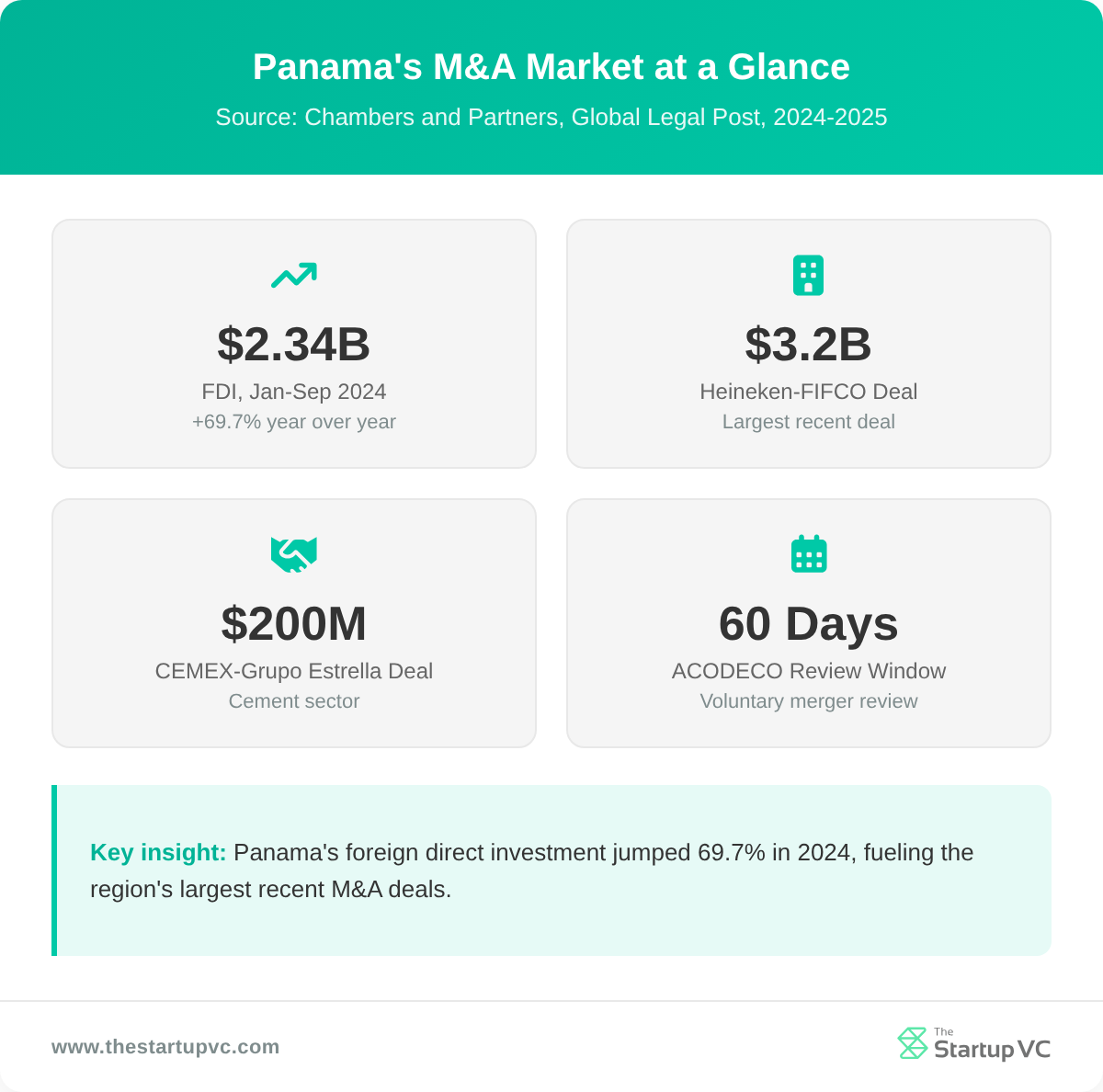
Foreign direct investment into Panama reached $2.337 billion between January and September 2024. That marked a 69.7% jump over the same period in 2023. Reinvested earnings in banking and corporate sectors drove most of the increase.
The most active sectors for M&A in Panama are:
- Financial services. Davivienda completed its integration of Scotiabank’s Panama banking operations in December 2025.
- Beverage and retail. Heineken’s $3.20 billion FIFCO deal is the region’s largest recent transaction.
- Automotive distribution. Sojitz acquired Petroautos, a Hyundai dealer, and Grupo Silaba, a Kia and Mazda dealer.
- Industrial and building materials. CEMEX sold its Panama operations to Grupo Estrella for $200 million in October 2025.
Recent headline deals show the scale of activity:
| Deal | Buyer | Value | Status |
|---|---|---|---|
| FIFCO Panama beverage and retail | Heineken N.V. | $3.20 billion | Closing Q1 2026 |
| CEMEX Panama operations | Grupo Estrella | $200 million | Closed October 2025 |
| Scotiabank Panama banking operations | Davivienda | Undisclosed | Completed December 2025 |
Panama’s growing preference for arbitration is making the market more sophisticated. A more standardized regulatory environment is helping buyers and sellers alike.
How Do You Buy a Company in Panama?
You can buy a company in Panama by choosing a deal structure and running due diligence. You close the deal through Panama’s Public Registry. Buyers first decide with the seller whether the deal will be a share purchase or an asset purchase. A share deal transfers ownership of the company itself. An asset deal transfers specific assets, like equipment, contracts, or real estate.
Due diligence follows target selection. A thorough Panama due diligence review checks four areas:
- Corporate records. Incorporation documents, share ownership, and good standing status with the Public Registry.
- Tax compliance. Filings, RUC tax ID status, and outstanding liabilities with the DGI, Panama’s tax authority.
- Labor obligations. Employee contracts, payroll compliance, and Social Security (CSS) liabilities.
- Contracts and regulatory status. Client and supplier agreements, licenses, and data protection compliance.
Buyers should watch for common risks. These include undisclosed tax or labor liabilities, incomplete corporate records, hidden debts, and unclear share ownership.
After due diligence, buyers and sellers sign a purchase agreement with clear representations and warranties. Many deals use an escrow or holdback mechanism to cover post-closing claims.
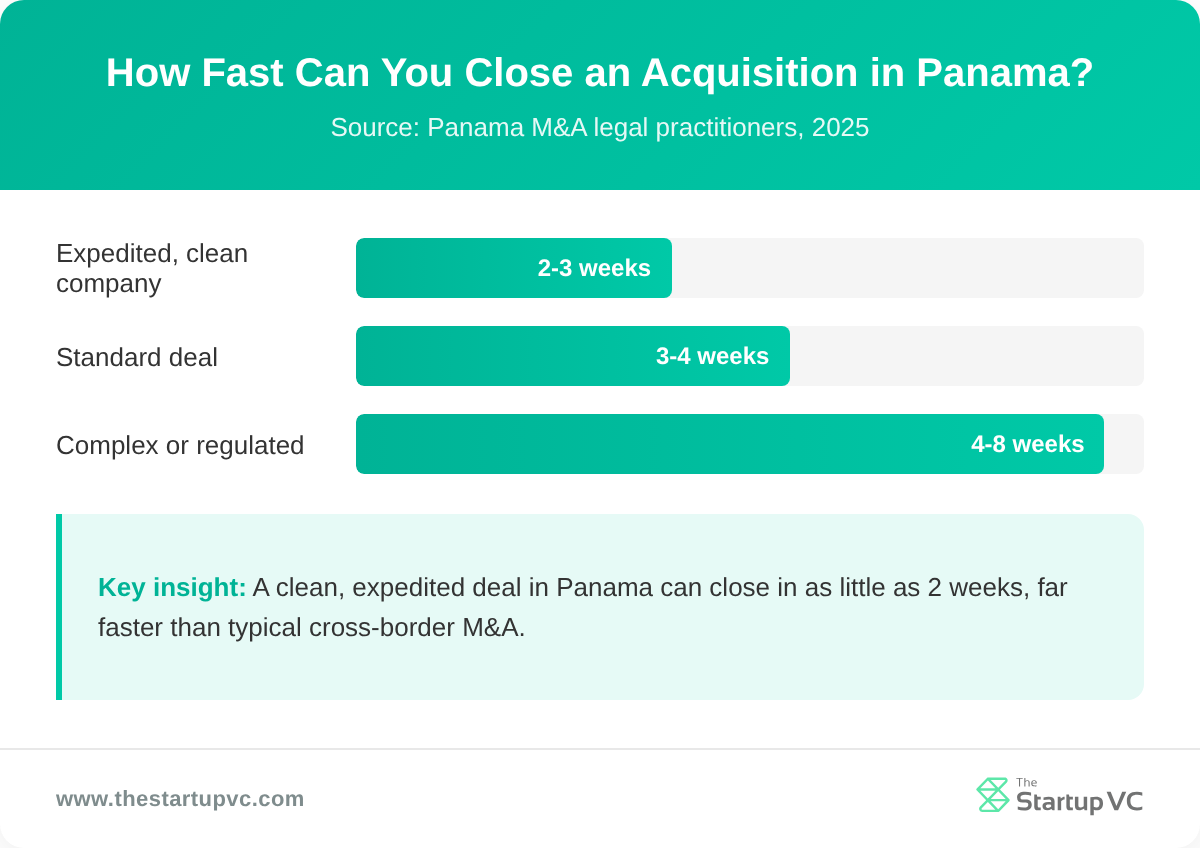
Closing speed depends on how clean the target’s records are. A clean company can close in 2 to 3 weeks on an expedited basis. A standard deal takes 3 to 4 weeks. Complex or regulated deals, like those in banking, take 4 to 8 weeks or more.
| Deal complexity | Typical closing time |
|---|---|
| Expedited, clean company | 2-3 weeks |
| Standard | 3-4 weeks |
| Complex or regulated | 4-8 weeks or more |
Due diligence itself usually takes 6 to 12 weeks. Expedited deals can compress this to 3 to 4 weeks.
How Do You Sell a Business in Panama?
You can sell a business in Panama by getting a valuation, preparing clean financials, and choosing the right exit path. An independent valuation should come before you list the business. Valuation factors include revenue, customer base, location, competition, inventory, debt, and past net profit.
A qualified accountant should review the books before you go to market. This step confirms real sales volume and profit. It also rules out questionable accounting practices. Owners who rush this process without preparing financials usually take a hit on valuation.
Panama business owners typically choose from three exit paths:
- Third-party sale. The most common path, selling to a strategic buyer or investor.
- Family succession. Passing the business to children or other family members.
- Employee buyout. Selling the business in stages to existing employees or a management partner.
If a sale is not viable, liquidation is a separate legal process. Panama liquidation follows its own formal steps, distinct from a negotiated sale.
What Deal Structures Are Used in Panama Acquisitions?
Panama acquisitions use three main deal structures: share purchases, asset purchases, and mergers. Panama has no single M&A code. Deals fall under general corporate and commercial law, mainly Law 32 of 1927, the Corporations Law, and the Commercial Code. Buyers structuring deals across borders often set up a Panama holding company to take advantage of territorial taxation.
| Structure | How it works | Buyer’s liability |
|---|---|---|
| Share purchase | Buyer acquires the company’s shares directly | Assumes all existing liabilities |
| Asset purchase | Buyer acquires specific assets named in the contract | Limited to contracted liabilities |
| Merger | Two companies combine by absorption or consolidation | Combined entity assumes liabilities |
Share purchases are simpler and carry lower transaction costs, but the buyer takes on every existing liability. Asset purchases let buyers carve out unwanted liabilities. Buyers assume only what the contract specifies. Transfer costs and asset-level registrations can raise the price.
Mergers in Panama take two forms:
- Merger by absorption. One company absorbs another and assumes all its assets and liabilities.
- Merger by consolidation. Two companies combine to form a new entity.
Both merger types need majority approval from directors and shareholders. Both must be registered with the Public Registry to take effect.
What Regulatory and Tax Rules Govern M&A in Panama?
The regulatory and tax rules that govern M&A in Panama include antitrust review and foreign ownership limits. Panama also runs a territorial tax system. ACODECO, the Authority for the Protection of the Consumer and Competition Defense, enforces antitrust law under Law No. 45 of 2007.
Merger notification in Panama is voluntary, not mandatory. Panama’s Competition Law still bans concentrations that unreasonably restrict competition. Parties that choose to notify ACODECO get a decision within 60 calendar days. If ACODECO misses that deadline, approval is deemed granted.
Some sectors require mandatory prior approval before a deal can close:
- Banking. Panama’s banking authority must approve ownership changes.
- Securities. Deals need clearance from securities regulators.
- Insurance. Insurance sector regulators must approve the transaction.
Panama places few limits on foreign ownership outside these sectors. Foreign investors can generally own 100% of a Panamanian company. The main exceptions are aviation, radio and TV, and retail trade, restricted for national security reasons.
Panama’s territorial tax system taxes only Panama-source income. Foreign dividends, capital gains, interest, and offshore profits face zero Panamanian tax for residents and non-residents alike.
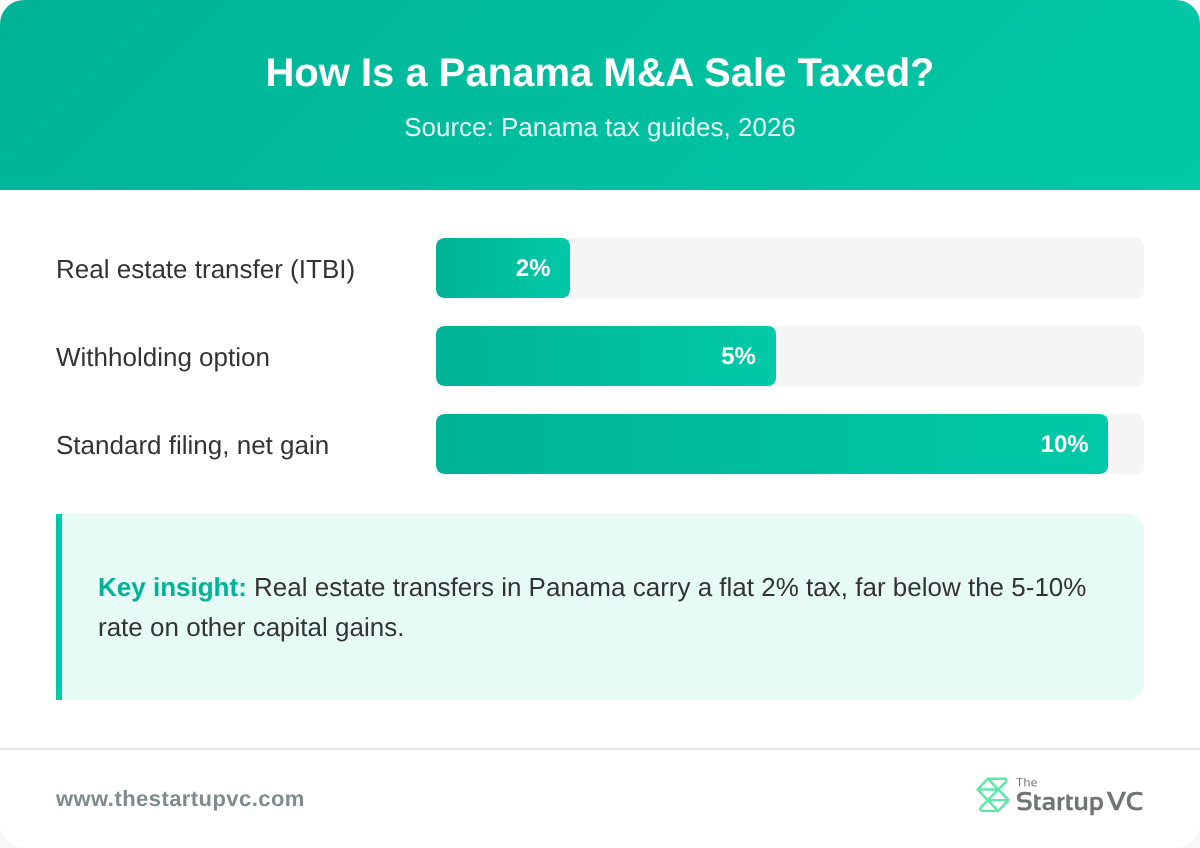
On Panama-source, non-real estate capital gains, sellers choose between two tax treatments:
| Method | Rate | How it works |
|---|---|---|
| Withholding | 5% | Final tax on the full transaction value |
| Standard filing | 10% | Tax on the actual net gain, with a refund available if withholding exceeds the amount owed |
Real estate transfers use a separate 2% transfer tax instead of capital gains tax. This tax, known as ITBI, applies to the transaction value. The seller pays ITBI as a final tax, regardless of profit or loss.
What Questions Do Founders Ask Most Often About M&A in Panama?
How Long Does It Take to Close an Acquisition in Panama?
Closing an acquisition in Panama takes 2 to 8 weeks in most cases. A clean, expedited deal can close in 2 to 3 weeks. Complex or regulated deals, like banking transactions, take 4 to 8 weeks or more.
Can Foreign Investors Own 100% of a Panamanian Company?
Yes, foreign investors can own 100% of most Panamanian companies. Panama places few restrictions on foreign ownership. Exceptions apply to aviation, radio and TV, and retail trade for national security reasons.
Is Merger Notification Mandatory in Panama?
No, merger notification to ACODECO is voluntary in Panama. Panama’s Competition Law still bans concentrations that harm competition. Parties that notify voluntarily get a decision within 60 calendar days.
What Taxes Apply When You Sell a Business in Panama?
The taxes that apply include a 5% withholding tax or a 10% tax on net capital gains. This applies to non-real estate assets. Real estate transfers use a 2% transfer tax, ITBI, instead.
Which Deal Structure Is Best for Buying a Company in Panama?
The best structure depends on your risk tolerance and target company. Asset purchases limit liability but cost more to register. Share purchases are simpler but transfer every existing liability to the buyer.
How Much Does It Cost to Buy a Company in Panama?
The cost of buying a company in Panama varies by deal size and structure. Expect legal and due diligence fees, plus applicable taxes. Real estate carries a 2% ITBI, while other capital gains face a 5-10% tax. Escrow and advisory fees add to the total.
Ready to Buy or Sell a Company in Panama?
The Startup VC is Craig Dempsey’s family office and company builder, active across Latin America. We back and guide founders through acquisitions, exits, and cross-border structuring. Our experience comes directly from Biz Latin Hub’s operations in 17 countries. Our team understands Panama’s due diligence requirements, tax rules, and closing timelines firsthand. We offer practical support built on real deal experience, not generic advice. This holds whether you are buying your first company or preparing to sell. Contact us today to talk through your Panama M&A plans.