
Accounting firms sell for about 1.0x revenue or 4x to 7x adjusted EBITDA in Latin America, making them the region’s most active B2B services roll-up target.
Latin America recorded 2,650 M&A deals worth $96 billion in 2025. Accounting practices lead professional-services deal volume because they earn recurring revenue. Buyers pay 70% to 80% cash at closing for a clean book, with the rest tied to client retention.
The Startup VC builds and backs service companies across Latin America, including Biz Latin Hub in 17 countries. Below you will find practice valuation methods, client concentration limits, partner retention structures, pricing benchmarks, and a step-by-step acquisition path.
Why Is the Accounting Sector the Top Roll-Up Target in Latin America?
The accounting sector is the top roll-up target in Latin America because it has the largest B2B services deal volume and recurring revenue. Latin America recorded 2,650 M&A deals worth $96 billion in 2025. Deal value rose 13% year over year. This signals a shift toward larger, more professional transactions.

Professional services firms draw strong buyer demand for three reasons:
- Recurring revenue. Tax and bookkeeping work repeats every month and every year.
- Stronger margins. Service firms beat asset-heavy industrial businesses on profit.
- Low capital needs. You buy a client book and a team, not factories or inventory.
Several buyer types compete for these practices. To understand the wider sector, see this overview of the B2B services sector in Latin America.
| Buyer Type | Why They Buy |
|---|---|
| Big Four and mid-tier (Grant Thornton, BDO, RSM) | Add nearshore delivery capacity |
| PE-backed roll-up platforms | Build pan-regional brands across countries |
| Family offices and company builders | Hold cash-flowing assets long term |
Recent deals show the trend. Vistra acquired Biz Latin Hub in December 2025, gaining 17 countries and 36 partner firms. Grant Thornton US acquired Auxis, a firm with 1,400 staff across Costa Rica, Colombia, Mexico, and Guatemala.
How Do You Value an Accounting Firm in Latin America?
You value an accounting firm by applying revenue, EBITDA, and SDE multiples to its financials. The median practice sells for about 1.0x revenue. Most larger firms close at 4x to 7x adjusted EBITDA. Buyers triangulate all three numbers against client retention and growth.
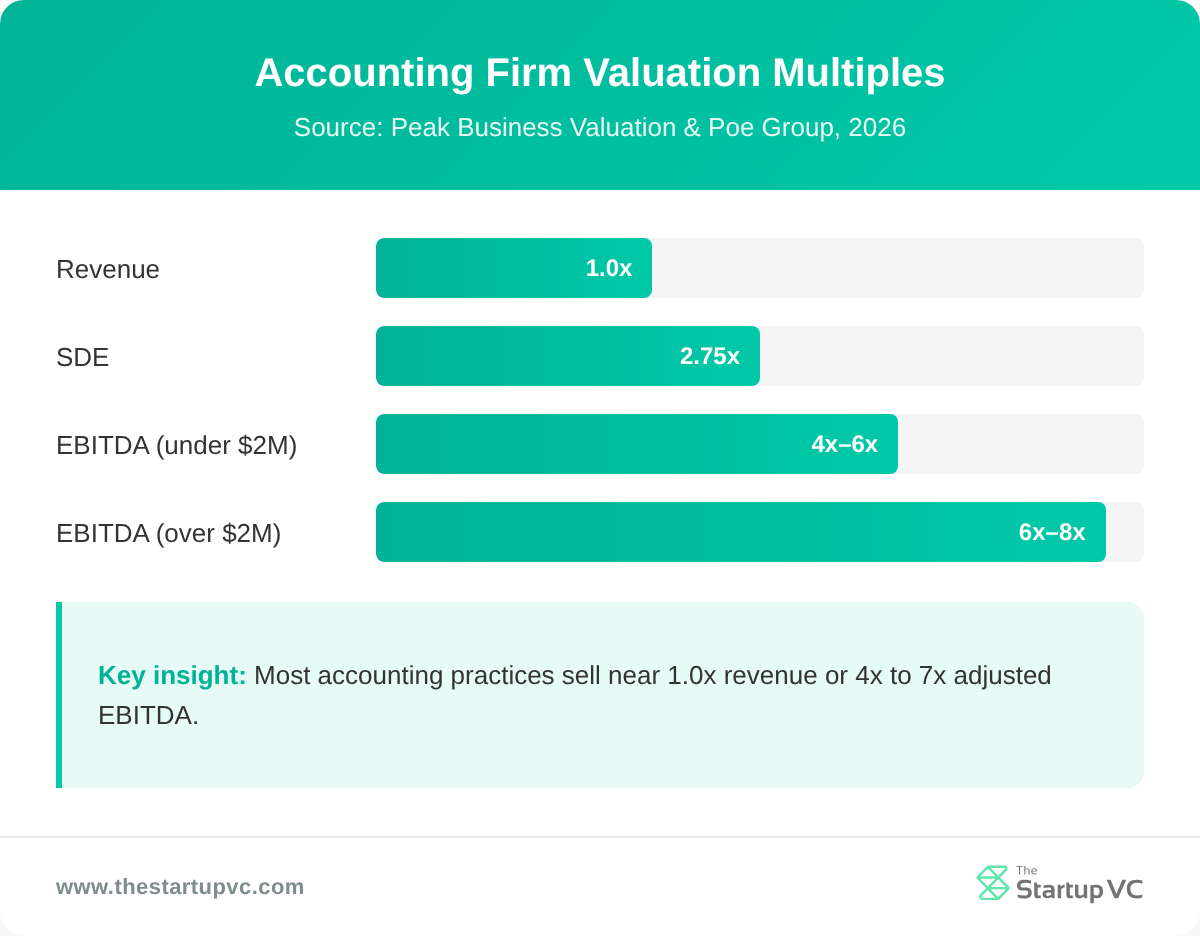
Adjusted EBITDA matters most for larger deals. It normalizes owner pay to a market-rate manager salary. It also removes one-time expenses. This shows the real profit a buyer would keep. Learn how to apply these methods in our guide on how to value a company in Latin America.
The table below shows typical multiple ranges for accounting practices.
| Metric | Typical Range | Notes |
|---|---|---|
| Revenue | 0.71x to 1.09x | Median sells near 1.0x revenue |
| Adjusted EBITDA | 4x to 7x | Below $2M EBITDA: 4x to 6x |
| Adjusted EBITDA | 6x to 8x | Above $2M EBITDA |
| SDE | 1.81x to 3.25x | Median near 2.75x SDE |
What Drives a Higher Valuation?
Several factors push the multiple higher. Strong client retention proves the revenue will last. A diversified book lowers risk for the buyer. Modern technology and high recurring revenue both add value. A clean, well-run practice earns the top end of each range.
How Much Does It Cost to Buy an Accounting Practice in Latin America?
A typical accounting practice costs $500K to $5M, financed mostly through bank loans and seller notes. SBA 7(a) loans fund US-side acquisitions up to $5M. Buyers usually put 10% to 25% cash down. Sellers often finance another 10% to 20% of the price.
Most deals use a blended structure. The table below shows a common $1M example.
| Source | Amount | Share |
|---|---|---|
| Bank or SBA loan | $800,000 | 80% |
| Buyer cash equity | $100,000 | 10% |
| Seller note | $100,000 | 10% |
Seller financing helps both sides. A practice can sell for 10% to 15% more when the seller holds paper. It also keeps the seller motivated during the handover. Latin America adds a cost advantage too. Accounting talent there costs about 65% less than US salaries. Controllers run roughly 70% cheaper. For the full process, read our guide on how to buy a company in Latin America.
How Do You Manage Client Concentration Risk When Buying a Firm?
You manage client concentration risk by checking how revenue spreads across the client book. If the top 5 clients make up 50% of revenue, you are buying a risk. The safe benchmark is that no single client exceeds 15% of revenue. Above that line, losing one client creates a margin crisis.
Concentration directly changes the deal terms. A clean, diversified book sells at 60% to 80% cash at closing. A concentrated book with partner dependency sells at 40% to 50% cash. It also carries 2 to 3 year earn-outs.
Run these checks before you sign:
- Review 3 to 5 years of financials. This reveals patterns and hidden anomalies.
- Map revenue by client. Flag any client above 15% of total revenue.
- Test recurring revenue. Aim for 40% to 60% from repeat work.
- Check partner dependency. See which clients follow a person, not the firm.
A practice with 40% to 60% recurring revenue weathers downturns far better. Recurring work also makes the post-deal cash flow easier to predict.
How Do You Retain Partners and Staff After an Accounting Acquisition?
You retain partners and staff by tying part of the price to retention and a transition period. Deals commonly hold back 20% to 30% of the purchase price. This portion pays out based on client retention over 12 to 24 months. The structure keeps sellers focused on a smooth handover.
A retention-based deal pays 70% to 80% at closing. The rest pays over 12 to 24 months based on which clients stay. This earn-out aligns incentives on both sides. The seller becomes a temporary business-development lead. They personally introduce the buyer to key clients.
Transition support usually lasts 6 to 24 months. The seller stays available for client questions. They assist through at least one full tax season. This protects the relationships you paid for.
Partner economics matter for retention planning. Median revenue per partner for firms with 2 to 10 staff is $350K to $450K. Top-quartile firms reach $500K to $700K per partner. Keep your best partners, and you keep this revenue.
What Are the Main Steps to Complete an Accounting Firm Acquisition?
You complete an accounting firm acquisition by moving through sourcing, diligence, valuation, structuring, and integration. Start by setting your strategic goal. Growth, geographic expansion, and niche focus each shape the deal. The goal guides every later decision.
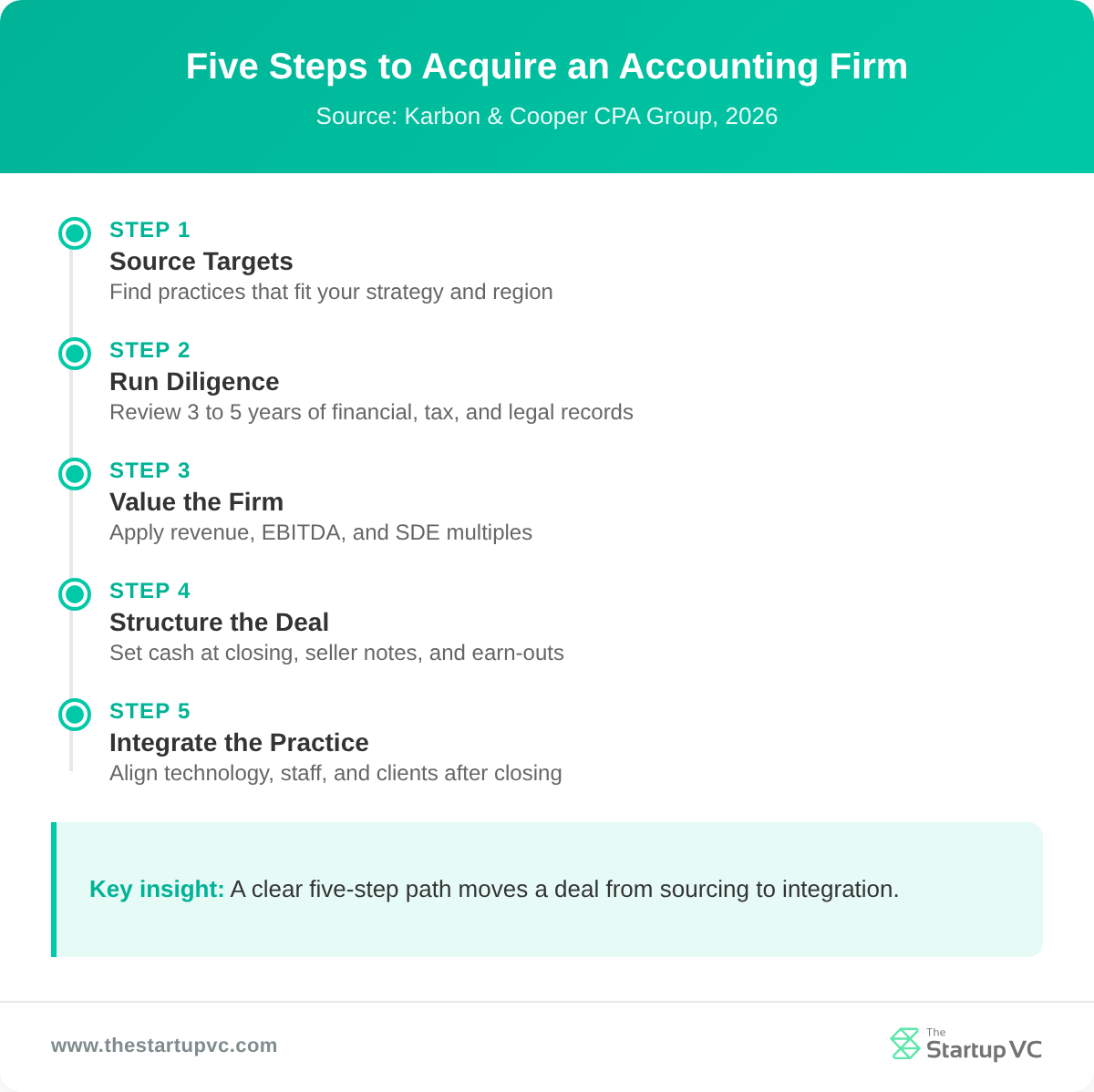
Follow these five steps in order:
- Source targets. Find practices that fit your strategy and region.
- Run two-stage diligence. A quick review decides if the target is worth pursuing.
- Value the firm. Apply revenue, EBITDA, and SDE multiples to clean financials.
- Structure the deal. Set cash at closing, seller notes, and retention earn-outs.
- Integrate the practice. Align technology, staff, and clients after closing.
What Should Due Diligence Cover?
Due diligence covers financial, tax, and legal review. Financial diligence reviews 3 to 5 years of statements to verify performance. Tax diligence finds past liabilities and compliance gaps. Legal diligence surfaces contract, employment, and litigation risk.
Technology compatibility often decides if two practices can merge well. A modern, well-integrated tech stack lets teams align fast. Plan the integration during diligence, not after. This step protects the deal value you negotiated.
What Questions Do Buyers Ask Most Often About Acquiring Accounting Firms in Latin America?
How long does it take to acquire an accounting firm?
A typical acquisition takes 3 to 9 months from first contact to closing. Diligence and financing drive most of the timeline. The transition period then runs another 6 to 24 months after closing.
What is a fair multiple for an accounting practice?
A fair multiple is about 1.0x revenue or 4x to 7x adjusted EBITDA. Firms under $2M EBITDA usually sell at 4x to 6x. Larger, cleaner firms reach the higher end.
How much cash do I need to buy a practice?
You usually need 10% to 25% of the price in cash. A bank loan covers most of the rest. A seller note often fills the remaining 10% to 20%.
What is the biggest risk in buying an accounting firm?
The biggest risk is client concentration. If one client tops 15% of revenue, losing them hurts badly. Always map revenue by client before you sign.
How do I keep clients after the deal?
You keep clients by structuring retention earn-outs and a transition period. The seller introduces you to key clients over 12 to 24 months. This protects the revenue you bought.
Why is accounting a good roll-up sector?
Accounting is a good roll-up sector because it earns recurring revenue with strong margins. It has the largest B2B services deal volume in Latin America. Practices also need little capital to run.
Ready to Acquire an Accounting Firm in Latin America?
The Startup VC is Craig Dempsey’s family office and company builder. We create, back, and guide scalable ventures across Latin America. Our team brings real operating experience to roll-ups, from valuation to integration. Biz Latin Hub, our portfolio company, operates in 17 countries with hands-on regional knowledge.
We help founders and investors source, value, and structure accounting acquisitions. See our investment focus to learn how we partner on deals. Contact us today to start your roll-up.