
Panama is a dollarized business hub with 100% foreign ownership and a canal moving 6% of global trade.
Panama posted 4.4% GDP growth in 2025, with services driving 80% of GDP. Company formation runs 5 to 10 business days. Foreigners can own 100% of a Panama corporation in most sectors.
The Startup VC’s portfolio includes Biz Latin Hub, operating across 17 Latin American countries. This guide covers Panama company formation, banking, legal structures, key B2B sectors, and the operational launch sequence. For broader regional context, see our Panama startup hub for LatAm overview.
What Makes Panama a Strategic Gateway for International Ventures?
Panama is a strategic gateway because it connects Pacific, Atlantic, and inland routes through a single multimodal logistics corridor. The Panama Canal moves more than 6% of global trade and handles over 12,000 commercial vessel transits per year. The country uses the US dollar as legal tender, which removes currency risk for ventures expanding across Latin America.
Three infrastructure layers anchor Panama as an operational hub for international business:
- Maritime. The Colón Container Terminal serves the Atlantic side. The Balboa port handles Pacific cargo flows.
- Rail and road. The 76-kilometer Panama Canal Railway connects Pacific and Atlantic ports. The Pan-American Highway links Panama City to North and South America.
- Air. Tocumen International Airport serves as the regional passenger and cargo hub for Latin America.
Global operators have doubled down on Panama as their Latin America base. Maersk opened a Panama Pacifico logistics centre in 2025, spanning more than 20,000 square meters inside a Special Economic Zone. DP World added a Customs Bonded Warehouse at the Colón Logistics Park the same year. Both facilities serve as regional distribution hubs for companies operating across the Americas and Asia.
How Do You Form a Company in Panama?
You can form a Panama company by filing notarized articles of incorporation with the Public Registry. You then register with the tax authority. The process takes 5 to 10 business days for incorporation. Full setup, including banking and tax, runs 2 to 4 weeks total. Foreigners can own 100% of a Panama corporation with no residency requirement.
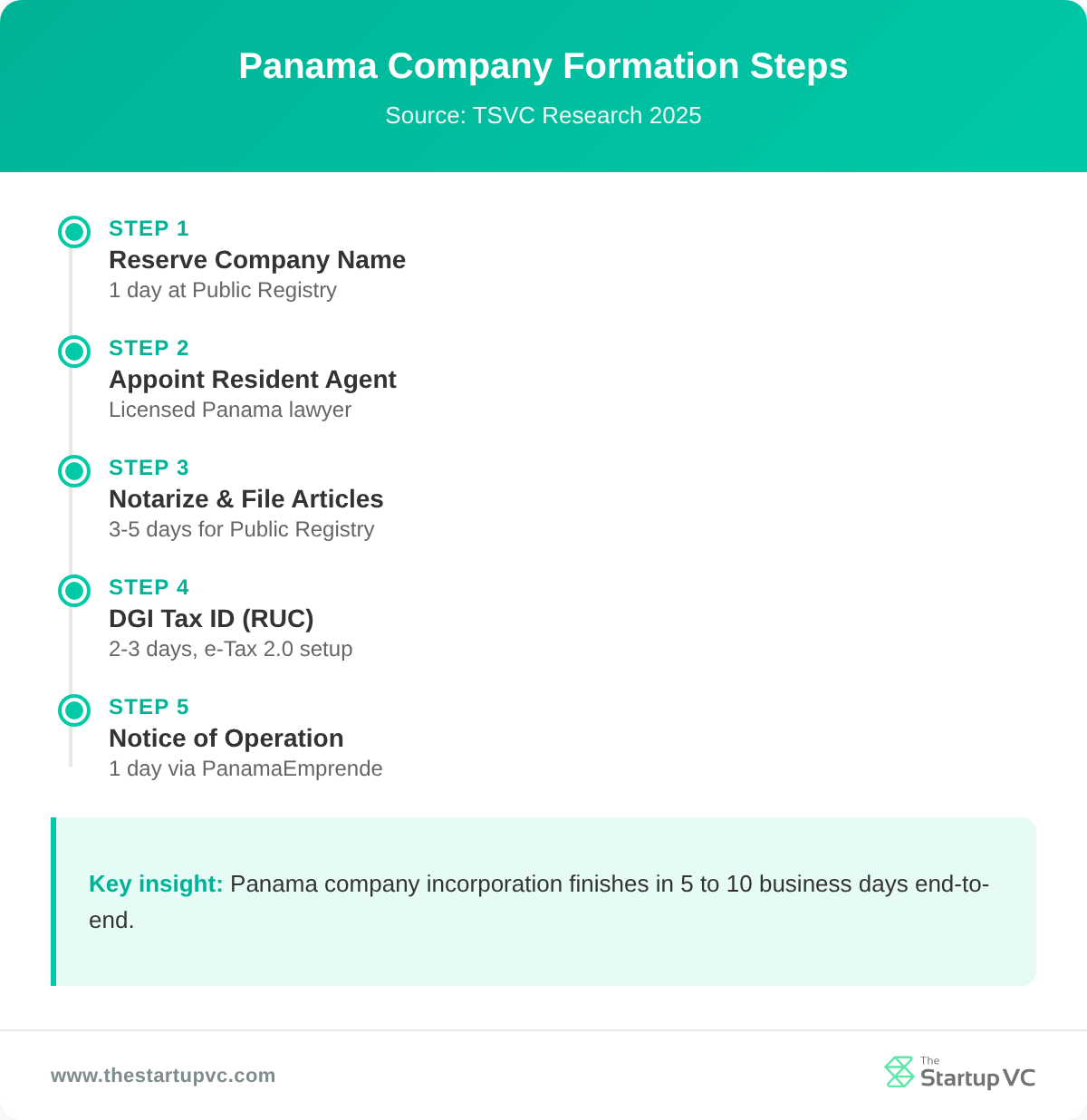
The formation sequence has six clear steps:
- Reserve a company name at the Public Registry.
- Appoint a resident agent. A licensed Panamanian lawyer is mandatory.
- Draft articles of incorporation. All documents must be in Spanish.
- Notarize and file with the Public Registry. This step grants legal personality.
- Register with the DGI for a RUC tax ID. This is the company’s tax number.
- Obtain a Notice of Operation through the PanamaEmprende portal. This authorizes commercial activity.
You need at least three directors and a registered office. The directors do not need to be Panamanian. Foreign shareholders provide a valid passport copy and basic identification. All Panama companies pay an annual franchise tax (Tasa Única) of USD $300 to remain in good standing.
What Legal Structures Are Available for Foreign Businesses in Panama?
The main legal structures are the Sociedad Anónima (S.A.), the SRL, and a registered branch of a foreign company. The S.A. is the most common choice for international ventures. The SRL fits closely held partnerships. A branch suits companies that want to keep operations under their parent entity.
| Structure | Minimum Capital | Ownership Format | Foreign Ownership | Best For |
|---|---|---|---|---|
| S.A. | None | Shares (private register) | 100% allowed | Most international ventures |
| SRL | None | Participation quotas (public) | 100% allowed | Small partnerships, joint ventures |
| Branch | None set | Parent company | Parent-owned | Existing foreign businesses |
What Is the Sociedad Anónima?
The Sociedad Anónima is a share-based corporation that requires at least three directors on a Board. Director names sit in the Public Registry. Shareholder identities stay private in an internal register. The S.A. has no minimum capital and no nationality restriction on owners. It is the standard vehicle for cross-border investment and operating companies.
What Is the Sociedad de Responsabilidad Limitada?
The SRL is a quota-based limited liability company. Instead of shares, ownership is divided into participation quotas recorded in the Public Deed. Partners cannot transfer quotas freely. Transfers usually need partner consent and a formal amendment to the Public Deed. The SRL works well for two or three founders who want stability.
Are There Restrictions on Foreign Ownership?
Panama allows 100% foreign ownership in most industries. The restricted sectors are retail trade, mass media, law, and accounting. These require Panamanian ownership or local partnerships. Logistics, financial services, technology, professional services, and real estate are fully open to foreign investors.
How Do You Open a Business Bank Account in Panama?
You can open a Panama corporate bank account by submitting apostilled documents and clearing the bank’s KYC review. The process takes 4 to 6 weeks for most foreign-owned companies. Some banks finish in 2 weeks with clean files. Online banking access usually follows 35 to 60 days after submission.
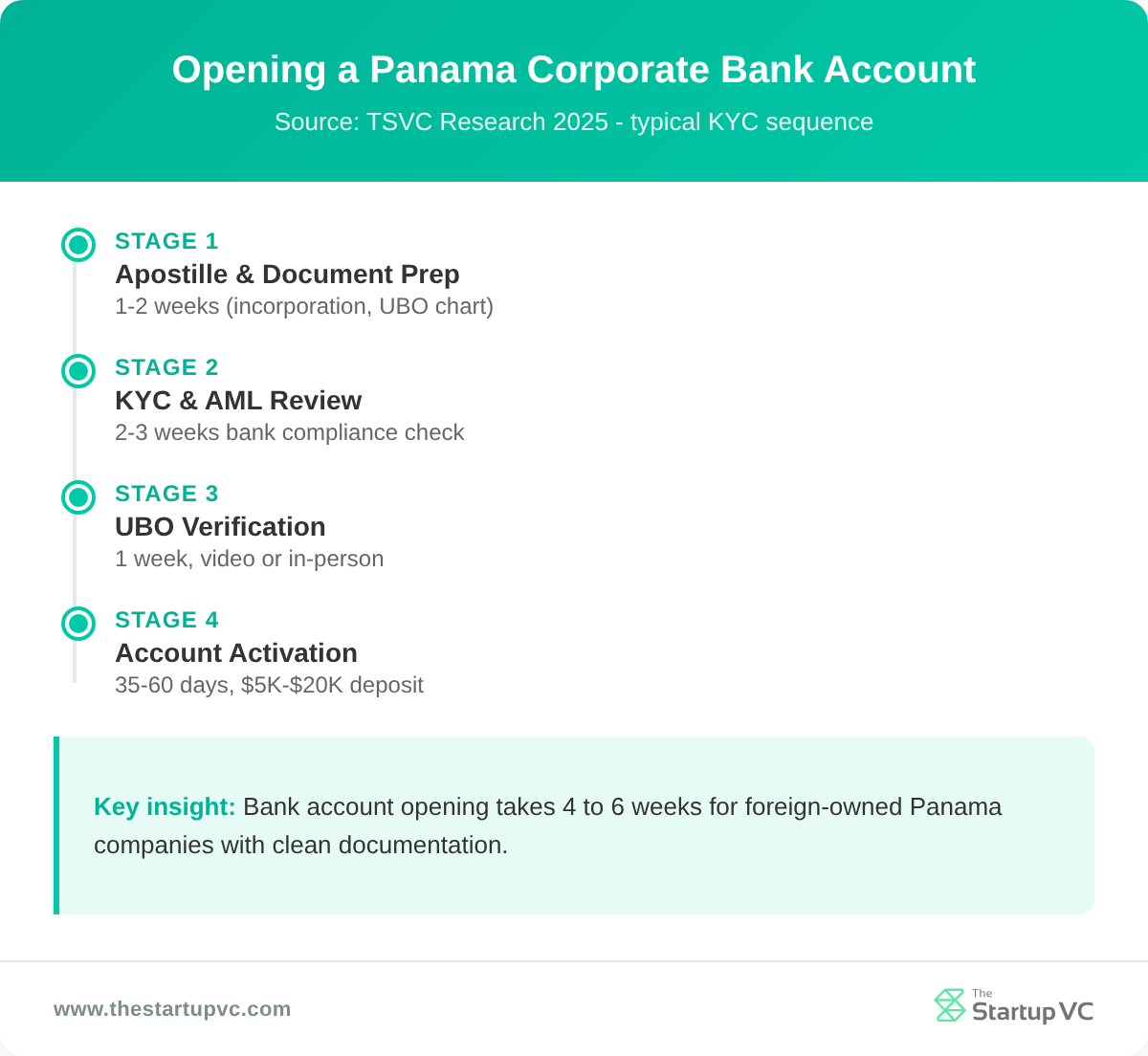
The required document package is detailed:
- Apostilled certificate of incorporation and certificate of good standing
- Board resolution authorizing the account opening
- Organizational chart showing ultimate beneficial owners (UBOs)
- Certified passport copies and proof of address for UBOs and signatories
- Bank or professional references for the company and UBOs
- Source of wealth and source of funds documentation
- Sample invoices, contracts, or letters of intent showing business activity
- Expected transaction volumes, currencies, and counterparty countries
Banks apply strict KYC and Anti-Money Laundering rules. The UBO must usually be available for a video interview or in-person meeting. Minimum opening deposits range from USD $5,000 to $20,000 depending on the bank. Some banks allow fully remote opening, but most require at least one in-person visit for final verification.
Which B2B Sectors Offer the Strongest Opportunities in Panama?
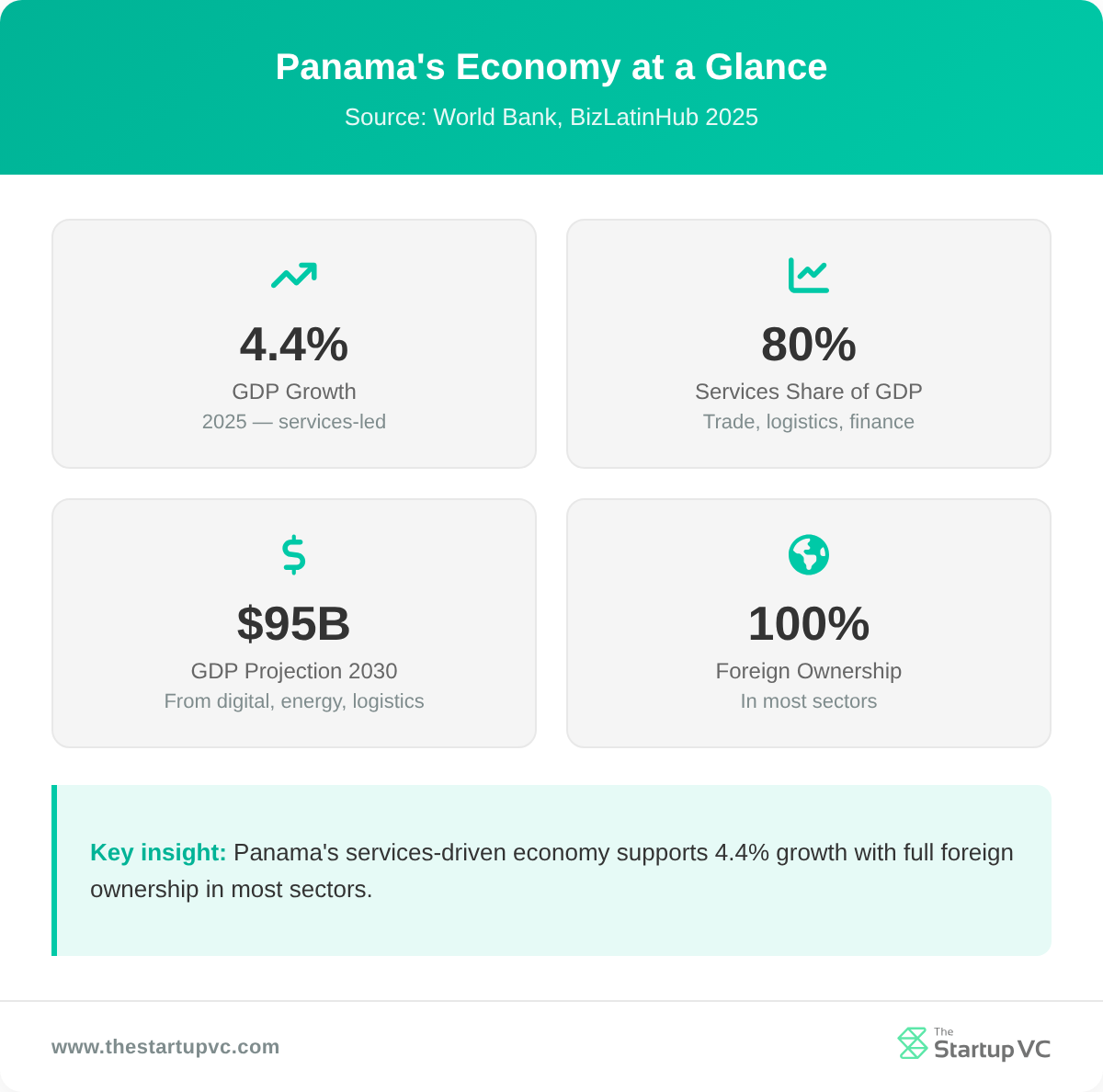
The strongest B2B sectors in Panama are logistics, financial services, technology, and professional services. The services sector accounts for about 80% of GDP. Panama posted 4.4% GDP growth in 2025. The country’s GDP is projected to exceed USD $95 billion by 2030.
| Sector | Why It Matters | Recent Activity |
|---|---|---|
| Logistics | Canal, ports, and free zones serve regional distribution | Maersk, DP World opened 2025 facilities |
| Financial services | Regional banking hub with dollarized economy | Active M&A in banking and insurance |
| Technology | Fintech, AI, logistics-tech drawing investment | International investors entering market |
| Professional services | Cross-border legal, audit, advisory demand | Steady growth supporting other sectors |
| Renewable energy | Government-backed projects across grid | Solar and wind capacity expanding |
International ventures usually anchor their Latin America operations in one of these sectors. The country’s regional connectivity helps B2B businesses serving Colombia, Costa Rica, and the wider region. Colombia is one of the largest demand centers Panama-based ventures serve. See our overview of entrepreneurship in Colombia for context.
What Are the Main Steps to Launch Operations in Panama?
The main steps to launch operations in Panama are entity registration, tax setup, banking, and hiring. The total runway from kick-off to active operations is usually 60 to 90 days. Each step depends on the previous one. Skipping ahead causes delays.
The operational launch sequence runs through six steps:
- Register the entity. File the S.A. or SRL with the Public Registry through a resident agent.
- Get the Notice of Operation. Apply through PanamaEmprende to authorize commercial activity.
- Register with the DGI. Obtain the RUC tax ID and set up the e-Tax 2.0 online filing account.
- Open the corporate bank account. Submit apostilled documents and clear KYC review.
- Register with social security. Set up payroll deductions before hiring the first employee.
- Hire or contract local talent. Use direct employment or an Employer of Record.
What Are the Tax Obligations?
Companies pay corporate income tax of 25% on locally-sourced income only. Panama uses a territorial tax system, so foreign-source income is not taxed locally. Companies file monthly and annual returns through the e-Tax 2.0 system. The annual Tasa Única franchise tax of USD $300 keeps the company in good standing.
What Are the Hiring Costs?
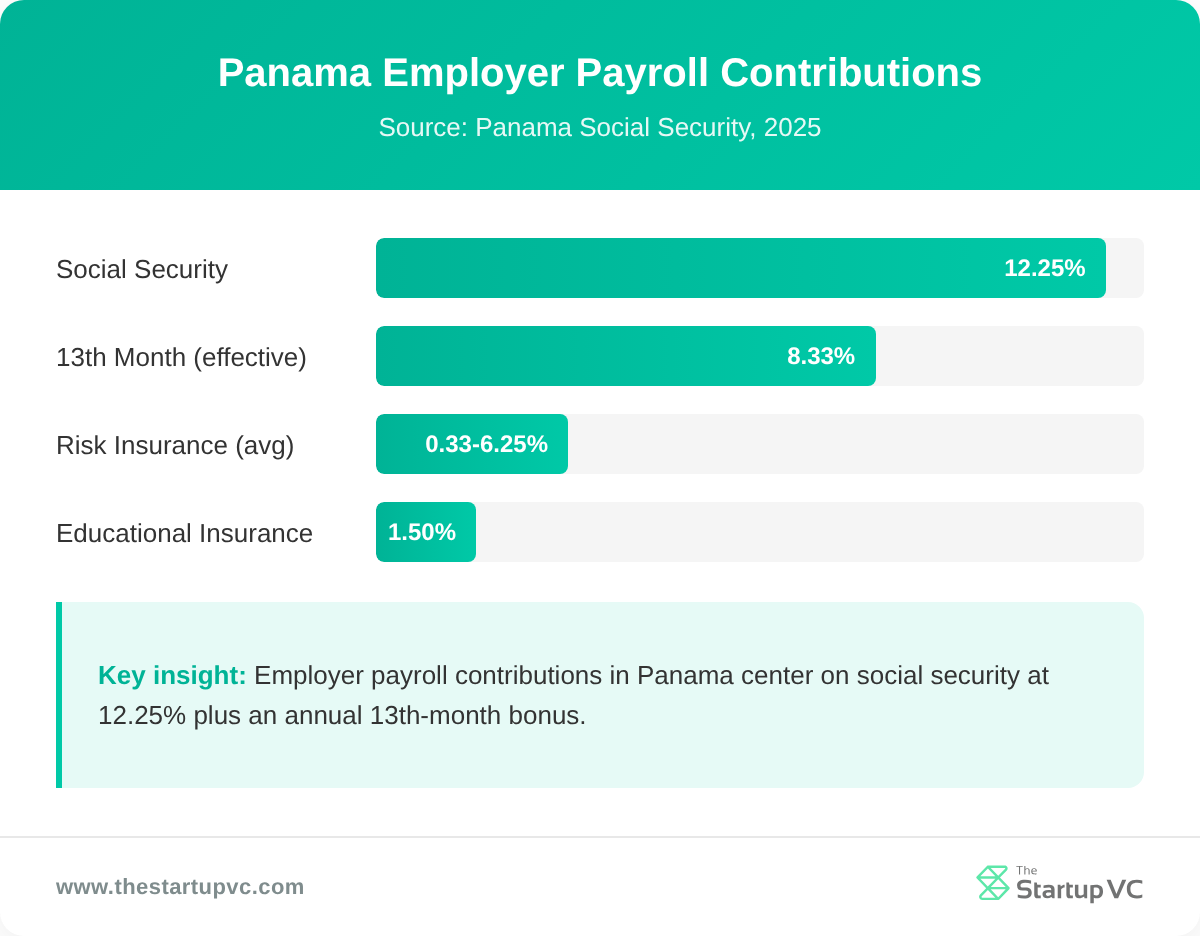
Panama’s minimum wage is PAB 400 per month in urban areas and PAB 300 in rural areas. Employer payroll contributions include social security at 12.25% and educational insurance at 1.50%. Professional risk insurance ranges from 0.33% to 6.25% by industry. Employers must also pay the Decimo Tercer Mes, a mandatory 13th-month bonus paid in December.
When Should You Use an Employer of Record?
You should use an Employer of Record when you need to hire before your local entity is fully set up. An EOR acts as the legal employer, provides compliant contracts, and runs payroll under Panama rules. This option works for the first 6 to 12 months while entity setup and banking finish. Active hiring through your own entity follows once payroll registration is complete.
What Questions Do Founders Ask Most Often About Doing Business in Panama?
How Much Does It Cost to Register a Company in Panama?
Registering a company in Panama costs between USD $1,500 and $3,500 for a standard S.A. or SRL through a resident agent. The cost covers government fees, notary work, the resident agent retainer, and the first year’s Tasa Única. Banking, accounting, and office setup add to the first-year total.
How Long Does It Take to Open a Bank Account?
Opening a bank account takes 4 to 6 weeks for most foreign-owned companies. Clean documentation can finish in 2 weeks. Complex ownership structures or higher-risk sectors can run to 8 weeks. The UBO must be available for a video or in-person verification.
Can Foreigners Own 100% of a Panama Company?
Yes, foreigners can own 100% of a Panama S.A. or SRL in most industries. Only retail trade, mass media, law, and accounting require Panamanian ownership. Logistics, financial services, technology, and professional services are fully open.
Does Panama Tax Foreign-Source Income?
No, Panama does not tax foreign-source income. The country uses a territorial tax system. Only income earned inside Panama is subject to the 25% corporate tax. Companies still file annual returns to maintain compliance.
What Is the Minimum Capital to Start a Panama Company?
The minimum capital to start a Panama S.A. or SRL is zero. The country has no required paid-in capital for either structure. Founders fund the company based on operational needs, not legal minimums.
Do You Need to Be in Panama to Register a Company?
No, you do not need to be in Panama to register a company. A licensed resident agent files all documents on your behalf. Founders sign notarized documents abroad. Bank account opening, however, usually requires at least one in-person visit.
Ready to Launch Your Venture in Panama?
The Startup VC is Craig Dempsey’s family office and company builder. We create, back, and guide scalable ventures across Latin America. Our teams operate in 17 countries with entity formation, compliance support, and active capital deployment. Learn more about our investment focus on B2B service ventures. Our portfolio companies show this hands-on building model in action. Contact us today to discuss your Panama entry plan.