Latin America requires antitrust clearance in five countries, including Brazil, where deals trigger review above BRL 750 million in revenue.
Brazil, Mexico, Colombia, Chile, and Argentina each run separate merger control regimes. Mexico’s threshold sits near USD 95.9 million. Colombia’s threshold sits near USD 22.8 million. Argentina’s pre-closing rule takes effect November 17, 2026.
The Startup VC has guided founders and investors through cross-border deals across Latin America. Our network includes portfolio companies like Biz Latin Hub, operating in 17 countries. This guide covers filing thresholds, review timelines, and gun jumping penalties for early closing.
What Is Merger Control and Why Does It Matter for M&A Deals in Latin America?
Merger control is the legal process that requires companies to notify antitrust regulators before closing qualifying deals. Latin American competition authorities review these transactions to check for harm to market competition. Dealmakers must clear merger control in the target country before closing, or risk fines and forced divestment.
No single regional standard governs merger review across Latin America. Brazil, Mexico, Colombia, Chile, and Argentina each run separate systems with their own thresholds and timelines. Founders and investors need country-specific counsel for every cross-border deal. Argentina activated a new regulator, the National Antitrust Competition Authority (ANC), in November 2025. Mexico replaced COFECE with a single National Antitrust Commission (CNA) in 2026.
Which Latin American Countries Require Antitrust Merger Notification?
The Latin American countries that require antitrust merger notification include Brazil, Mexico, Colombia, Chile, and Argentina. Each country sets its own antitrust authority and threshold rules. A deal that clears one jurisdiction still needs separate approval in every other jurisdiction where it triggers a threshold.
| Country | Antitrust Authority | Mandatory Notification Threshold |
|---|---|---|
| Brazil | CADE (Conselho Administrativo de Defesa Econômica) | One group over BRL 750 million and another over BRL 75 million in Brazilian revenue |
| Mexico | National Antitrust Commission (CNA) | About USD 95.9 million in transferred assets, or 30%+ of a target above that size |
| Colombia | Superintendence of Industry and Commerce (SIC) | 7,074,307.43 UVB in combined assets or revenue, about USD 22.8 million |
| Chile | Fiscalía Nacional Económica (FNE) | UF 2.5 million combined sales, with two parties over UF 450,000 individually |
| Argentina | National Antitrust Competition Authority (ANC) | ARS 145,005,000,000 in aggregate Argentine turnover |
Brazil and Chile require notification before closing. Argentina’s pre-closing rule takes full effect on November 17, 2026. Mexico and Colombia already require clearance before parties can complete a deal.
What Are the Merger Filing Thresholds in Brazil, Mexico, and Colombia?
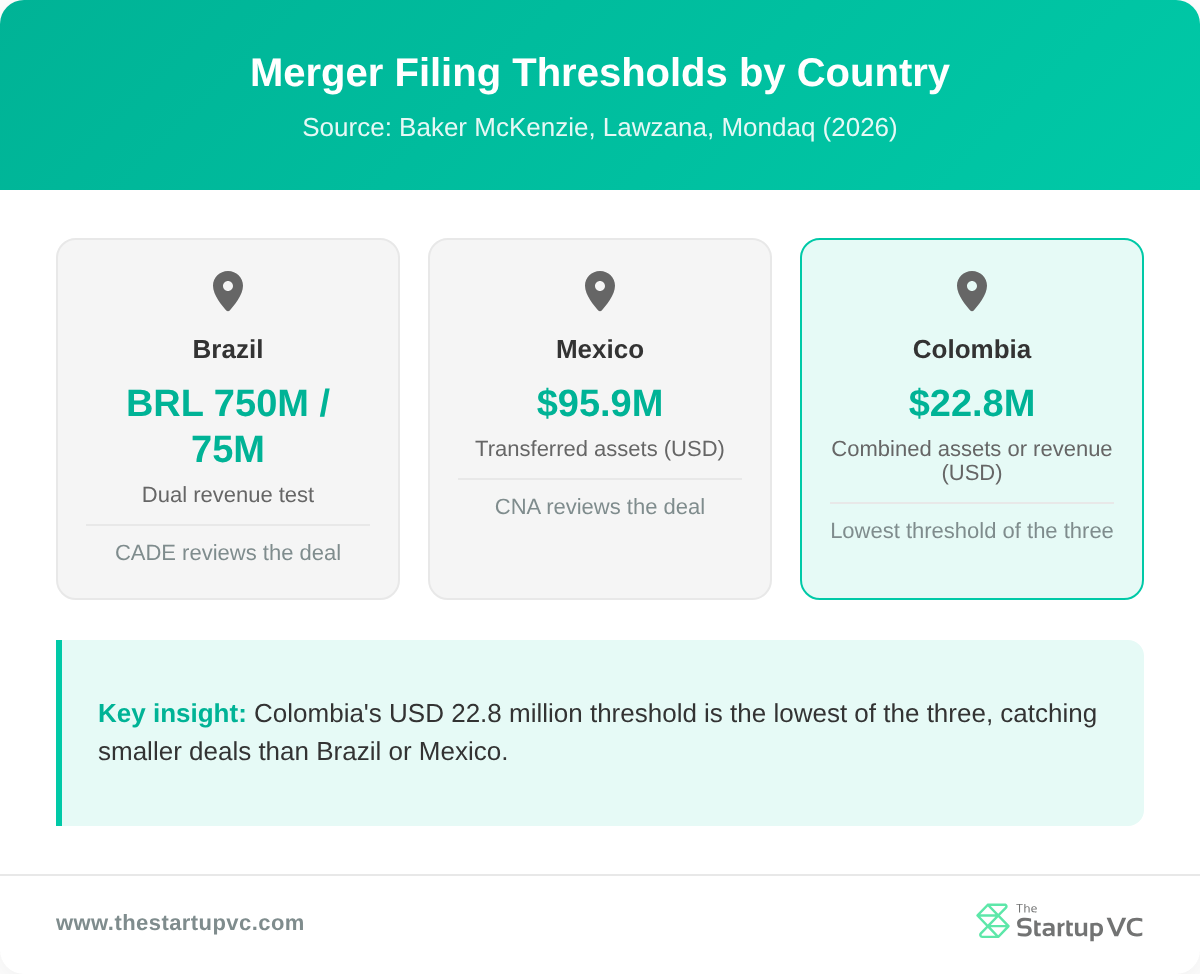
The merger filing thresholds in Brazil, Mexico, and Colombia are set by each country’s antitrust authority. All three test combined revenue or assets against a fixed cutoff. Deals below the threshold generally close without a mandatory filing.
| Country | Threshold (2026) | Recent Change |
|---|---|---|
| Brazil | One group over BRL 750 million, the other over BRL 75 million | CADE reaffirmed a broad filing standard for foreign-to-foreign deals in July 2026 |
| Mexico | About USD 95.9 million in transferred assets | Thresholds cut 12-17%, two prior exemptions removed in the 2026 reform |
| Colombia | 7,074,307.43 UVB, about USD 22.8 million | SIC set new tiered filing fees up to COP 53.9 million, about USD 14,864 |
Colombia’s SIC charges fees between COP 37.7 million and COP 53.9 million based on deal size. Mexico’s CNA received more than 100 merger notifications by May 2026. It is on pace to exceed 200 filings for the year.
What Are the Main Steps to Filing for Merger Control Approval in Latin America?
The main steps to filing for merger control approval are notification, review, and clearance. Each country adds its own forms and fee schedule on top of this base process. Timelines vary sharply between jurisdictions.
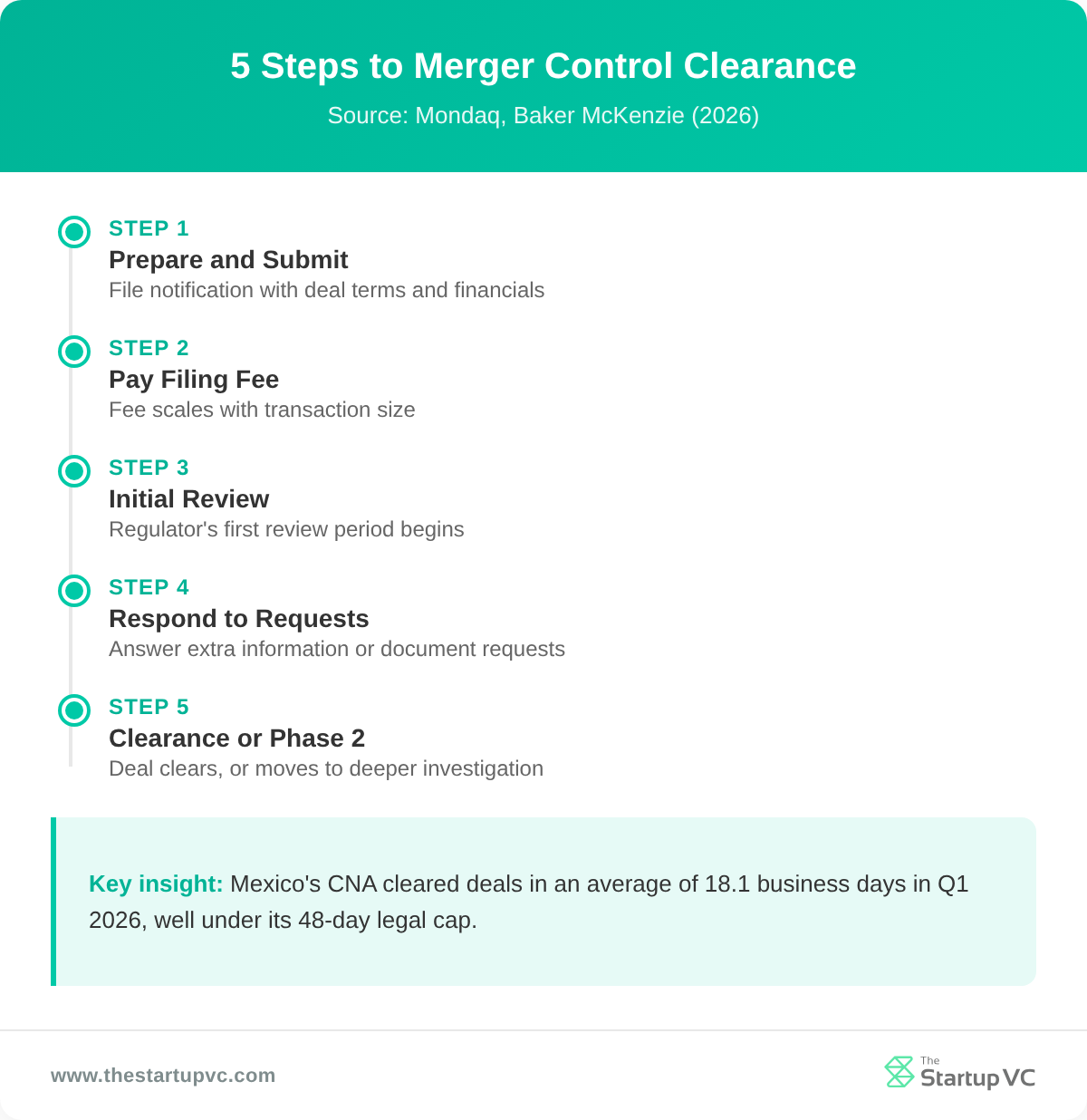
A typical filing follows these steps:
- Prepare and submit the notification form with deal terms and financial data.
- Pay the required filing fee, which scales with transaction size.
- Wait through the regulator’s initial review period.
- Respond to any requests for extra information or documents.
- Receive clearance, or move into an in-depth second-phase investigation.
Review speed differs by country. Brazil’s CADE clears fast-track deals in about 30 days, but complex cases can take up to 330 days. Mexico’s CNA averaged 18.1 business days in the first quarter of 2026, against a legal cap of 48 business days. Argentina’s ANC has up to 45 business days to decide if a deal qualifies for its summary procedure.
Merger control review runs alongside broader M&A due diligence in Latin America. Deal teams often coordinate both tracks at once to avoid delays.
What Happens If You Close a Deal Without Antitrust Approval in Latin America?
Closing a deal without antitrust approval in Latin America triggers fines and possible deal unwinding. Regulators call this practice gun jumping. Every major Latin American jurisdiction punishes it.
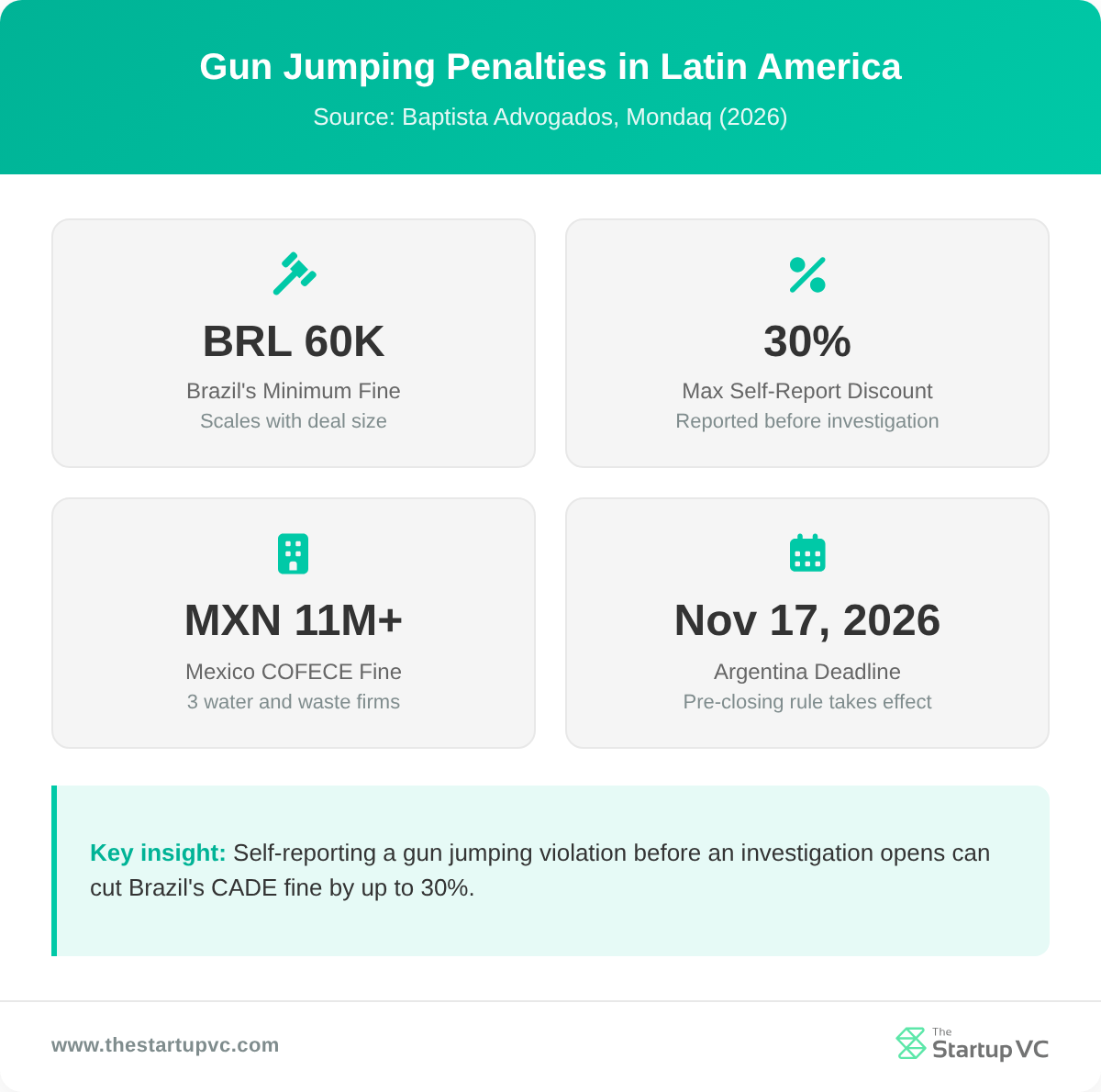
Gun jumping carries several concrete consequences:
- Fines starting at BRL 60,000 in Brazil, scaling up with deal size, group turnover, and delay before CADE’s decision.
- Reduced penalties of 20% to 30% for parties that self-report before or during an investigation.
- Forced deal unwinding or divestment orders in serious cases.
- Delayed or blocked closing until the regulator issues formal clearance.
CADE has fined companies over BRL 700,000 for closing before clearance and over BRL 500,000 for skipping notification entirely. Mexico’s COFECE fined three water and waste management firms more than 11 million pesos. The firms failed to complete the merger notification process. Argentina’s pre-closing regime, effective November 17, 2026, adds higher maximum fines for non-notified deals.
What Questions Do Dealmakers Ask Most Often About Latin American Merger Control?
How Much Does a Merger Control Filing Cost in Latin America?
A merger control filing in Colombia costs between USD 10,402 and USD 14,864, based on deal size. Brazil, Mexico, and Argentina set their own separate fee schedules tied to transaction value.
How Long Does Merger Control Review Take?
Merger control review takes anywhere from 18 days to 330 days. Mexico’s CNA averaged 18.1 business days in early 2026. Brazil’s CADE can take up to 330 days for complex, second-phase investigations.
Can a Deal Close Before Antitrust Approval in Latin America?
You cannot close a notifiable deal before approval in Brazil, Chile, Mexico, or Colombia. Argentina’s pre-closing rule takes full effect on November 17, 2026. Closing early risks gun jumping fines in every one of these markets.
Which Latin American Country Has the Strictest Merger Control Regime?
Brazil currently applies the strictest standard among major Latin American markets. CADE reaffirmed a broad, conservative filing test for foreign-to-foreign deals in July 2026. Mexico’s 2026 reform also tightened its thresholds and removed prior exemptions.
Do Cross-Border Deals Need Separate Filings in Each Latin American Country?
Yes, cross-border deals need separate filings in each country where a threshold is triggered. Clearance in Brazil does not cover Mexico, Colombia, Chile, or Argentina. Dealmakers must map every jurisdiction where the target or buyer has revenue.
What Is the Difference Between Pre-Closing and Post-Closing Merger Review?
The difference is timing. Pre-closing review requires clearance before parties finalize a deal. Post-closing review lets parties close first and notify the regulator afterward. Argentina is shifting from post-closing to pre-closing review by November 2026.
Ready to Navigate Merger Control for Your Latin America M&A Deal?
Merger control adds real complexity to any Latin America transaction. The Startup VC is Craig Dempsey’s family office and company builder, backing ventures built to grow across Latin America. Our team draws on hands-on experience closing deals in Brazil, Mexico, Colombia, Chile, and Argentina.
We help founders and investors map filing thresholds, timelines, and fees before they sign. Skip the guesswork on antitrust risk for your next Latin America deal. Contact us today to plan your merger control strategy.