
Buying a payroll company in Latin America gives you recurring revenue and sticky client contracts, in a regional EOR market worth about USD 235 million in 2025.
Latin America’s payroll and EOR sector is consolidating fast. The global payroll services market will reach USD 18.24 billion by 2030, up from USD 12.94 billion in 2024. Buyers target SaaS platforms, services firms, and EOR providers with recurring contracts across Brazil, Mexico, and Colombia.
This guide draws on The Startup VC’s experience building and backing service companies across Latin America. Below, you will find target types, valuation methods, country licensing rules, and the competitive moves of Deel, Remote, and Multiplier. You will also get a step-by-step acquisition process for buyers.
Why Is the Payroll and EOR Market in Latin America Consolidating?
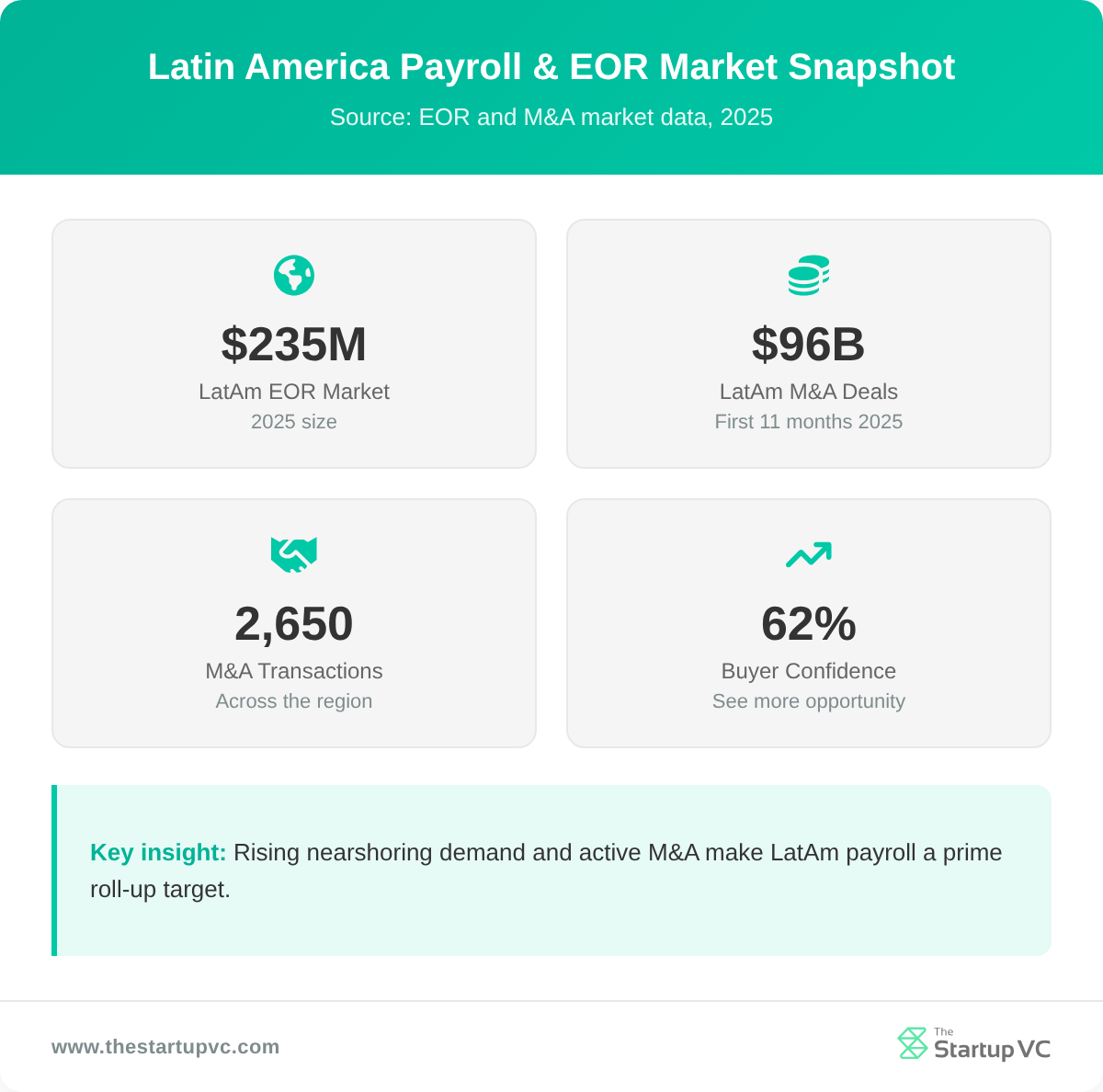
The payroll and EOR market in Latin America is consolidating because demand is rising while supply stays fragmented. US companies want to hire in the region. Nearshoring drives this demand. The regional EOR market reached about USD 235 million in 2025.
Several forces push buyers toward roll-ups in this sector:
- Strong market growth. Global payroll services will hit USD 18.24 billion by 2030, up from USD 12.94 billion in 2024.
- Active deal flow. Over 19 strategic EOR acquisitions happened globally in 2023, including platform buyouts and payroll automation deals.
- A regional M&A boom. Latin America saw about 2,650 M&A deals worth nearly USD 96 billion in the first 11 months of 2025.
- Buyer confidence. Around 62% of business leaders believe regional M&A opportunities have never been greater.
This sector roll-up follows the same logic as other regional plays. For broader context, read our guide on how to buy a company in Latin America. Many small payroll firms operate in just one country. A buyer can combine them into a multi-country platform.
What Types of Payroll Companies Can You Acquire in Latin America?
The payroll companies you can acquire in Latin America include SaaS platforms, payroll services firms, and EOR providers. Each type carries a different revenue mix. That mix shapes both the price and the risk of a deal.
The three target types differ in how they make money and how they scale:
| Target Type | Revenue Model | Margin Profile |
|---|---|---|
| SaaS payroll platform | Software priced per employee | High margin, high recurring |
| Payroll services firm | Managed payroll run for clients | Lower margin, labor-heavy |
| EOR provider | Legal employer fees per worker | Recurring, compliance-driven |
SaaS payroll platforms sell self-serve software. Clients pay a fee per employee each month. These firms carry high gross margins and strong recurring revenue. Payroll services firms run payroll for clients as a managed service. They blend software with labor, so margins are lower.
EOR providers hire workers through their own local entity. They act as the legal employer. They handle compliance to avoid Permanent Establishment risk. Deel shows the scale this model can reach. It processes USD 22 billion in annual payroll across 150 countries for 37,000 clients. Multiplier uses flat-rate EOR pricing, which produces clean recurring revenue for an acquirer. The B2B services sector offers many such targets. See our overview of the B2B services sector in Latin America for the wider landscape.
How Do You Value a Payroll Company in Latin America?
You value a payroll company in Latin America by applying a revenue multiple to its recurring revenue, then adjusting for retention and growth. SaaS payroll firms trade at 6 to 7 times ARR. Services-heavy firms trade lower, often on EBITDA.
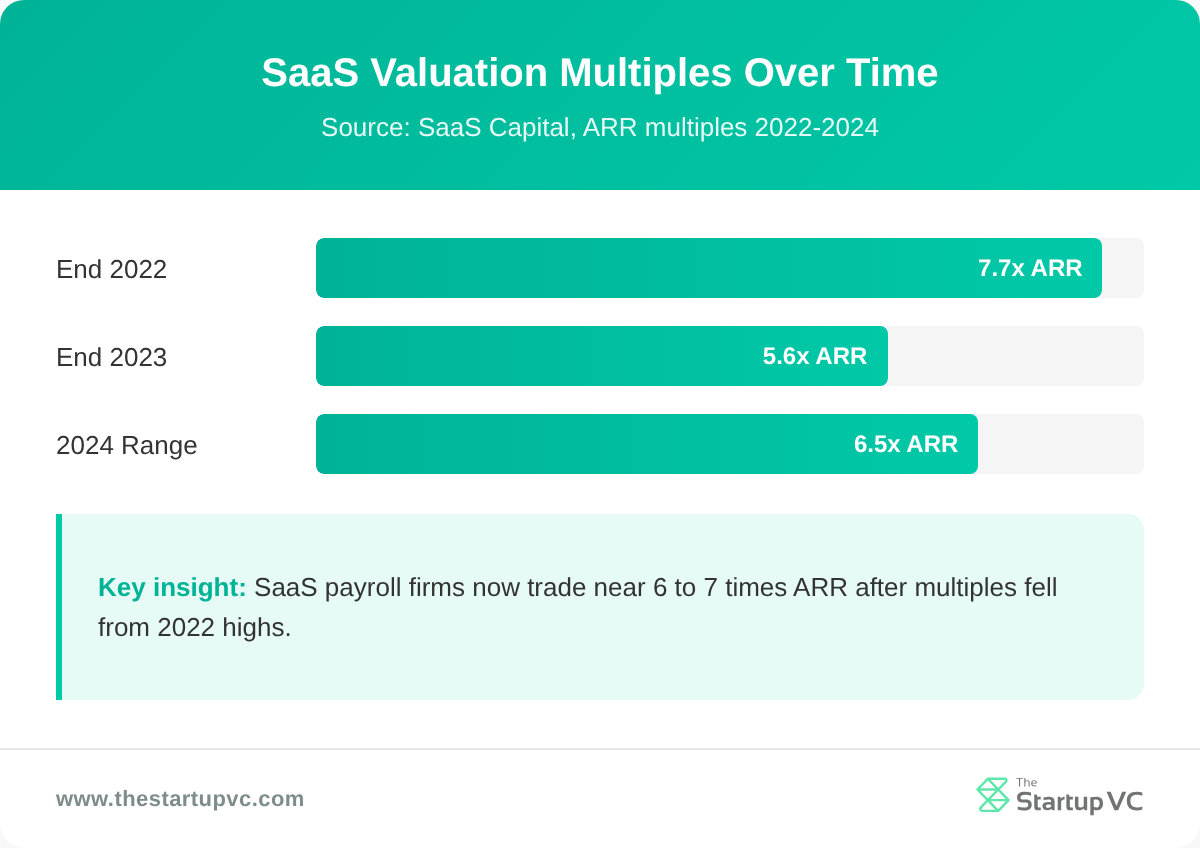
The ARR multiple is the core SaaS valuation ratio. It compares enterprise value to annual recurring revenue. Multiples fell from 7.7x ARR at the end of 2022 to 5.6x by the end of 2023. They have since stabilized in the 6 to 7x range. Revenue mix matters here. SaaS payroll grows near 9% a year, while services payroll grows about 6%.
Two metrics drive the multiple a buyer will pay:
- Net Revenue Retention (NRR). High NRR signals loyal customers who spend more over time. It justifies a higher multiple.
- Churn. Low churn shows sticky contracts. It also lifts the price a buyer accepts.
Buyers should review 3 to 5 years of financial statements. This helps establish patterns and detect anomalies. To go deeper on multiples and methods, read our guide on how to value a company in Latin America.
What Regulatory and Licensing Issues Affect Payroll Acquisitions?
Regulatory and licensing issues affect payroll acquisitions because each country sets its own labor rules. A buyer inherits these duties on close. Every EOR must hold a registered local legal entity per country. This entity employs workers compliantly.
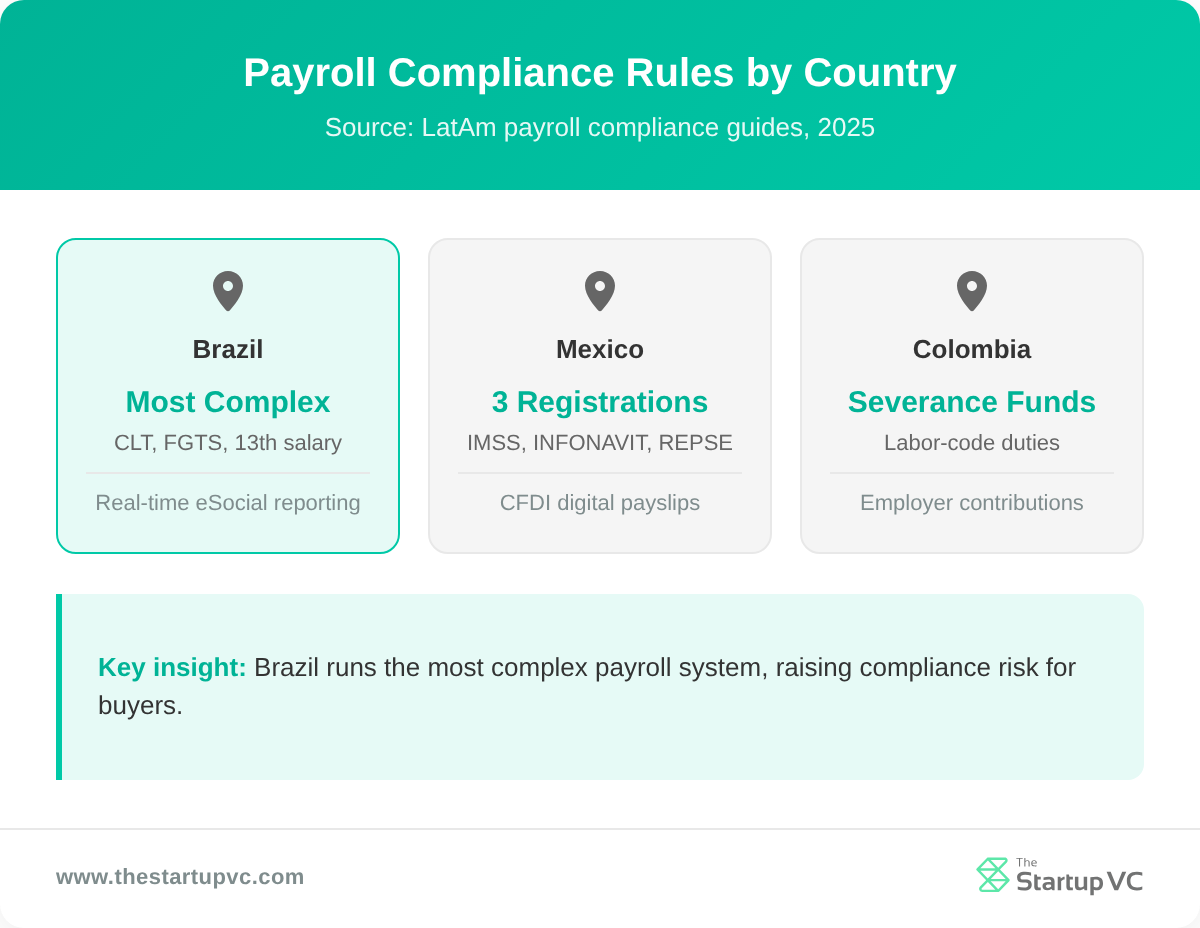
Compliance rules vary widely across the region’s three largest markets:
| Country | Key Requirements |
|---|---|
| Brazil | CLT contracts, FGTS deposits, 13th salary, eSocial reporting |
| Mexico | IMSS, INFONAVIT, REPSE registration, CFDI payslips |
| Colombia | Severance fund contributions, labor-code duties |
Brazil runs the most complex payroll system in Latin America. It mandates CLT contracts, FGTS deposits, and a 13th salary. It also requires real-time eSocial reporting to tax authorities. Mexico needs IMSS, INFONAVIT, and REPSE registration plus CFDI digital payslips. Colombia enforces severance fund contributions on employers.
Compliance risk shapes due diligence. Informality runs at about 47.6% across the region. Regulators are intensifying enforcement of formal compliance. A buyer must confirm the target holds valid licenses in every country it serves.
How Do Deel, Remote, and Multiplier Shape the Competitive Landscape?
Deel, Remote, and Multiplier shape the competitive landscape by setting price benchmarks and buying smaller firms. Deel leads on scale. It raised USD 300 million in a 2025 Series E at a USD 17.3 billion valuation. It surpassed USD 1 billion ARR in early 2025.
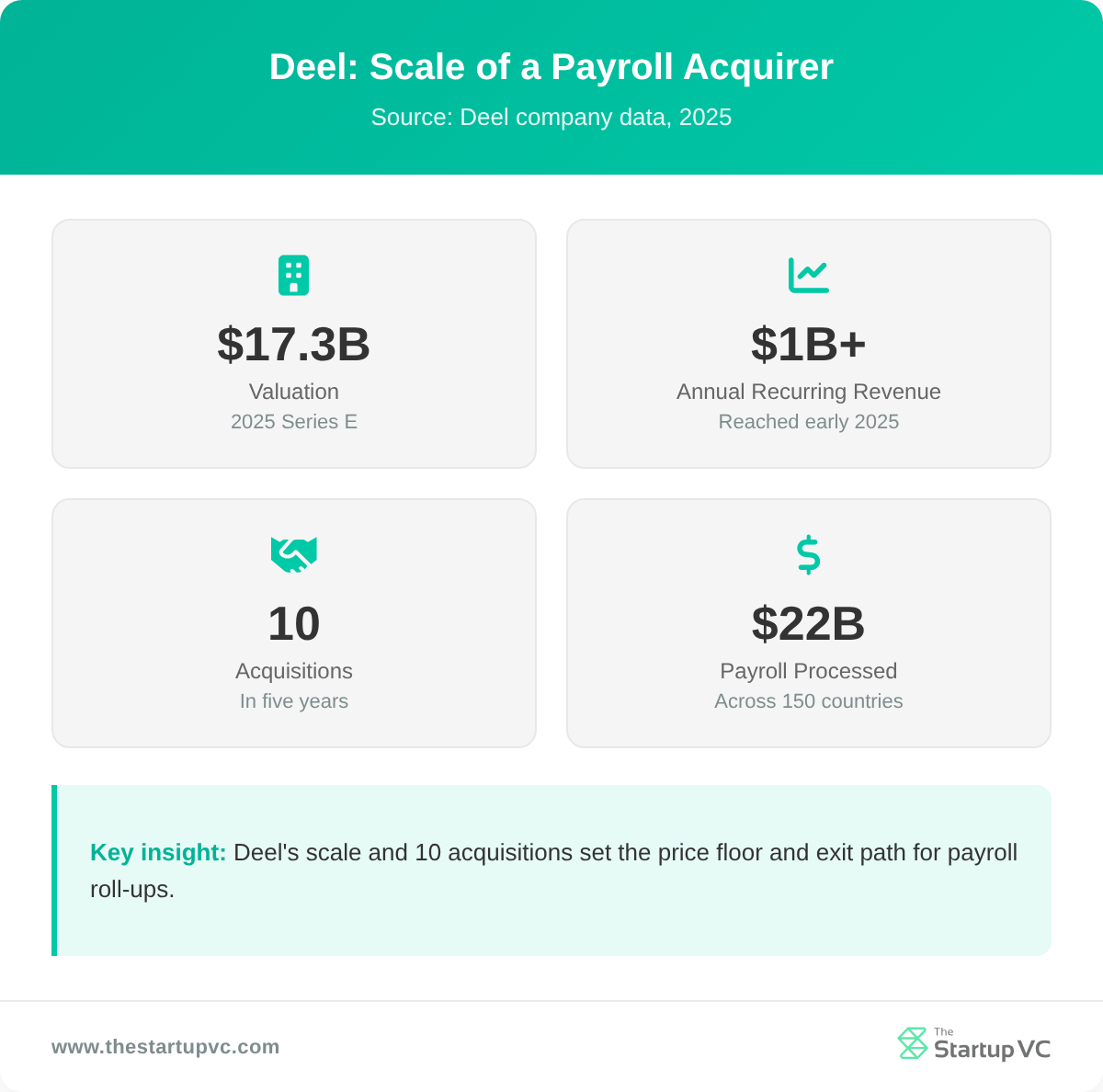
Deel is the most active acquirer in this space. It completed 10 acquisitions in five years. These include Safeguard Global’s payroll division, Zavvy, and Omnipresent. It also bought PaySpace, which runs native payroll in 44 countries. Deel hit three straight years of profitability. It reached its first USD 100 million revenue month in September 2025.
The major platforms compete on different strengths:
- Deel. Largest scale and the most aggressive buyer of payroll firms.
- Globalization Partners. Added 18 new jurisdictions in 2025 and grew users 22% in six months.
- Multiplier. Competes on flat-rate pricing and strong compliance coverage.
These dynamics matter for any buyer. The big platforms set the price floor for small targets. They also create exit paths, since a roll-up can later sell to Deel or Remote.
What Are the Main Steps to Buy a Payroll Company in Latin America?
You buy a payroll company in Latin America by following five clear steps, from sourcing targets to integration. The process starts with finding firms and ends with keeping their clients. Due diligence and retention planning sit at the center.
Follow these five steps to complete a payroll acquisition:
- Source targets. Find single-country payroll or EOR firms with recurring contracts and clean compliance records.
- Run due diligence. Review 3 to 5 years of financials. Confirm all payroll, sales, and corporate tax filings are current.
- Value and structure the deal. Apply an ARR multiple for SaaS revenue. Use EBITDA for services revenue.
- Plan retention before announcing. Build a list of key client threats, response strategies, and timelines.
- Integrate and retain staff. Keep the target’s sales and service teams. They hold the client relationships.
Communication is the most important retention step. Inform customers early. Explain what changes to expect. Retaining the target’s sales, marketing, and service staff keeps acquired customers. The Startup VC backs founders through this full process. Learn more about our investment focus for LatAm service companies.
What Questions Do Buyers Ask Most Often About Payroll Company Acquisitions?
How Much Does a Payroll Company Cost to Acquire in Latin America?
A payroll company costs a multiple of its recurring revenue. SaaS payroll firms trade at 6 to 7 times ARR. Services-heavy firms trade lower, often on EBITDA. Retention and growth rates move the final price.
What Is the Difference Between a Payroll Company and an EOR?
A payroll company runs payroll for clients who employ their own staff. An EOR acts as the legal employer itself. The EOR hires through its own local entity. It carries more compliance duties and more risk.
How Long Does a Payroll Acquisition Take?
A payroll acquisition takes several months from sourcing to close. Due diligence drives the timeline. A buyer reviews 3 to 5 years of financials and confirms licenses in each country. Multi-country deals take longer.
Why Is Recurring Revenue So Important in Payroll Deals?
Recurring revenue is important because it makes earnings predictable. Payroll contracts renew month after month. High retention and low churn raise the valuation multiple a buyer will pay.
Which Countries Are Hardest for Payroll Compliance?
The hardest country for payroll compliance is Brazil. It requires CLT contracts, FGTS deposits, a 13th salary, and eSocial reporting. Mexico and Colombia add their own registration and severance rules.
Ready to Acquire a Payroll Company in Latin America?
The Startup VC is Craig Dempsey’s family office and company builder. We create, back, and guide scalable ventures across Latin America. Our team brings operational playbooks, regional networks, and deep compliance experience to every deal. We help founders source targets, run diligence, and integrate payroll and EOR firms across the region. If you plan to buy or build a payroll company in Latin America, we offer practical, hands-on support. Contact us today to start the conversation.