Latin America’s BPO market reached USD 14.07 billion in 2024 and grows near 9% a year, making nearshore contact center acquisitions a fast-rising M&A category.
Buying a BPO company in Latin America means acquiring seats, contracts, and bilingual agents in markets like Colombia and Mexico. High-performing BPOs trade at 6-10x EBITDA. Deals close in 6 to 9 months from a signed letter of intent.
The Startup VC is Craig Dempsey’s family office and company builder, with portfolio firm Biz Latin Hub operating across 17 Latin American countries. This guide covers nearshoring tailwinds, due diligence checks, valuation multiples, deal steps, and the main risks of a nearshore contact center deal.
Why Is Latin America a Hot Market for BPO Acquisitions?
Latin America is a hot market for BPO acquisitions because nearshoring demand and a multilingual talent pool are driving fast revenue growth. North American buyers want timezone-aligned teams and lower costs. The region delivers both.
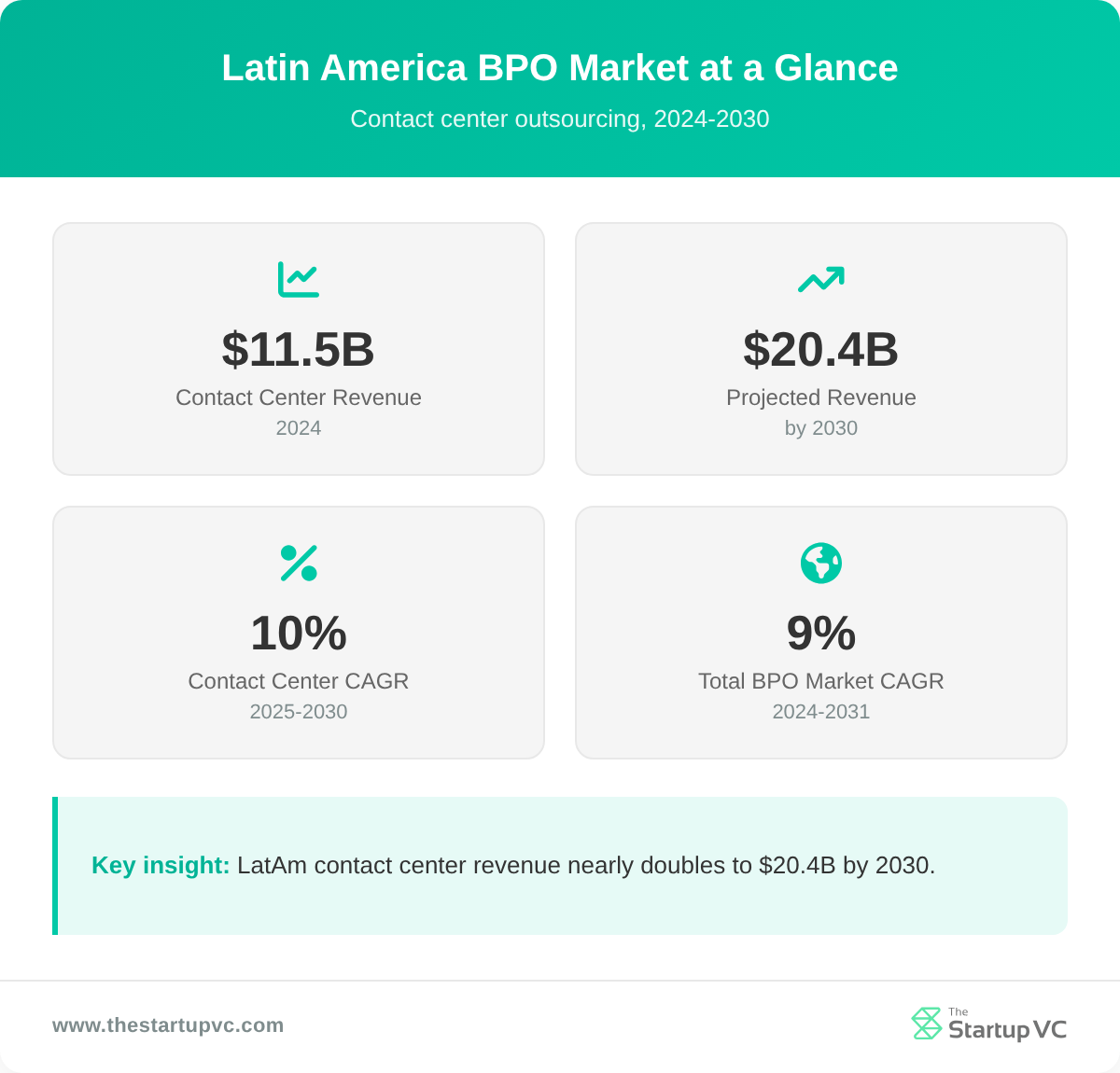
The numbers show strong momentum across the sector. The Latin America call and contact center outsourcing market generated USD 11.5 billion in 2024. It is projected to reach USD 20.4 billion by 2030 at a 10% yearly growth rate. The broader BPO market sat at USD 14.07 billion in 2024.
Several forces make this category attractive to acquirers:
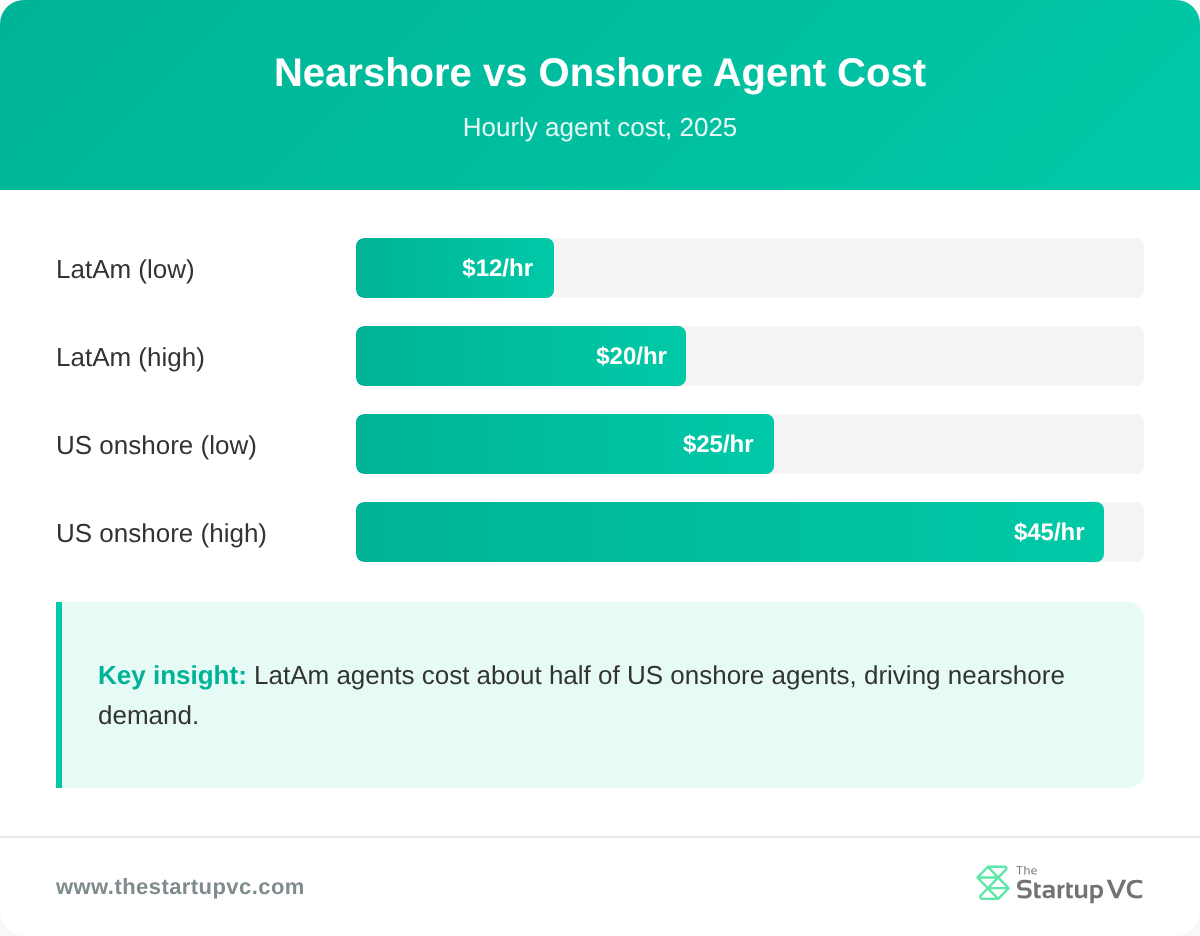
- Cost gap. LatAm agents run $12-20 per hour. US onshore agents cost $25-45 per hour.
- Bilingual supply. Colombia and Mexico offer large pools of neutral-accent English speakers.
- Timezone fit. Business hours overlap with US East Coast operations.
- Active deal market. BPO M&A stays strong despite automation worries, led by nearshore expansion.
Big operators show where the market is heading. Teleperformance is the world’s largest BPO with 410,000+ employees and $8.2 billion in 2024 revenue. Atento is the largest CRM and BPO provider in Latin America. TaskUs and Alorica have scaled fast across Mexico and Colombia. Their growth signals deep buyer interest in regional roll-ups. For broader context, see our overview of the B2B services sector in Latin America.
What Should You Check Before You Buy a BPO Company in Latin America?
You should check seat capacity, customer concentration, USD revenue mix, attrition, and language capability before you buy a BPO company in Latin America. These five items decide whether the revenue is durable. Skipping any one of them can hide a deal-breaking risk.
How Do Seat Capacity and Utilization Affect the Deal?
Seat capacity and utilization affect the deal by setting the real revenue ceiling of the business. A seat is one agent workstation. The industry seat utilization standard sits near 1.7, and strong operations run 70-80% utilization.
Low utilization means idle seats and wasted rent. High utilization with no spare seats means growth needs new capital. Check the lease terms and the cost to add seats. Workstation hardware runs $1,500-$3,000 per agent. CRM platforms cost about $150 per seat each month.
Why Does Customer Concentration Matter So Much?
Customer concentration matters because too much revenue from too few clients raises risk and lowers the price. One client leaving can wipe out the margin. Buyers and private equity firms treat this as a top diligence factor.
Map every client to its share of total revenue. A target where one client drives over 30% of revenue carries real danger. Spread revenue across many long-term, name-brand clients supports a higher valuation.
How Do USD Revenue Mix, Attrition, and Language Capability Compare?
USD revenue mix, attrition, and language capability each protect different parts of the business. USD contracts protect revenue value. Low attrition protects service quality. Strong English protects client retention.
| Check | What good looks like | Why it matters |
|---|---|---|
| USD revenue mix | High share of dollar contracts | Shields revenue from peso swings |
| Attrition | Well below the 100% near-shore norm | Keeps trained agents and quality high |
| Language capability | Neutral-accent bilingual agents | Holds US client contracts |
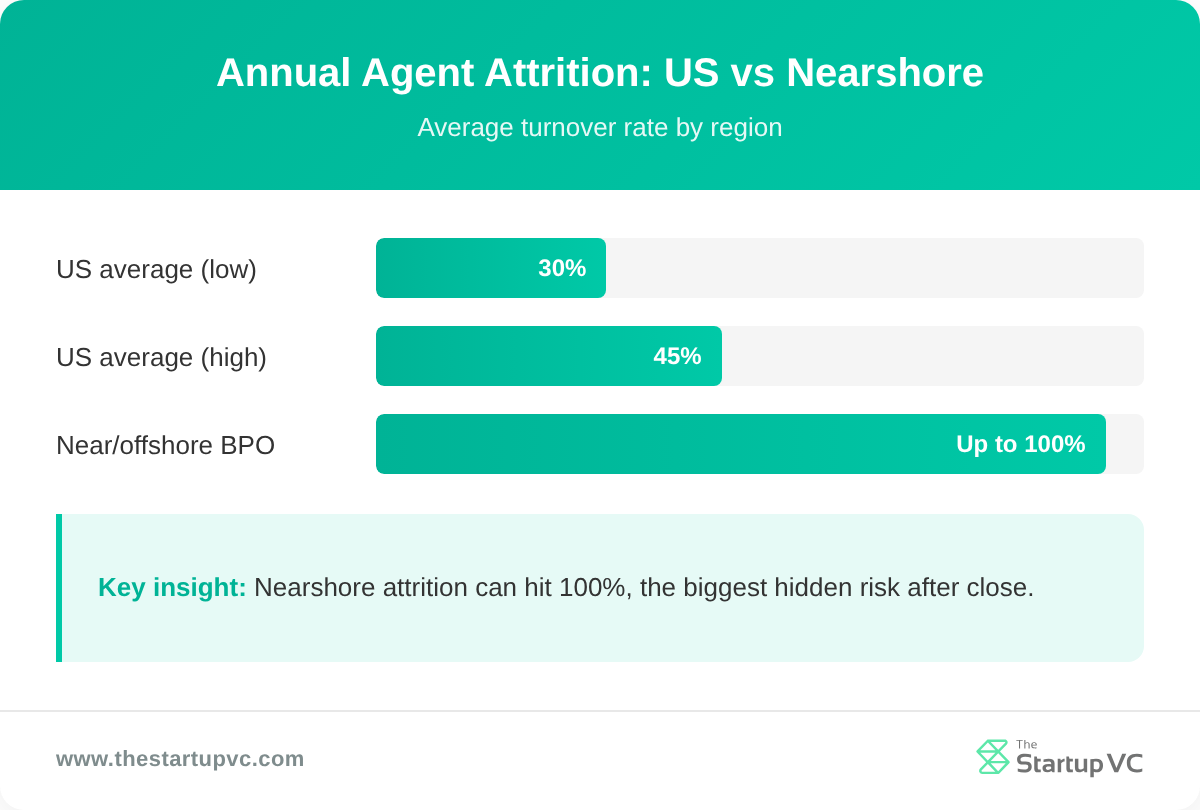
Attrition is the biggest hidden threat. Near and offshore BPO turnover can approach 100%, against a 30-45% average US rate. Also review core metrics like CSAT, first-contact resolution, and average handle time.
How Do You Value a BPO Company in Latin America?
You value a BPO company in Latin America by applying an EBITDA multiple adjusted for contract quality and risk. High-performing BPOs trade at 6-10x EBITDA. They can also trade at 1.5-3.0x revenue, based on sector focus, contract length, and ability to grow.
Several drivers move the multiple up or down. Buyers weigh longevity, profit stability, contract strength, and client concentration. They also weigh growth, geography, management depth, and technology. A long roster of name-brand clients and a strong pipeline push the number higher.
Unit economics anchor the math under the multiple. Labor makes up 60-75% of operating costs. Cost per seat in the Philippines runs about US$18,086 per year, a useful nearshore benchmark. USD-denominated contracts add value because they hold their worth when local currencies fall.
These factors combine into a simple valuation view:
- Revenue quality. USD and recurring contracts beat one-off peso work.
- Margin. Higher EBITDA margins earn higher multiples.
- Concentration. Diversified clients reduce the risk discount.
- Growth. A filled sales pipeline lifts the price.
The same EBITDA logic applies across the region’s service sectors. To go deeper on the method, read our guide on how to increase the valuation of a services company in Latin America.
What Are the Main Steps to Acquire a BPO Company in Latin America?
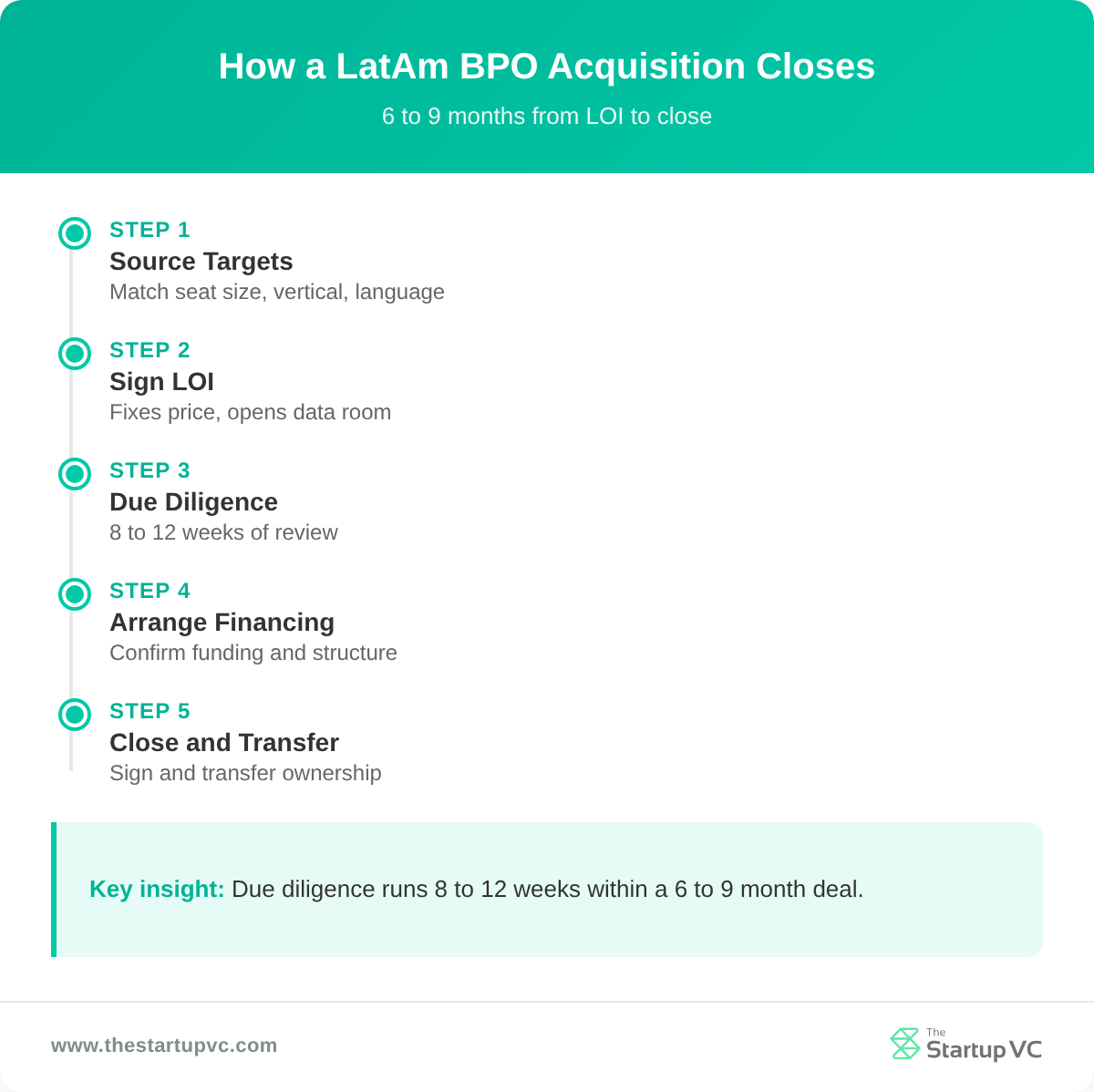
You acquire a BPO company in Latin America by moving through five clear steps from search to close. A mid-market deal takes 6 to 9 months from a signed letter of intent. Antitrust review can add 30 to 90 days.
The process follows a standard M&A path adapted for the region:
- Source targets. Build a list of BPOs that fit your seat size, vertical, and language needs.
- Sign an LOI. The letter of intent fixes price, structure, earnout terms, and rolling equity. It also opens the data room.
- Run due diligence. Buyers spend 8 to 12 weeks on commercial, financial, tax, legal, labor, and operational review.
- Arrange financing. Confirm funding and final deal structure before signing.
- Close and transfer. Sign the purchase agreement, meet closing conditions, and transfer ownership.
Foreign buyers face extra layers in Latin America. You can own 100% in nearly all sectors. Still, you must handle FDI rules, foreign exchange controls, and labor law differences. Local counsel is not optional, since language and culture slow diligence. For the full buy-side framework, see our guide on how to buy a company in Latin America.
What Risks Come With Buying a Nearshore BPO Company?
Buying a nearshore BPO company carries risks from attrition, currency swings, client concentration, and labor law. Each risk can shrink the value you paid for. Smart buyers price these risks into the deal before closing.
The main risks cluster into four areas:
- Attrition. Near and offshore turnover can reach nearly 100%, hurting quality after close.
- Currency. FX moves can shift outsourcing costs by 5-15% and compress margins on peso work.
- Concentration. Heavy reliance on a few clients makes revenue unpredictable.
- Labor law. Payroll, social security, severance, and union exposure all need close review.
Currency risk deserves extra attention in this region. Contracts without FX adjustment clauses create one-sided losses when local money weakens. A falling vendor currency can force renegotiation or drive staff to quit. Check whether client contracts pass FX risk through to the customer.
Labor exposure is the other quiet danger. Latin American severance and social security rules can create large hidden liabilities. A full labor assessment protects you from post-close surprises.
What Questions Do Buyers Ask Most Often About Buying a BPO Company in Latin America?
How much does it cost to buy a BPO company in Latin America?
A BPO company in Latin America costs 6-10x EBITDA for high performers. It can also price at 1.5-3.0x revenue. The final number depends on contract quality, client mix, and growth.
How long does a nearshore BPO acquisition take?
A nearshore BPO acquisition takes 6 to 9 months from a signed letter of intent to close. Antitrust review can add 30 to 90 days. Due diligence alone runs 8 to 12 weeks.
Can foreign buyers own 100% of a BPO in Latin America?
Yes. Foreign buyers can own 100% of a BPO in nearly all Latin American sectors. You still need to manage FDI rules, FX controls, and local labor law. Local counsel is essential.
What is the most important due diligence check?
The most important due diligence check is customer concentration. One client holding over 30% of revenue creates serious risk. Spread revenue across many clients supports a safer, higher-value deal.
Why does attrition matter when buying a contact center?
Attrition matters because high turnover destroys service quality and raises hiring costs. Near and offshore BPO attrition can reach almost 100%. Low attrition signals stable, trained teams worth paying for.
Which countries lead nearshore BPO in Latin America?
The leading nearshore BPO countries are Mexico and Colombia. Both offer large bilingual pools and US timezone overlap. Operators like TaskUs and Alorica run major sites in these markets.
Ready to Acquire a BPO Company in Latin America?
The Startup VC is Craig Dempsey’s family office and company builder, creating and backing scalable ventures across Latin America. We bring hands-on operational experience, regional team networks, and deep compliance knowledge to BPO and contact center deals. Our team helps you source targets, run sharp due diligence, and structure deals that hold up after close. Explore our investment focus to see how we partner on LatAm acquisitions. Ready to move on a nearshore BPO target? Contact us today.