
Post-merger integration in Latin America works best with a 100-day plan, since Day-1 synergy tracking drives 92% success rates.
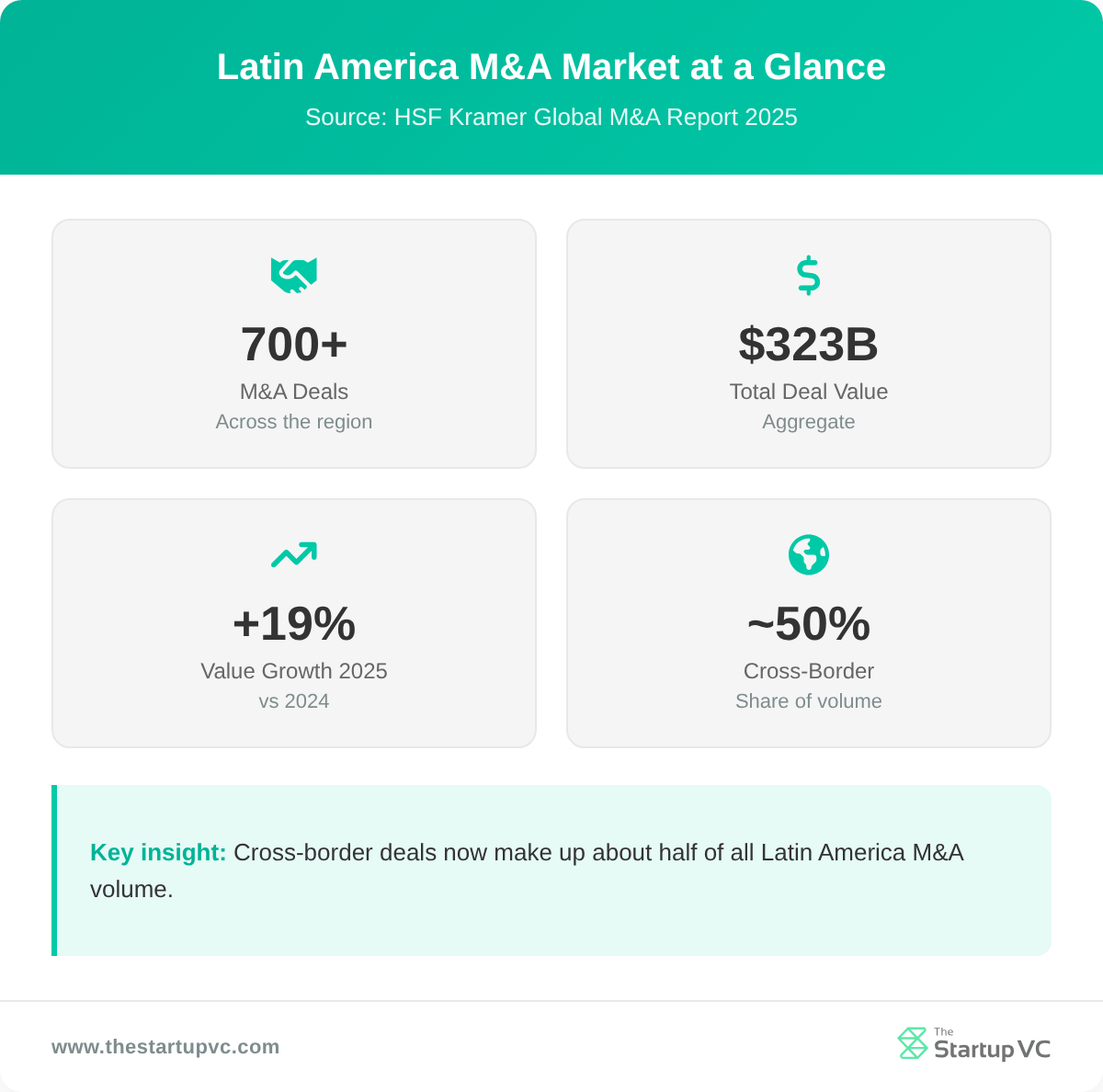
Latin America recorded over 700 M&A deals worth nearly $323 billion in recent years. Cross-border deals made up about 50% of 2025 volume. Inbound activity grew 45% by value to $40.6 billion.
The Startup VC has built and scaled ventures across 17 Latin American countries through Biz Latin Hub. This guide covers the 100-day plan, multi-country payroll, ERP consolidation, finance reporting, and cultural integration across LatAm jurisdictions.
What Is Post-Merger Integration in Latin America?
Post-merger integration (PMI) is the phase after closing when you combine the acquirer and target to capture value. It turns deal projections into real results. In Latin America, this means uniting teams and systems across many countries at once.
PMI captures two kinds of synergy:
- Cost synergies. You consolidate offices, streamline processes, and remove duplicate roles.
- Revenue synergies. You cross-sell products, win new customers, and expand into new markets.
Most integration work splits into functional workstreams. These cover Finance, HR, IT, Sales, and Operations. Two more streams handle customer management and communication. A final stream owns Day 1 readiness and business continuity.
An Integration Management Office (IMO) coordinates all of this. The IMO links executive leaders to each operational workstream. It tracks owners, dates, and decisions in one place.
Latin America makes PMI both attractive and complex. The region recorded over 700 M&A deals worth close to $323 billion. Cross-border deals made up about half of 2025 volume. Each deal can span Mexico, Brazil, Colombia, Chile, and more.
Why Do M&A Integrations Fail in Latin America?
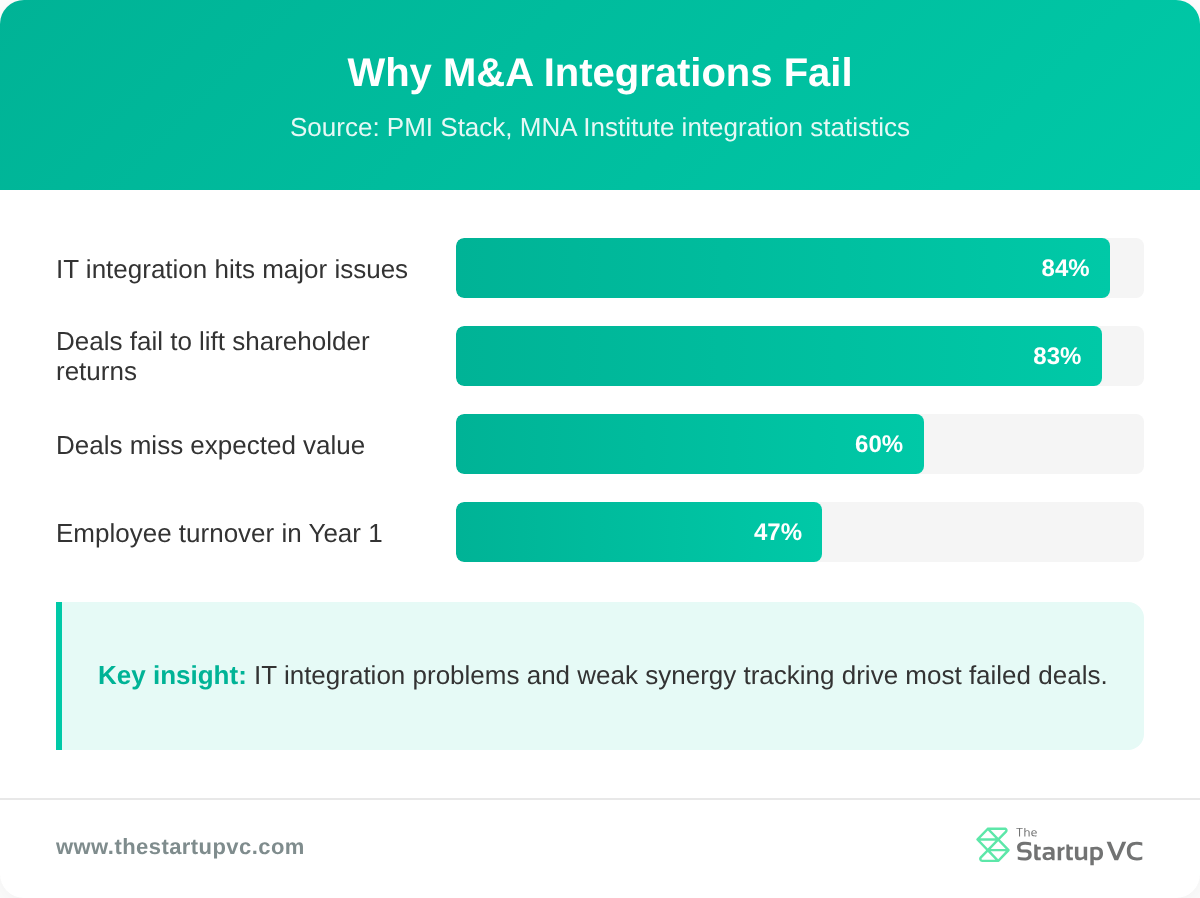
M&A integrations fail in Latin America because teams underestimate country-level complexity. About 60% of global M&A deals fail to create their expected value during integration. The fragmented LatAm legal map raises that risk further.
Five problems cause most failures across the region:
- No unified labor code. Each country sets its own labor law and tax rules. What works in Mexico can trigger fines in Brazil.
- Disconnected ERP systems. Separate systems slow the financial close and reporting. This causes poor data quality and compliance risk.
- Weak cultural integration. Poor cultural work drives turnover among key employees. Employee turnover hits 47% in Year 1.
- Failed IT integration. IT integrations fail or hit major issues 84% of the time.
- No synergy tracking. Many teams never measure synergies after close. Then 83% of deals fail to boost shareholder returns.
These risks compound in multi-country deals. A payroll error in one country does not stay contained. It can stall the whole integration and delay value capture.
The Startup VC has navigated these jurisdictions firsthand. You can review the firm’s portfolio of venture companies operating across the region.
How Do You Build a 100-Day Integration Plan for a LatAm Acquisition?
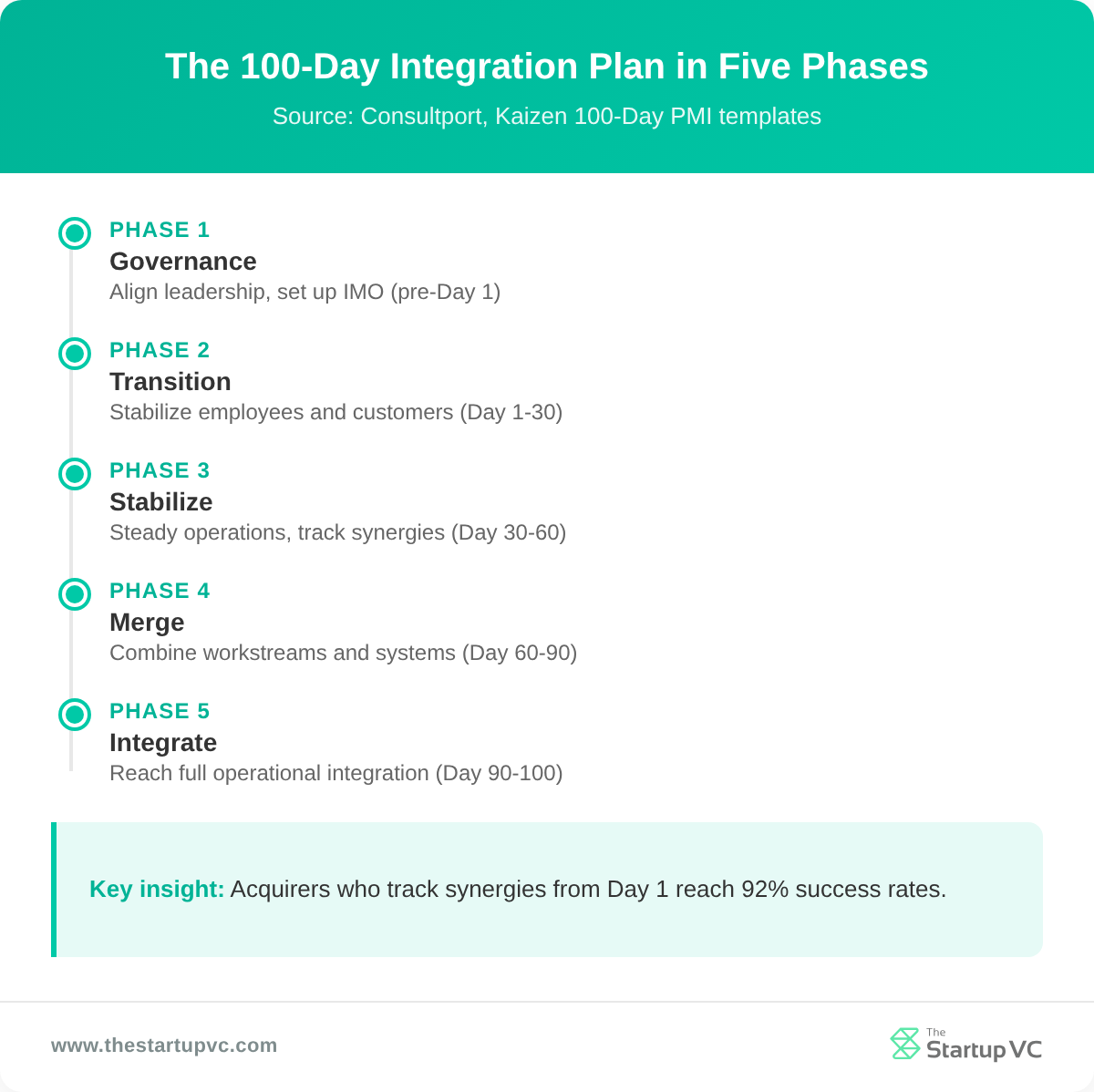
You build a 100-day integration plan by setting up governance first, then sequencing five phases. The plan runs across the first three to four months after close. It aligns operations, cultures, and processes to capture synergies fast.
Start before Day 1 with three core moves:
- Name an Integration Lead and deputy. Give them clear authority over every workstream.
- Stand up an IMO tracker. List every task with an owner and a date.
- Create a single Decision Log. Record every decision from Day 1 through Day 100.
A strong 100-day plan moves through five phases. The table below shows each phase and its focus.
| Phase | Focus | Timing |
|---|---|---|
| 1. Governance | Align leadership and set up the IMO | Pre-close to Day 1 |
| 2. Transition | Stabilize employees and customers | Day 1 to Day 30 |
| 3. Stabilize | Steady operations and track early synergies | Day 30 to Day 60 |
| 4. Merge | Combine workstreams and systems | Day 60 to Day 90 |
| 5. Integrate | Reach full operational integration | Day 90 to Day 100 |
Day 1 has three goals: take control, communicate, and protect business continuity. You run Day 1 runbooks for each country. You reassure top accounts and confirm service continuity. This step is similar to the planning you do when you buy a company in Latin America.
Governance keeps the plan on track. A Steering Committee meets every two weeks. It includes the CEO, CFO, functional heads, and the IMO lead. The IMO meets weekly to review cross-workstream status and dependencies. This discipline matters: acquirers who track synergies from Day 1 hit 92% success rates.
How Do You Harmonize Payroll and HR Across LatAm Jurisdictions?
You harmonize payroll and HR by centralizing systems while respecting each country’s labor law. There is no unified LatAm labor code. Each country runs its own tax authority, social security system, and reporting rules.
Mandatory bonuses are a clear example. Every major LatAm country requires a 13th-month payment. The names differ by country.
| Country | Bonus name | Key rule |
|---|---|---|
| Brazil | Décimo Terceiro | One full month’s salary, paid in two parts |
| Mexico | Aguinaldo | Minimum 15 days of pay before December 20 |
| Colombia | Prima | One month split across June and December |
| Chile | Gratificación | Profit share or capped fixed amount |
Pay cadence rules also differ across the region. In Mexico, manual laborers must be paid weekly. In Brazil, monthly salary must reach accounts by the 5th business day. Miss that deadline and penalties apply.
Digital reporting adds another layer. Mexico requires a CFDI de nómina XML e-invoice for every payroll run. Brazil requires event-by-event filings to its federal eSocial system. These rules leave little room for error.
Treat payroll as a cross-functional process from the start. Involve HR, Legal, Tax, and Finance together. A centralized payroll platform then helps you harmonize pay cycles, benefits, and policies. This keeps employees from different countries on one consistent system.
How Do You Integrate ERP and Consolidate Finance After an Acquisition?
You integrate ERP by defining the scope and timeline, then assessing both systems for gaps. Moving data from two ERP systems into one is complex. IT teams must reformat data and fix errors during the migration.
Follow a clear sequence to consolidate finance:
- Define scope. List the critical systems and processes to merge first.
- Assess both systems. Map gaps and overlaps between the two ERP platforms.
- Standardize the chart of accounts. Align account codes across every entity.
- Migrate and validate. Move data, then test for accuracy before go-live.
- Consolidate reporting. Run statutory and management reports from one platform.
A unified platform pays off across LatAm entities. You can manage many entities and align data from day one. This supports both statutory and management consolidation. It reduces the load on finance and IT teams.
The financial case is strong. Companies that integrate data and technology during M&A see 40% higher operational efficiency. They also report 25% stronger growth in the first 12 months. Consolidating systems can cut licensing, maintenance, and IT overhead by up to 40%. The same operational discipline supports building an international venture in Latin America.
How Do You Manage Cultural Integration Across Latin American Countries?
You manage cultural integration by retaining key leaders and communicating clearly across countries. Companies that handle culture well are about 50% more likely to meet or beat synergy targets. This makes culture a financial priority, not a soft one.
Focus on three areas during cultural integration:
- Leadership retention. Top performers rank retaining leaders and key talent as their first priority.
- Communication and change. They rank communication and change management as the second priority.
- Cross-cultural training. Training programs help employees learn each other’s norms and reduce turnover.
Leadership styles often clash in cross-border deals. Leaders from each firm bring different decision-making habits. Aligning them takes open dialogue and a shared vision. Without this, friction spreads down to frontline teams.
Cross-cultural teams bridge these gaps. They blend working styles across Mexico, Colombia, and other markets. The Startup VC applies this regional playbook directly. You can see how the firm structures support through its investment focus. The firm also draws on its experience as a startup hub across LatAm.
What Questions Do Founders Ask Most Often About Post-Merger Integration in Latin America?
How long does post-merger integration take in Latin America?
Most integration plans run 100 days for core stabilization. The full 100-day plan covers the first three to four months after close. Deeper synergy capture can extend over the first year.
Why do most M&A integrations fail?
Most integrations fail because teams do not create expected value during integration. About 60% of global deals fail this way. Weak culture work, poor IT integration, and no synergy tracking are common causes.
What is the most important first step after closing?
The most important first step is naming an Integration Lead with full authority. You then stand up an IMO tracker and a single Decision Log. This gives every workstream clear owners and dates.
How much can ERP consolidation save?
ERP consolidation can cut licensing, maintenance, and IT overhead by up to 40%. Companies that integrate technology well also see 40% higher operational efficiency. Growth runs 25% stronger in the first 12 months.
Which LatAm payroll rules cause the most problems?
The hardest rules involve mandatory bonuses and digital reporting. Every major country requires a 13th-month payment with different rules. Mexico and Brazil also enforce strict e-invoice and eSocial filings.
How big is the Latin America M&A market?
The Latin America M&A market saw over 700 deals worth nearly $323 billion. Deal value rose 19% in 2025 versus 2024. Brazil accounted for over 60% of regional deal value.
Ready to Integrate Your Latin American Acquisition?
The Startup VC is Craig Dempsey’s family office and company builder. It creates, backs, and guides scalable ventures across Latin America. Through Biz Latin Hub, the team has operated in 17 countries. This gives you real operators who have harmonized payroll, consolidated ERP systems, and aligned teams across borders. You get experience-backed support, not generic advice. Contact us today to plan your post-close integration.