
The Startup VC builds international ventures across Latin America, with Biz Latin Hub scaling to 18 offices before its 2025 Vistra exit.
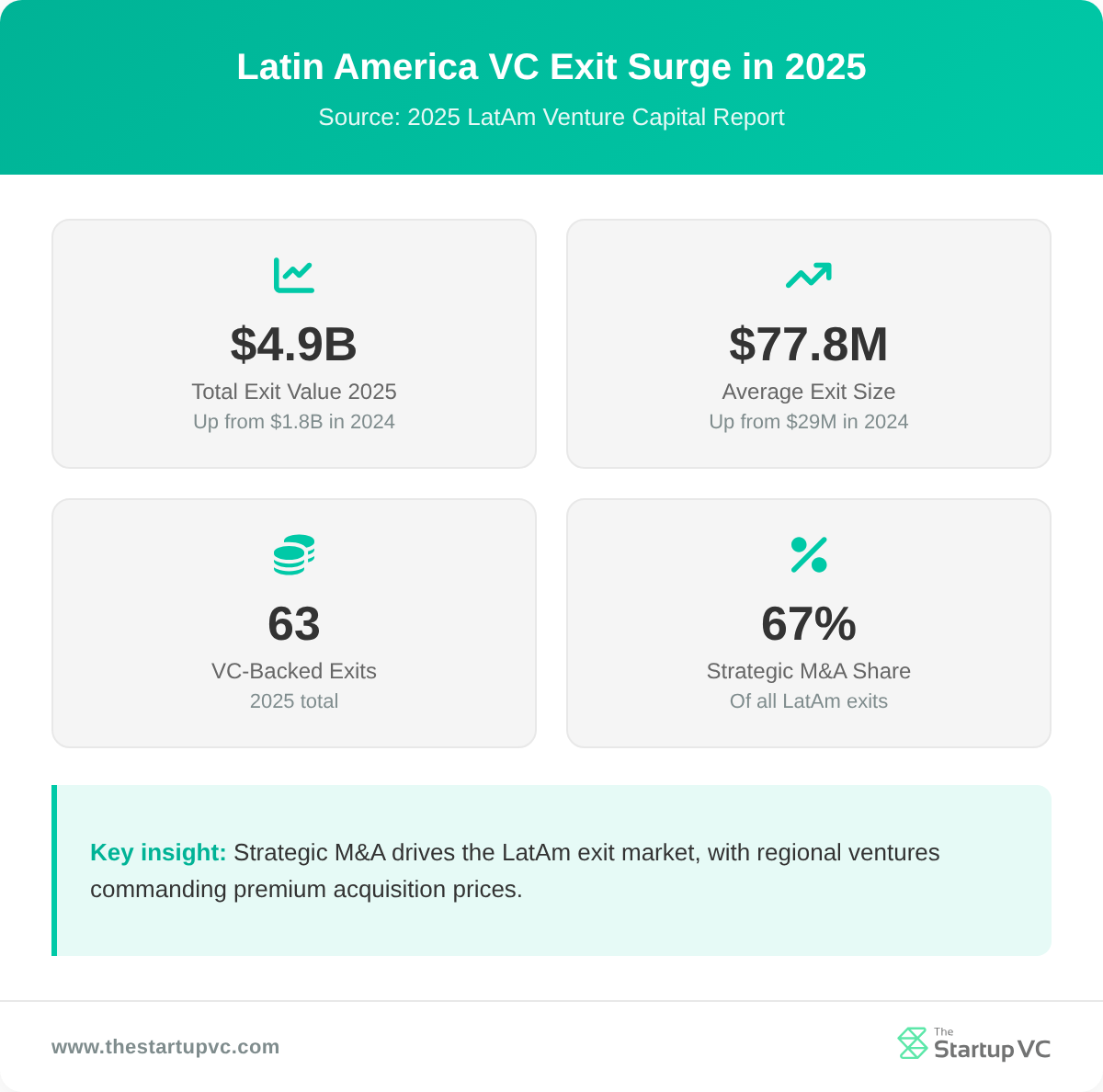
Latin America’s 2025 VC exit value rose to US$4.9 billion across 63 deals. Average exit size grew to US$77.8 million. The Startup VC builds regional B2B ventures in 17 LatAm countries.
The Startup VC is Craig Dempsey’s family office and company builder. It creates ventures from scratch, deploys capital, and scales them across Latin America. Below, you will find the definition, the case for regional scale, the company builder model, the cross-border playbook, and the Biz Latin Hub case study.
What Is an International Venture in Latin America?
An international venture in Latin America is a company that operates in 2 or more countries across the region. It has cross-border clients, a regional service delivery model, and a structure built for multi-jurisdiction operations. This differs from a single-country startup that serves only one local market.
The model has three core traits:
- Multi-country structure. Legal entities in each operating country, with a parent company for consolidation.
- Cross-border operations. Shared services, regional management, and standard playbooks across all entities.
- Regionally diversified clients. Revenue spread across countries, currencies, and industries.
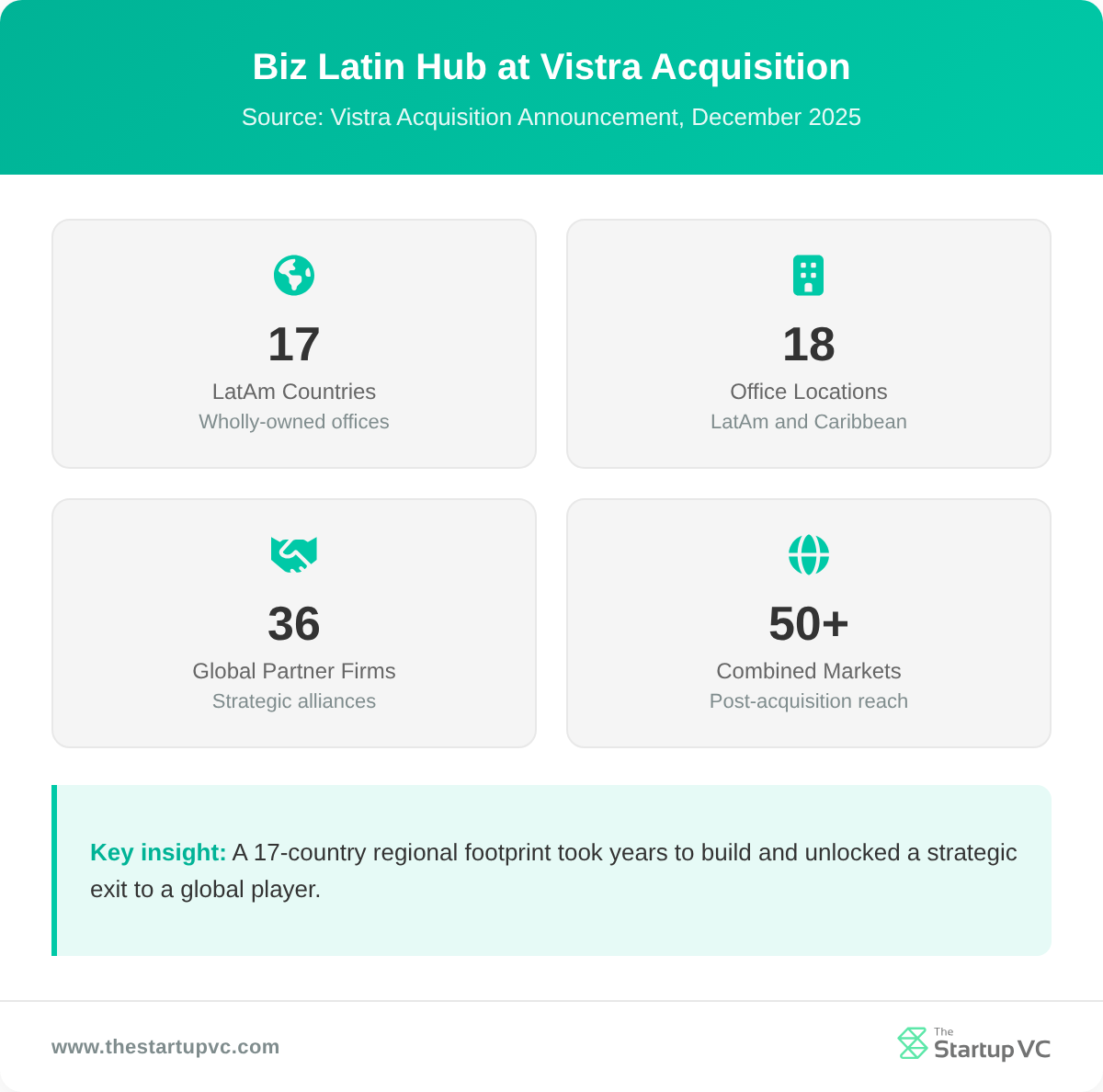
Biz Latin Hub is a clear example. It scaled from a single Bogota office to 18 locations across 17 Latin American and Caribbean countries. Vistra acquired the company in December 2025. Other examples include multilatinas like Grupo Bimbo from Mexico and Carvajal SA from Colombia. Both expanded across the region through joint ventures and acquisitions.
International ventures differ from local startups in three ways. They face regulatory complexity across many jurisdictions. They handle currency exposure across several national currencies. They build shared service infrastructure that creates operating leverage as they grow.
Why Build International Ventures in Latin America Instead of Single-Country Startups?
International ventures in Latin America win because they capture more market, reduce country risk, and command higher exit multiples. Strategic acquirers want regional footprint. Founders building across borders gain a structural advantage that local startups cannot match.
Five reasons drive the model:
- Larger total market. A regional venture reaches over 650 million consumers, while a single country caps at 50 to 200 million.
- Lower country risk. Revenue spread across 5 to 17 countries protects against political shifts in any one market.
- Higher exit multiples. Strategic M&A makes up 67% of LatAm exits, and acquirers pay premiums for regional platforms.
- Faster cross-border scale. A common Spanish language across 17 countries speeds expansion into new markets.
- Currency diversification. Revenue in multiple currencies reduces exposure to any single inflation cycle.
The numbers support the case. Latin America’s 2025 VC exit value rose to US$4.9 billion across 63 deals. Average exit size grew from US$29 million to US$77.8 million. The region’s startup ecosystem raised US$4.1 billion across 681 rounds in 2025.
| Metric | Single-Country Startup | International Venture |
|---|---|---|
| Total addressable market | 50-200M consumers | 650M+ consumers |
| Country concentration risk | High | Low (spread across 5-17) |
| Average exit multiple | Lower (product premium) | Higher (footprint premium) |
| Currency exposure | One local currency | Multiple currencies |
| Strategic M&A demand | Limited | Strong (nearshoring buyers) |
Foreign direct investment into Latin America grew over 7% in 2024 from nearshoring trends. U.S. companies are repositioning supply chains. They now demand regional service partners. The Startup VC’s investment focus targets exactly this gap.
How Does The Startup VC Build International Ventures in Latin America?
The Startup VC builds international ventures by combining a company builder, a family office, and an operational playbook. It creates companies from scratch, funds them with private capital, and scales them across LatAm using shared infrastructure. This model is faster and more capital-efficient than traditional VC backing.
What Is the Company Builder Layer?
The company builder layer creates ventures from idea to launch. It generates business ideas internally, hires founding teams, and runs operations from day one. Studio-built startups reach Series A in 25 months versus 56 months for VC-backed founders. That is a 55% time compression.
The Startup VC’s company builder applies a repeatable method:
- Idea selection. Spot a B2B service gap with clear regional demand and recurring revenue.
- Team build. Recruit a founding executive with regional experience and operational depth.
- Capital deployment. Seed the venture with private family office capital. This removes friction of raising from external VCs.
- Operational playbook. Apply proven processes for hiring, client onboarding, market expansion, and service delivery.
What Is the Family Office Layer?
The family office layer provides patient, strategic capital. It backs early-stage startups and scalable ventures across Latin America. It targets B2B and B2C service companies with predictable, strong cash flows. The capital is long-term and aligned with operational milestones, not fund timelines.
What Role Do the Portfolio Companies Play?
The portfolio includes Biz Latin Hub, GGI, MTP, and other ventures. Each portfolio company shares operating playbooks, regional networks, and compliance expertise. The Startup VC’s portfolio venture companies form a network. Lessons learned in one venture accelerate the next.
Craig Dempsey leads The Startup VC. He served as a commissioned officer in the Australian Army. He held executive roles in mining across Peru and Colombia. This background gave him the regional network needed to scale ventures quickly across LatAm.
What Are the Main Steps to Scaling a Venture Across Latin American Markets?
You can scale a venture across Latin American markets by following a six-step playbook. The steps cover country selection, entity formation, hiring, compliance, integration, and revenue rollout. Each step has known costs and timelines. Skipping a step creates legal or operational risk.
The playbook works in this order:
- Pick the first country. Most ventures start in Colombia, Mexico, or Chile based on business climate and proximity to clients.
- Form the local entity. Use the SAS in Colombia or the SpA in Chile. Both let you standardize bylaws across other LatAm countries later.
- Appoint a local legal representative. Each country requires a citizen or work-residency holder as the company’s representative.
- Register for tax and labor. Register with the public commercial registry, then with local labor and social security authorities.
- Hire the founding team. Use Employer of Record (EOR) services for fast launches. Move to direct hiring at 50+ employees.
- Roll out to the next country. Repeat the entity-and-hiring sequence in each new market, reusing standardized templates.
| Step | Typical Timeline | Cost Range (USD) | Key Trade-off |
|---|---|---|---|
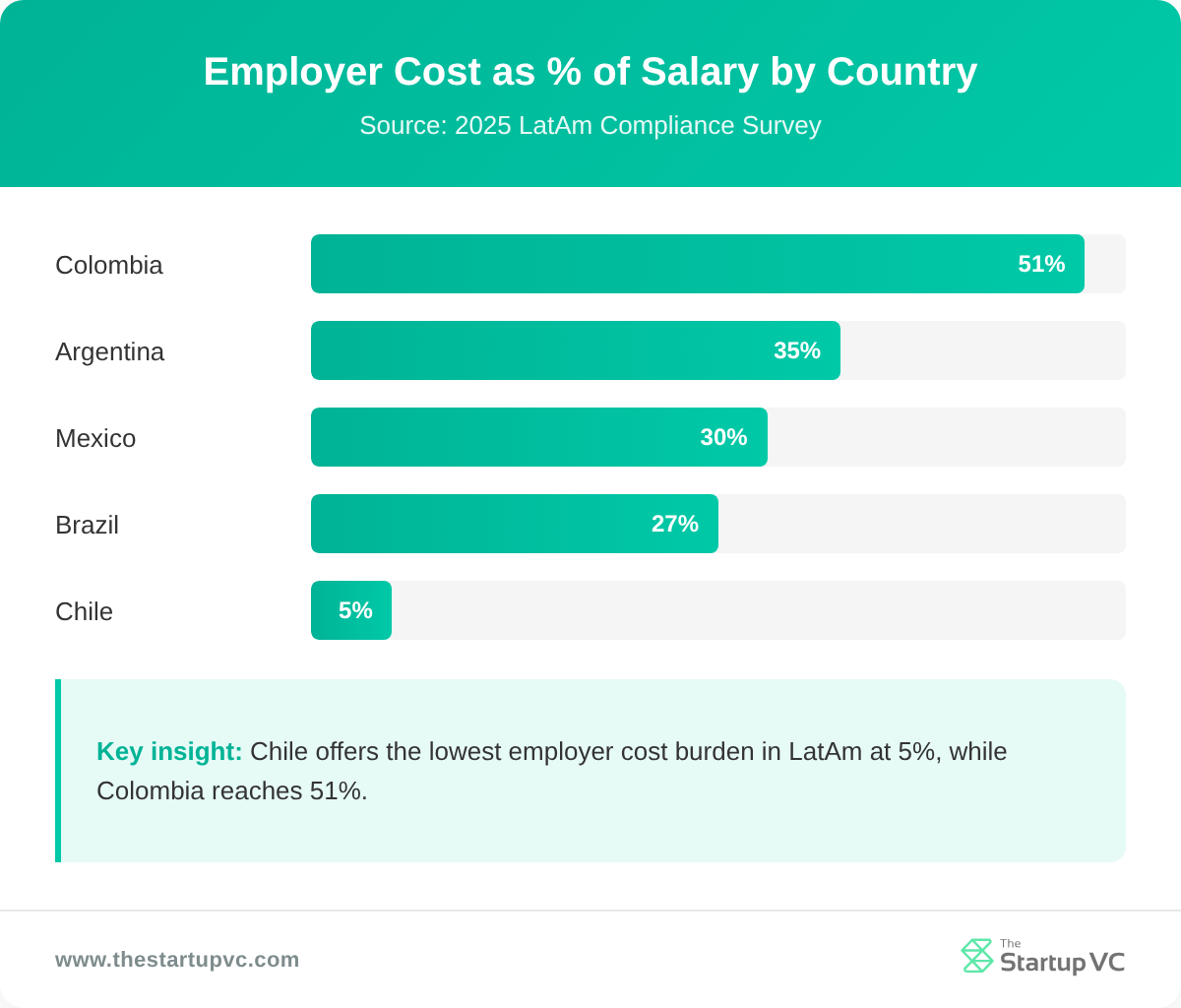
| Entity formation (Colombia) | 2-4 months | $3,000-$8,000 | High employer costs (up to 51% of salary) |
| Entity formation (Chile) | 1-2 months | $2,000-$5,000 | Low employer costs (~5% of salary) |
| EOR launch | 1-3 weeks | $500-$1,500 per employee/month | Higher per-head cost, no entity ownership |
| Direct hire (post-entity) | 2-6 weeks | Country-specific payroll | Mandatory 13th-month salary in most countries |
| Multi-country compliance | Ongoing | Country-specific accountant retainer | Country-specific collective bargaining rules |
Compliance is the main hidden cost. Employer costs in Chile sit near 5% of salary. Colombia can reach 51% in some cases. The 13th-month salary is mandatory in most countries. Some countries add a 14th-month payment. Companies must follow collective bargaining agreements that vary by industry and location.
For founders running multiple ventures across regions, the venture studio model standardizes these steps. The Startup VC reuses playbooks across portfolio companies to compress launch time.
How Did Biz Latin Hub Prove the International Venture Model with Its Vistra Acquisition?
Biz Latin Hub proved the international venture model by building a 17-country regional footprint and exiting to Vistra in December 2025. The acquisition validated three core ideas. Regional scale commands a premium. Strategic acquirers pay for footprint. The company builder model produces institutional-grade exits.
What Was the Vistra Acquisition Deal?
Vistra completed the BLH acquisition on December 4, 2025. The two companies had operated as affiliates since 2018. The combined platform now serves clients in over 50 markets globally. The LatAm footprint covers 18 countries. Deal value was not publicly disclosed.
How Did Biz Latin Hub Scale to 17 Countries?
Biz Latin Hub grew from a single Bogota office to 18 locations across 17 Latin American and Caribbean countries. It built wholly-owned offices in major markets including Brazil, Mexico, Colombia, and Chile. By exit, BLH had 36 global partner firms. It was the largest independent professional services provider in the region.
BLH offered four core services across every country:
- Company formation. Entity setup, legal representation, and registration with local authorities.
- Legal services. Contracts, compliance, and regulatory advice.
- Accounting and tax. Local accounting, tax filings, and financial reporting.
- Recruitment. Executive search and direct hires for international clients entering LatAm.
Why Did Vistra Buy a Regional Footprint?
Vistra bought BLH because regional footprint takes years to build organically. Vistra could reach 17 LatAm markets faster by acquisition than by building entities one by one. Foreign direct investment into LatAm grew over 7% in 2024 from nearshoring. This created strong demand for regional service partners.
The exit proves a thesis for LatAm founders. Strategic M&A by global players is the most viable exit route. Public markets are underdeveloped, and growth-stage capital is limited. The Startup VC’s coverage of Panama as a LatAm startup hub shows how country selection sets up future regional plays.
What Questions Do Founders Ask Most Often About Building International Ventures in Latin America?
How Much Capital Do You Need to Build an International Venture in Latin America?
You need US$500K to US$2M in seed capital to launch a B2B service venture before international expansion. Capital-light models can self-fund expansion through cash flow. Family office capital often replaces traditional VC at the seed stage in LatAm.
How Long Does It Take to Exit a LatAm International Venture?
LatAm secondary sales take 8.4 years on average. IPOs take 17.2 years. Strategic M&A is faster than IPO and makes up 67% of all VC-backed exits in the region. Founders should plan for an 8 to 10 year exit horizon.
Which Country Should You Start In When Building Regionally?
The best starting countries are Colombia, Mexico, and Chile. Colombia offers a large talent pool. Chile offers low employer costs and stable rules. Mexico offers the largest market and strong US trade ties. Country choice depends on your sector and target clients.
What Are the Biggest Risks in Building International Ventures in LatAm?
The biggest risks are currency volatility, country-level political risk, and talent retention. You can manage currency risk by invoicing in USD where possible. You can reduce political risk through geographic diversification. You can keep talent with competitive equity packages.
How Is a Company Builder Different from a VC Fund?
A company builder creates ventures from scratch with internal teams and capital. A VC fund invests in external founders building their own startups. Studio-built startups reach Series A 55% faster than VC-backed ones. The advantage comes from operational playbooks and shared infrastructure.
Can You Use One Legal Entity for the Whole Region?
No. Each LatAm country requires its own legal entity for client billing, payroll, and tax compliance. You can hold all entities under a single parent company. The SAS in Colombia or the SpA in Chile lets you reuse documents across other markets.
Ready to Build Your International Venture in Latin America?
The Startup VC is Craig Dempsey’s family office and company builder. We create, back, and scale ventures across Latin America. Our team has built regional operations in 17 countries. We exited a multi-country venture to a global player. We have refined the playbook through more than a decade of practice. If you want operational backing, regional networks, and patient capital for your B2B service venture, contact us today.