
Venture studios hit 30% higher success rates and reach Series A in 25 months, versus 56 months for VC-backed startups.
Venture studios take 30-60% equity and act as co-founders. VC funds take 10-20% and invest capital in existing startups. Studios build 3-5 companies yearly with 53% IRR. Over 700 studios operate globally alongside thousands of VC funds.
The Startup VC is Craig Dempsey’s family office and company builder. Portfolio ventures like Biz Latin Hub operate across 17 Latin American countries. Below, you will find a full comparison of equity stakes, timelines, and operating models. You will also see a decision framework for choosing between the two paths.
What Is the Difference Between a Venture Studio and a VC Fund?
A venture studio is a company builder that creates startups from scratch. A VC fund invests money into startups that already exist. This is the core split between the two models.
Venture studios act as co-founders. They come up with the idea, validate it, build the product, and recruit the first team. VC funds wait for founders to pitch a company with real traction. They then write a check and sit on the board.
The two models also differ in scale and pace:
| Feature | Venture Studio | VC Fund |
|---|---|---|
| Entry stage | Idea / pre-seed | Seed and later |
| Role | Co-founder and operator | Capital provider |
| Companies per year | 3-5 | 10-40 |
| Daily involvement | High | Low |
| Number globally | 700+ studios | Thousands of funds |
The term “company builder” means the same thing as venture studio in most contexts. Some corporate-backed company builders focus on one sector, like fintech or logistics. Traditional VCs rarely operate the companies they back.
The confusion often comes from overlap with accelerators and incubators. Accelerators run fixed cohorts with small checks, like Y Combinator or 500 Startups. Incubators offer workspace and mentorship without equity. Studios go further than both. They create the company itself.
How Does a Venture Studio Work Compared to a VC Fund?
A venture studio works by running a repeatable process for creating companies. Staff generate ideas, test them with customers, and build a minimum viable product. Only the strongest ideas move forward to spinout.
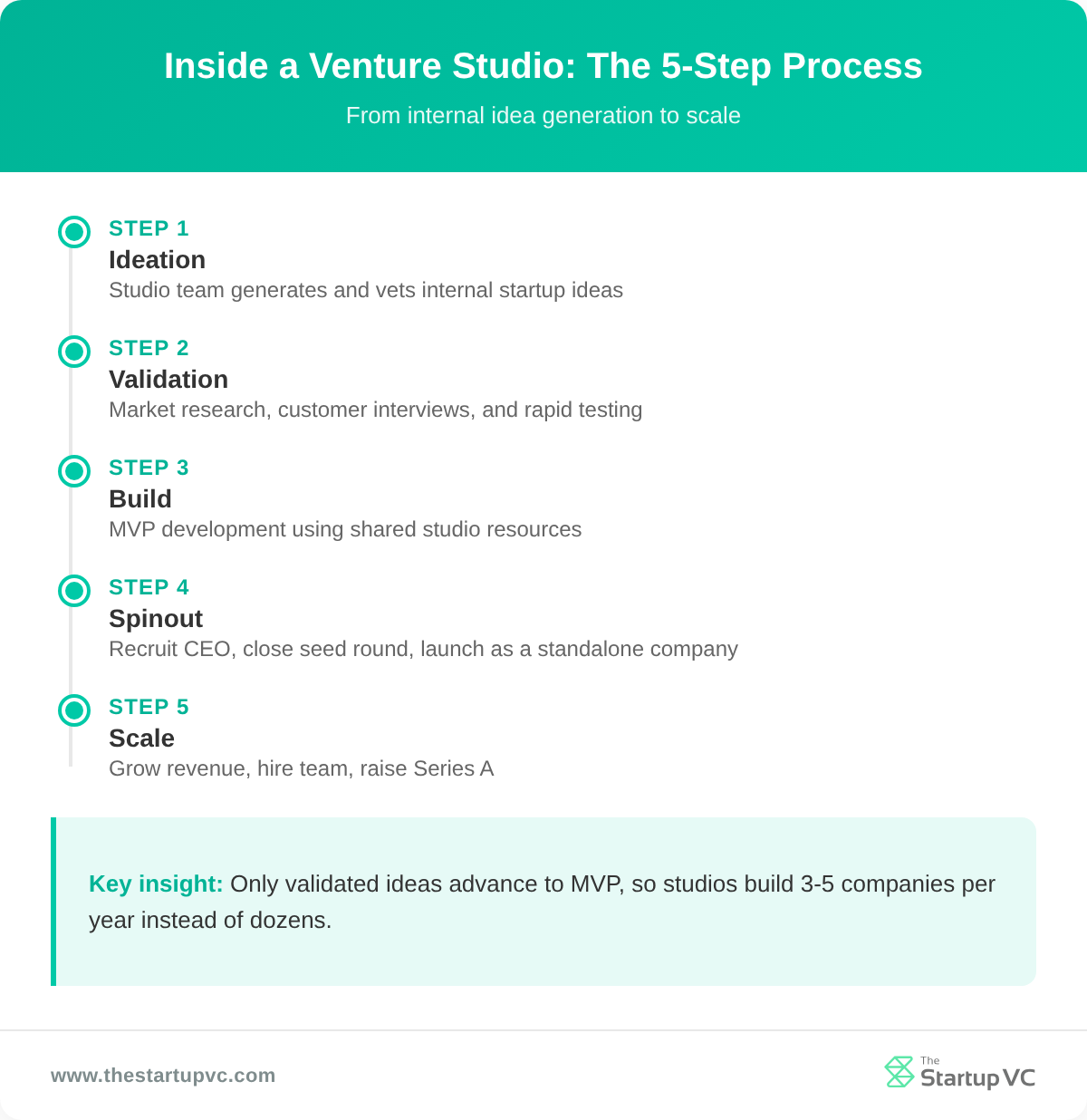
Here is the workflow inside a typical venture studio:
- Ideation. Partners brainstorm ideas based on market trends and founder networks.
- Validation. Teams test ideas with potential customers before writing code.
- Build. The studio builds the MVP, brand, legal entity, and first hires.
- Spinout. The company launches with a founding team and initial capital.
- Scale. The studio supports the company with shared services and funding intros.
A VC fund works differently. Partners raise capital from limited partners (LPs). They deploy that capital into 20-40 companies per fund. They offer advice but not day-to-day support.
Studio involvement shifts over time. Early on, studios build the product alongside founders. Later, they move to board-level support and help with Series A. VC firms stay episodic the whole time. They check in at board meetings and introduce portfolio companies to later-stage investors.
The two models also differ in capital source. VC funds raise from pension funds, endowments, and family offices. They have fixed fund lifecycles, usually ten years, with pressure to exit. Venture studios may raise a dedicated fund or deploy evergreen capital from a parent entity. Evergreen studios can hold companies longer and focus on operations, not quick exits.
This structural difference shapes founder experience. A VC-backed company faces pressure to show growth metrics every quarter. A studio-backed company can take time to find product-market fit before scaling. Both models work, but they fit different founder temperaments.
For a deeper look at the full operating process, read our breakdown of the venture studio model.
How Much Equity Does a Venture Studio Take Versus a VC Fund?
A venture studio takes 30-60% equity in a new company at founding. A seed-stage VC fund takes 10-20% per round. This is the biggest equity gap founders need to understand.
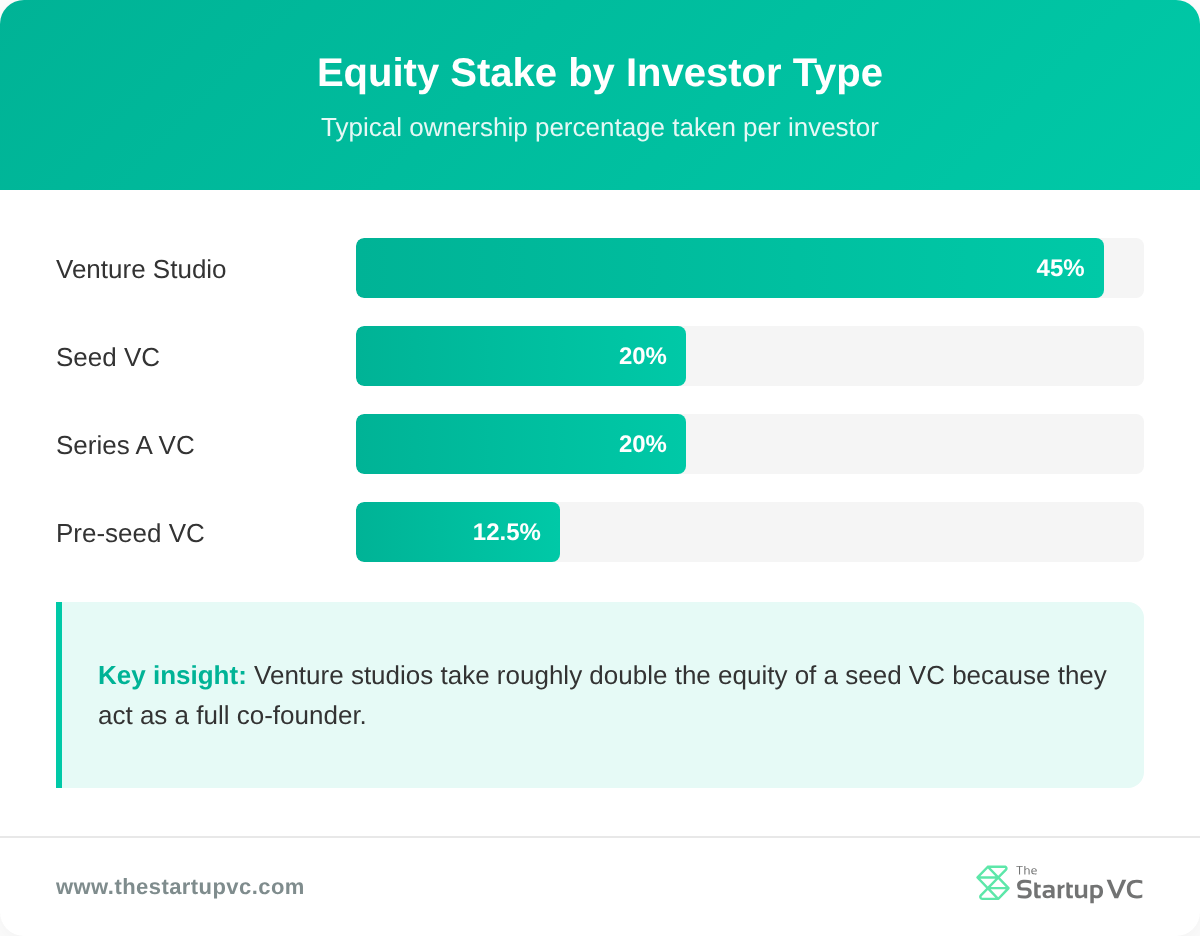
The venture studio equity vs VC comparison looks like this:
| Investor Type | Typical Equity Stake | Stage | Check Size |
|---|---|---|---|
| Venture studio | 30-60% (sometimes 15-80%) | Pre-idea to spinout | Services + $50K-$500K cash |
| Pre-seed VC | 10-15% | Pre-seed round | $250K-$1M |
| Seed VC | 15-25% | Seed round | $1M-$5M |
| Series A VC | 15-25% | Post product-market fit | $5M-$15M |
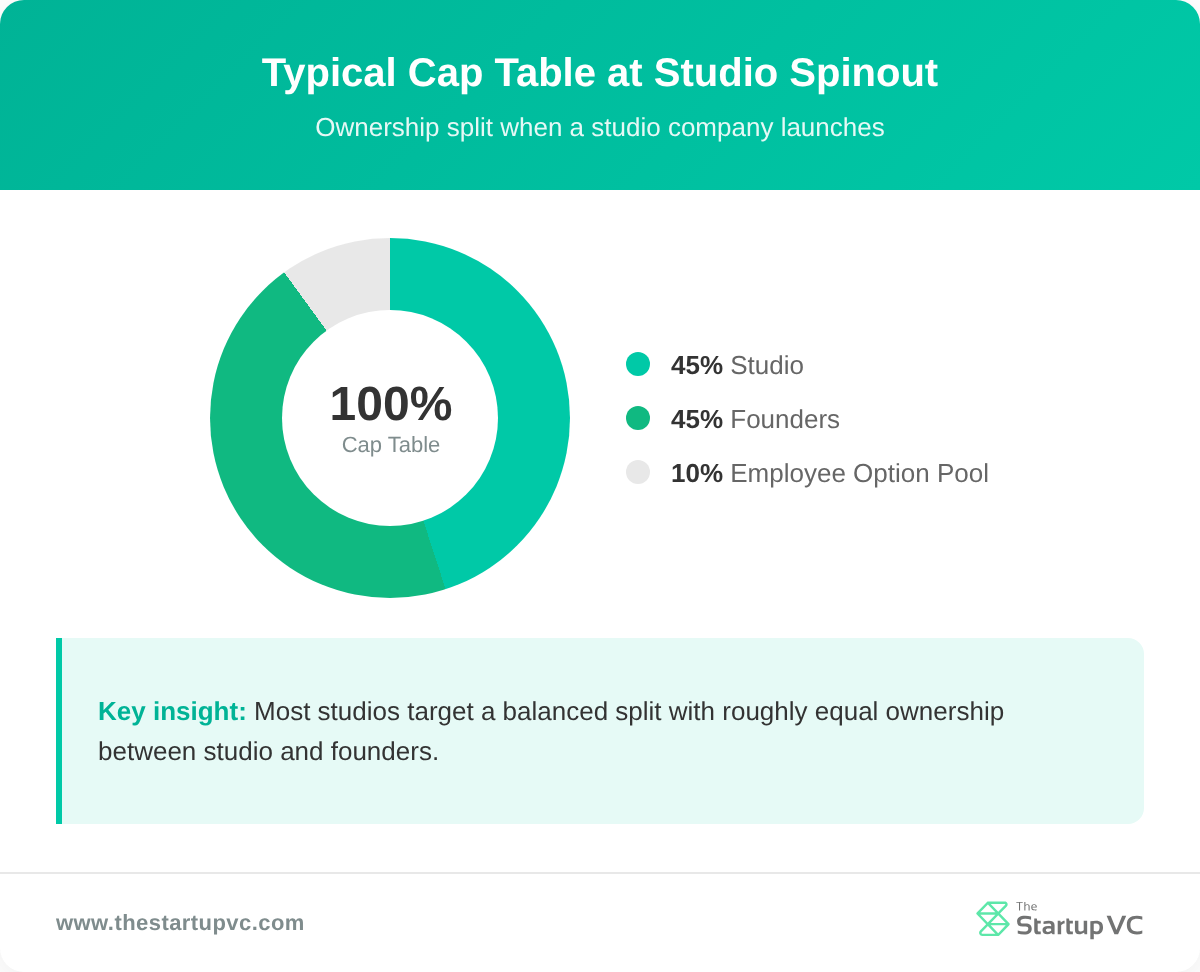
Studios take more equity because they act as a full co-founder. They contribute the idea, the validation work, the MVP, a legal entity, the initial hires, and shared infrastructure. Founders at a studio receive a smaller slice, but they start with a company that already works.
Studios with very high equity stakes can hurt future rounds. Later investors may see a low founder ownership and worry about founder motivation. Founders should ask about post-studio dilution before signing.
The structure of the cap table matters as much as the numbers. A founder holding 20% after spinout can raise three to four more rounds before hitting critical dilution. A founder holding 50% has more room but might give away studio leverage. Most studios target a 40-50% studio stake with 40-50% for founders and 10-20% for the employee option pool.
Salary treatment also differs. Studio founders often receive a salary during the build phase, funded by the studio. VC-backed founders pay themselves from seed capital after the round closes. This changes early-stage personal risk, especially for founders without savings.
Why Should Founders Consider a Venture Studio Over a VC Fund?
Founders should consider a venture studio over a VC fund because it removes the hardest parts of early-stage building. The studio provides an idea, a validation framework, a team, and operational support from day one. This cuts early-stage risk sharply.
Venture studios offer clear benefits for first-time or technical founders:
- Ready infrastructure. Legal, HR, finance, and marketing services are shared across the portfolio.
- A co-founder on day one. The studio fills the commercial or product gap most solo founders face.
- Validated ideas. Concepts are tested before any code is written.
- Shared playbooks. Studios reuse go-to-market strategies that worked for past companies.
- Speed. Founders skip the legal setup, hiring search, and early product discovery phase.
VCs do not offer most of this. A VC fund provides capital and introductions. Founders raising from VCs still build their own team, run their own validation, and handle their own operations. This suits experienced founders with traction but hurts first-time builders.
Studios also support novel or unconventional ideas better. VCs often require proof of demand before investing. A studio can co-develop a concept from scratch, which helps in emerging sectors or new regions like Latin America. To see how this works in practice, review our portfolio at The Startup VC.
Which Model Delivers Better Outcomes for Early-Stage Startups?
Venture studios deliver better outcomes than VC-only funded startups on most key metrics. According to the Global Startup Studio Network (GSSN), studio startups have a 30% higher success rate than traditional startups. Studio founders also move faster and keep more capital efficient.
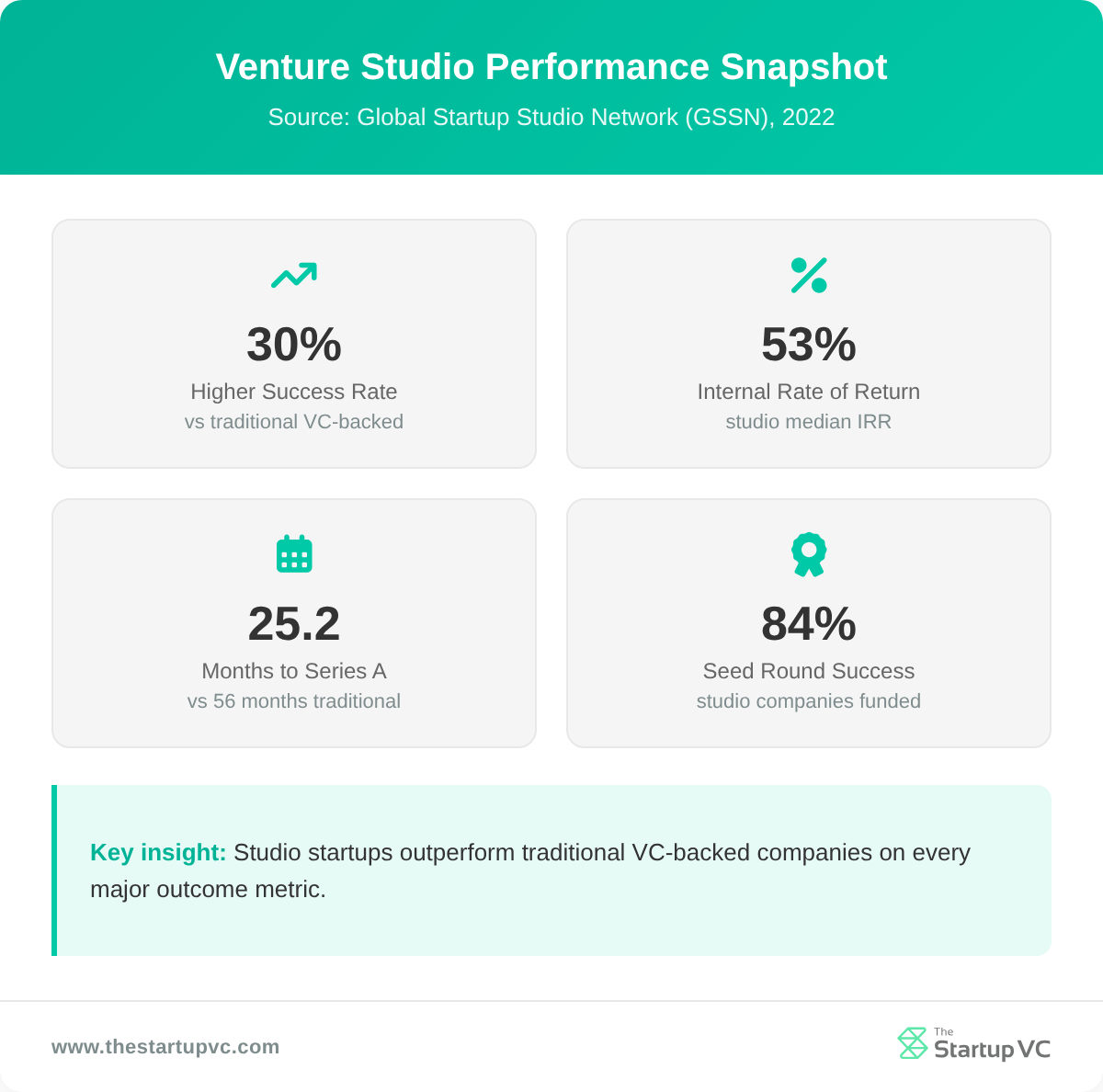
The data on studio vs traditional outcomes is clear:
| Metric | Venture Studio | Traditional VC-Backed |
|---|---|---|
| Time to Series A | 25.2 months | 56 months |
| Average IRR | 53% | 21.3% |
| Seed round success | 84% | ~50% |
| Time to acquisition | 5 years | 7.5 years |
| Time to IPO | 7.5 years | 10.9 years |
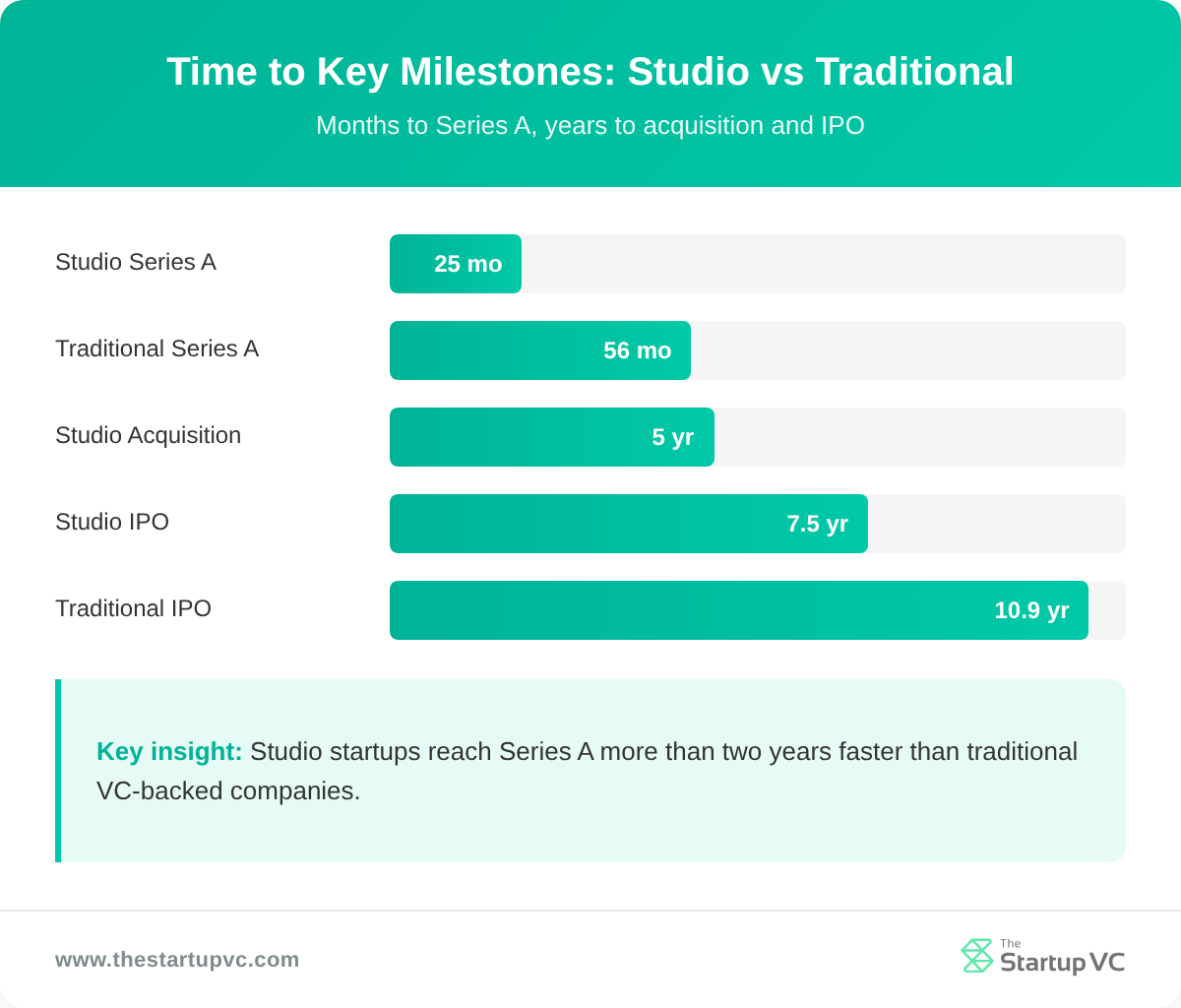
Studio startups reach Series A in 25.2 months on average. Traditional startups need 56 months. This saves over two and a half years of cash burn. It also means founders spend less time fundraising.
The financial returns are also stronger. GSSN research shows studio companies post a 53% internal rate of return. Traditional VC-backed startups average 21.3%. Studio startups reach acquisition 33% faster and IPO 31% faster than non-studio startups.
The trade-off is founder equity. Studios take more at the start. But the stronger support often leads to a bigger outcome at exit, even with less ownership.
These numbers come from GSSN research covering hundreds of studio startups. Not every studio matches these benchmarks. Top-tier studios like High Alpha, Atomic, and eFounders outperform the averages. Mid-tier and new studios may post weaker results. Founders should ask about a studio’s portfolio history and spinout performance before signing.
Should You Join a Venture Studio or Raise from a VC Fund?
You should join a venture studio if you have an idea but no team, no infrastructure, and limited startup experience. You should raise from a VC fund if you already have product-market fit and need capital to scale. The right choice depends on your current stage.
Use this quick framework to decide:
| Your Situation | Best Match |
|---|---|
| Solo founder with idea, no team | Venture studio |
| Technical founder, no commercial co-founder | Venture studio |
| Product live, early customers, growing | Seed VC fund |
| Product-market fit proven, need to scale | Series A VC fund |
| First-time founder, no prior startup | Venture studio |
| Serial founder with proven track record | VC fund |
| Corporate operator moving into startups | Venture studio |
| Value full autonomy over operations | VC fund |
Founders who choose a studio get hands-on help. They trade equity for speed, support, and shared resources. Founders who raise VC keep more equity but bear all the operational load.
The “should I join a venture studio” question comes down to three things. First, how validated your idea is. Second, how much operational support you need. Third, how much equity you are willing to trade. A strong solo operator with a raw idea often wins by starting with a studio. A seasoned founder with traction often wins by raising VC.
Compare Latin American venture studio options and read our company venture builder explainer before deciding.
What Questions Do Founders Ask Most Often About Venture Studios and VC Funds?
What is the difference between a venture studio and a VC fund? A venture studio builds companies from scratch and acts as a co-founder. A VC fund invests money into existing startups. Studios take more equity but give more operational support.
How much equity does a venture studio take? A venture studio takes 30-60% of the company at founding. Some studios take as little as 15% or as much as 80%. The stake depends on what the studio provides.
How long does it take a studio startup to reach Series A? A studio startup takes 25.2 months on average to reach Series A. Traditional startups take 56 months. This saves about two and a half years of cash burn.
Do venture studio founders receive a salary? Yes, founders at a venture studio often receive a salary during the building phase. Studios pay from their own fund or shared pool. VC-funded founders pay themselves from raised capital.
How many venture studios exist globally? There are 700+ venture studios worldwide as of 2024. The number has more than doubled in the last five years. By contrast, there are thousands of active VC funds.
Is a venture studio better than a VC fund for a first-time founder? Yes, a venture studio is often better for first-time founders. It provides a co-founder, shared resources, and a validated idea. A VC fund assumes founders already have these pieces.
Ready to Build Your Next Venture With Operational Support?
The Startup VC is Craig Dempsey’s entrepreneurial ecosystem. It combines a family office and a company builder that creates, backs, and scales ventures across Latin America. Portfolio companies include Biz Latin Hub, operating in 17 countries. Our model gives founders hands-on operations, regional networks, and practical capital. Learn more about how we build companies and our investment focus.
If you are weighing a studio path against traditional VC, we can help you decide. Contact us today to talk through your idea, your team, and your capital needs.