
Latin America’s B2B eCommerce market reached USD 860 billion in 2025 and grows 23.9% per year through 2033.
Brazil holds 45% of regional eCommerce. Mexico captures 26%. Regional startup investment reached USD 4.2 billion in 2024, up 27% year over year. Mexico, Colombia, Brazil, and Panama anchor priority markets for B2B service expansion.
The Startup VC has built and scaled B2B service ventures across Latin America. Portfolio firms like Biz Latin Hub operate in 17 countries. This playbook walks you through six sequential steps, from pre-entry diagnostics to scale-or-kill decision points. You will find market comparisons, entry mode tradeoffs, hiring sequences, and the milestones that separate winners from stalls.
When Does Latin America Make Sense for Your B2B Expansion?
Latin America makes sense for your B2B expansion when three signals align. You need real customer pull, a clear ICP match, and partner readiness. Push-driven entries waste capital. Pull-driven entries compound fast.
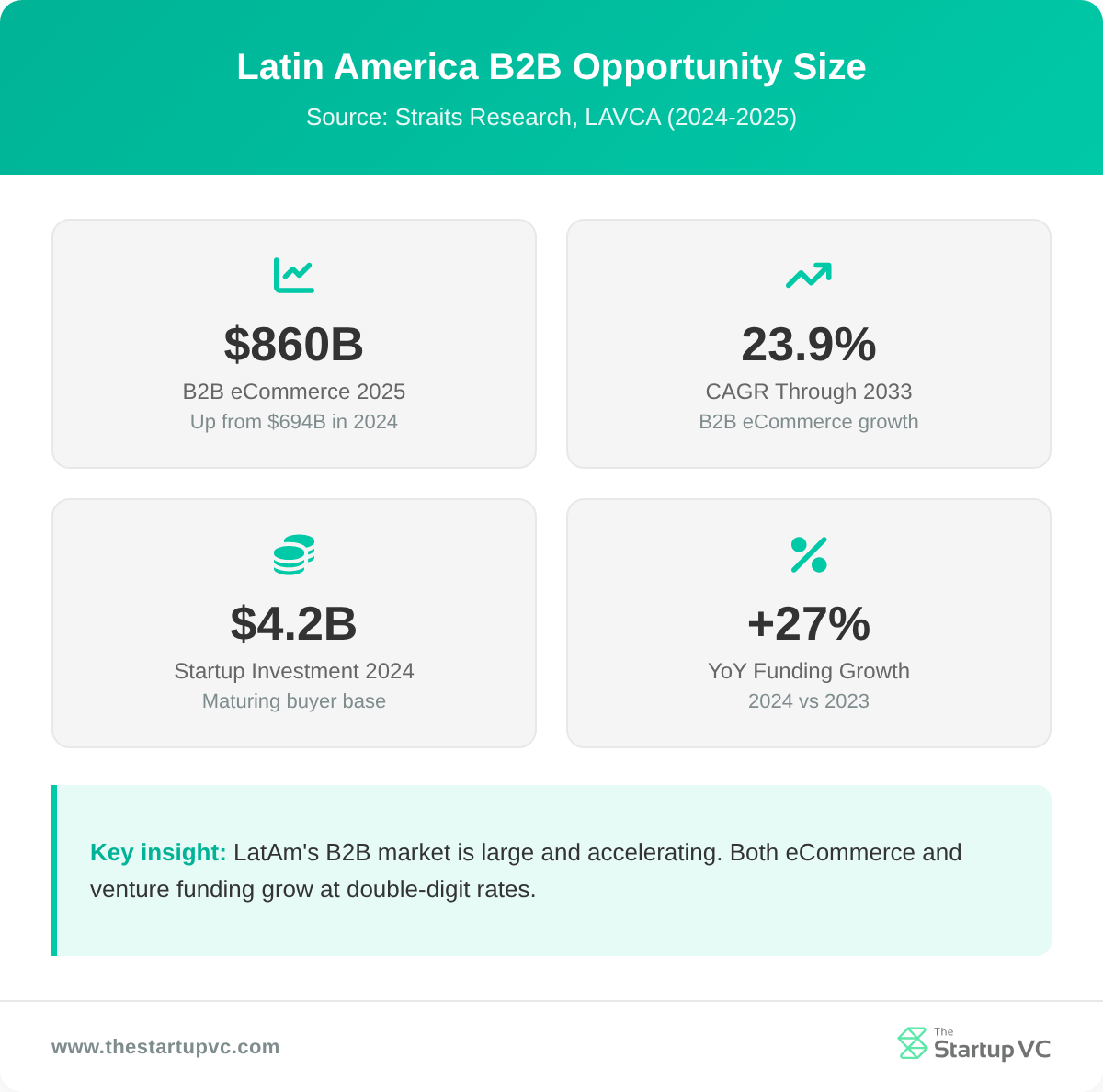
The B2B opportunity is large. Latin America’s B2B eCommerce market was worth USD 694.24 billion in 2024. It reached USD 860.16 billion in 2025 and grows at 23.9% per year through 2033.
Before you commit a dollar, run a quick diagnostic. Three signals matter most.
What Pre-Entry Signals Should You Look For?
You should look for buyer pull, ICP match, and partner readiness before committing.
- Customer pull. Inbound leads from LatAm, paying logos already there, or partners asking to resell. No pull means no entry.
- ICP match. Your top 20% of customers reveal product-market fit and adoption patterns. Map them against LatAm firmographics first.
- Partner readiness. Local distributors, advisors, or studio partners already willing to engage. Cold entries take twice as long.
- Funding signals. Regional startups raised USD 4.2 billion in 2024, up 27% year over year. A maturing buyer base helps.
- Conversion math. Firms with a defined ICP see conversion rates rise up to 68%. Validate ICP fit before you spend on GTM.
A clear “yes” on all five means the market is ready. A “no” on partner readiness is a strong stop signal.
Which Latin American Market Should You Enter First?
The best first market is usually Mexico, Colombia, Brazil, or Panama, depending on your ICP and TAM. Brazil leads in size. Mexico leads in nearshore access. Colombia leads in speed and cost. Panama serves as a regional hub.
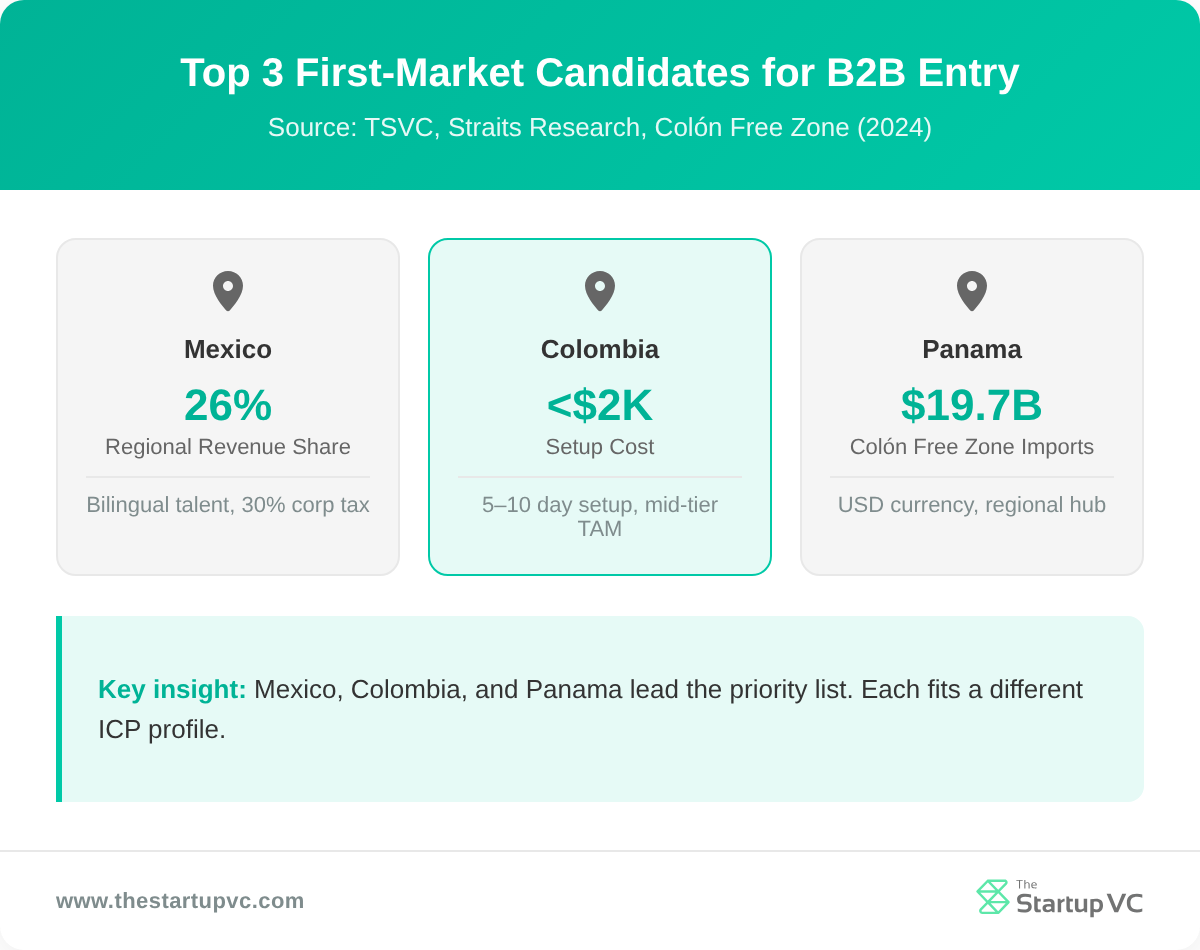
Each market has tradeoffs. The table below shows the key dimensions for our B2B services sector in Latin America entry decisions.
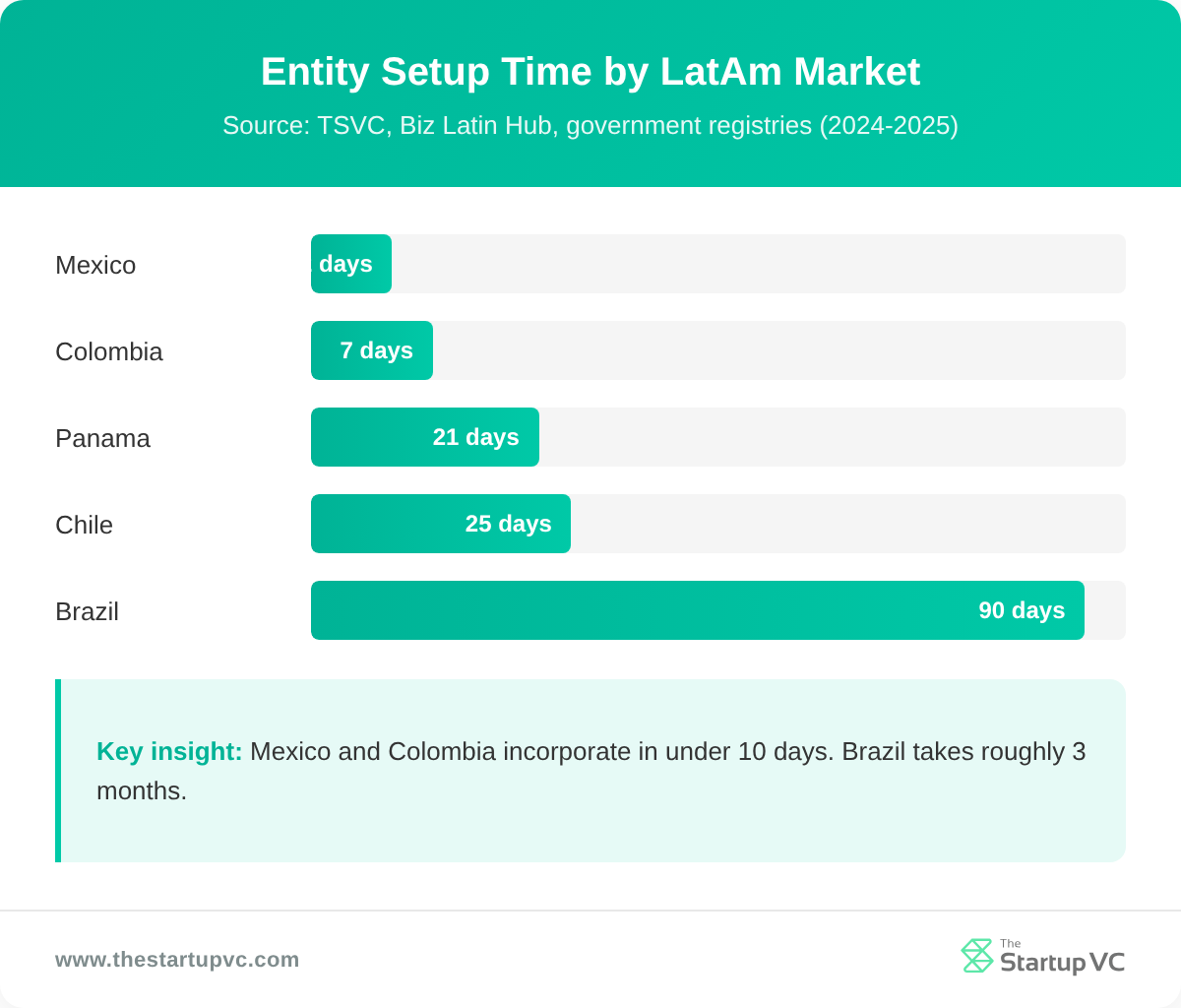
| Market | Share of Regional SaaS / B2B Spend | Entity Setup | Setup Cost | Currency | Key Trait |
|---|---|---|---|---|---|
| Brazil | 45.1% of regional e-commerce | ~3 months | USD 1k–5k | BRL | Largest TAM, complex labor law |
| Mexico | 26% of regional revenues | 1–3 days digital | USD 1k–5k | MXN | Nearshore + bilingual |
| Colombia | Strong growth, mid-tier TAM | 5–10 days | Under USD 2k | COP | Fastest, cheapest setup |
| Panama | Hub for re-export and services | 2–4 weeks | USD 2k–4k | USD | Dollarized, free trade zones |
| Argentina | Volatile but high tech talent | 4–8 weeks | USD 2k–4k | ARS (USD pricing common) | Hyperinflation; price in USD |
| Chile | Stable, mid-tier TAM | 3–4 weeks | USD 2k–4k | CLP | Strong rule of law, smaller market |
Brazil holds the most revenue but the highest friction. Mexico and Colombia combined cover most US-aligned ICPs. Panama works well for cross-border B2B services and treasury. Panama’s role as a LatAm hub is anchored by the Colón Free Zone. That zone booked USD 19.7 billion in imports in 2023.
If most of your buyers price in USD, start in Panama or Mexico. If your buyers are local mid-market firms, start in Colombia.
How Do You Choose the Right Entry Mode in Latin America?
You choose the right entry mode by matching control needs to risk tolerance and stage of customer pull. Low pull means a low-commitment mode. High pull and clear ICP means a higher-commitment mode.
There are six common modes. Each has a different cost, speed, and control profile.
What Are the Six Main Entry Modes?
The six main entry modes are direct sales, distributor, joint venture, acquihire, new entity, and venture studio partnership. The choice depends on stage, deal size, and local complexity.
| Entry Mode | Speed | Control | Cost | Best For |
|---|---|---|---|---|
| Direct sales (cross-border) | Days | High | Low | USD-priced SaaS, light support |
| Distributor / reseller | Weeks | Low | Low | Technical products, after-sales support |
| Joint venture | 3–6 months | Shared | Medium | Regulated sectors, local partner needed |
| Acquihire | 6–12 months | High | High | Buying team, brand, and book of business |
| New entity (subsidiary) | 1–4 months | Maximum | High | Multi-year commit, 50+ hires |
| Venture studio partnership | Weeks to months | Shared | Medium | Multi-market entry, shared infrastructure |
A staged approach often works best. Many firms start with direct sales backed by an EOR. They add a distributor for technical support. They migrate to a subsidiary once revenue justifies the cost.
A venture studio model compresses this path. Studio-built startups reach Series A in 25 months versus 56 months for VC-backed founders. Company builders also report 30% higher success rates because teams, capital, and playbooks are shared across portfolio firms.
When Should You Pick a Subsidiary Over an EOR?
You should pick a subsidiary over an EOR when you plan 50+ hires in one country. You also need a subsidiary when you require full IP and tax control. EOR setup happens in roughly five business days. Entity setup takes up to 3.5 months but pays back as headcount grows.
The cost math is simple:
- EOR. No setup fee. Monthly fees per employee. Fast exit if the bet fails.
- Entity. USD 3,500 to USD 4,500 in setup costs. Lower per-employee cost over time. Slower to wind down.
Below 50 hires, EOR delivers faster ROI. Above 50, the subsidiary pays back. Brazil also requires CLT contracts, FGTS deposits, and a 13th salary. Mexico requires IMSS, INFONAVIT, and REPSE registration. Colombia enforces severance fund contributions. These obligations apply whether you use EOR or your own entity.
How Do You Localize Your Product, Pricing, and Sales Motion?
You localize your product, pricing, and sales motion by adapting each layer to local buyer behavior and rules. Half of SaaS firms fail to localize pricing. That failure leaves real revenue on the table.
Localization has three layers: pricing, payments, and compliance.
How Should You Price for Each LatAm Market?
You should price based on what local buyers expect and what they can pay. Two patterns dominate.
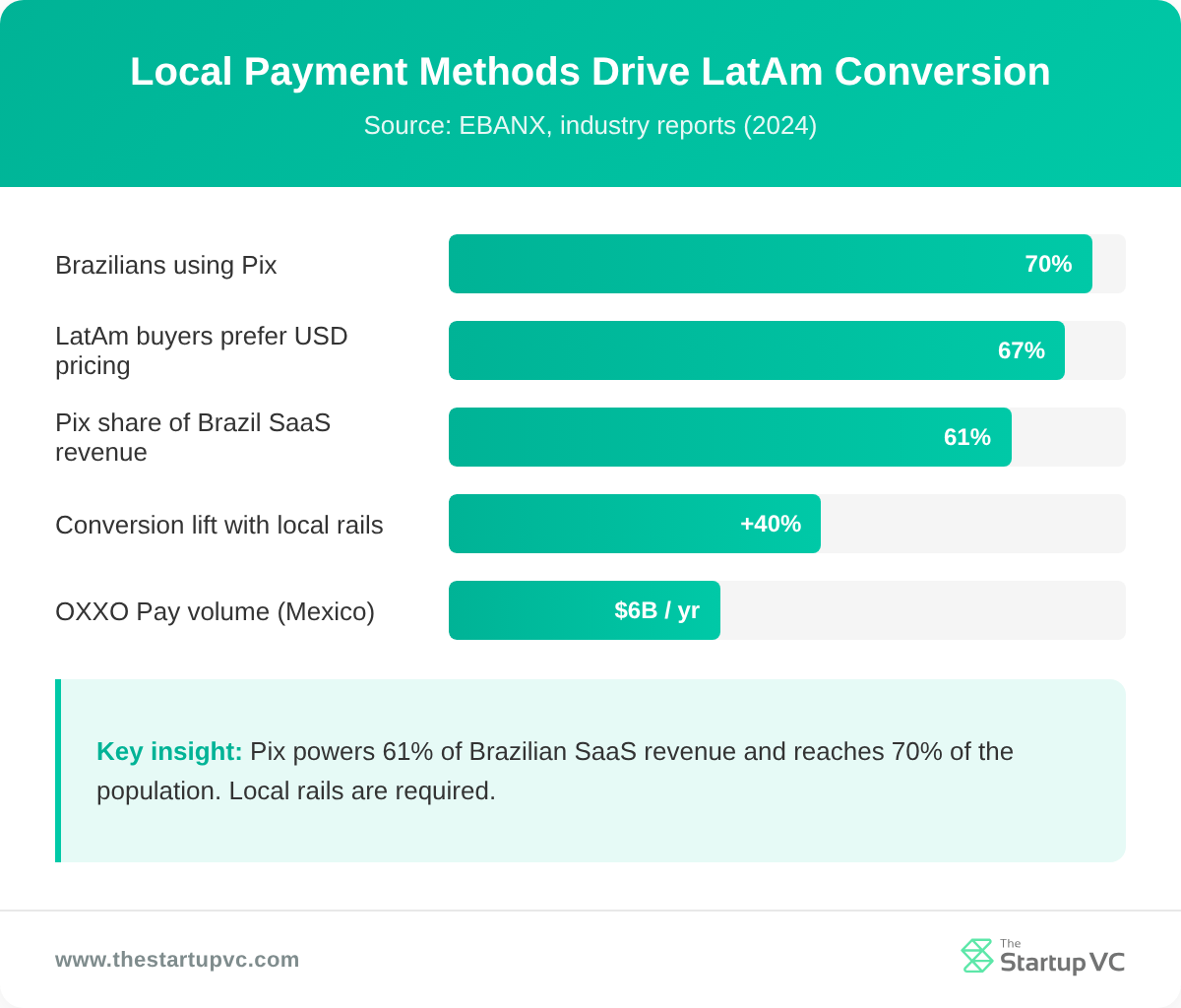
- USD pricing. 67% of LatAm SaaS buyers prefer USD pricing from North American vendors. They view USD prices as premium and stable.
- Local-currency pricing with purchasing-power discounts. SaaS adoption in Brazil and India accelerates when prices drop 40% to 60% to match local purchasing power.
For Argentina, default to USD pricing because of hyperinflation. For Brazil and Mexico, test purchasing-power-adjusted local pricing on mid-market accounts. For enterprise buyers across the region, USD often wins on perception.
What Payment Methods Must You Support?
You must support local payment rails or lose conversions. Cards alone are not enough.
- Pix (Brazil). Pix accounts for 61% of SaaS revenue in Brazil. Over 70% of Brazilians use it.
- OXXO Pay (Mexico). OXXO Pay processed over USD 6 billion in transactions in 2024.
- Installments. Brazil and Mexico expect installment payment options. Conversion rates rise up to 40% when you support local methods.
If your billing stack cannot handle Pix, OXXO, or local cards, partner with a regional processor before launch.
What Compliance Rules Apply to B2B Data and Sales?
The main compliance rules for B2B data and sales fall into three buckets. They are LGPD in Brazil, Mexico’s federal data protection law, and country-specific labor and tax rules. Each adds real cost if ignored.
- Brazil LGPD. ANPD-approved Standard Contractual Clauses are mandatory for international data transfers. The compliance deadline ran on August 23, 2025.
- Brazil breach notification. Proposed reforms require notification within 10 business days of discovery.
- Mexico 2025 reforms. New rules tighten prior consent, restrict commercial use of personal data, and raise corporate accountability.
- Cross-border data. Each country sets its own transfer rules. Map them market by market before signing enterprise deals.
For B2B SaaS firms, LGPD and Mexico’s reforms are the two non-negotiables. Build them into your DPA and contracts from day one.
How Do You Win Your First Customers and Scale or Kill the Bet?
You win your first customers by hiring local sales talent and selling in-person. You scale or kill based on hard milestones at 6, 12, and 18 months. Relationships in LatAm cannot be built from far away.
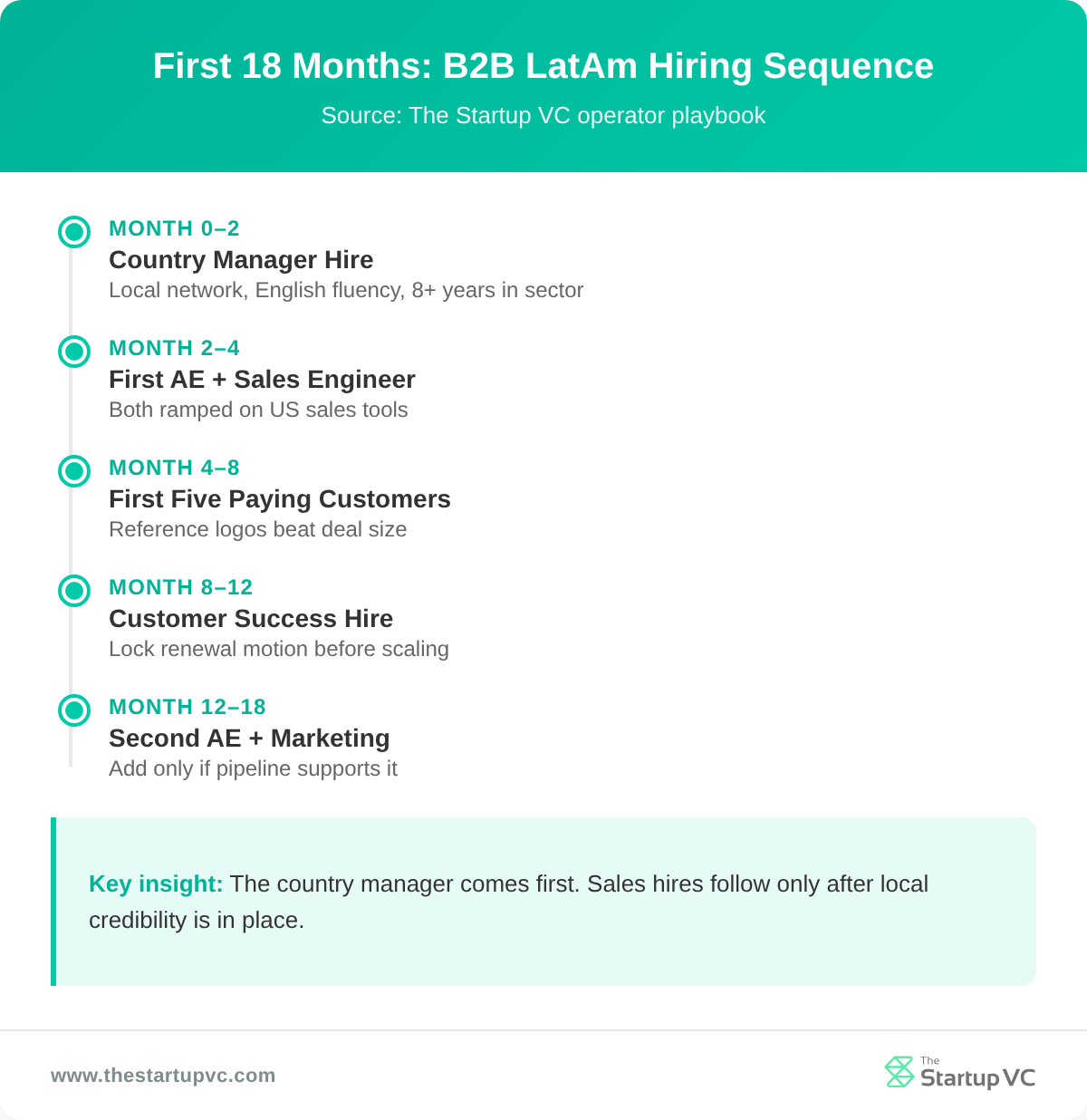
The first 18 months follow a clear sequence.
What Is the Right Hiring Order?
The right hiring order is country manager first, then sales lead, then a small support team. The country manager owns relationships, hiring, and local credibility. A sales lead alone usually struggles to open enterprise doors.
A typical sequence for your first market:
- Month 0–2. Country manager hire. Local network, English fluency, 8+ years in the sector.
- Month 2–4. First account executive plus a sales engineer. Both ramped on US tools.
- Month 4–8. First five paying customers. Reference logos matter more than deal size.
- Month 8–12. Customer success hire. Renewal motion locked in before scaling sales.
- Month 12–18. Second AE and marketing hire if pipeline supports it. Otherwise hold.
Nearshore GTM talent ramps faster, stays longer, and integrates more cleanly into US sales motions. Mexico, Colombia, Chile, and Costa Rica show the strongest digital infrastructure and bilingual talent.
What Scale-or-Kill Milestones Should You Track?
You should track three milestones: pipeline coverage, win rate, and gross retention. These signals decide whether to double down or shut down.
| Milestone | Month 6 | Month 12 | Month 18 |
|---|---|---|---|
| Paying customers | 3+ | 8+ | 20+ |
| Pipeline coverage | 3x ARR target | 3x ARR target | 3x ARR target |
| Win rate | 15%+ | 20%+ | 25%+ |
| Gross retention | n/a | 90%+ | 92%+ |
| Local hires | 2–3 | 5–7 | 8–12 |
Miss two of these at any checkpoint and you should pause hiring. Miss three and consider switching entry mode or exiting the market.
A company-builder approach can de-risk these milestones. The Startup VC’s TSVC’s investment focus leans into shared infrastructure across portfolio firms. Biz Latin Hub scaled to 18 offices across LatAm before Vistra acquired it in 2025. That growth pattern came from shared playbooks and compliance teams, not one-off hires per country.
What Questions Do B2B Executives Ask Most Often About LatAm Market Entry?
How Long Does Latin America Market Entry Take End to End?
Latin America market entry takes 6 to 18 months from decision to first paying customer. Entity setup runs 1 to 4 months. The first five customers usually close inside the first 8 months. Multi-market expansion adds 3 to 6 months per added country.
How Much Does a Single-Market Entry Cost?
A single-market entry costs USD 250,000 to USD 750,000 in the first year. The range covers entity setup, two to three hires, marketing, and legal fees. Mexico and Colombia sit at the lower end. Brazil sits at the high end because of labor and tax complexity.
Should You Hire a Country Manager Before Setting Up an Entity?
Yes, you can hire a country manager before setting up an entity by using an EOR. EOR onboarding takes about five business days. This lets you place a strong leader fast and start customer development. You can convert to your own entity once headcount or revenue justifies the cost.
Which Market Is Easiest for First-Time B2B Entrants?
The easiest market for first-time B2B entrants is usually Colombia or Mexico. Colombia offers the fastest and cheapest setup at 5 to 10 days and under USD 2,000. Mexico offers nearshore time zones, bilingual talent, and 30% corporate tax. Both have lower friction than Brazil.
Can a Venture Studio Partner Replace a Country Manager Hire?
Yes, a venture studio partner can replace a country manager hire in the early months. Studio teams bring local hiring networks, legal support, and proven playbooks. They cost less than a full executive hire. They cannot replace a dedicated leader once revenue scales past USD 1 million in a country.
What Is the Biggest Mistake B2B Firms Make in LatAm Entry?
The biggest mistake B2B firms make in LatAm entry is treating the region as one market. Lima buyers behave differently from Mexico City buyers. Sales decks, pricing, and channels must be tuned per country. Firms that copy-paste US playbooks usually stall inside the first 12 months.
Ready to Build Your Latin America Market Entry Plan?
The Startup VC is Craig Dempsey’s family office and company builder. We create and scale B2B service ventures across Latin America. We work with operators who want a partner that knows the region, not a generic consultant. Our portfolio includes Biz Latin Hub, GGI, and MTP, each tested across multiple LatAm markets. If you are planning a single-market or multi-market entry, we can shorten the path from decision to first revenue. Contact us today to discuss your playbook.