
Panama hosts 186 SEM-licensed regional headquarters in 2025, with a 5% tax rate, USD economy, and direct flights to 90 cities.
Panama hosts over 140 multinational regional headquarters, including Maersk, Dell, Nestle, and BMW. The country offers a 5% SEM tax rate and a US dollar economy since 1904. The IMF forecasts 4% GDP growth for Panama in 2025.
The Startup VC has helped international founders launch ventures across 17 LatAm markets. Biz Latin Hub and other portfolio companies anchor that work. This guide covers the SEM regime, logistics, financial advantages, talent, and setup steps. Use it to compare Panama against Mexico City and San Jose.
Why Should Companies Choose Panama as a Regional Headquarters for Latin America?
Companies choose Panama because it combines the SEM tax regime, a dollarized economy, and central geography. Panama hosts over 140 multinational regional HQs under Law 41 of 2007. The country has held an active SEM license for 186 companies as of February 2025.
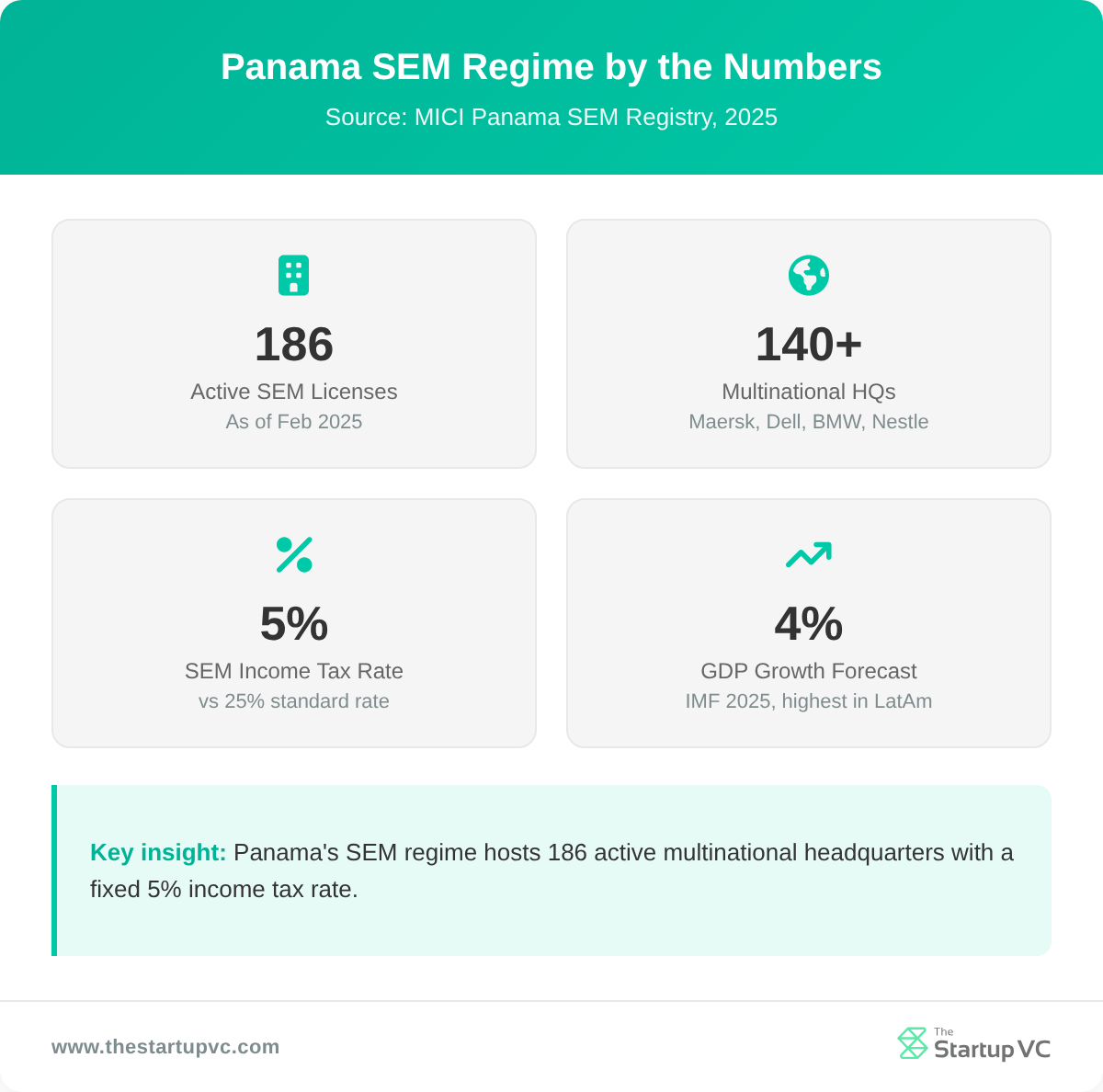
The SEM regime (Sede de Empresa Multinacional) anchors the value proposition. It locks in a 5% corporate income tax on services sold to the group. It exempts VAT on cross-border service flows. It also exempts dividend withholding tax for the headquarters entity.
Stability sits on top of those tax rules. Panama earns automatic legal stability for 10 years once the SEM license is granted. The IMF forecasts 4% GDP growth in 2025, the highest in Latin America. Major employers in country include Maersk, Dell, Nestle, BMW, Heineken, Sanofi, Cemex, LG, and Philips. This profile aligns with our investment focus on cash-flow strong Latin American service companies.
Foreign founders evaluating Latin America for a Panama business hub usually compare three pillars:
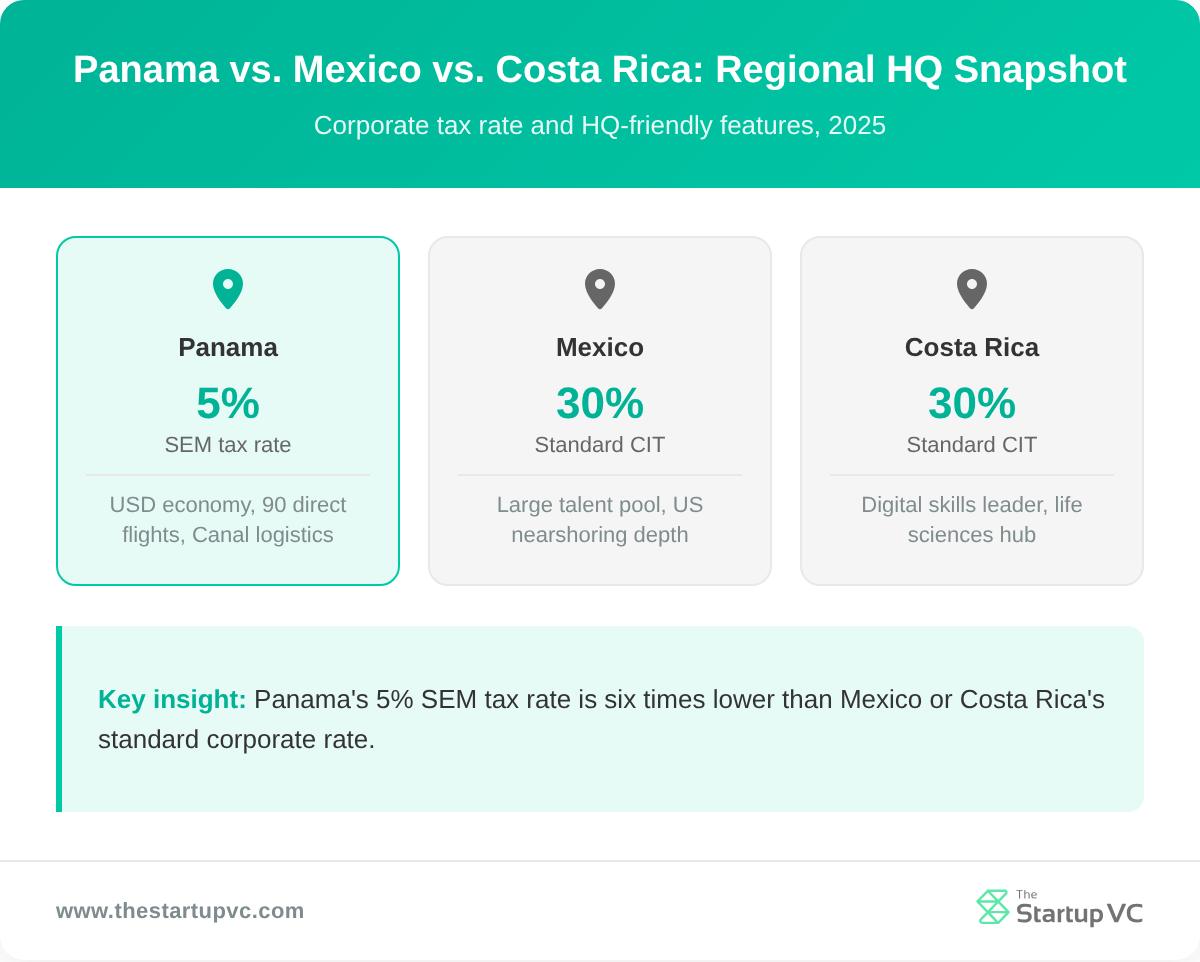
- Tax certainty. A fixed 5% income tax beats statutory rates in Mexico (30%) and Costa Rica (30%).
- USD operations. Revenue, payroll, and reporting all stay in dollars with no FX layer.
- Geographic reach. A regional HQ in Panama can serve North, Central, and South America from one office.
How Does Panama’s Logistics and Connectivity Support Regional Operations?
Panama’s logistics and connectivity support regional operations by combining three assets in one hub. The Panama Canal, Tocumen International Airport, and the Colón Free Zone all sit within the country. PTY closed 2025 with 20.98 million passengers, up 9% versus 2024. The Canal handles around 6% of global maritime trade.
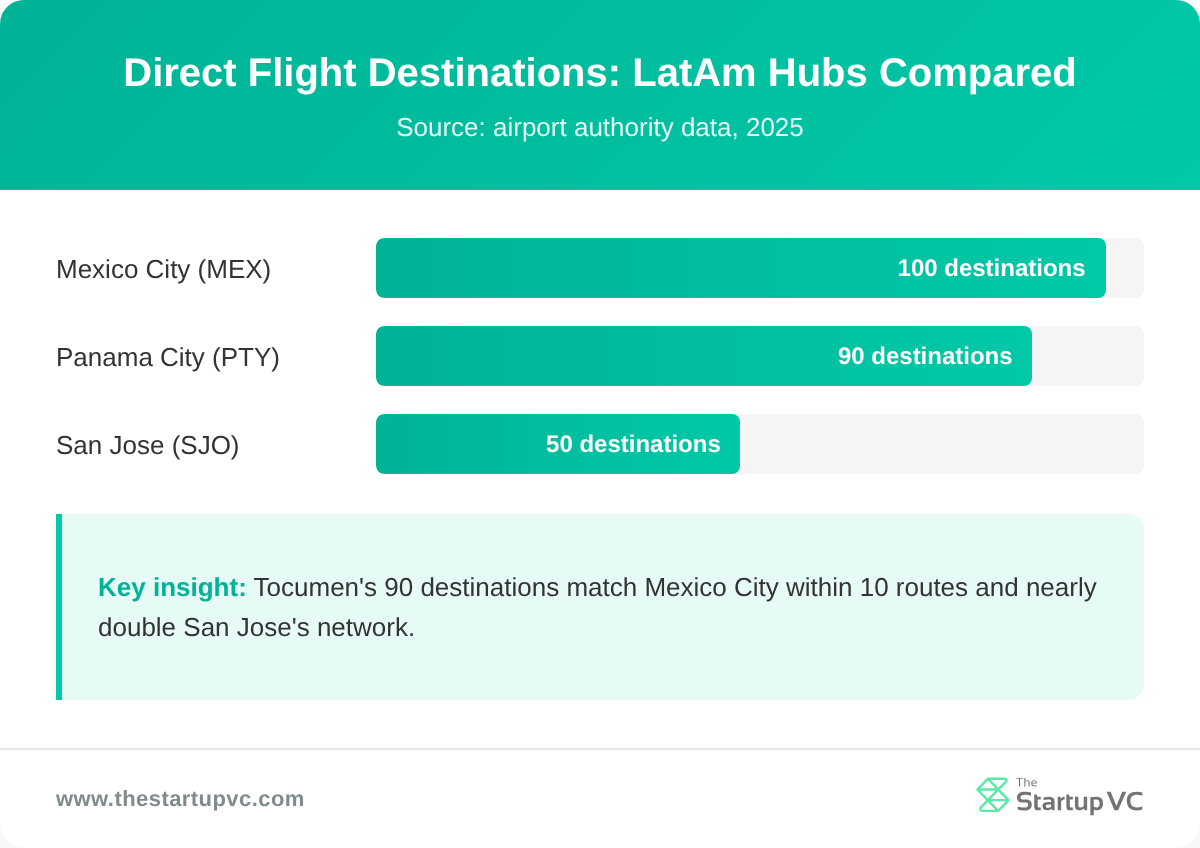
Tocumen International Airport (PTY) anchors air connectivity for any regional HQ. The airport connects to 90 destinations across the Americas and Europe. It operates 24 hours a day, 365 days a year. Copa Airlines runs PTY as its hub, with new routes including direct San Diego service launched in June 2025.
Why Does Air Access Matter for a Regional HQ?
Air access matters because executives based in Panama can reach almost any Latin American capital in a single travel day. A regional finance director can be in Bogota for breakfast and back in Panama City for dinner. This single-leg coverage cuts travel time and per-trip costs across the year.
| Hub | Destinations | Airlines | Daily Passenger Flow |
|---|---|---|---|
| Panama City (PTY) | 90 | 37 | ~57,000 |
| San Jose (SJO) | 50 | 21 | ~21,000 |
| Mexico City (MEX) | 100 | 30+ | ~135,000 |
PTY also has expansion in the pipeline. Tocumen plans to add 10 to 12 new gates and expand Terminal 2 capacity. The bidding process starts in 2026, supporting growth in regional headquarters traffic.
How Does the Colón Free Zone Fit Into the Model?
The Colón Free Zone fits the model by giving distribution-heavy headquarters a tax-free import, re-export, and storage hub. It sits at the Atlantic mouth of the Canal. It is the largest free port in the Americas. Annual trade volume has grown above 20% in recent years.
A regional HQ that ships physical goods can stage inventory in Colón. From there, products move out to Caribbean, Central American, and South American markets without paying Panama import duties. Companies like Maersk, Cemex, and Philips already run this model from Panama.
What Tax and Financial Advantages Does Panama Offer International Ventures?
Panama offers four tax and financial advantages that drive headquarters decisions. They are a dollarized economy, a territorial tax system, the SEM 5% regime, and a deep banking sector. The Balboa has been pegged 1:1 to the US dollar since 1904. Average inflation has stayed below 2% over the past decade.
How Does the Dollarized Economy Reduce Risk?
The dollarized economy reduces risk by removing currency conversion exposure across the whole P&L. Panama has used the US dollar as legal tender since 1904. The local Balboa is only minted as coins, with no paper notes in circulation.
For a regional HQ, this means three things. Payroll runs in dollars. Vendor contracts stay in dollars. Investor reporting needs no FX adjustment line. A treasury team running operations from Panama can plan with the same currency assumptions as a US parent company.
What Does the SEM 5% Tax Rate Cover?
The SEM 5% tax rate covers income earned from services sold to companies in the multinational group. Qualifying services include management, financial, logistics, and shared services. It applies only to SEM-licensed entities. Services exported to entities outside Panama also receive VAT exemption.
For services provided to entities located in Panama, the rate is reduced by 50% off the standard 25%. The combined effect produces one of the most competitive headquarters tax regimes in the hemisphere. The license itself is granted for an indefinite term.
How Deep Is Panama’s Banking Sector?
Panama’s banking sector is deep, with more than 60 international banks operating out of Panama City. The international banking center handles billions in cross-border flows annually. It is one of the largest financial hubs in Latin America.
This depth matters for a regional HQ holding multi-country cash. A treasury can sweep balances from Colombia, Peru, and Chile into a Panama master account. International banks also offer USD trade finance facilities tied to the Canal economy.
How Strong Is Panama’s Talent Pool for Multinational Headquarters?
Panama’s talent pool is strong because the workforce is bilingual and time-zone aligned with the US East Coast. SEM hiring rules also remove friction for foreign executives. English is the lingua franca of business in Panama City. Around 87% of millennials list digital skills as a top career priority.
The SEM regime also makes hiring foreign executives simple. There is no cap on the number of foreign hires inside an SEM headquarters. Foreign executives are exempt from Panamanian income tax. Mandatory social security affiliation is also waived.
Time zone alignment removes a friction layer that other Latin American hubs cannot match. Panama observes Eastern Standard Time (UTC-5) all year. There is no daylight saving change. US East Coast meetings happen in the same business window every month.
| Hub | Working Language | Time Zone | Daylight Saving |
|---|---|---|---|
| Panama City | English / Spanish | UTC-5 year-round | No |
| Mexico City | Spanish, English in some sectors | UTC-6 / UTC-5 | Yes (in some states) |
| San Jose | Spanish, English in tech | UTC-6 year-round | No |
The market also rewards demand. In 2025, the SEM regime granted 13 new licenses with projected investments of US$37.3 million. This drives hiring for bilingual finance, operations, and technology roles in Panama City. Read our analysis of why Panama is emerging as a base for LatAm startups for the local founder view.
What Are the Main Steps to Setting Up a Regional HQ in Panama?
The main steps to setting up a regional HQ in Panama are four sequential stages. You form a Panamanian corporation, apply for the SEM license, secure executive work permits, and open corporate banking. Panama company registration takes 4 to 5 business days. The SEM license then takes 2 to 4 months to approve.
Step 1: Form the Panamanian Corporation
You can form the corporation by drafting articles of incorporation and filing them at the Public Registry. The corporation needs at least three directors, who can be of any nationality. A Panamanian-licensed attorney must serve as resident agent.
Step 2: Apply for the SEM License
You apply for the SEM license through the Ministry of Commerce and Industries (MICI). The applicant must show that the Panama entity serves group operations in multiple countries. Approval grants the 5% income tax rate and the legal stability guarantee.
Step 3: Process SEM Personnel Visas
You process SEM personnel visas through the same MICI track for foreign executives. The SEM Permanent Personnel Visa is valid for up to 5 years. It is renewable for another 5 years with no separate work permit needed.
Documentation requirements are standard for SEM personnel:
- Police clearance. Issued by the country of residence or nationality.
- Medical certificate. Confirms good health, issued in Panama.
- Employment contract. Signed letter from the SEM-licensed employer.
- Valid passport. Must be valid at least 6 months from application date.
Non-SEM foreign workers follow a separate path through the Ministry of Labor and National Immigration Service. That process takes 1 to 3 months.
Step 4: Open Corporate Banking and Launch
You open corporate banking by selecting from the 60-plus international banks in Panama City. KYC and account opening usually take 4 to 8 weeks. Once banking is live, the SEM headquarters can begin invoicing the multinational group. Founders raising in parallel should review how to structure a cap table for cross-border investors.
What Questions Do Founders Ask Most Often About Setting Up in Panama?
How Long Does It Take to Set Up a Regional HQ in Panama?
Setup takes between 3 and 6 months in total. Company registration takes 4 to 5 business days. SEM license approval takes 2 to 4 months. Corporate banking adds another 4 to 8 weeks in parallel.
How Much Does the SEM License Cost?
The SEM license has no public application fee, but professional and filing costs typically run between US$5,000 and US$15,000. Annual maintenance and resident agent fees add a few thousand dollars per year. SEM-specific tax savings far exceed setup costs for active headquarters.
What Sectors Qualify for SEM Status?
The sectors that qualify include pharmaceuticals, transportation, logistics, maritime, energy, technology, finance, engineering, insurance, and reinsurance. Service activities sold to other entities in the multinational group are the core eligibility test. Manufacturing inside Panama does not qualify under SEM but may qualify under other regimes.
Can Foreign Executives Get Permanent Residency in Panama?
Yes, foreign executives can apply for permanent residency through the SEM Personnel Visa track. The visa is valid for 5 years and renewable for another 5. Holders are exempt from Panamanian income tax and social security affiliation.
How Does Panama Compare to Mexico for a Regional HQ?
Panama leads on tax certainty, dollarized stability, and Canal-based logistics. Mexico leads on talent pool size and US nearshoring depth. Mexico’s corporate income tax is 30%, against Panama’s 5% SEM rate. Mexico City’s airport handles more domestic traffic, but Panama City has more intra-LatAm flights.
What Is the Minimum Capital Required for a Panama Corporation?
There is no minimum capital required to incorporate in Panama. The standard authorized capital declared in articles is US$10,000, but no funds need to be deposited. Banks may require their own opening balances based on KYC tier.
Ready to Establish Your Regional Headquarters in Panama?
Setting up a Panama regional headquarters takes operational playbooks built across Latin America. The Startup VC is Craig Dempsey’s family office and company builder. We have launched and scaled ventures across 17 LatAm markets through Biz Latin Hub and other portfolio companies. We help international founders pick the right structure, secure SEM status, and run regional operations. Contact us today to plan your Panama HQ build.