
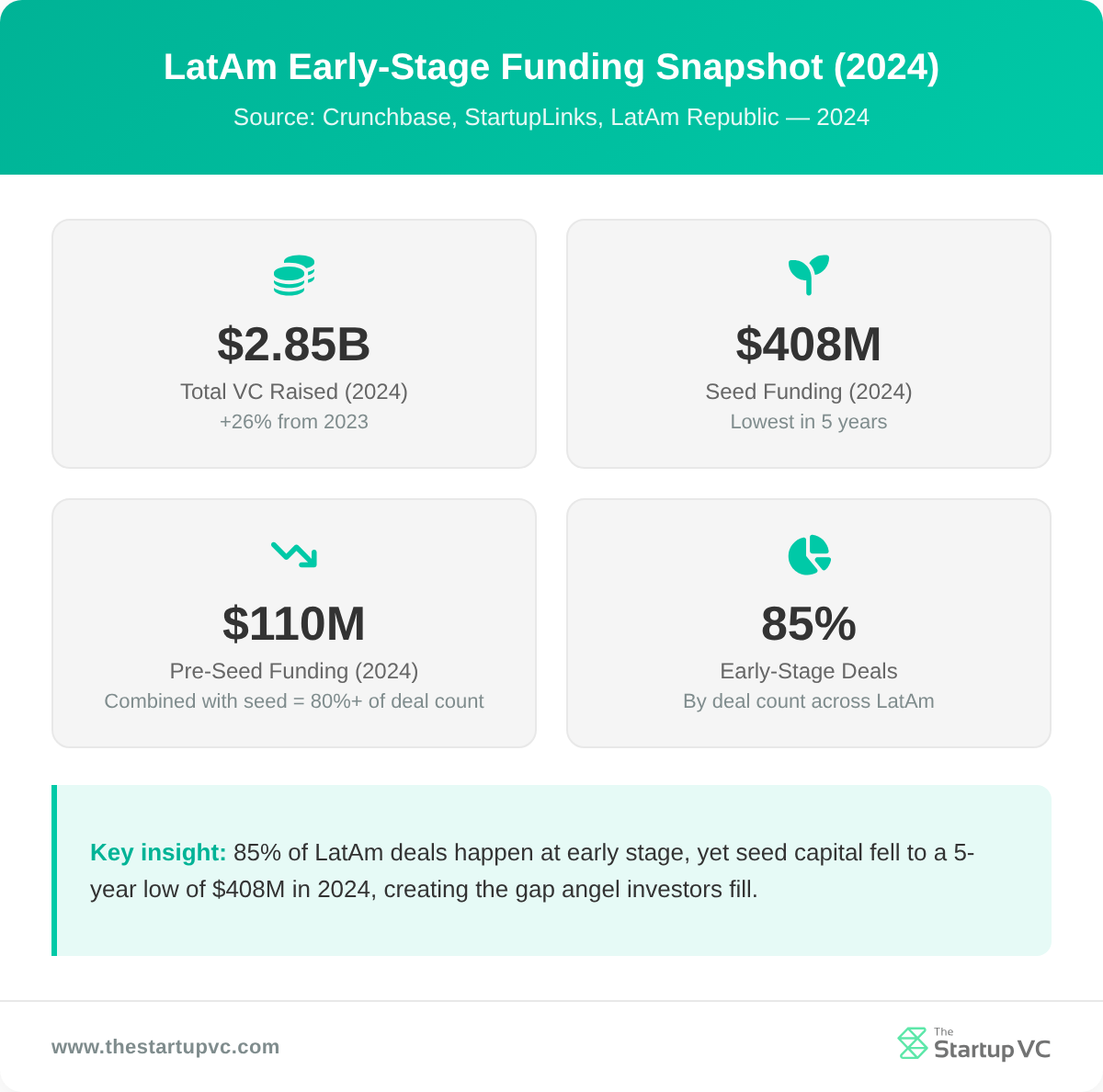
Angel investing in Latin America reached $408M in seed funding in 2024, with 85% of all deals at early stage.
Angel investors in Latin America write checks of $25,000 to $500,000. Networks like Angel Ventures (440+ members), ChileGlobal Angels, and Angels Nest LATAM connect founders to capital in Mexico, Colombia, Chile, and Argentina.
The Startup VC works with early-stage founders and investors across Latin America. We track capital trends and funding structures from Brazil to Colombia. This guide covers how angel investing works in LatAm, what investors look for, and which networks are most active. It also covers how to attract angel capital to your startup.
What Is Angel Investing and How Does It Work in Latin America?
Angel investing is a form of early-stage funding where individuals invest personal capital in startups. In exchange, they receive equity in the company. In Latin America, angel investors fill a unique role. Traditional bank loans and venture capital are often out of reach for first-time founders. Angels step in before institutional money arrives.
The process works by an investor reviewing a startup’s pitch, team, and early traction. If interested, the angel negotiates terms with the founder. The two most common deal structures are SAFE notes and convertible notes. A SAFE (Simple Agreement for Future Equity) gives the investor the right to equity in a future funding round. A convertible note is a short-term loan that converts to equity later.
Angel Ventures, founded in 2008, is the largest professionally managed angel investor network in Latin America. It has more than 440 members. These members co-invest in early-stage companies with high growth potential. Beyond Mexico, Angel Ventures operates in Colombia, Peru, and Chile.
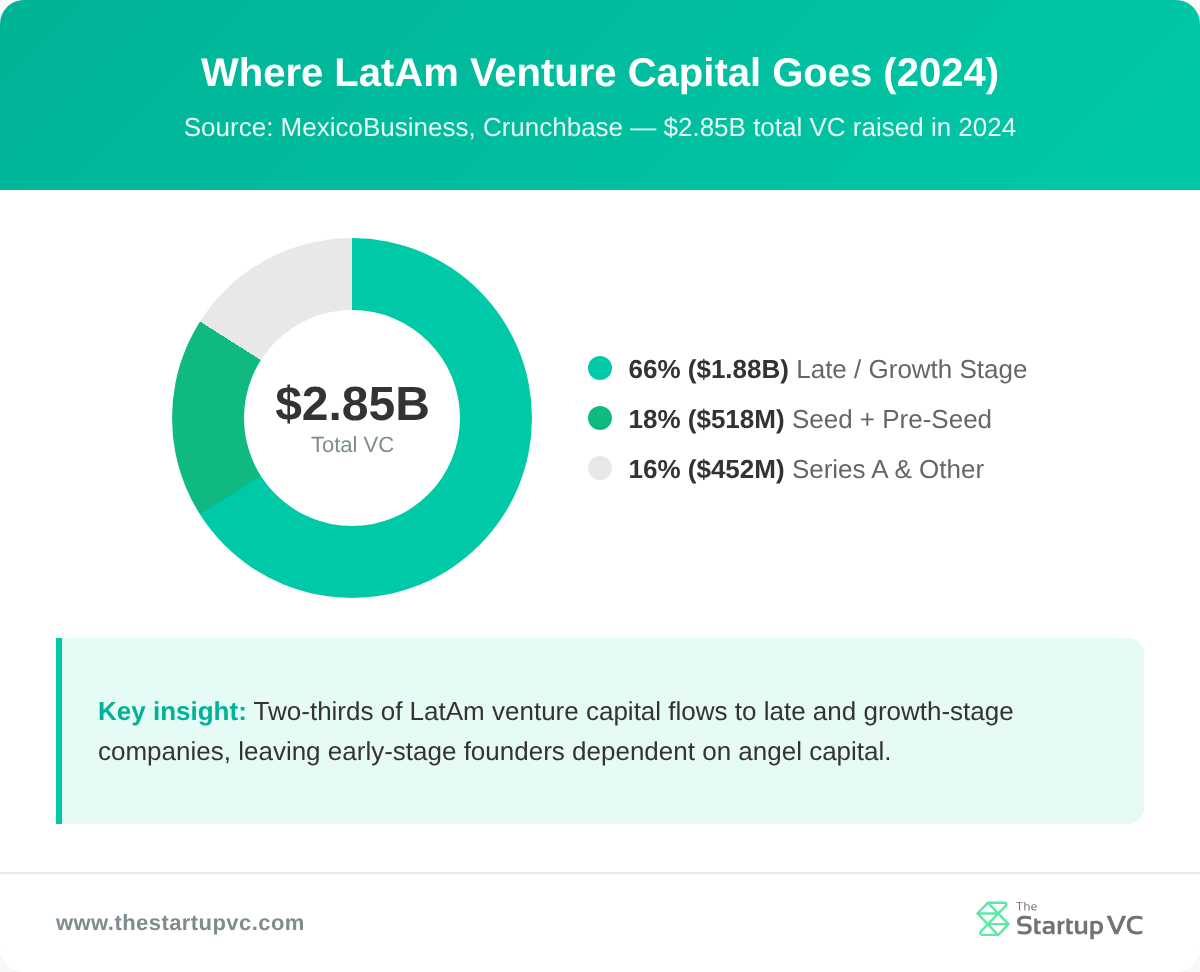
In 2024, Latin America raised US$2.85 billion in venture capital. That was a 26% increase from 2023. But 66% of that capital went to growth and late-stage rounds. This left a wide gap for angel investors to fill at the pre-seed and seed levels.
Angel groups in Latin America support early-stage founders in several ways:
- Capital. Individual angels write checks of $25,000 to $500,000. Angel syndicates pool capital to reach $1 million or more.
- Training programs. Many networks run investor academies and incubation programs for new startups.
- Syndication. Multiple angels co-invest in a single deal, spreading risk and increasing total capital available.
- Introductions. Active angels open doors to later-stage VCs and strategic partners across the region.
Why Are Angel Investors Important for LatAm Startups?
Angel investors are important for LatAm startups because traditional funding sources do not serve early-stage companies well. Banks rarely lend to startups without revenue or collateral. Most venture capital firms focus on Series A deals and beyond.
The Early-Stage Funding Gap
The funding gap in Latin America is measurable. Seed investment fell to $408 million in 2024, the lowest in five years. Pre-seed deal count dropped 77% from its 2022 peak. Stricter investor criteria pushed institutional capital away from the earliest stages.
This gap creates real consequences for founders. Without early capital, startups cannot build their product or validate their market. Many promising ideas never reach a fundable stage. Angel investors address this by taking the earliest bets. They invest when risk is highest and formal structures are not yet in place.
What Angels Provide Beyond Capital
Angel investors provide capital, mentorship, regional networks, and introductions to later-stage investors. In Latin America’s developing startup ecosystems, experienced mentors are hard to find. Angels fill that gap alongside the capital.
QuintoAndar, now one of Brazil’s largest proptech companies, received angel funding before attracting Chinese and US venture capital. Its angel investors helped validate the business model and open doors to follow-on funding.
Family offices play a similar role. They provide patient capital with longer time horizons than most VCs. Local and regional fund managers, including angel networks, support over 80% of seed deals by count in Latin America. Learn more about The Startup VC’s investment focus and what we look for in early-stage LatAm companies.
How Much Capital Do Angel Investors Typically Invest in LatAm Startups?
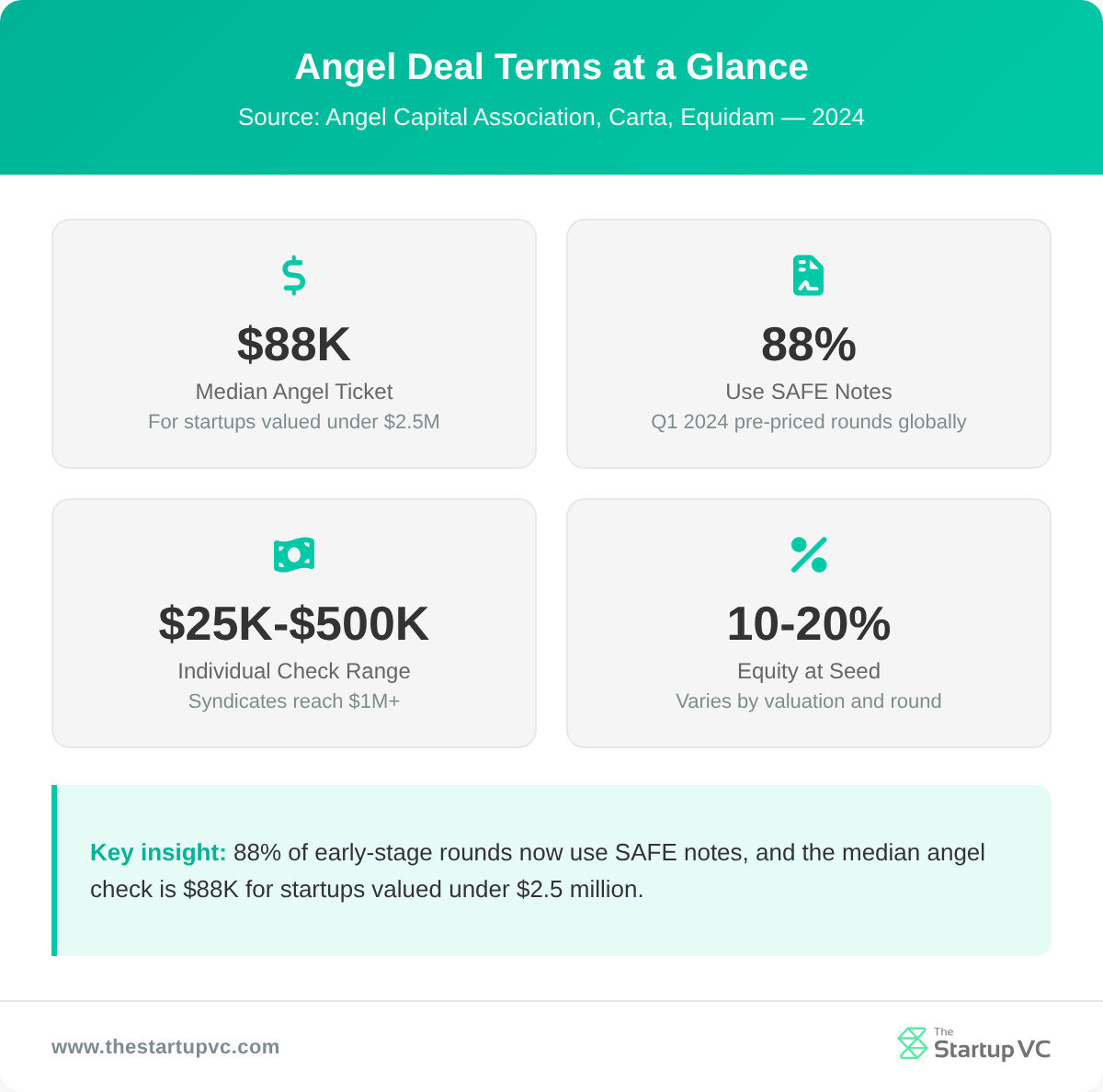
Angel investors typically invest between $25,000 and $500,000 per deal in Latin America. Individual ticket sizes depend on the investor, the startup’s stage, and the deal structure. An angel round overall can total between $25,000 and $1 million.
Typical Ticket Sizes
In 2024, angel groups investing at the earliest valuations (below $2.5 million) deployed a median of $88,000 per deal. That figure was down 17% from 2022. Tighter market conditions pushed investors to be more selective.
The table below shows the typical capital ranges by stage for early-stage funding in Latin America:
| Funding Stage | Typical Ticket Size (Angel) | Total Round Size | Typical Equity Given |
|---|---|---|---|
| Pre-Seed | $25K–$150K | $110M total LatAm (2024) | 10–15% |
| Seed | $50K–$500K | $408M total LatAm (2024) | 10–20% |
| Seed (Group/Syndicate) | $200K–$1M | Varies by network | 15–25% |
How Seed Funding Flows in the Region
Seed investment across Latin America reached $408 million in 2024. Pre-seed funding added $110 million more. Combined, those stages represented more than 80% of all deals by count.
In 2025, seed and angel investment totaled $540 million across the region. That was down 22% from $692 million in 2024. Investors became more selective about team quality and traction before writing checks.
Founders in markets like Mexico City, São Paulo, Bogotá, and Santiago attract the most angel attention. These cities have the strongest accelerator programs and the deepest networks of experienced investors.
What Are the Main Angel Investing Networks and Platforms in Latin America?
The main angel investing networks in Latin America include Angel Ventures, Angels Nest LATAM, ChileGlobal Angels, NXTP Labs, and Manos Accelerator. Each operates in different countries and focuses on different stages and sectors.
| Network | Country Focus | Members / Portfolio | Key Feature |
|---|---|---|---|
| Angel Ventures | Mexico, Colombia, Peru, Chile | 440+ members, $30M+ committed | Largest professionally managed network, founded 2008 |
| Angels Nest LATAM | Region-wide | 400+ angels from LatAm, US, Canada, UK | Cited as most active by XCALA |
| ChileGlobal Angels | Chile | Government-backed (CORFO) | Longest-running in Chile; runs investor training academy |
| NXTP Labs | Argentina, region | 190+ startups funded | Early-stage venture capital + angel syndication |
| Manos Accelerator | US + LatAm founders | Focused on Latino entrepreneurs | First US network focused on Latino high-tech founders |
Angel Ventures operates as both an angel network and a venture fund. It invests at Series Seed and Series A. Its members include corporate executives, private investors, and strategic partners from Mexico, Colombia, and Peru.
ChileGlobal Angels is backed by CORFO, Chile’s economic development agency. It runs a training academy for new angel investors. The program has expanded beyond tech into biotech, clean energy, and other sectors through initiatives like “Invierte: Redes Ángeles.”
NXTP Labs, based in Argentina, has invested in more than 190 startups across Latin America. It serves as both an accelerator and an early-stage investment platform. Founders can access NXTP through its regional offices and application programs.
How Do You Attract an Angel Investor for Your LatAm Startup?
You can attract an angel investor for your LatAm startup by demonstrating a strong team and measurable traction. Show a clear path to a scalable business. Angels in Latin America look for the same fundamentals as investors in the US. They also value local market knowledge and regional networks.
What Angel Investors Evaluate
Angel investors use a consistent set of criteria when reviewing early-stage startups. The factors below are the most common decision points:
- Strong founding team. Investors back people first. The team’s experience, complementary skills, and ability to execute matter more than the idea.
- Measurable traction. Even at pre-seed stage, some evidence of demand helps. User signups, pilot customers, or early revenue all count.
- Large market opportunity. Angels want to see a market that can support a significant return. LatAm’s 650 million+ population across key markets is a common proof point.
- Scalable business model. The startup must be able to grow without costs rising at the same rate as revenue.
- Clear competitive advantage. What makes this startup hard to copy? Patents, network effects, proprietary data, or deep sector knowledge all qualify.
Investors in Latin America have shifted their focus to fintech, SaaS, and AI-driven companies with strong unit economics. Founders in these sectors attract more interest in 2024 and 2025.
How to Find and Reach Angel Investors in Latin America
Latin American founders often struggle to communicate directly with investors. Clear, specific answers to investor questions are a major differentiator. US and global investors expect direct responses during pitches.
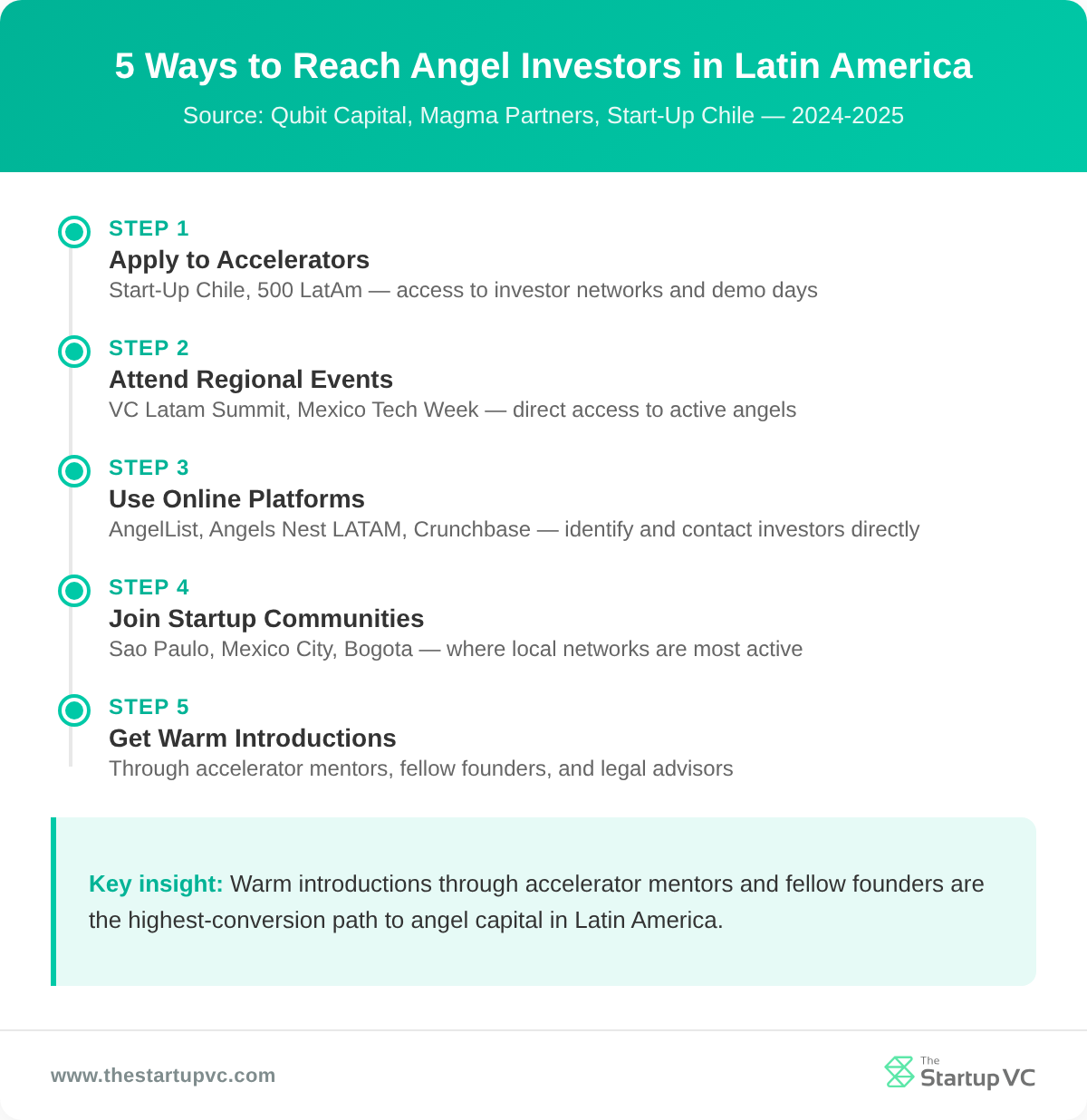
The most effective ways to reach angel investors in Latin America include:
- Apply to accelerators such as Start-Up Chile or 500 LatAm. These programs include investor networks and demo days.
- Attend regional events like VC Latam Summit and Mexico Tech Week. These create direct access to active angels.
- Use platforms like AngelList, Crunchbase, and Angels Nest LATAM to identify and contact investors directly.
- Join startup communities in São Paulo, Mexico City, or Bogotá, where local angel networks are most active.
- Get warm introductions through accelerator mentors, fellow founders, or legal and accounting advisors who work in the startup space.
What Questions Do Founders Ask Most Often About Angel Investing in Latin America?
How much equity do I give up to an angel investor? Founders typically give up 10–15% equity at pre-seed stage. Seed rounds often see 10–20% dilution. The exact amount depends on your valuation, the investor’s ticket size, and the deal structure you use.
What is a SAFE note and should I use one? A SAFE (Simple Agreement for Future Equity) gives the investor equity rights at a future priced round. SAFEs have no interest rate and no maturity date. In Q1 2024, 88% of pre-priced rounds globally used SAFE notes over convertible notes. They simplify negotiation and allow founders to close multiple angels quickly.
What is the difference between a SAFE and a convertible note? A SAFE is not a debt instrument. A convertible note is a short-term loan. The loan carries interest and has a maturity date. If no priced round happens before maturity, the note must be repaid or renegotiated. SAFEs carry none of these repayment risks.
How do I find angel investors in Latin America? The best starting points are regional networks like Angel Ventures, Angels Nest LATAM, and ChileGlobal Angels. You can also search Crunchbase and AngelList for LatAm-focused angels. Accelerator programs like Start-Up Chile and 500 LatAm connect founders to investor networks directly.
What do angel investors provide beyond money? Angels in Latin America provide mentorship, introductions to follow-on investors, and regional business networks. In markets where startup ecosystems are still developing, these connections can be worth more than the capital itself.
Is it harder to raise angel funding in Latin America than in the US? Yes, the angel market in Latin America is smaller and less liquid than in the US. Seed investment across LatAm totaled $408 million in 2024, compared to tens of billions in North America. But the competition for early-stage deals is also lower. Well-prepared founders in fintech, SaaS, and AI with strong traction can access capital from regional and global angels.
Ready to Connect with Early-Stage Capital for Your LatAm Startup?
The Startup VC is Craig Dempsey’s family office and company builder. It creates, backs, and grows scalable ventures across Latin America. The Startup VC operates across more than 17 countries. It brings capital, regional networks, proven playbooks, and hands-on support to early-stage founders. See our portfolio venture companies to understand the kinds of businesses we build and back. If you are building a company in Latin America and looking for an experienced partner at the earliest stages, Contact us today.