
M&A Advisory · Search Funds
How Do Search Funds Buy a Business in Latin America? M&A Advisory for ETA Searchers
Search funds have completed 54 acquisitions in Latin America, buying owner-run firms with recurring revenue to operate and grow.
The IESE International Search Funds Study 2024 counted 320 funds outside the US and Canada. Latin America leads much of that growth, with Mexico and Brazil most active. The Startup VC advises searchers buying professional-services firms across the region.
The Startup VC is led by Craig Dempsey, who co-founded Biz Latin Hub and later exited it to Vistra. That operator experience guides how we source deals, run diligence, and structure terms for searchers. Below, you will learn how to find, check, and buy a succession-ready business in Latin America.

54
search-fund acquisitions in LatAm (IESE 2024)
$11.7M
median international acquisition
5.7x
median EBITDA multiple
What Is a Search Fund, and How Does Entrepreneurship Through Acquisition Work in Latin America?
A search fund is a way for one entrepreneur to buy and run a single company. Investors back a searcher through entrepreneurship through acquisition, often shortened to ETA. The searcher raises money, buys one business, then leads it as the owner. The Stanford GSB 2024 Search Fund Study has tracked 681 funds in the US and Canada since 1984.
What Are the Four Stages of a Search Fund?
The four stages are raising the fund, searching, operating, and exiting. Each stage moves the searcher closer to owning and growing a company.
- Raise the fund. Investors provide search capital to fund the hunt for a target.
- Search and acquire. The searcher screens companies, then buys one business.
- Operate. The searcher runs the company as CEO for several years.
- Exit. The searcher sells the company and returns capital to investors.
What Is the Difference Between a Traditional and Self-Funded Search?
The difference is how the searcher pays for the search phase. Traditional searchers raise dedicated search capital from a group of investors. Self-funded searchers cover their own costs, then raise money to buy. The Stanford GSB 2024 Search Fund Study and IESE International Search Funds Study 2024 track only traditional, or core, funds.
How Active Is Entrepreneurship Through Acquisition in Latin America?
Entrepreneurship through acquisition is growing across Latin America. The IESE International Search Funds Study 2024 counted 320 funds outside the US and Canada. The study ranks Mexico and Brazil as the region’s most active markets.
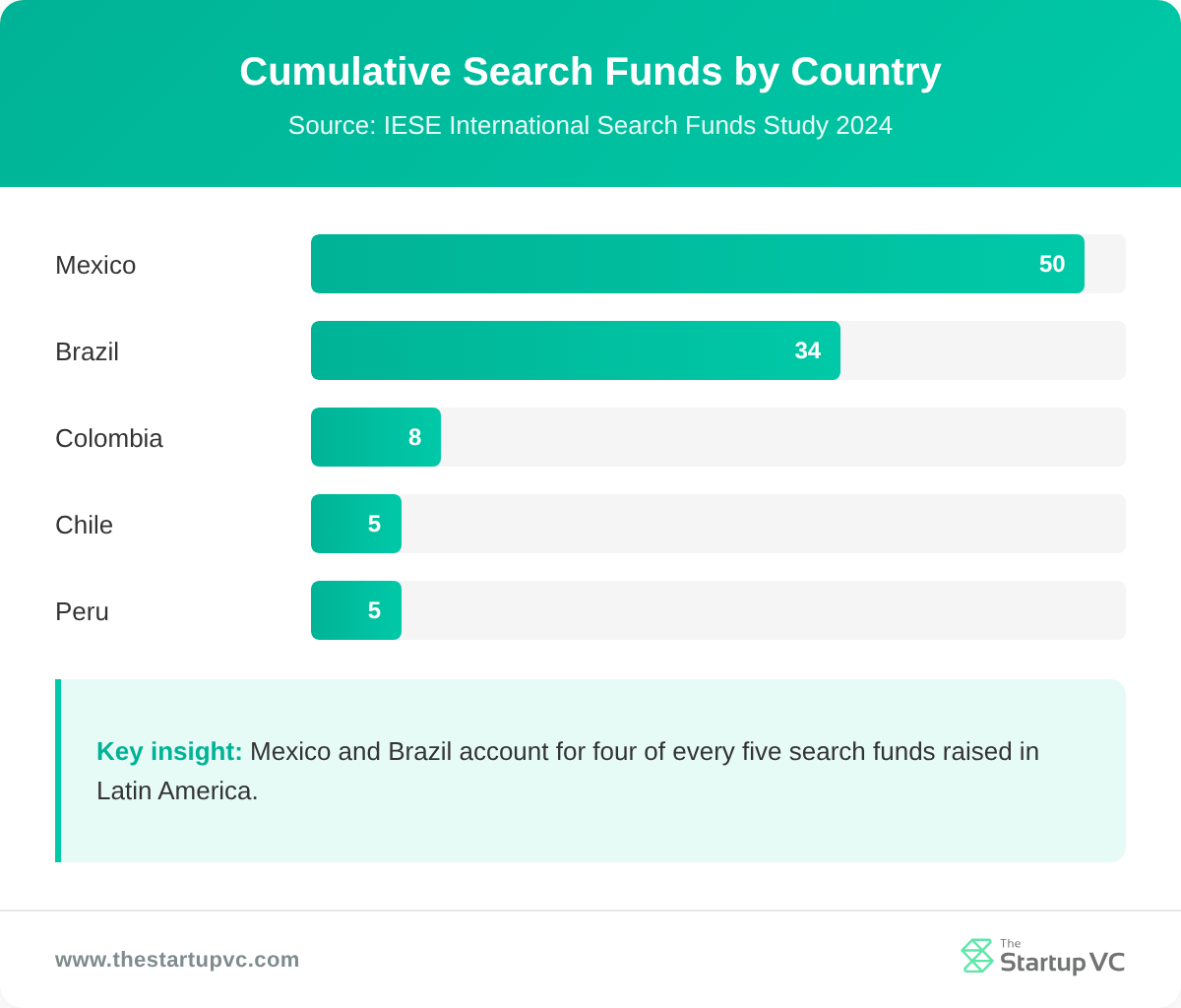
| Country | Cumulative search funds |
|---|---|
| Mexico | 50 |
| Brazil | 34 |
| Colombia | 8 |
| Chile | 5 |
| Peru | 5 |
Mexico leads the region’s search-fund activity. See our guide to M&A in Mexico.
The Latin America Search Fund Study 2022 mapped over 100 funds and 30 acquisitions in the region since 2010.
Why Do Latin American Professional-Services Firms Fit Search Fund Criteria?
Latin American professional-services firms fit search fund criteria because they earn recurring revenue and need little capital. Their owners often near retirement, and the market holds thousands of small firms. SMEs make up 99.5% of businesses in the region, per the OECD SME Policy Index 2024.
What Makes a Services Firm a Good Search Target?
A services firm makes a good search target when it matches four traits. The Stanford GSB Search Fund Primer lists the traits of an ideal target.
| Search criterion | How Latin American services firms fit |
|---|---|
| Recurring or repeat revenue | Retainers and renewing contracts in accounting, legal, and staffing |
| Low customer concentration | Many clients, with no single client dominating revenue |
| Low capital intensity | People-based work needs little fixed investment |
| Fragmented industry | Thousands of small, owner-run firms across Latin America |
Which Service Sectors Suit a Search Fund in Latin America?
The sectors that fit best are accounting, legal, staffing, and nearshore outsourcing. Each runs on repeat work and light assets.
Accounting and tax firms
Clients renew every year for compliance and filings.
Legal and corporate services
Retainers cover contracts, labor, and compliance work.
Recruitment and staffing
Repeat hiring mandates create steady, repeatable revenue.
Nearshore and BPO providers
Multi-year, often US-dollar contracts support stable margins.
The Startup VC invests in and builds service companies across Latin America. Our investment focus covers the cash-generative businesses we back.
How Do You Find a Succession-Ready Business to Buy in Latin America?
You can find a succession-ready business by reaching owners directly before they list it. Latin America is entering a wave of business handovers. A 2019 INSEAD study found fewer than 15% of family firms reach third-generation leadership. Many founders will sell to an outside buyer instead.
What Makes a Business Succession-Ready?
A business is succession-ready when the owner wants out and it can run without them. The IESE International Search Funds Study 2024 shows searchers favor steady revenue and strong margins.
- An owner near exit. The founder is approaching retirement or a life change.
- Recurring revenue. Clients renew, so income does not restart each month.
- Transferable operations. The business runs on systems, so it does not need the founder daily.
- Healthy margins. Steady profit supports seller financing and day-one operations.
How Does Deal Sourcing Work in Latin America?
Deal sourcing works by reaching owner-operators directly, not by waiting for listings. Most sales in the region close privately, and there is no central marketplace. Direct outreach through local networks becomes the main way to find deals. The Startup VC opens doors to owners across Latin America through in-region relationships.
See our playbook on finding acquisition targets in Latin America.
How Do You Run Diligence and Structure a Deal on a Searcher Budget?
You can run diligence and structure a deal by pairing local checks with seller-friendly terms. Small firms in the region often keep informal books, so financials need care. Nearly 50% of SMEs in Latin America operate informally, per the OECD SME Policy Index 2024.
How Do You Validate the Financials of a Latin American SME?
You can validate the financials by rebuilding the numbers from source records. Quality-of-earnings work normalizes undeclared cash, off-book payroll, and personal costs. Tax and labor diligence prices hidden severance and social-security exposure before closing.
Our step-by-step guide to due diligence in Latin America covers this work in depth.
How Do You Structure a Seller Note or Earnout?
You can structure a deal by using seller notes, earnouts, and holdbacks. These tools bridge the price gap and keep the seller invested in the handover.
- Seller note. The seller finances part of the price and gets paid over time.
- Earnout. Part of the price depends on the business hitting future targets.
- Holdback. Money is held back to cover problems found after the sale.
Seller notes often carry a real share of the price. Axial found a median near 16.7% across 100 deals that used a seller note. US SBA 7(a) loans cannot fund a foreign business, since the SBA requires a US location.
How Does the Legal System Change the Deal?
The civil-law system changes the deal by keeping some liabilities with the business. In Brazil, share deals are more common and simpler than asset deals, per Baker McKenzie. An asset purchase still passes tax, labor, and environmental liabilities to the buyer. The Startup VC scopes diligence to a searcher’s budget, spending where risk is highest.
Rules differ by country across the region. See our guide to M&A in Brazil.
Why Choose an M&A Advisor Who Has Built and Sold a Business in Latin America?
You should choose an advisor who has built and sold a company in Latin America because they know the work. Craig Dempsey is behind The Startup VC.
Craig co-founded Biz Latin Hub in Bogota in 2014 and scaled it into a professional-services firm across Latin America. By December 2025, Biz Latin Hub served clients in 17 countries with 18 locations.
Vistra completed its full acquisition of Biz Latin Hub on December 4, 2025. Its announcement called Biz Latin Hub a leading independent provider of professional services across Latin America. That operator experience shapes how The Startup VC supports searchers:
- Deal sourcing. We reach owner-operators across Latin America through in-region networks.
- Local diligence support. We know where SME books hide risk and how to test them.
- Structuring guidance. We help set seller notes and earnouts that fit local law.
- An operator’s view. We have run services firms, so we advise on operating them.
See our track record of building and backing companies across Latin America.
What Questions Do Search Fund Searchers Ask Most Often About Buying in Latin America?
Searchers ask these questions most often before buying a business in Latin America.
How Long Does a Search Take Before You Buy a Company?
A search usually takes up to about two years of full-time work. The Stanford GSB Search Fund Primer puts the phase near 18 to 24 months. Searchers back it with about $400,000 to $750,000 of raised capital, per the same Stanford Primer.
How Do You Finance the Purchase of a Business in Latin America?
You can finance the purchase by combining investor equity with a seller note. Search fund investors provide the equity for the acquisition. US SBA 7(a) loans do not apply, since the SBA requires a US-based business.
Can a Foreigner Own 100% of a Company in Latin America?
Yes, foreigners can own 100% of a company in most major markets. The US State Department’s 2024 Investment Climate Statement says firms in Chile may be fully foreign-owned. Colombia and Mexico also allow full foreign ownership outside a few reserved sectors.
What Size of Company Do Search Funds Usually Buy?
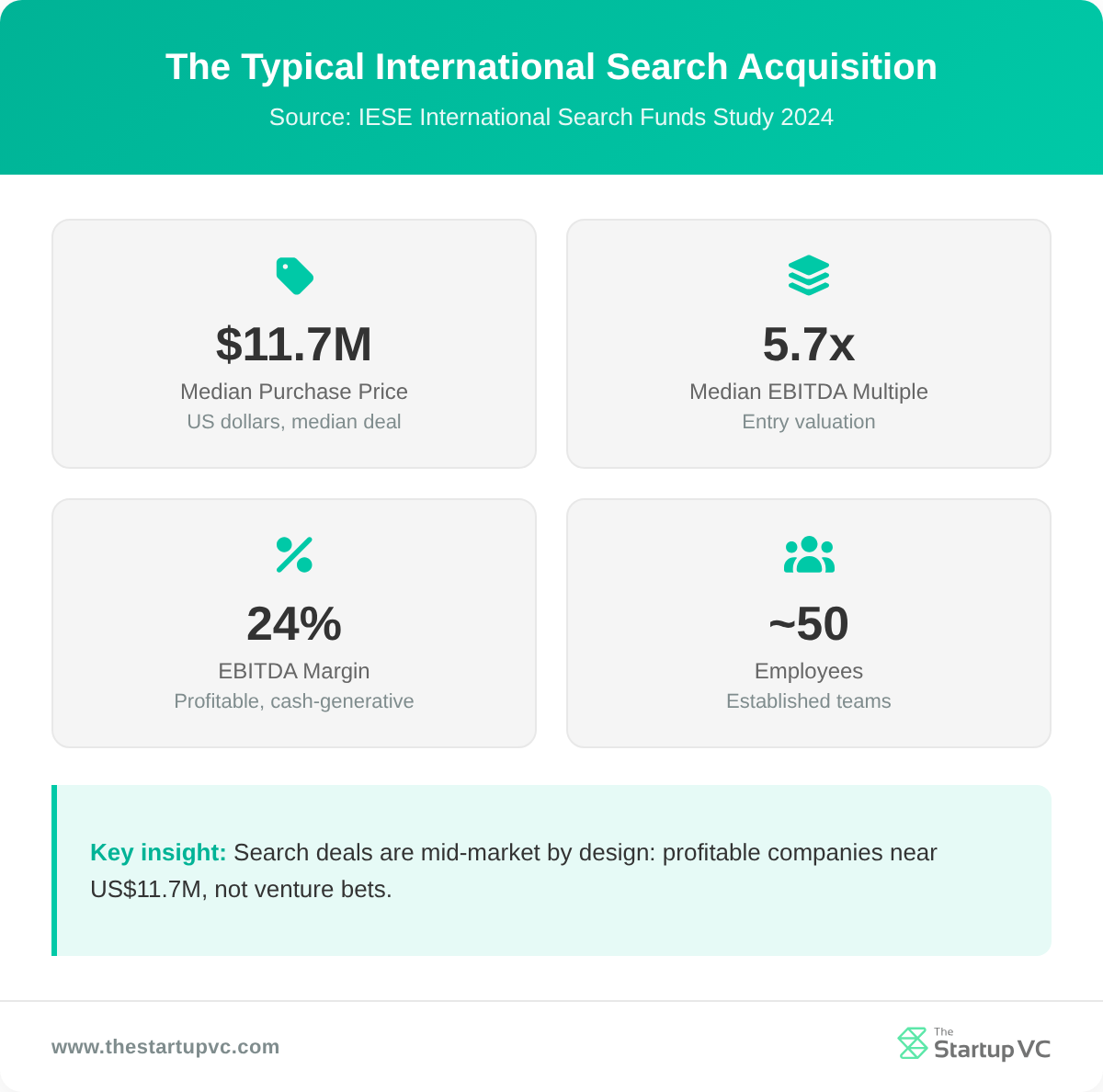
Search funds usually buy small, profitable companies. The IESE International Search Funds Study 2024 reports a median deal near $11.7 million. The same IESE study shows a 5.7x EBITDA multiple and about a 24% margin.
What Sectors Suit a Search Acquisition in Latin America?
The sectors that suit a search acquisition are recurring-revenue services. The Stanford GSB 2024 Search Fund Study finds business services and healthcare are most acquired. Fragmented industries with many mid-size firms work best.
Do You Need Residency or a Visa to Run the Company?
You do not need residency to own shares in most countries. But most Latin American countries require a locally resident legal representative. In Mexico, one legal representative must be a citizen or resident foreigner, per Auxadi.
Let’s talk
Ready to Discuss Your Acquisition Criteria in Latin America?
The Startup VC is Craig Dempsey’s family office and company builder in Latin America. We create, back, and guide ventures across the region. Craig built and sold a professional-services firm here, so we know the deals searchers chase. Tell us your acquisition criteria, target sector, and budget. We will help you source, check, and structure a business you can run. Contact us today and select Investment Banking.