Startup accelerators give founders seed funding, mentorship, and investor networks, with Y Combinator alumni reporting a 93% survival rate.
A startup accelerator is a 3- to 6-month cohort program that provides seed funding, mentorship, and investor access in exchange for 3–10% equity. Top programs like Y Combinator and Start-Up Chile have launched companies across North and Latin America.
The Startup VC is a company builder and family office in Latin America. Our portfolio includes Biz Latin Hub, operating across 17 countries in the region. This guide covers how accelerators work, the top LatAm programs, and how to apply.
What Is a Startup Accelerator Program?
A startup accelerator is a fixed-term, cohort-based program. It gives early-stage companies funding, mentorship, and resources in exchange for equity. Programs typically run for 3 to 6 months and end with a pitch event called demo day.
Accelerators take a small stake in each startup in exchange for their support. Equity ranges from 3% to 10%, depending on the program. Y Combinator takes 7% in exchange for $500,000 in total funding.
Many founders confuse accelerators with incubators. They are different in structure and purpose:
| Feature | Accelerator | Incubator |
|---|---|---|
| Duration | Fixed (3–6 months) | Open-ended (1–5 years) |
| Cohort structure | Batch-based | Individual or ongoing |
| Funding provided | Yes, seed capital for equity | Rarely |
| Goal | Rapid growth and investor readiness | Early concept development |
| Graduation | Yes, with demo day | No fixed endpoint |
Accelerators are designed for startups that already have a founding team and an early idea or product. Incubators typically support founders at an even earlier stage.
How Do Startup Accelerator Programs Work?
Startup accelerator programs work by guiding a batch of startups through a structured curriculum over 3 to 6 months. Each startup in the cohort moves through the same stages at the same time, creating a shared learning environment.
What Does a Typical Accelerator Curriculum Cover?
Accelerator curricula cover the core skills founders need to build and grow a company. Topics include business development, product-market fit, customer acquisition, fundraising, and scaling strategy.
Mentors play a central role in the process. They include experienced entrepreneurs, industry experts, and investors. Each mentor provides specific knowledge to help founders tackle real challenges.
Most programs also provide:
- Co-working space or a shared working environment
- Access to legal, accounting, and HR resources
- Investor introductions and alumni network access
- Weekly founder check-ins and progress reviews
What Happens on Demo Day?
Demo day is the final event of most accelerator programs. Founders present their company to a selected audience of investors, press, and potential partners. The goal is to generate funding interest and launch follow-on fundraising conversations.
Demo day is not a one-day event in isolation. Preparation begins weeks before the final presentation. Founders refine their pitch, financial projections, and product story with help from program mentors.
What Are the Benefits of Joining a Startup Accelerator?
The benefits of joining a startup accelerator include funding, mentorship, and investor network access. Founders also gain a peer cohort of fellow early-stage builders.
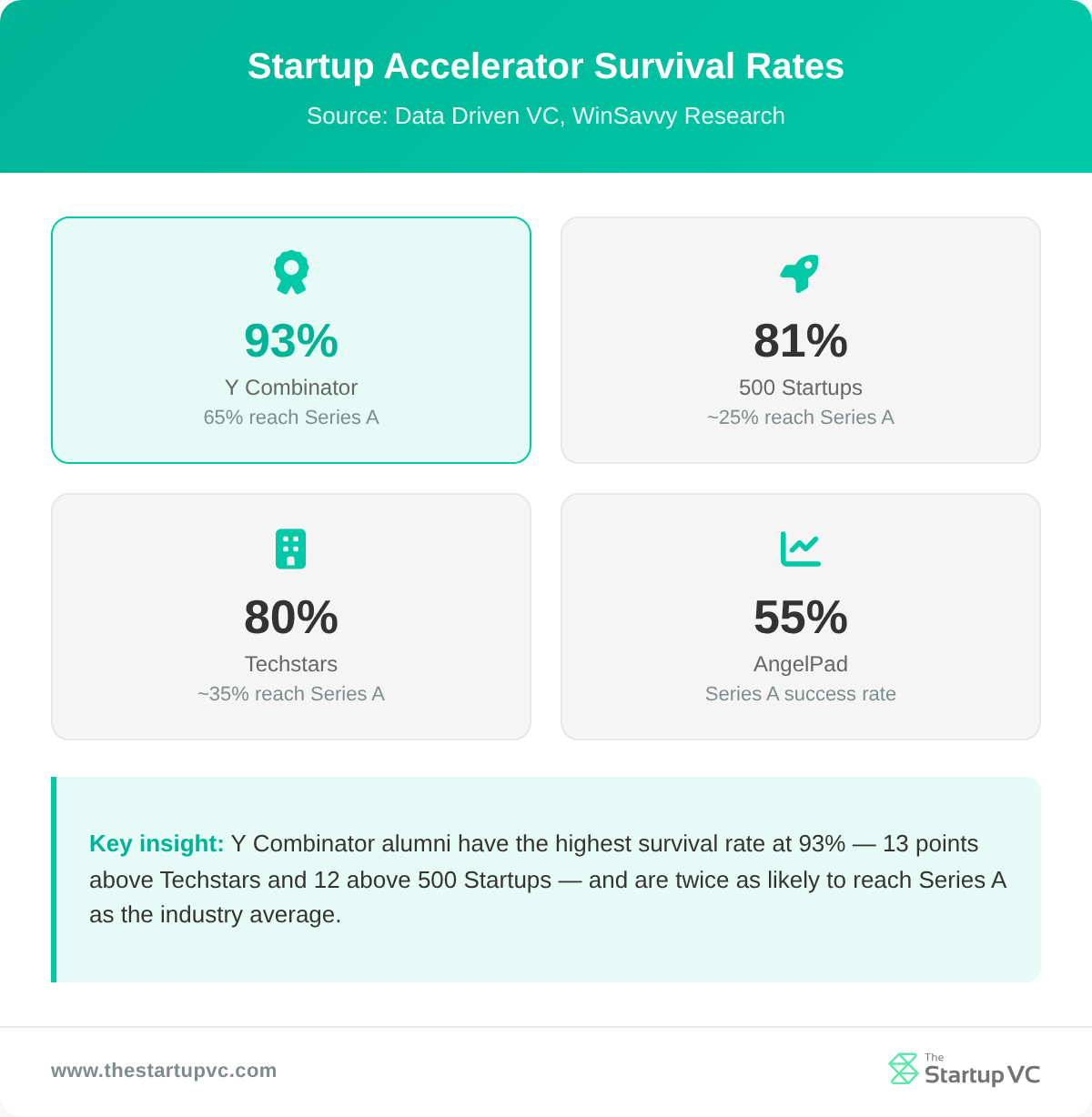
The data on accelerator outcomes is strong. YC-backed startups have a 93% survival rate, compared to 80% for Techstars graduates and 81% for 500 Startups graduates. Accelerator alumni also raise much more than peers in their first year after graduation.
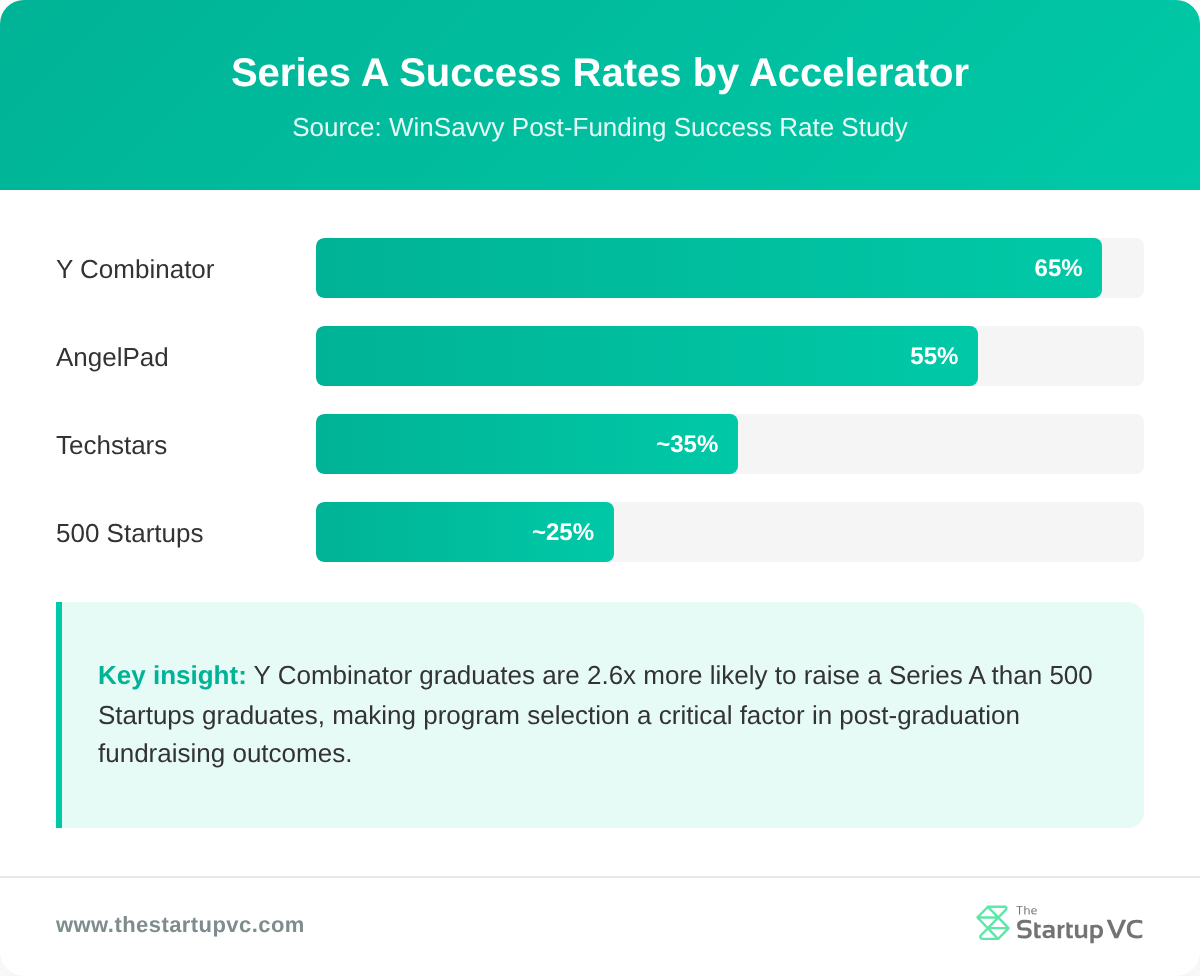
| Accelerator | Survival Rate | Series A Success Rate |
|---|---|---|
| Y Combinator | ~93% | 65% |
| 500 Startups | ~81% | ~25% |
| Techstars | ~80% | ~35% |
| AngelPad | Not reported | 55% |
Accelerated startups raise $1.8 million more in the first year after graduation than non-accelerated peers. This includes growth in revenue, employment, and wages across the business.
Beyond capital, the core benefit is learning. Accelerators provide firsthand knowledge about the startup experience. This knowledge is hard to acquire through books or courses alone.
For founders entering Latin America, accelerator networks offer an added layer of value. Regional investor relationships and local mentor networks can be the difference between a slow market entry and a fast one. For a deeper look at LatAm startup funding, see our analysis of where venture capital is going in Latin America.
What Are the Top Startup Accelerator Programs in Latin America?
The top startup accelerator programs in Latin America include Start-Up Chile, ACE Startups, and 500 Startups LATAM. MassChallenge Mexico and Google for Startups Accelerator are also active in the region.
These programs vary in structure, funding terms, and equity requirements. The table below shows the key details:
| Program | Country | Duration | Funding | Equity |
|---|---|---|---|---|
| Start-Up Chile | Chile | 6–12 months | Varies by track | 0% |
| 500 Startups LATAM | Mexico | 16 weeks | $60,000 | 6% |
| ACE Startups | Brazil | 4 months | Undisclosed | Undisclosed |
| MassChallenge Mexico | Mexico | 4 months | Equity-free grants | 0% |
| Google for Startups | Latin America | 12 weeks | Equity-free | 0% |
| Founder Institute | Multi-country | 14 weeks | No direct funding | ~3.5% |
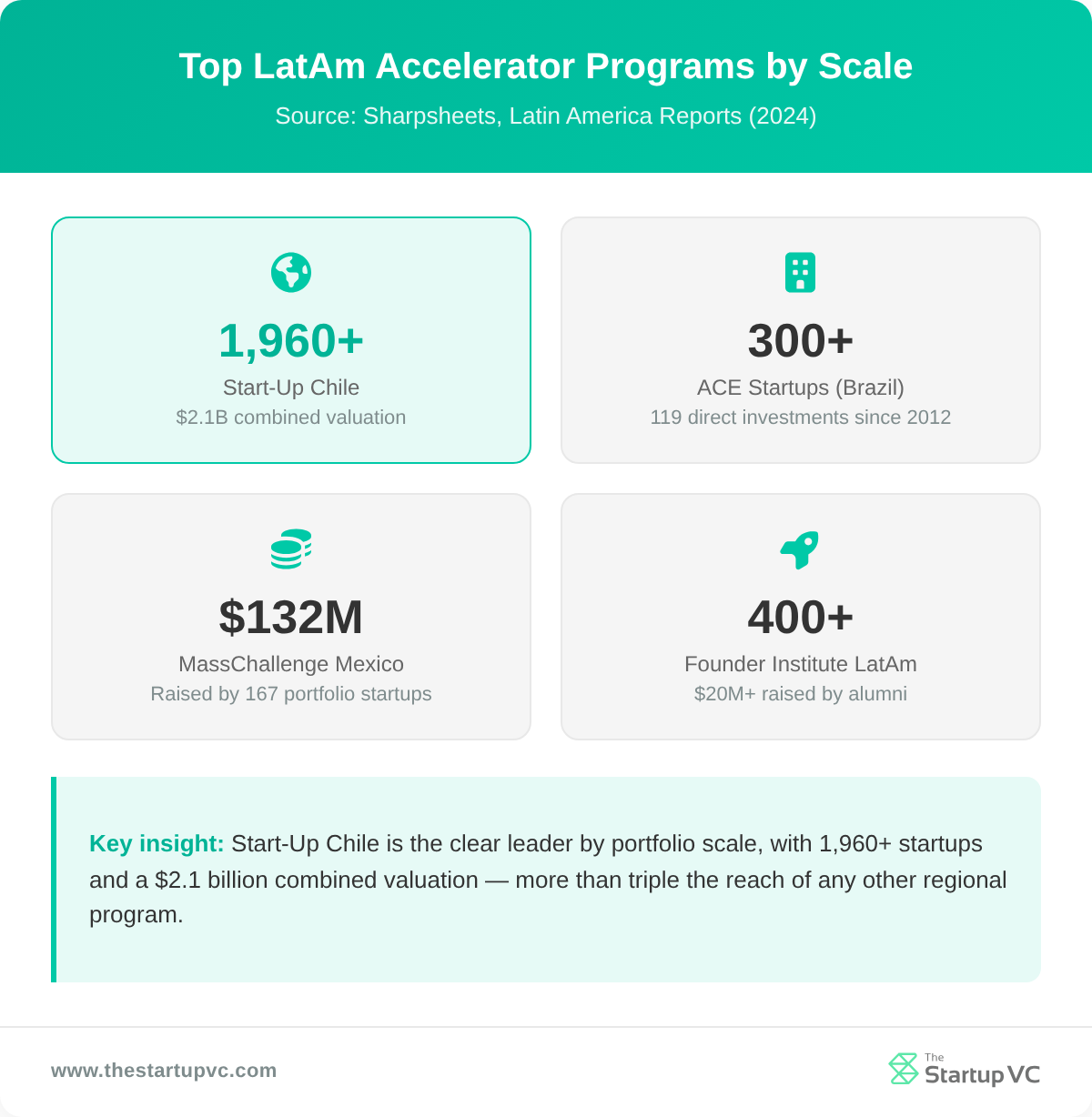
Start-Up Chile is the largest state-backed program in Latin America. Run by CORFO, it has supported over 1,960 startups with a combined valuation of $2.1 billion.
ACE Startups is the largest private accelerator in Brazil. It has made direct investments in 119 of the 300+ startups it has accelerated since 2012.
Other standout programs in the region include:
- 500 Startups LATAM. Based in Mexico City, this 16-week program invests $60,000 per startup for equity.
- MassChallenge Mexico. Has backed 167 startups that collectively raised $132 million since 2016.
- Google for Startups Accelerator. A 12-week equity-free program for Seed to Series A startups across Spanish-speaking Latin America.
How Do You Get Into a Startup Accelerator Program?
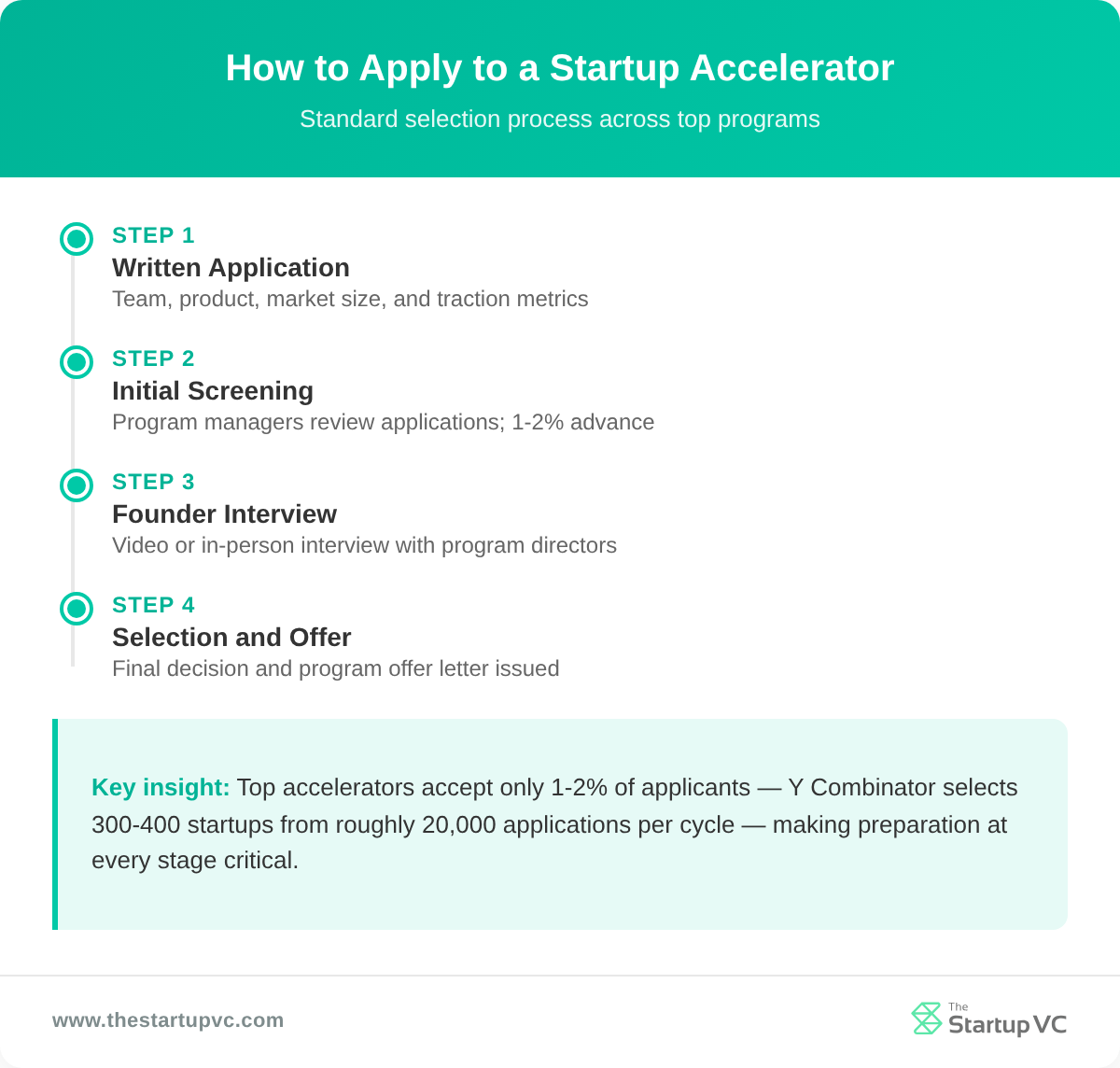
You can get into a startup accelerator by submitting an application that highlights your team, market, and traction. Acceptance rates at top programs are typically between 1% and 2%, so strong preparation is important.
What Are Accelerators Looking for in Applications?
Accelerators look for four core factors in every application:
- Team quality. Strong, complementary founding teams are the top selection factor across most programs.
- Market size. Programs want startups targeting large markets with clear growth potential.
- Product-market fit. Evidence that customers want the product, even at early stages, improves acceptance chances.
- Traction. Revenue growth, user numbers, or signed letters of intent show the startup is moving.
Y Combinator receives around 20,000 applications per cycle. It accepts only 300 to 400 startups, an acceptance rate of roughly 1.5% to 2%.
How Does the Selection Process Work?
The selection process works by moving applicants through several rounds, from written application to interviews. Techstars uses a rolling application with multiple interview rounds. Y Combinator runs two cycles per year, summer and winter, each with a fixed application deadline.
Most programs follow this sequence:
- Written application covering team, product, market, and traction
- Initial screening by program managers
- Video or live interview with program directors
- Final selection and offer letter
For founders building in Latin America, programs like Start-Up Chile and 500 Startups LATAM run their own application cycles. Timelines and requirements differ from global programs. For guidance on company setup before applying, see our overview of business tips for startups in Latin America.
What Questions Do Startup Founders Ask Most Often About Accelerator Programs?
How long does a startup accelerator program last?
A startup accelerator program lasts 3 to 6 months. Most top programs, including Y Combinator and Techstars, run 3-month cohorts. Some LatAm programs, like Start-Up Chile, run for up to 12 months.
How much equity does a startup accelerator take?
Startup accelerators typically take 3% to 10% equity. Y Combinator takes 7%, and 500 Global takes 6%. Equity-free programs also exist, including Google for Startups Accelerator and Start-Up Chile.
What happens after a startup accelerator program ends?
After the program ends, founders keep their company and continue building independently. Most programs expect founders to raise follow-on funding using investor relationships from demo day. Many graduates close their next round within 6 to 12 months of graduating.
Do founders need to relocate for a startup accelerator?
No, founders do not always need to relocate for an accelerator. Many programs, including Y Combinator and Techstars, offer remote or hybrid participation. In-person programs may require temporary relocation for the cohort duration.
Can a pre-revenue startup apply to an accelerator?
Yes, pre-revenue startups can apply to most accelerator programs. Programs evaluate team quality and market potential alongside traction. Some LatAm programs, like Start-Up Chile, specifically target early-stage companies.
What is a startup accelerator demo day?
Demo day is the final event of an accelerator program. Startups pitch their company to a selected audience of investors and partners. It is designed to generate follow-on funding conversations.
Ready to Accelerate Your Startup in Latin America?
The Startup VC is Craig Dempsey’s company builder and family office. We create, scale, and invest in ventures across Latin America. Our support combines operational experience, regional networks, and hands-on company building. We work with founders who are serious about building long-term value in the region.
If you are ready to build your company in Latin America, we can help. Contact us today to start the conversation.