
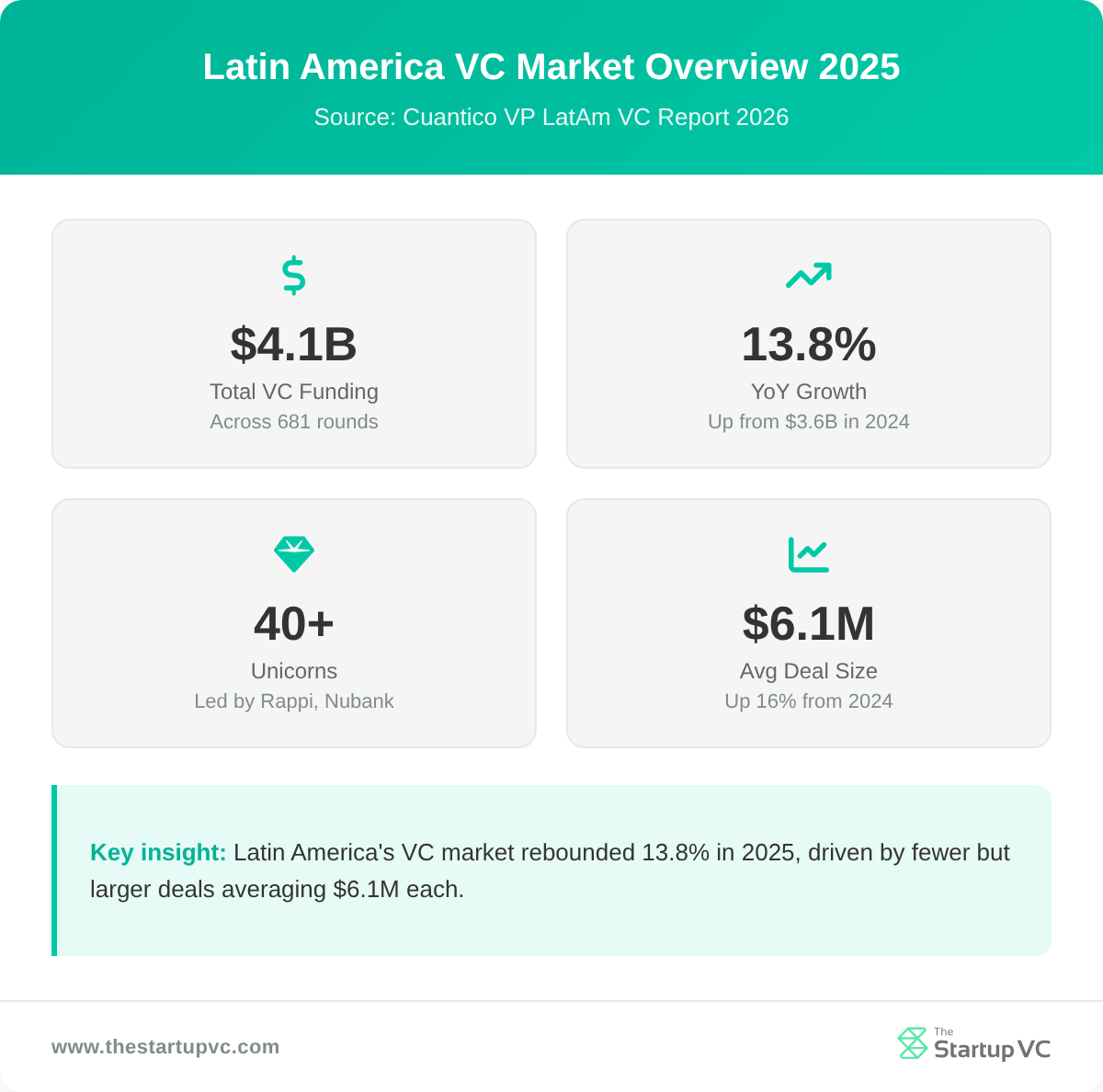
Latin America’s startup ecosystem raised US$4.1 billion in VC funding in 2025, a 13.8% rebound led by fintech and SaaS.
Brazil and Mexico captured 78.5% of all venture capital in the region. Fintech alone took 61% of total funding. The region now hosts over 40 unicorns, including Rappi, Nubank, and Plata. Early-stage rounds totaled US$2 billion, up 31.9% from 2024.
The Startup VC tracks these trends as a family office and company builder with ventures across Latin America. Our portfolio includes Biz Latin Hub, operating across 17 countries. Below, you will find country-by-country funding data, sector breakdowns, and top investors. We also cover the main challenges founders face in 2025 and 2026.
What Is the Current State of the Latin America Startup Ecosystem?
The Latin America startup ecosystem is a fast-growing market that raised US$4.1 billion in venture capital across 681 rounds in 2025. This marks a 13.8% increase over 2024. The rebound follows three years of correction since the 2021 peak of US$17.4 billion.
The region serves over 650 million consumers across 20 countries. Operating costs run 40-60% lower than in the United States. A young population and rising internet access create strong demand for digital products. These factors make Latin America one of the fastest-growing startup regions in the world.
How Has Funding Changed in 2025?
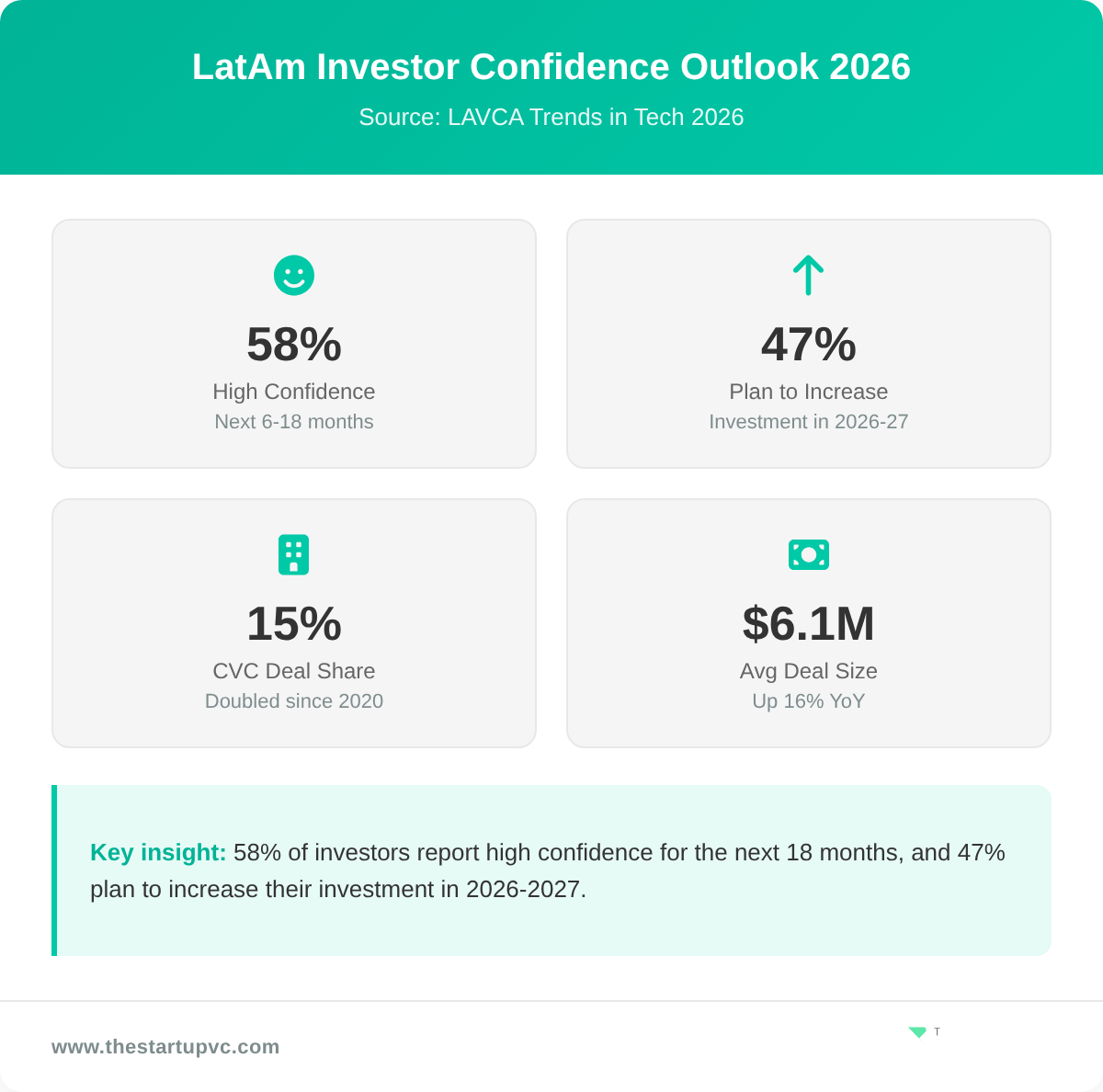
Funding has changed in 2025 by shifting toward fewer, larger deals. Deal volume fell 1.9% to its lowest level since 2017. The average deal size grew 16%, from US$5.2 million to US$6.1 million. Investors now favor proven companies over early experiments. Learn more about where venture capital is going in Latin America.
Early-stage rounds made up 52% of all VC investment in 2025. That totaled nearly US$2 billion, up 31.9% from 2024. VC-backed startups also secured over US$2 billion through credit lines and structured debt.
Startups raised US$1.8 billion in just the first half of 2025. That was a 35% jump from H1 2024. Q1 alone brought in US$1.1 billion, up 45% year over year. The numbers show a market that is recovering faster than many expected.
Which Unicorns Define the Region?
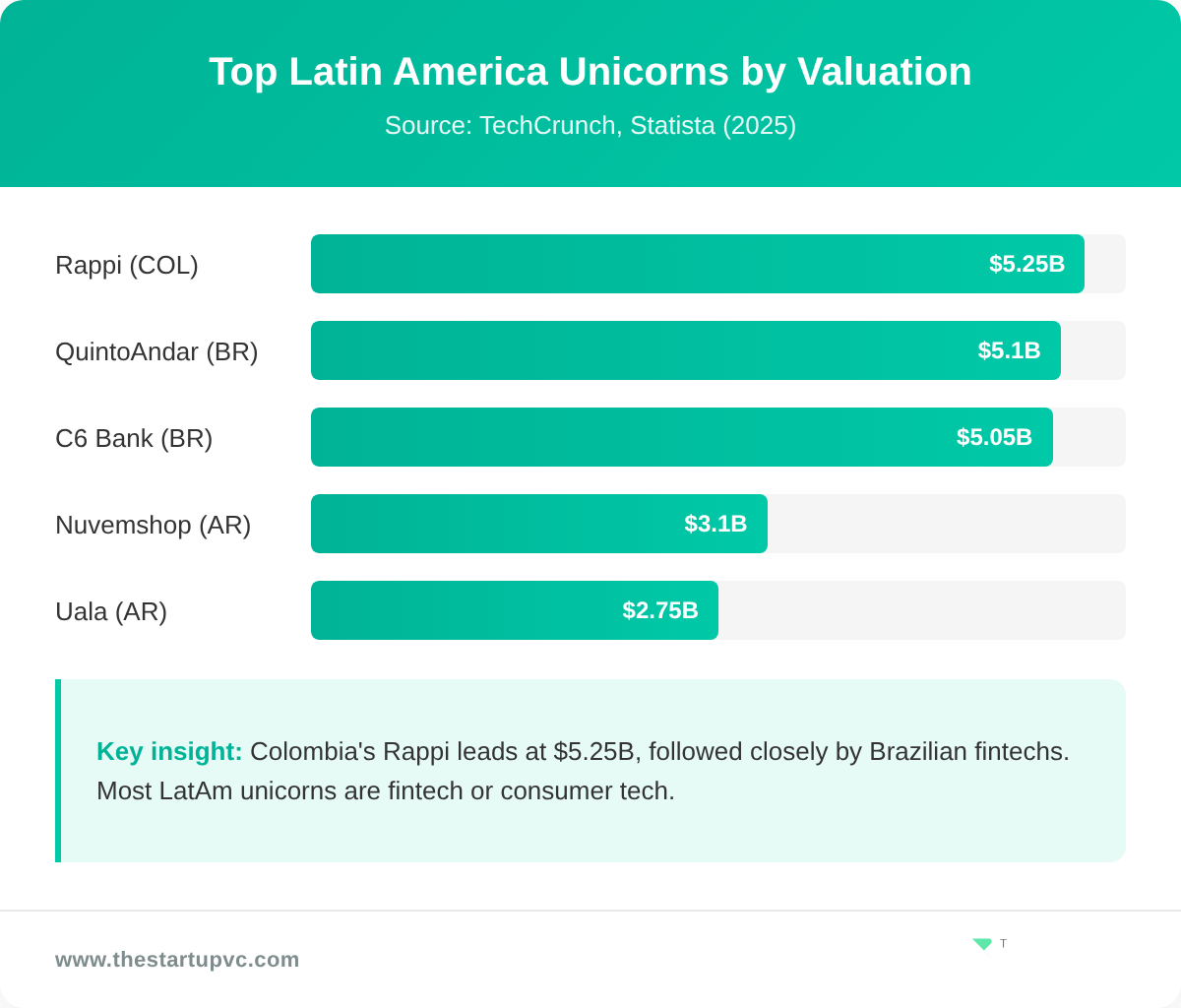
Latin America now hosts more than 40 unicorns. The largest include Rappi at US$5.25 billion, QuintoAndar at US$5.1 billion, and C6 Bank at US$5.05 billion. Nubank, the biggest success story, went public in the US.
Other major names include Nuvemshop (US$3.1 billion), Wildlife Studios (US$3.0 billion), and Uala (US$2.75 billion). Mexico’s Plata became the newest unicorn in 2025 at a US$1.5 billion valuation. Bitso, a Mexican crypto exchange, is valued at US$2.2 billion. CloudWalk from Brazil is worth US$2.15 billion.
Most LatAm unicorns are fintech or consumer technology companies. This reflects the region’s large unbanked population. Over 200 million adults in Latin America lack full access to banking. Fintech companies solve real problems for real users at scale.
| Unicorn | Country | Valuation (US$) | Sector |
|---|---|---|---|
| Rappi | Colombia | $5.25B | Superapp |
| QuintoAndar | Brazil | $5.1B | Proptech |
| C6 Bank | Brazil | $5.05B | Fintech |
| Nuvemshop | Argentina | $3.1B | E-commerce |
| Uala | Argentina | $2.75B | Fintech |
| Plata | Mexico | $1.5B | Fintech |
Which Countries Lead the Latin America Startup Ecosystem in 2025?
The countries that lead the Latin America startup ecosystem are Brazil, Mexico, Colombia, Chile, and Argentina. Brazil dominates in total funding. Mexico is gaining ground fast.
Why Does Brazil Lead in Funding?
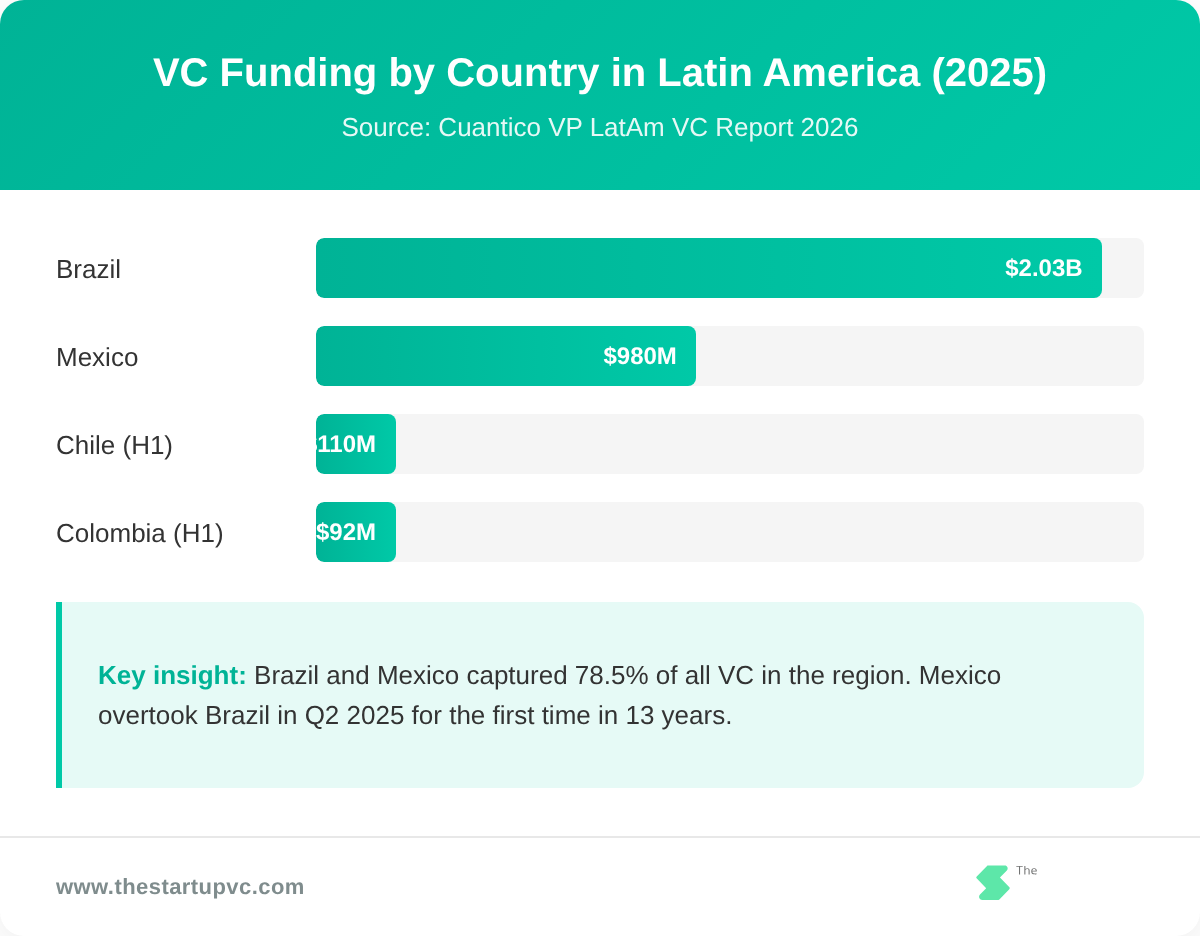
Brazil leads in funding because it has the largest domestic market in the region. It attracted US$2.03 billion across 363 deals in 2025, representing 52.9% of all regional funding. Sao Paulo serves as Latin America’s tech capital. The country produced unicorns like Nubank, QuintoAndar, and C6 Bank.
Brazil benefits from a domestic market of 215 million people. Its fintech sector alone hosts 59% of all Latin American fintech startups. The country also leads in SaaS, proptech, and digital health. Government programs like BNDES support innovation funding at below-market rates.
How Is Mexico Closing the Gap?
Mexico is closing the gap by attracting US$980 million across 86 rounds in 2025. That accounts for 25.5% of regional investment. Mexican startups overtook Brazil in Q2 2025 for the first time in 13 years. The three largest VC deals of 2025 were all Mexican fintechs.
Plata raised a US$160 million Series A and a US$250 million Series B. Klar closed a US$170 million Series C. Mexico City is now a top destination for fintech founders.
Mexico’s proximity to the United States gives its startups a natural advantage. Cross-border trade and remittances create large markets for fintech. The country’s fintech law provides a clear regulatory framework. Guadalajara and Monterrey also host growing tech scenes.
Where Do Colombia, Chile, and Argentina Stand?
Colombia, Chile, and Argentina stand at different stages of growth. Colombia posted US$92 million in H1 2025 from seed and early-stage deals. It ranks 36th worldwide with the highest growth rate in the region at over 22%. Bogota and Medellin are the main startup hubs.
Chile brought in US$110 million in H1 2025. Clean energy and logistics drove most of the activity. Start-Up Chile has supported over 1,960 startups with a combined portfolio value of US$2.1 billion.
Argentina produced unicorns like Nuvemshop (US$3.1 billion) and Uala (US$2.75 billion). The country’s founders succeed despite currency volatility and high inflation. Buenos Aires has a deep pool of engineering talent. Many Argentine startups target global markets from day one.
Peru and Uruguay also show promise as emerging startup markets. Lima’s fintech scene is growing. Montevideo attracts founders who want a stable base with low taxes. These smaller markets benefit from regional VC funds that invest across borders.
| Country | 2025 VC Funding | Share of Regional Total | Key Strength |
|---|---|---|---|
| Brazil | $2.03B | 52.9% | Largest market, most unicorns |
| Mexico | $980M | 25.5% | Fintech leader, fastest growth |
| Colombia | $92M (H1) | Growing | Highest growth rate (22%+) |
| Chile | $110M (H1) | Growing | Government programs, clean energy |
| Argentina | N/A | Variable | Strong founders, unicorn output |
Where Is Venture Capital Going in Latin America in 2025-2026?
Venture capital in Latin America is going toward fintech, SaaS, and AI-driven companies that show strong unit economics. Investors are backing fewer startups with larger checks. The focus has shifted from growth at all costs to profitability.
Which Sectors Attract the Most Capital?
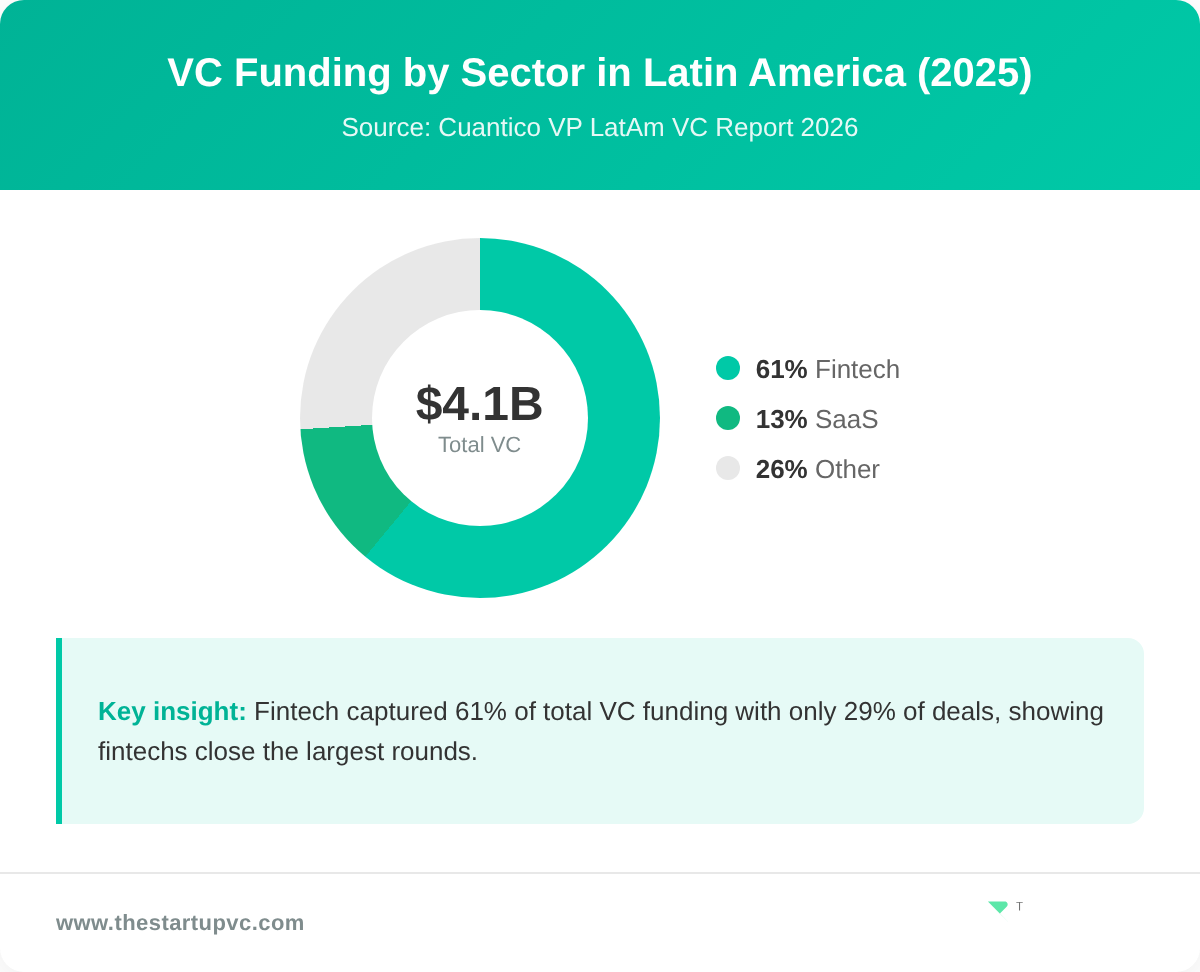
Fintech captured 61% of total VC funding in 2025 with only 29% of deals. This means fintech companies close the largest rounds. SaaS is the second-largest sector at 13% of both deals and funding.
AI and stablecoins are boosting payments and lending platforms. Healthtech and logistics also attract growing interest. Clean energy startups gained traction in Chile and Colombia.
Digital payments remain a core driver of fintech growth. Over 70% of Latin Americans now use digital wallets or mobile banking. Open banking regulations in Brazil and Mexico create new opportunities. Embedded finance is expanding into e-commerce and payroll platforms.
AI startups are growing across the region. Companies use AI for credit scoring, fraud detection, and customer support. Brazilian and Mexican AI startups raised over US$300 million combined in 2025. Investors see AI as a way to cut costs in banking and insurance.
| Sector | Share of 2025 VC Funding | Share of Deals | Trend |
|---|---|---|---|
| Fintech | 61% | 29% | Dominant, largest rounds |
| SaaS | 13% | 13% | Steady second |
| Healthtech | Growing | Growing | Rising interest |
| Clean Energy | Growing | Growing | Chile and Colombia focused |
What Are Investors Looking for in 2026?
Investors reward operational discipline and capital efficiency. Capital is now priced around execution and governance. Narrative alone no longer attracts funding.
A survey of LatAm investors shows 58% report high confidence for the next 6 to 18 months. About 47% plan to increase investment in 2026 and 2027. IPOs and M&A activity are expected to rise.
The exit market is also changing. Investors want to see clear paths to liquidity. Strategic acquisitions by larger companies are more common than IPOs. Nubank’s successful US listing set a benchmark for the region.
Corporate venture capital (CVC) is growing in Latin America. CVC activity doubled between 2020 and 2023. It now accounts for 15% of all VC deals that involve corporate investors. Large banks and telecom companies are the most active corporate backers.
Which VC Firms Are Most Active?
The most active VC firms in Latin America include Kaszek, ALLVP, 500 LatAm, and SoftBank Latin America. These firms invest across stages from seed to growth.
- Kaszek. Closed a US$540 million early-stage fund and a US$435 million later-stage fund. They invest from seed through pre-IPO.
- ALLVP. Mexico’s first institutional seed fund. Check sizes range from US$1 million to US$10 million.
- 500 LatAm. Invests US$300,000 per startup in early-stage Spanish-speaking companies.
- SoftBank Latin America. Backs rounds from its regional fund and its main global fund.
Other notable investors include Monashees, a pioneer Brazilian VC firm. Bossa Invest and Crescera Capital are also very active. International firms like Andreessen Horowitz and Tiger Global have made select bets in the region. The investor base is broader and more diverse than ever before.
The typical VC investment timeline in Latin America runs 7-10 years. Funds raised in 2020-2022 are now deploying their final capital. New fund vintages from 2024-2025 target the post-correction market. This creates opportunities for founders who can show strong metrics.
How Do Startups Raise Funding in Latin America?
You can raise funding in Latin America by starting with accelerators or angel investors, then moving to institutional VC rounds. The path depends on your stage, sector, and country.
What Are the Main Funding Stages?
Startups in Latin America follow a clear funding path. Each stage has different capital sources and expectations.
- Pre-seed and angel. Founders bootstrap or raise from angel networks. Seed and angel investment totaled US$540 million across the region in 2025.
- Accelerators. Programs like Start-Up Chile, 500 LatAm, and Founder Institute provide capital, mentorship, and networks.
- Seed and Series A. Early-stage rounds totaled nearly US$2 billion in 2025. This was up 31.9% from 2024.
- Series B and beyond. Growth-stage rounds are larger but fewer. Plata raised US$250 million at Series B in 2025.
Which Accelerators Support LatAm Founders?
Several accelerators help startups get started in Latin America. Each offers different funding amounts and program structures. See our guide to startup accelerator programs for a full breakdown.
| Accelerator | Typical Investment | Startups Supported | Focus |
|---|---|---|---|
| Start-Up Chile | Equity-free grants | 1,960+ | All sectors |
| 500 LatAm | $300K | Hundreds | Early-stage, Spanish-speaking |
| Founder Institute | Varies | 400+ in LatAm | Pre-seed |
| Y Combinator | $500K | 100+ LatAm alumni | All sectors |
What Role Do Family Offices Play?
Family offices emerged as key players in Latin America’s funding market. They provide patient capital and deep regional expertise. Unlike traditional VCs, family offices can take longer time horizons.
The Startup VC operates as Craig Dempsey’s family office and company builder. It creates, backs, and guides ventures across Latin America. This model combines capital with hands-on operational support.
Over 25% of LatAm firms face credit constraints. That rate is about twice the OECD average. Family offices help fill this gap for founders who need flexible terms.
Networking is also key to raising capital in Latin America. Events like the VC Latam Summit and Mexico Tech Week connect founders with investors. Building relationships before you need money gives you a stronger position. Investors prefer founders who understand local markets deeply.
How Should Founders Prepare Before Raising?
You should prepare before raising by building a product with real users and proving your business model works. Investors in 2025 expect revenue or clear product-market fit. A common mistake is seeking VC too early.
Founders should also understand their target country’s legal structure. Company formation rules differ in Brazil, Mexico, Colombia, and Chile. Working with local advisors like Biz Latin Hub helps founders avoid costly compliance mistakes. Service providers can handle entity setup, tax registration, and hiring.
Key preparation steps for raising in Latin America include:
- Build traction first. Show monthly revenue or strong user growth before pitching VCs.
- Know your unit economics. Investors want to see clear margins and a path to profit.
- Choose the right structure. Each country has different entity types and tax rules.
- Get local advisors. Legal and accounting partners save time and prevent mistakes.
- Target the right investors. Match your stage and sector to funds that invest at your level.
What Challenges Do Startups Face in the Latin America Ecosystem?
The challenges startups face in Latin America include regulatory complexity, limited financing, talent shortages, and infrastructure gaps. These barriers vary by country but affect founders across the region.
How Does Regulation Slow Startups Down?
Regulation slows startups down by creating different rules in every country. Each market has its own requirements for company formation, taxes, and compliance. Brazil’s tax code alone has thousands of pages.
Taxation regimes vary widely between Brazil, Mexico, Colombia, and Chile. Startups that operate across borders face overlapping requirements. This adds legal costs and slows expansion.
In Brazil, the tax system has over 90 different taxes at federal, state, and municipal levels. Mexico’s SAT (tax authority) requires detailed monthly reporting. Colombia recently reformed its tax code, adding new rules for digital companies. These changes force startups to hire local accountants and lawyers in each market.
Why Is Talent Hard to Find?
Talent is hard to find because demand for software developers and engineers exceeds supply in most markets. This is especially true outside major cities like Sao Paulo, Mexico City, and Bogota.
The skills gap limits how fast startups can grow. Companies compete with US firms that offer remote roles at higher salaries. Founders must invest in training or recruit from other countries. Read more about why Latin American startups are having to change and evolve.
What Infrastructure Gaps Exist?
Infrastructure gaps and limited digital adoption outside major cities slow scaling. Internet access and payment systems are less reliable in smaller markets. Logistics networks vary in quality across the region.
Rural areas in Brazil, Mexico, and Colombia still lack reliable broadband. Last-mile delivery remains expensive in many countries. Payment processing outside major cities often depends on cash. Startups that solve infrastructure problems can find large untapped markets.
How Do Economic Risks Affect Startups?
Economic risks affect startups by creating uncertainty in costs and revenue. Currency volatility in Argentina and Brazil can erase margins. Inflation changes operating costs month to month.
Some founders address currency risk by pricing in US dollars. Others use stablecoins for cross-border payments. Dollarized economies like Panama and Ecuador offer natural hedges. Building revenue in multiple currencies can also reduce exposure.
Despite these challenges, the Latin America startup ecosystem continues to grow. Founders who plan for these barriers often build stronger companies. Local partners and advisors help reduce risk. The market rewards patience and operational discipline.
These five challenges affect startups across Latin America:
- Regulatory fragmentation. Different rules in every country increase compliance costs.
- Financing constraints. Over 25% of firms face credit issues, twice the OECD rate.
- Talent shortages. Developer demand exceeds supply in most markets.
- Infrastructure gaps. Digital adoption is low outside major cities.
- Economic instability. Currency and inflation risk vary by country.
What Questions Do Founders Ask Most Often About the Latin America Startup Ecosystem?
How Much Venture Capital Did Latin America Raise in 2025?
Latin America raised US$4.1 billion in venture capital across 681 rounds in 2025. This was a 13.8% increase over 2024. Fintech captured 61% of all funding.
Which Country Is Best for Launching a Startup in Latin America?
The best country depends on your sector and target market. Brazil has the largest market and most funding. Mexico leads in fintech. Colombia offers the fastest ecosystem growth rate at over 22%.
What Sectors Attract the Most Investment in Latin America?
The sectors that attract the most investment are fintech, SaaS, and healthtech. Fintech alone captured 61% of all VC funding in 2025. SaaS ranks second at 13% of deals and funding.
How Do I Find Investors for My LatAm Startup?
You can find investors by applying to accelerators like Start-Up Chile or 500 LatAm. Attend events like VC Latam Summit and Mexico Tech Week. Build relationships with firms like Kaszek, ALLVP, or SoftBank Latin America. Online platforms like AngelList and OpenVC also list active LatAm investors.
Is Latin America a Good Market for Foreign Founders?
Yes, Latin America is a strong market for foreign founders. The region has 650 million consumers. Operating costs run 40-60% lower than US markets. Service providers like Biz Latin Hub help with market entry across 17 countries. Many successful LatAm startups were started by foreign founders or founding teams with international experience.
What Is the Biggest Risk for Startups in Latin America?
The biggest risk is regulatory fragmentation across countries. Each market has different rules for taxes, compliance, and company formation. Currency volatility in some countries also creates financial risk. Working with local legal and tax advisors helps reduce these risks. Many founders use service providers to handle compliance in multiple markets at once.
Ready to Build or Invest in Latin America?
The Startup VC is Craig Dempsey’s family office and company builder. We create, back, and guide scalable ventures across Latin America. Our portfolio includes Biz Latin Hub, which operates in 17 countries.
We bring hands-on operational support to every venture. Our team has deep experience with market entry, compliance, and scaling in the region. Whether you are a founder or an investor, we can help you move faster.
Contact us today to discuss your next venture in Latin America.