
Company builders achieve 30% higher startup success rates by creating and operating ventures with shared teams, capital, and playbooks.
The Startup VC is Craig Dempsey’s company builder in Latin America. Portfolio company Biz Latin Hub scaled to 18 offices before Vistra acquired it in 2025. Studio-built startups reach Series A in 25 months versus 56 for VC-backed founders.
This guide covers how the company builder model works and why The Startup VC targets B2B services. You will find the step-by-step process from idea to launch, key metrics, and answers to common founder questions.
What Is a Company Builder and How Does It Differ from a Venture Studio?
A company builder is an organization that creates new businesses from scratch. It generates ideas internally, builds teams, and launches ventures using its own resources.
Traditional venture capital firms invest money in startups founded by outside entrepreneurs. Company builders take a different path. They build the company themselves from day one.
How Does a Company Builder Create New Ventures?
A company builder starts by identifying market gaps. It then assigns internal teams to develop each new business. The builder provides capital, office space, legal support, and hiring resources.
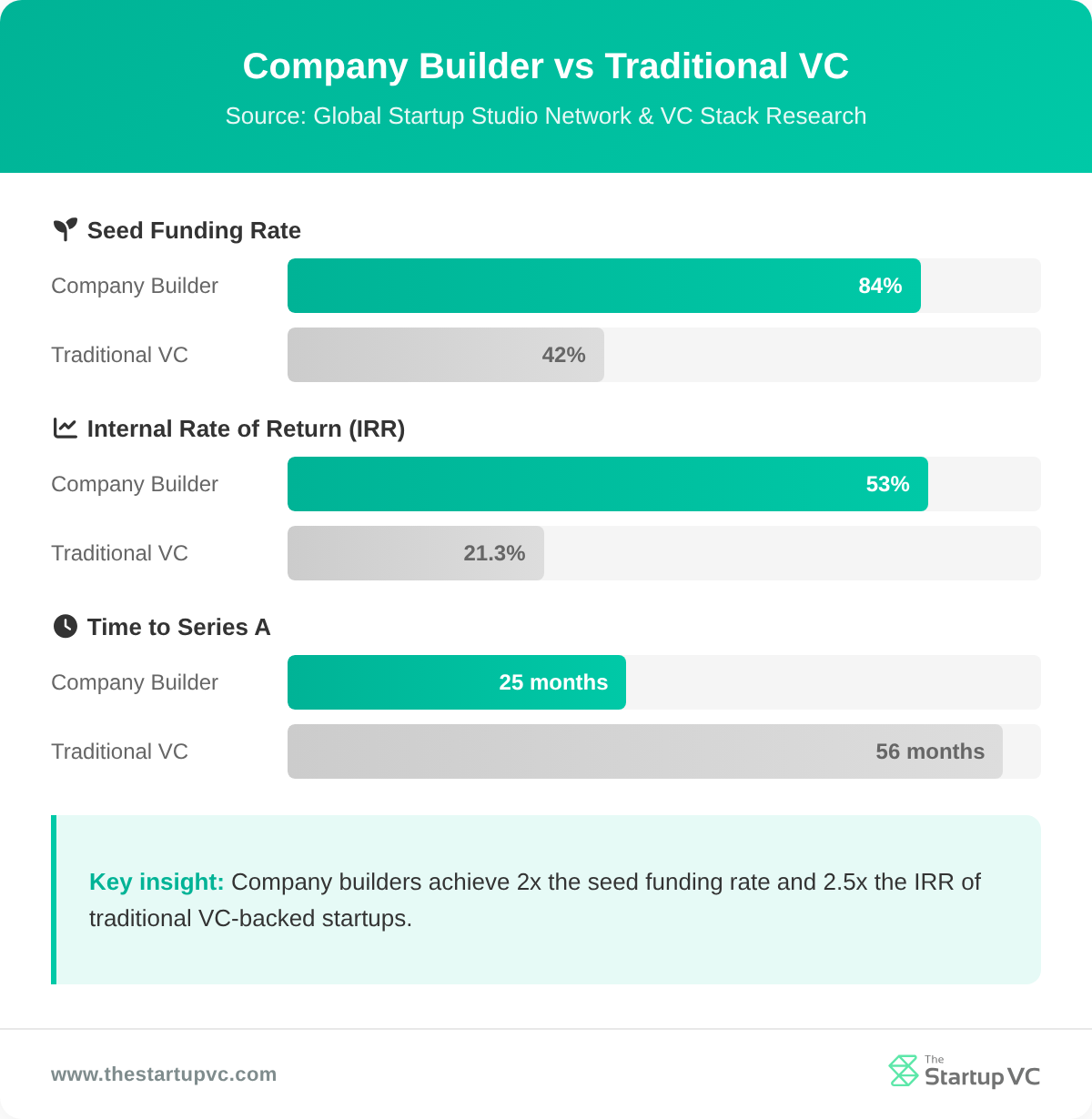
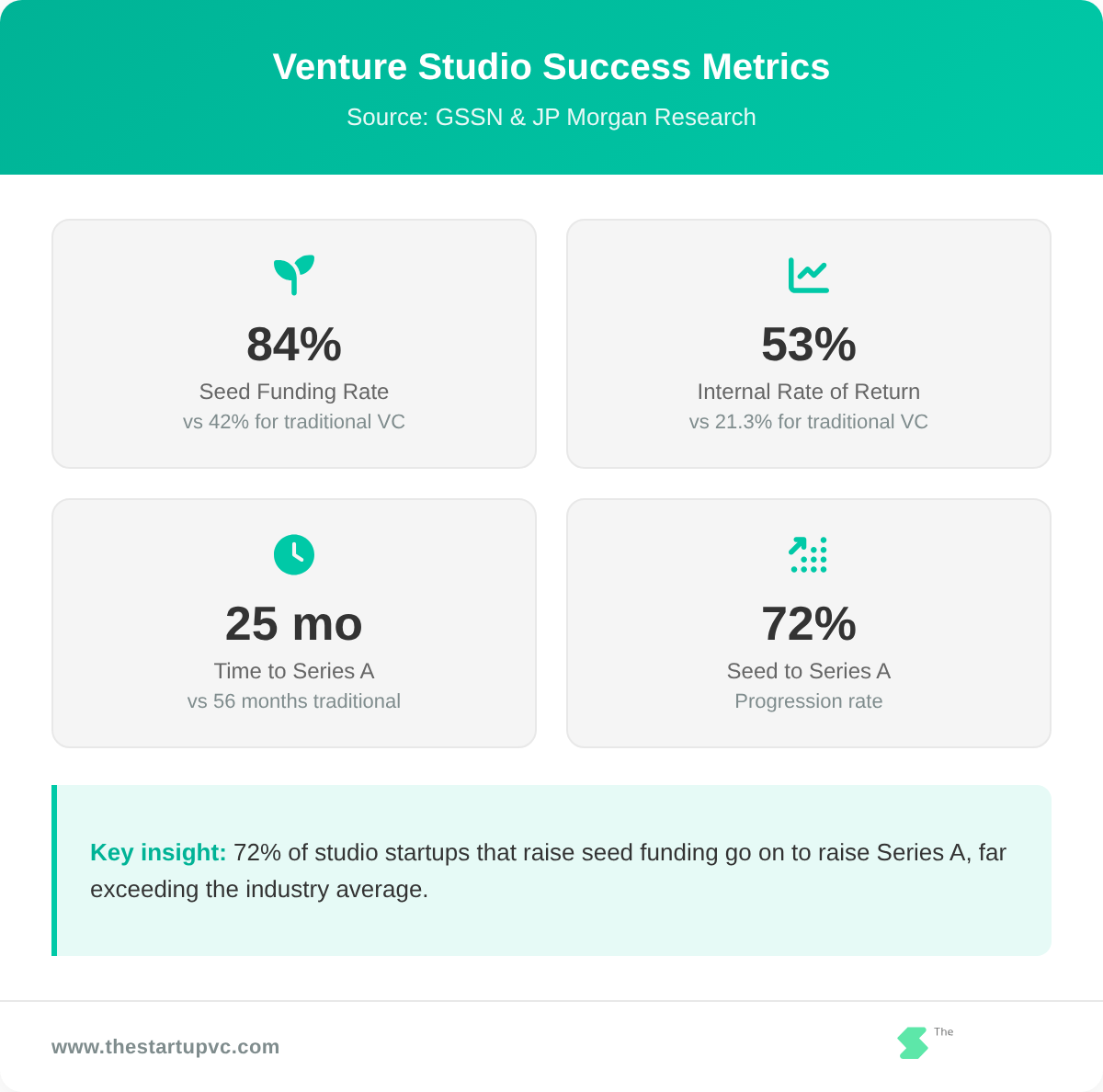
This hands-on approach produces strong results. Studio-built startups achieve an 84% seed funding rate. Traditional VC-backed startups achieve only 42%. Company builders also reach Series A in 25 months. Conventional founders take 56 months on average.
How Does This Compare to Traditional Venture Capital?
This compares by looking at who builds the company. Traditional VC firms write checks to external founders. They offer advice and board seats but do not run daily operations.
Company builders stay involved at every stage. They share equity stakes of 30% to 60% at incorporation. This makes the builder the largest shareholder in each portfolio company.
| Feature | Company Builder | Traditional VC |
|---|---|---|
| Role | Creates and operates ventures | Invests in external startups |
| Equity stake | 30-60% at founding | 10-25% per round |
| Seed funding rate | 84% | 42% |
| Time to Series A | 25 months | 56 months |
| IRR | 53% | 21.3% |
The data shows company builders outperform traditional VC across key metrics. Higher success rates come from hands-on involvement in daily operations. Learn more about the venture studio model and how it differs from traditional venture capital.
Why Does The Startup VC Focus on B2B Service Companies in Latin America?
The Startup VC focuses on B2B service companies in Latin America because the region has fast-growing demand and limited supply. Foreign companies entering Latin American markets need local legal, HR, and accounting support.
What Market Opportunity Exists for B2B Services?
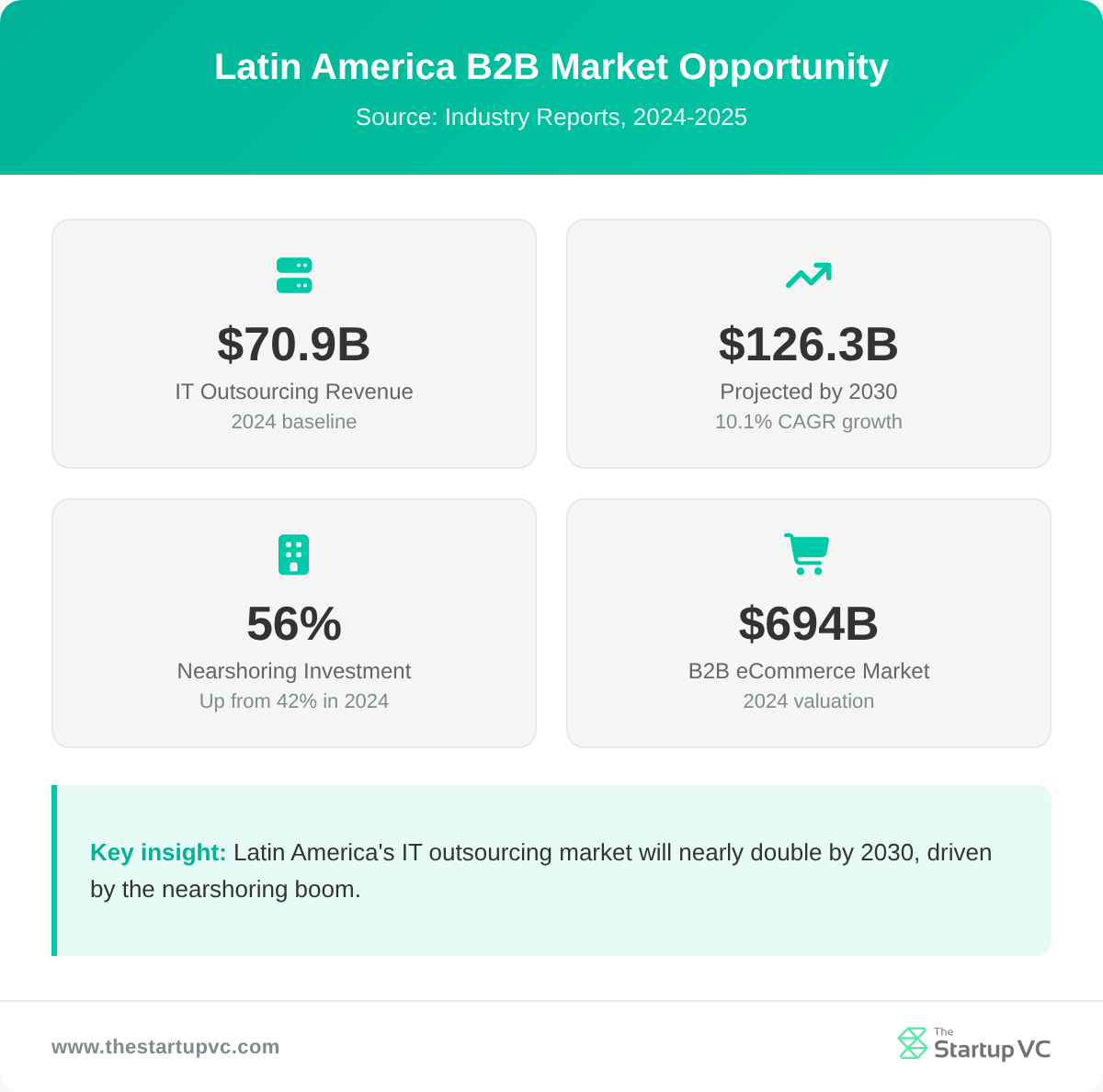
The market opportunity includes IT outsourcing, back-office services, and B2B eCommerce. Latin America’s IT services outsourcing revenue reached $70.85 billion in 2024. This figure is on track for $126.3 billion by 2030 at a 10.1% CAGR. The B2B eCommerce market was valued at $694.24 billion in 2024.
Nearshoring is driving new demand. Executive investment in nearshoring rose from 42% in 2024 to 56% in 2025. US companies expanding to Mexico and Colombia need on-the-ground support services. Read our overview of the B2B services sector in Latin America for a deeper look at these trends.
How Did Biz Latin Hub Prove This Model?
Biz Latin Hub proved this model by growing from one office to 18 locations across Latin America. Craig Dempsey co-founded the company in Bogota, Colombia in 2014. It provided back-office services for foreign companies entering the region.
Vistra, a global business services firm, acquired Biz Latin Hub in December 2025. This exit validated the B2B service model for Latin America. It proved that foreign companies will pay for reliable local support.
Craig Dempsey’s background shaped this focus. He served as a commissioned officer in the Australian Army. He later held executive roles in mining across Peru and Colombia. This gave him the regional network needed to scale ventures quickly.
How Does The Startup VC Build a Company from Idea to Launch?
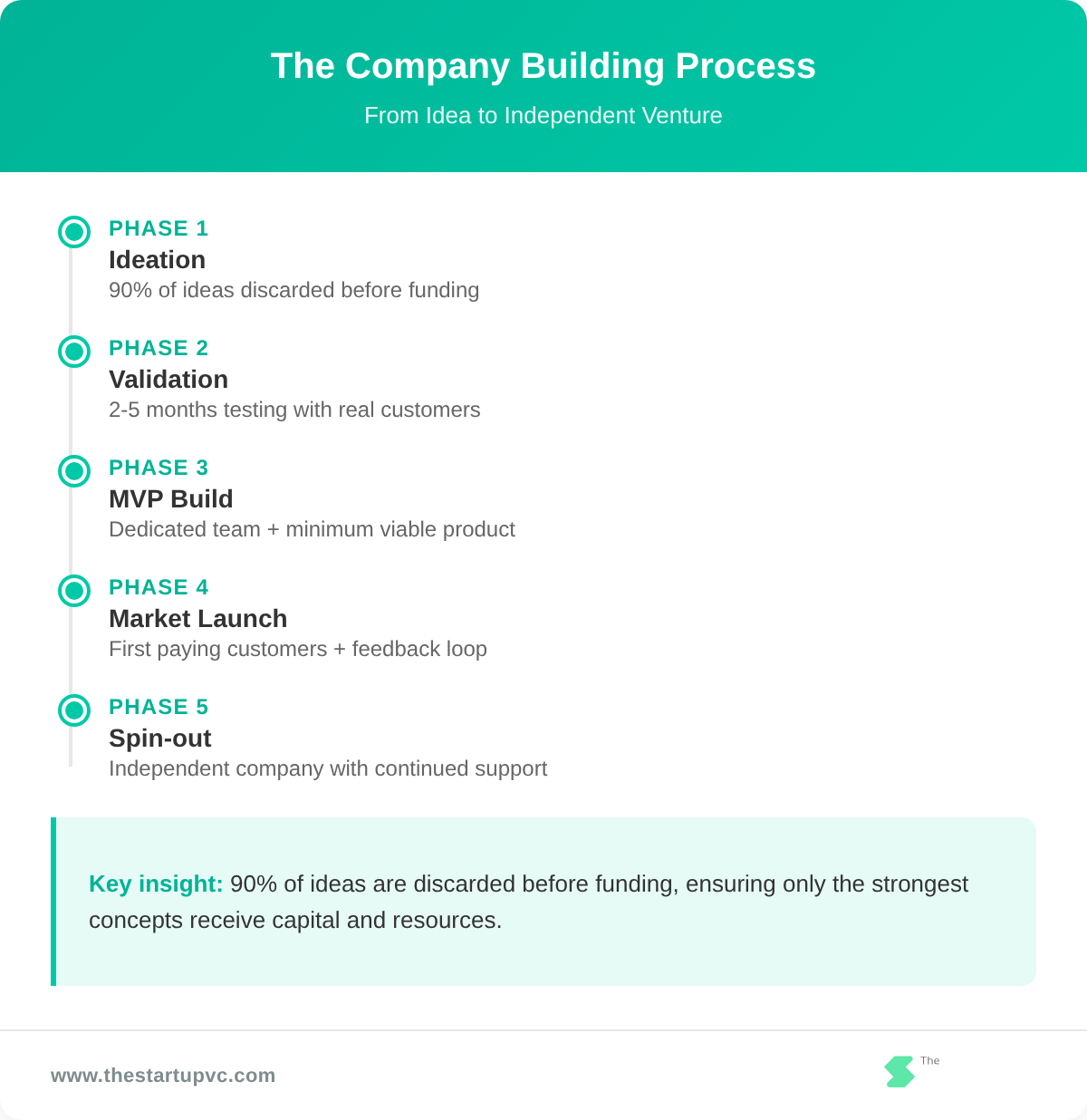
The Startup VC builds a company from idea to launch by following a structured five-phase process. Each phase has clear goals and exit criteria before the next begins.
What Happens During the Ideation Phase?
The process starts with identifying unmet needs in Latin American B2B markets. The team studies market gaps where foreign companies lack local support. Ideas must align with the builder’s existing expertise and regional network.
Most ideas do not survive this stage. Approximately 90% of concepts are discarded before any equity funding goes out. This high kill rate protects capital and focuses resources on the strongest opportunities.
How Does Validation Work?
Validation works by testing core assumptions with real customers. This phase takes 2 to 5 months. The team checks customer demand, pricing, and delivery models. They talk to potential buyers and study competitor offerings.
Only ideas that show clear demand move forward. The goal is to prove the business model before spending on product development.
What Comes After Validation?
After validation, The Startup VC assembles a dedicated team for the new venture. It builds a minimum viable product to test real market response. Early customers provide feedback that shapes the final service offering.
The builder provides initial funding and shared infrastructure. New ventures get immediate access to legal, HR, and compliance support across Latin America.
How Do Ventures Become Independent?
Ventures become independent by building their own leadership teams and revenue streams. The Startup VC retains its equity stake and provides continued support. Portfolio companies like Biz Latin Hub grew into standalone businesses this way.
The transition timeline varies by venture. Some companies reach independence within two years. Others benefit from longer builder involvement during rapid growth phases.
What Resources and Infrastructure Does The Startup VC Provide to Its Portfolio Companies?
The resources include shared legal, HR, finance, and compliance teams that serve all portfolio companies at once. This model cuts costs and speeds up launch timelines.
What Shared Services Are Available?
The shared services available include legal, HR, finance, and compliance teams. Fixed costs for these functions fall under the builder’s umbrella. Each department services all portfolio companies at the same time.
These services cover:
- Legal support. Entity formation, contracts, and regulatory compliance across Latin American jurisdictions.
- HR and recruitment. Hiring local talent using established networks in 18 countries.
- Finance and accounting. Bookkeeping, tax filing, and financial reporting for each market.
- Compliance. Anti-money laundering, data protection, and industry-specific regulations.
- Office space. Physical locations across Latin America for client meetings and local operations.
How Do Operational Playbooks Help New Ventures?
Operational playbooks help new ventures by providing proven processes from day one. Craig Dempsey built these playbooks while scaling Biz Latin Hub to 18 offices. They cover hiring, client onboarding, market expansion, and service delivery.
This pre-built infrastructure creates a 55% time compression in reaching Series A. Founders spend less time building systems and more time serving customers.
What Regional Expertise Does the Builder Share?
The regional expertise includes teams across 17 Latin American markets. The Startup VC has direct experience in Colombia, Mexico, Chile, Peru, and Brazil. Portfolio companies can expand into new countries using existing relationships and local knowledge.
This regional network is hard to replicate. It takes years to build trusted contacts in government, legal, and business circles. New ventures get instant access to connections that would otherwise take a decade to develop.
How Do Company Builders Measure Success Across Their Portfolio?
Company builders measure success by tracking both individual venture performance and overall portfolio health. They use financial metrics, operational KPIs, and pipeline indicators.
What Financial Metrics Matter Most?
The most important financial metrics include:
| Metric | What It Measures | Target |
|---|---|---|
| IRR (Internal Rate of Return) | Time-adjusted annualized returns | 20-30% for VC funds |
| DPI (Distributions to Paid-In) | Actual cash returned to investors | Above 1.0x |
| TVPI (Total Value to Paid-In) | Realized plus unrealized returns | Above 1.0x |
| MRR (Monthly Recurring Revenue) | Predictable monthly income | Steady growth |
Studio-built startups achieve a 53% IRR on average. Traditional VC-backed startups achieve only 21.3%. This gap reflects the hands-on support company builders provide.
What Operational KPIs Do Builders Track?
Operational KPIs focus on the venture building process itself. Builders track three key indicators:
- Idea kill rate. The percentage of ideas discarded during validation. A healthy rate shows disciplined selection.
- Time to market. How fast a venture goes from concept to first paying customer.
- Funnel healthiness. The strength of the idea pipeline from concept to market entry.
How Do Individual Ventures Report Progress?
Individual ventures report progress by tracking standard startup metrics during scaling. These include customer acquisition cost (CAC), lifetime value (LTV), churn rate, and monthly active users. Growth rate and gross margin show whether the business model works.
The data is clear: 72% of studio startups that raise a seed round go on to raise Series A. This progression rate is much higher than the industry average.
What Questions Do Founders Ask Most Often About the Company Builder Model?
How Much Equity Does a Company Builder Take?
A company builder typically takes 30% to 60% equity at incorporation. This is higher than a traditional VC round. However, the builder provides capital, infrastructure, and operational support that would otherwise cost hundreds of thousands of dollars.
How Long Does It Take to Launch a New Venture?
The process from idea to launch usually takes 6 to 12 months. Concept validation alone takes 2 to 5 months. The timeline depends on market complexity and regulatory requirements in each Latin American country.
Can Founders Keep Control of Their Company?
Yes, founders can retain operational control. The company builder acts as a co-founder and major shareholder. Day-to-day decisions stay with the founding team. Strategic decisions involve both the builder and the founder.
How Does This Compare to Raising VC Funding?
This compares by looking at what founders receive beyond money. Company builders provide capital plus shared teams, legal support, and proven playbooks. Traditional VC gives you money and advice. Studio-built startups reach Series A in 25 months versus 56 months for VC-backed founders.
What Types of Companies Does The Startup VC Build?
The Startup VC focuses on B2B service companies in Latin America. Portfolio examples include Biz Latin Hub (market entry services across 18 countries) and Medical Tourism Packages (healthcare access for international patients).
Do Company Builders Work with External Founders?
Yes, company builders often partner with external founders. The builder brings infrastructure and capital. The founder brings industry expertise and vision. This partnership model combines the strengths of both parties.
Ready to Build Your Next Venture in Latin America?
The Startup VC is Craig Dempsey’s family office and company builder. It creates, backs, and guides B2B service companies across Latin America. Its playbooks come from scaling Biz Latin Hub to 18 countries. The Startup VC gives founders the infrastructure to launch faster. Whether you have an idea or an existing business, the team brings hands-on experience and regional networks that accelerate results. Contact us today to explore how we can build together.