
Craig Dempsey built Biz Latin Hub into a 17-country operation, selling it to Vistra in December 2025.
Craig Dempsey co-founded Biz Latin Hub in Bogotá in 2014. By 2025, BLH operated in 17 countries with 36 global partner firms. Vistra, a business services firm with 9,000+ experts in 50+ markets, completed the acquisition on December 4, 2025.
Biz Latin Hub is a key portfolio company in Craig Dempsey’s entrepreneurial ecosystem, The Startup VC. This article covers how Craig built BLH and why he chose to exit. It also explains what the Vistra deal means for B2B founders in Latin America.
What Is Biz Latin Hub and How Did It Grow Into LatAm’s Largest Market Entry Firm?
Biz Latin Hub is an integrated legal, accounting, and recruitment firm. It operates wholly owned offices throughout Latin America and the Caribbean. The firm helps foreign companies enter and operate in LatAm markets. It also supports local companies expanding abroad.
BLH serves clients across 17 countries. Major markets include Brazil, Colombia, Mexico, Chile, Argentina, and Peru. It has 36 global partner firms that extend its reach further. Its client base is concentrated in mid to large U.S.-based enterprises.
BLH provides seven core professional services to its clients:
- Company formation and business registration
- Legal services and corporate compliance
- Accounting, taxation, and financial reporting
- Professional Employer Organization (PEO) and recruitment
- Bank account opening for foreign entities
- Tax advisory and planning
- Visa processing and immigration support
The firm earned Professional Employer Organization of the Year 2022. This recognition came from the Remote Tech Breakthrough Awards. BLH was also ranked among the top BPO companies in 2023. Both awards reflect its scale and service quality across the region.
How Did Craig Dempsey Build Biz Latin Hub From a Small Firm Into a 17-Country Operation?
Craig Dempsey built Biz Latin Hub by spotting a gap in Latin America’s professional services market. Foreign companies expanding into the region lacked reliable, English-speaking legal and accounting support. He co-founded BLH on September 1, 2014 in Bogotá, Colombia with David Wright.
Dempsey’s career prepared him for this role. He served as a commissioned officer in the Australian Army, with deployments to Central Asia and the Middle East. He later held executive roles in mining across Australia, Canada, Peru, and Colombia. This experience gave him the regional network and operational discipline to scale BLH quickly.
BLH’s growth followed five key milestones from 2014 to 2025:
| Year | Milestone |
|---|---|
| 2014 | Founded in Bogotá, Colombia with co-founder David Wright |
| 2018 | Established affiliate arrangement with Vistra for LatAm client delivery |
| 2022 | Named Professional Employer Organization of the Year |
| 2023 | Ranked among the top BPO companies globally |
| 2025 | Acquired by Vistra on December 4 |
By December 2025, BLH had grown from a single Bogotá office to 18 locations across Latin America and the Caribbean. Its team represented 20+ nationalities, making it one of the fastest-growing Australian-owned businesses in the region.
Why Did Craig Dempsey Decide to Exit Biz Latin Hub?
Craig Dempsey decided to exit Biz Latin Hub because the Vistra deal formalized a long-running partnership. BLH and Vistra had operated as affiliates since approximately 2018. The two firms had already delivered joint client solutions across Latin America for years.
Douglas Davis, BLH Group President, described the deal as “the natural next step in our relationship.” The existing trust and operational fit made the acquisition a low-friction transition for both clients and staff.
Three factors shaped the timing of the exit:
- FDI momentum. FDI into Latin America grew over 7% in 2024. U.S. companies were repositioning supply chains closer to home. This made BLH’s LatAm network highly valuable to a global buyer.
- Scale opportunity. Vistra gave BLH access to a 50+ market global platform. BLH could reach these markets through Vistra faster than it could build them alone.
- Founder focus. Craig Dempsey redirected his entrepreneurial energy to The Startup VC, his family office and company builder in Latin America.
For Craig, the exit opened a new chapter. The Startup VC creates, backs, and scales B2B ventures across Latin America. The BLH sale freed him to concentrate on that mission.
Who Is Vistra and What Did the Biz Latin Hub Acquisition Include?
Vistra is the global business services firm that acquired Biz Latin Hub in December 2025. It brings together corporate solutions, fund administration, and private client services across more than 50 markets.
Who Is Vistra?
Vistra is a global leader in essential business services. It operates with 9,000+ experts across more than 50 markets worldwide. Its service lines include corporate solutions, fund administration, and private client services.
Before the BLH acquisition, Vistra had already expanded its Americas presence. It acquired iiPay, a global payroll company, positioning itself as a top four market leader in global payroll. The BLH acquisition followed as the next step in its Americas strategy.
What Did the BLH Acquisition Include?
The BLH acquisition included three core components:
- Office network. BLH’s 18-country Latin American and Caribbean network of wholly owned subsidiary offices.
- Service delivery. BLH’s integrated legal, accounting, and recruitment services across all markets.
- Client base. BLH’s established relationships with mid to large U.S.-based enterprises seeking LatAm coverage.
Jim Lee, EVP Americas at Vistra, explained the rationale: “Combining BLH’s deep local knowledge and client relationships with Vistra’s global platform, we are uniquely placed to accelerate our shared ambition.”
The deal closed on December 4, 2025. Deal value was not publicly disclosed. After the acquisition, the combined entity serves clients across 50+ global markets while maintaining an 18-country LatAm footprint.
What Does the Biz Latin Hub Exit Mean for Founders and Market Entry in Latin America?
The Biz Latin Hub exit means that service-sector companies in Latin America can attract global strategic buyers. The deal is among the most significant LatAm exits of 2025.
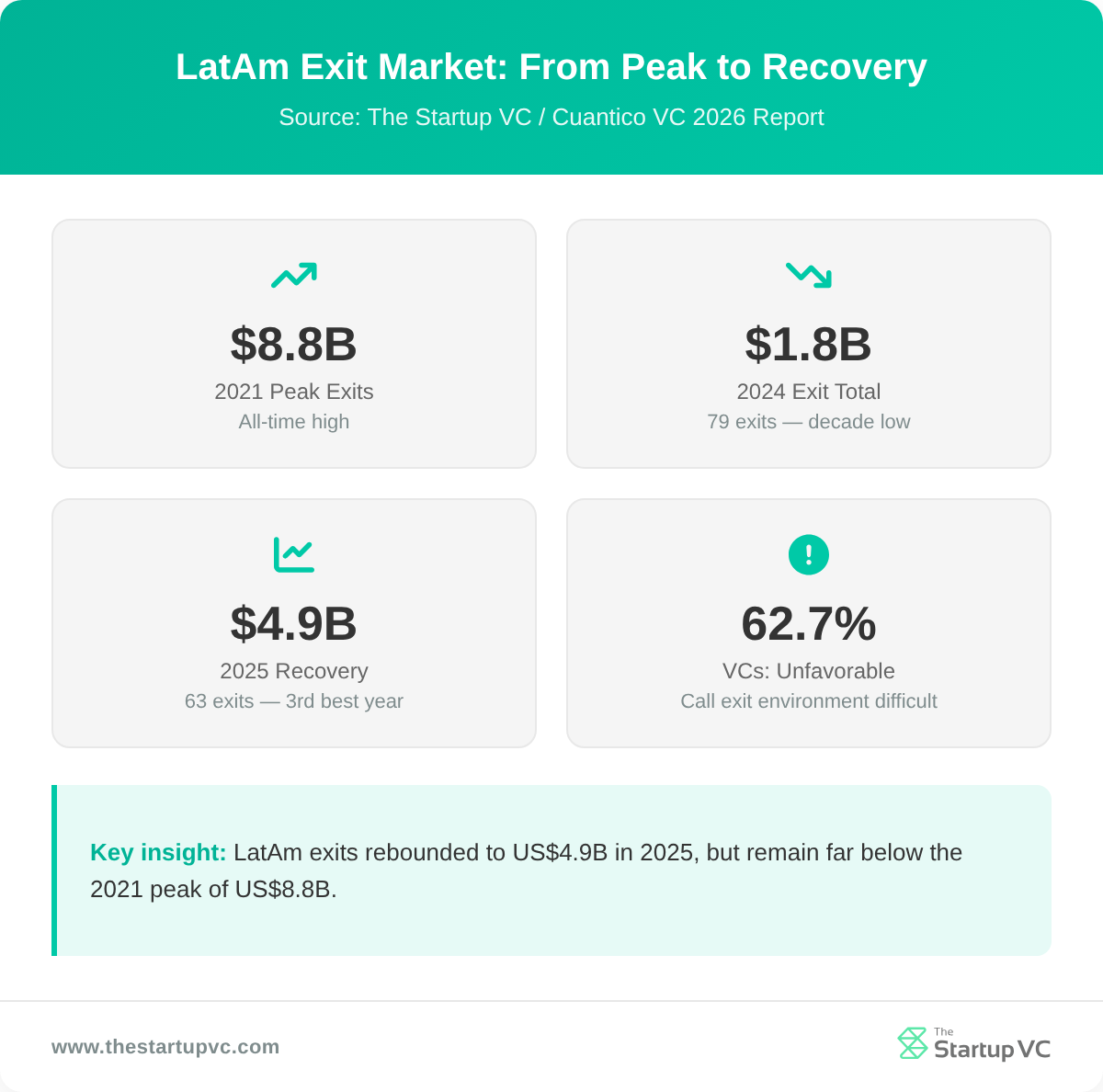
LatAm’s exit environment has been challenging in recent years. The region recorded only 79 VC-backed exits worth US$1.8 billion in 2024. This was the lowest total in years, down from US$8.8 billion at the 2021 peak. By 2025, activity had recovered to US$4.9 billion across 63 transactions.
LatAm exit activity by year:
| Year | VC-Backed Exits | Total Value |
|---|---|---|
| 2021 | Peak year | US$8.8B |
| 2024 | 79 exits | US$1.8B |
| 2025 | 63 exits | US$4.9B |
The BLH deal follows the dominant exit path in Latin America. Strategic M&A represents 67% of all VC-backed exits in the region. The average time from founding to acquisition is 11.9 years. BLH was founded in 2014 and acquired in 2025, matching this timeline closely.
Nearshoring is creating a new class of strategic buyers. U.S. companies are expanding to Mexico and Colombia. They need on-the-ground legal, accounting, and HR support. This demand makes B2B service firms attractive targets for global corporate services buyers.
What Questions Do Founders Ask Most Often About Exiting a Company in Latin America?
What are the main exit paths for founders in Latin America?
The main exit paths in Latin America are strategic M&A, secondary sales, and IPOs. Strategic M&A represents 67% of all VC-backed exits in the region. The average time from founding to acquisition is 11.9 years. IPOs have been largely absent from the region since early 2024.
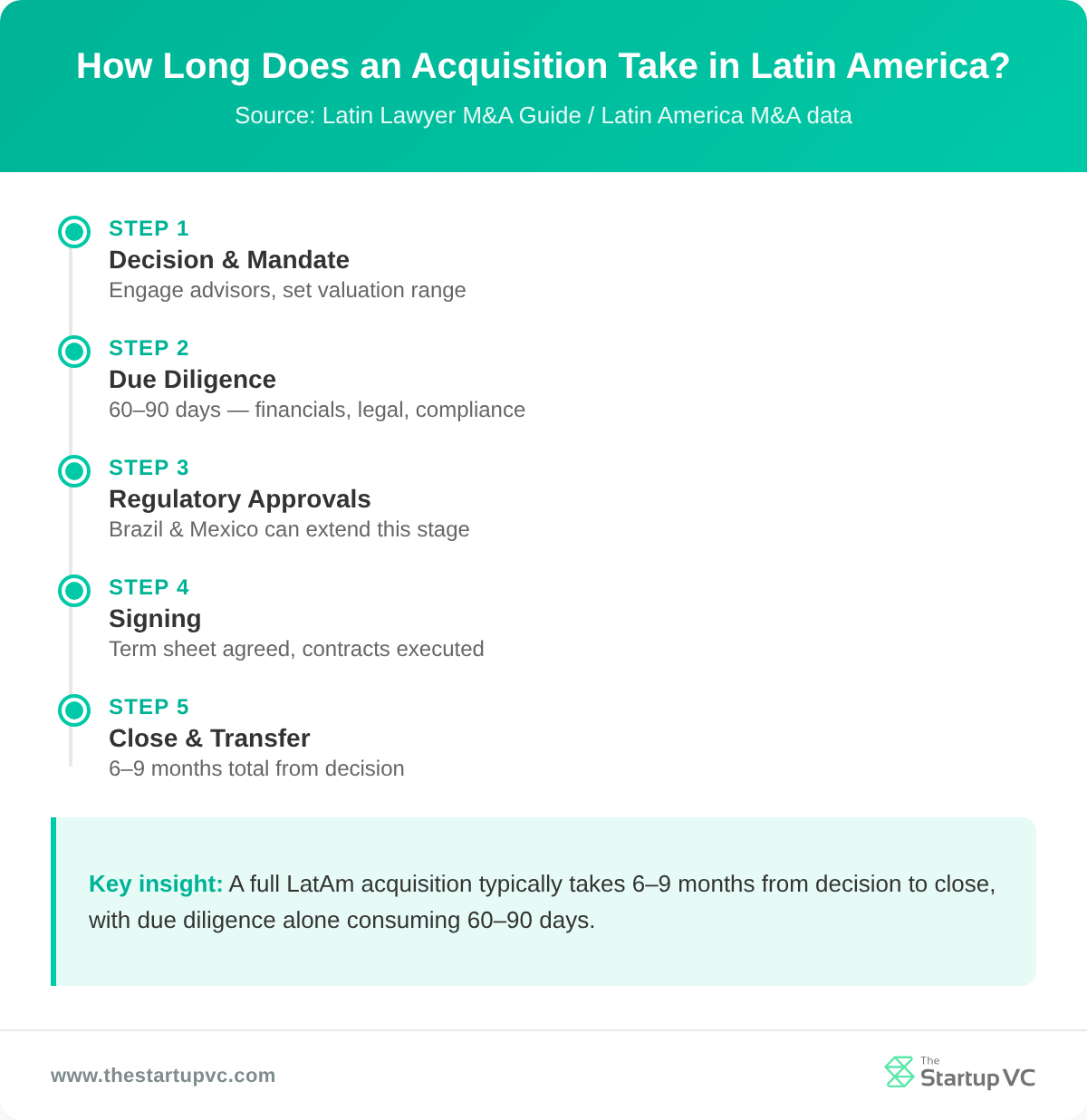
How long does a company acquisition take in Latin America?
A company acquisition in Latin America takes 6–9 months from decision to close. Due diligence alone typically runs 60–90 days. Regulatory approvals in markets like Brazil and Mexico can extend this timeline further.
What do strategic buyers look for when acquiring a LatAm company?
Strategic buyers look for anti-corruption and AML compliance, enforceable client contracts, and labor law compliance. They also review ESG risk and working capital treatment across multiple jurisdictions. Governance documentation and multi-jurisdiction tax compliance are common deal-breakers.
How are LatAm companies valued in an acquisition?
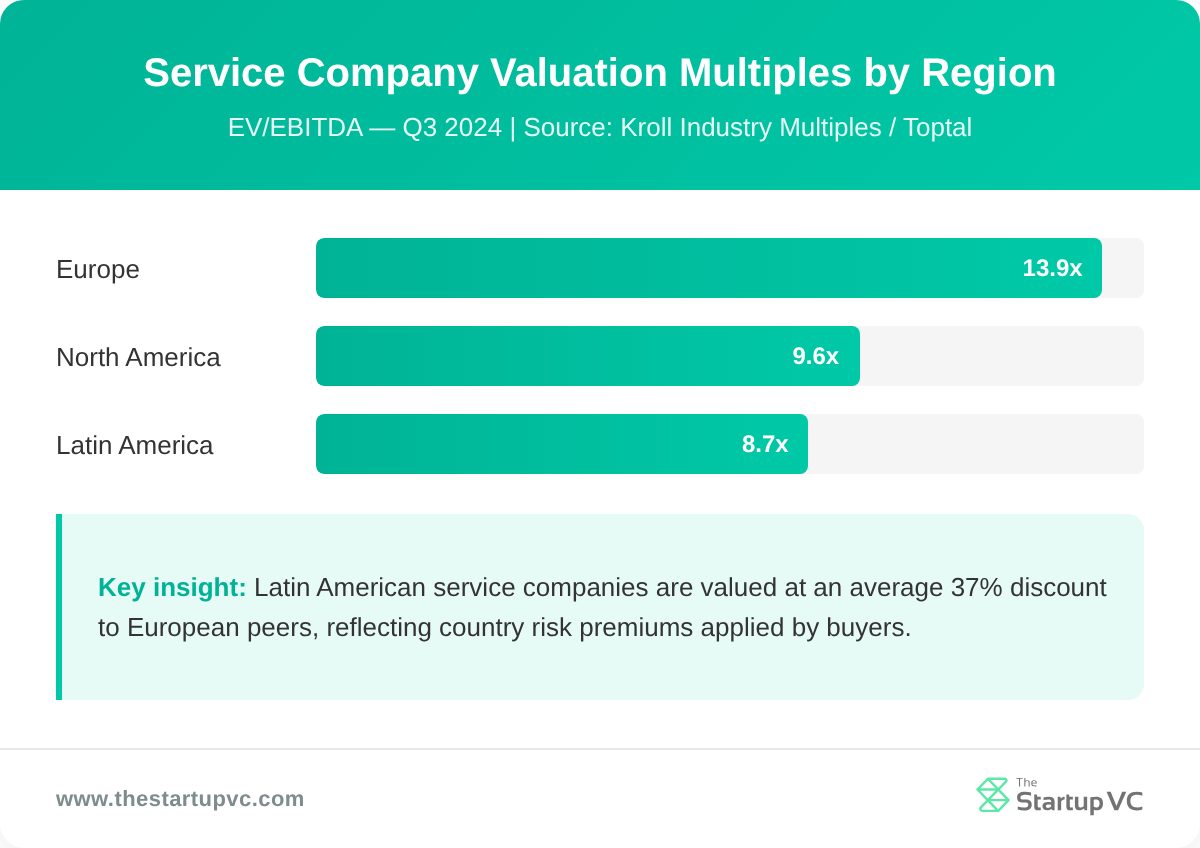
LatAm companies are valued by applying a country risk premium to the standard DCF model. This premium accounts for FX volatility, political risk, and concerns about contract enforcement. Professional services companies in Latin America traded at 8.7x EV/EBITDA in Q3 2024. This is below the 9.6x–13.9x range for comparable North American and European peers.
What happens to the team after an acquisition in Latin America?
You can expect 50% of key staff to leave within the first year after an acquisition. Around 75% typically leave within three years. Buyers often offer retention bonuses of 50–100% of base salary for 12–24 months. Founders on earnouts must remain employed to collect deferred payments.
Ready to Build and Exit Your Venture in Latin America?
The Startup VC is Craig Dempsey’s entrepreneurial ecosystem. It is a family office and company builder that creates, backs, and scales ventures across Latin America. Craig built Biz Latin Hub from a single Bogotá office to an 18-country operation before exiting to Vistra. The Startup VC offers practical, experience-backed support for founders who want to build scalable businesses in the region. Contact us today to explore how we can help you build your next venture.