
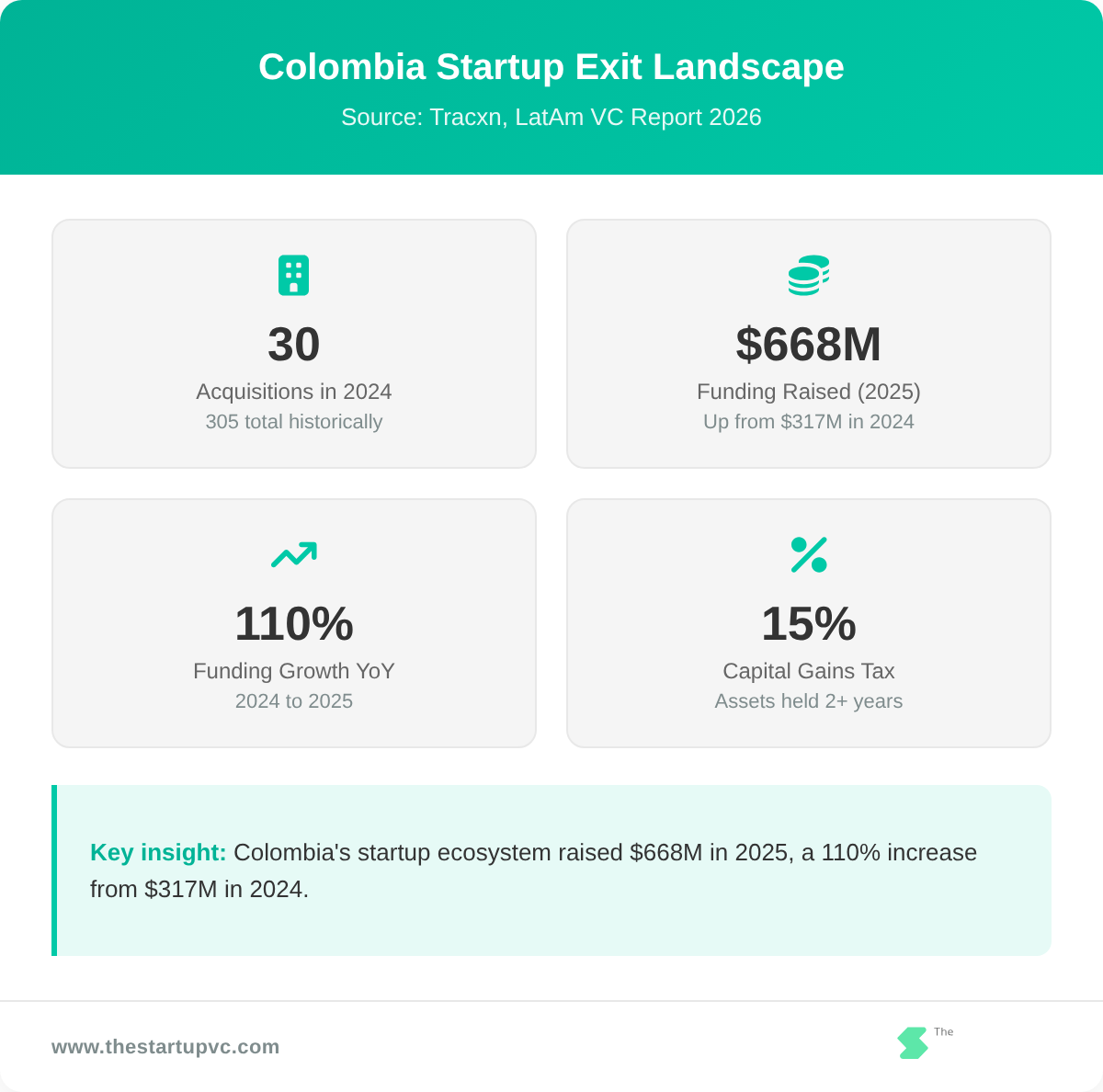
Colombia recorded 30 startup acquisitions in 2024, with ecosystem funding jumping 110% to $668M in 2025.
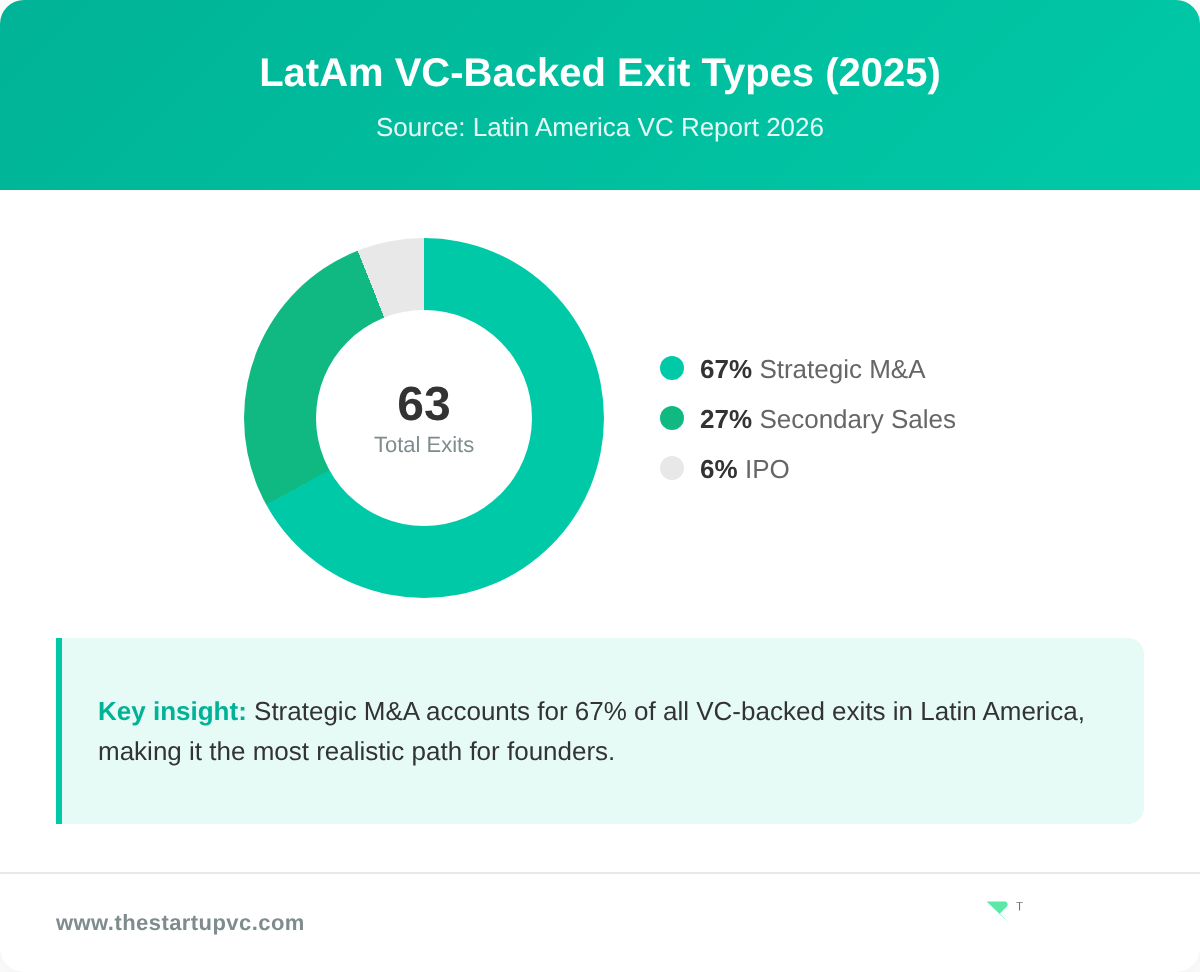
Strategic acquisitions account for 67% of all VC-backed exits in Latin America. Colombia offers a 15% capital gains tax rate and a founder-friendly SAS corporate structure. Its growing buyer base makes it one of the most accessible exit markets in the region.
The Startup VC has built and backed ventures across 17 Latin American markets, including Colombia. Below, you will find the legal steps, tax rules, and operational checklist for a successful startup exit in Colombia.
What Is a Startup Exit and Why Does It Matter in Colombia?
A startup exit is the process by which founders sell their ownership stake in a company. This happens through M&A, acqui-hires, asset sales, or IPOs. The goal is to convert equity into cash or stock in the acquiring company.
Colombia’s exit landscape is growing fast. The country recorded 30 acquisitions in 2024 alone. Its startup ecosystem raised $668M in 2025, up 110% from $317M in 2024.
Exit planning matters because it shapes every decision a founder makes. Cap table structure, IP ownership, and tax residency all affect final proceeds. Founders who plan early get better terms.
Across Latin America, strategic acquisitions account for 67% of all VC-backed exits. M&A is the most realistic path for most founders in the region. Learn more about the LatAm exits problem and what it means for founders. The total value of VC-backed exits jumped from $1.8B in 2024 to $4.9B in 2025.
Colombia’s most notable exit example is Rappi. SoftBank invested $1B in 2019, valuing the delivery startup at $3.5B. Rappi proved that Colombian startups can reach global scale.
What Types of Exits Are Available to Colombian Founders?
The types of exits available to Colombian founders include share sales, asset sales, mergers, and acqui-hires.
- Share sale. The buyer purchases equity directly from founders and investors. This is the most common structure for startup exits in Colombia.
- Asset sale. The buyer purchases specific assets like technology, contracts, or IP. The company itself remains with the original owners.
- Merger. Two companies combine into one legal entity. This requires approval from both shareholder groups.
- Acqui-hire. The buyer acquires the company mainly to hire its team. This is common in Colombia’s tech sector.
What Are the Legal Requirements for Selling a Business in Colombia?
The legal requirements for selling a business in Colombia include share transfer registration, regulatory filings, and due diligence compliance.
Most Colombian startups use the SAS (Sociedad por Acciones Simplificada) structure. SAS share transfers require endorsement of the share certificate. The transfer must also be registered in the company’s stock ledger.
How Do SAS Share Transfers Work?
SAS share transfers work by following a three-step legal process.
- Check bylaws for restrictions. SAS shares are freely negotiable. However, bylaws may include a right of first refusal for existing shareholders. Some bylaws prohibit transfers entirely for up to 10 years.
- Endorse the share certificate. The seller signs the share certificate over to the buyer. Both parties sign a share purchase agreement detailing price, terms, and representations.
- Register the transfer. The company must record the new ownership in its stock ledger. This makes the transfer effective against third parties.
What Role Does the Superintendencia de Sociedades Play?
The Superintendencia de Sociedades plays a key role by overseeing corporate compliance for all Colombian companies.
This regulatory body monitors SAS companies for governance failures. It can impose fines of up to 200 monthly minimum legal wages. Founders must keep shareholder registers and meeting minutes current before any exit.
When a transaction involves real estate, the law requires a public deed. This adds notarial costs and longer processing times.
Common deal structures in Colombia include share purchases, asset purchases, and mergers. Share purchases are the most frequent structure for startup exits.
How Do Tax Rules Affect Startup Exit Proceeds in Colombia?
Tax rules affect startup exit proceeds in Colombia by determining how much of the sale price founders actually keep.
Colombia’s capital gains tax rate is 15% on assets held for two or more years. This includes company shares. The standard corporate income tax rate is 35%. Free trade zone companies pay a reduced 20% rate.
What Is the Capital Gains Tax on a Startup Sale?
The capital gains tax on a startup sale is 15% for assets held longer than two years.
This rate applies to shares, fixed assets, and other capital property. A 2024 tax reform bill tried to raise this rate to 20%. Congress did not approve the increase. The 15% rate remains in effect for 2025.
Founders who hold shares for less than two years pay the standard income tax rate. That rate can reach 35% for corporations. Holding period planning is essential for tax savings.
How Does Withholding Tax Apply to Foreign Buyers?
Withholding tax applies to foreign buyers by requiring Colombian companies to withhold taxes on payments sent abroad.
The general withholding rate for non-residents is 20%. Interest payments face a 15% rate for terms over one year. These rates can decrease under double taxation treaties.
Colombia has tax treaties with Spain, Switzerland, Canada, Mexico, Chile, and several other countries. Founders should structure deals to use treaty benefits where possible. See how regulatory frameworks affect startup exits across different countries.
| Tax Type | Rate | Applies To |
|---|---|---|
| Capital gains (2+ year hold) | 15% | Share and asset sales |
| Corporate income tax | 35% | Standard rate |
| Free trade zone rate | 20% | Qualifying companies |
| Withholding (non-resident) | 20% | Payments to foreign entities |
| Interest withholding (1+ year) | 15% | Cross-border interest |
What Steps Should Founders Follow to Prepare a Startup for Acquisition in Colombia?
You should prepare a startup for acquisition by completing due diligence and organizing your legal structure.
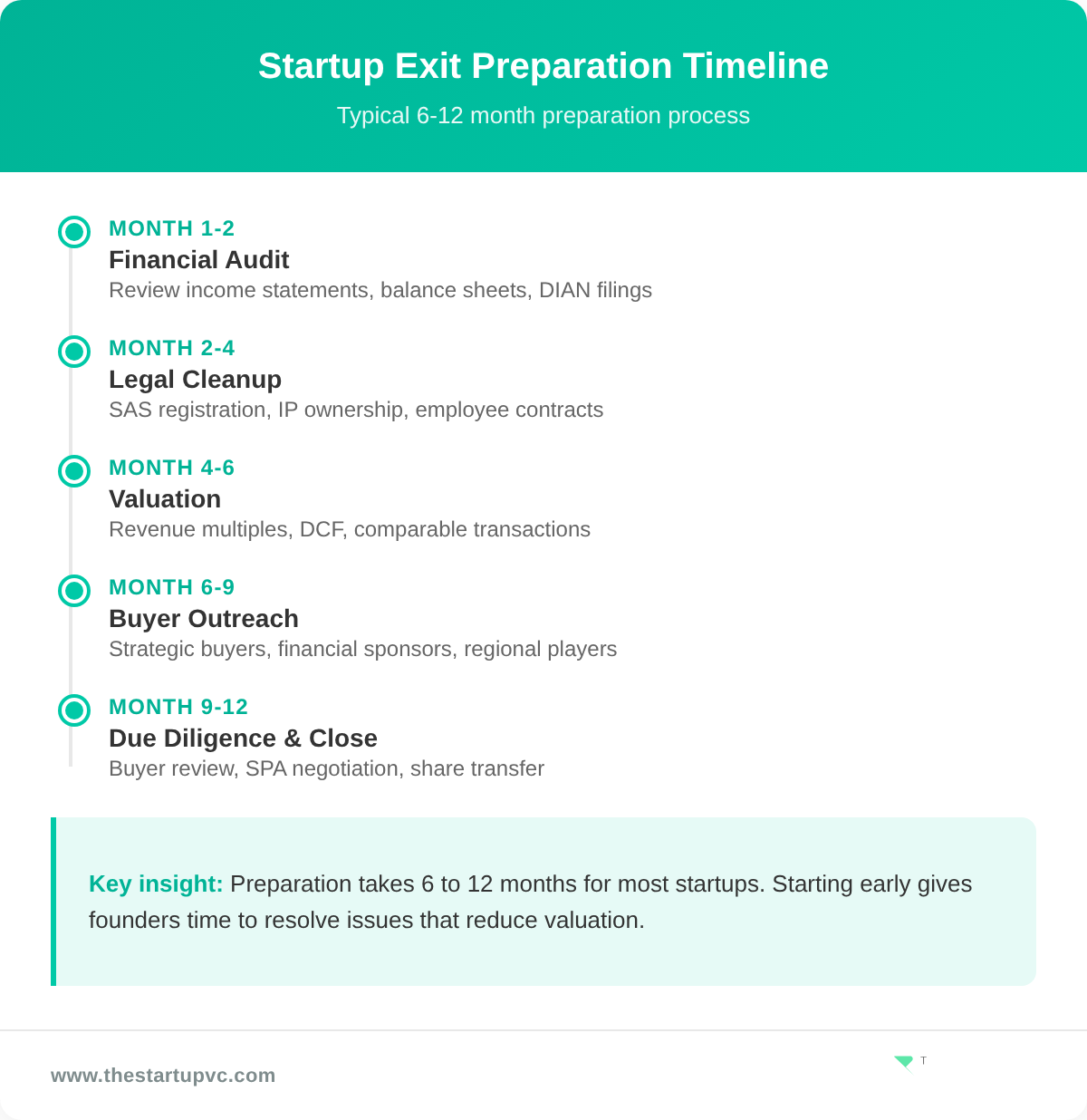
Preparation takes 6 to 12 months for most startups. Buyers examine nine key areas: finance, tax, legal, HR, assets, IT, products, marketing, and founder background. Each area needs clean records and clear documentation.
How Should Founders Organize Financial Records?
You should organize financial records by auditing your income statements, balance sheets, and cash flow statements.
Buyers look at revenue trends and profit margins first. They check asset composition and capital structure next. Cash flow patterns show whether the business can sustain itself.
Keep three years of audited financials ready. Update your tax filings with the DIAN (Colombia’s tax authority). Resolve any outstanding tax disputes before starting negotiations.
What Legal Documents Do Buyers Review?
The legal documents buyers review include corporate structure filings, IP registrations, employment agreements, and regulatory permits.
- Corporate structure. Verify your SAS registration, shareholder register, and meeting minutes are current with the Chamber of Commerce.
- IP ownership. Confirm all patents, trademarks, and software code are assigned to the company, not individual founders.
- Employment contracts. Review all employee agreements for non-compete clauses, stock option plans, and severance obligations.
- Regulatory compliance. Gather all permits, licenses, and Superintendencia de Sociedades filings.
How Do You Set a Valuation for Your Startup?
You can set a valuation for your startup by using revenue multiples, discounted cash flow, or comparable transaction analysis.
Colombia’s average deal size for startups is $3.6M per transaction. This is smaller than Chile’s $4.7M average. Valuation depends on revenue growth, market position, and the buyer’s strategic interest.
Hire a local valuation firm with M&A experience in Colombia. They understand local market conditions and buyer expectations. A third-party valuation also builds trust with potential acquirers.
How Does Colombia Compare to Other Latin American Markets for Startup Exits?
Colombia compares favorably to other Latin American markets by offering more deal volume than Chile and a growing investor base.
Brazil dominates the region with $2.032B across 363 deals in 2025. That represents 52.9% of all regional funding. Mexico follows with $980M across 86 rounds. Colombia and Chile trail behind these two leaders.
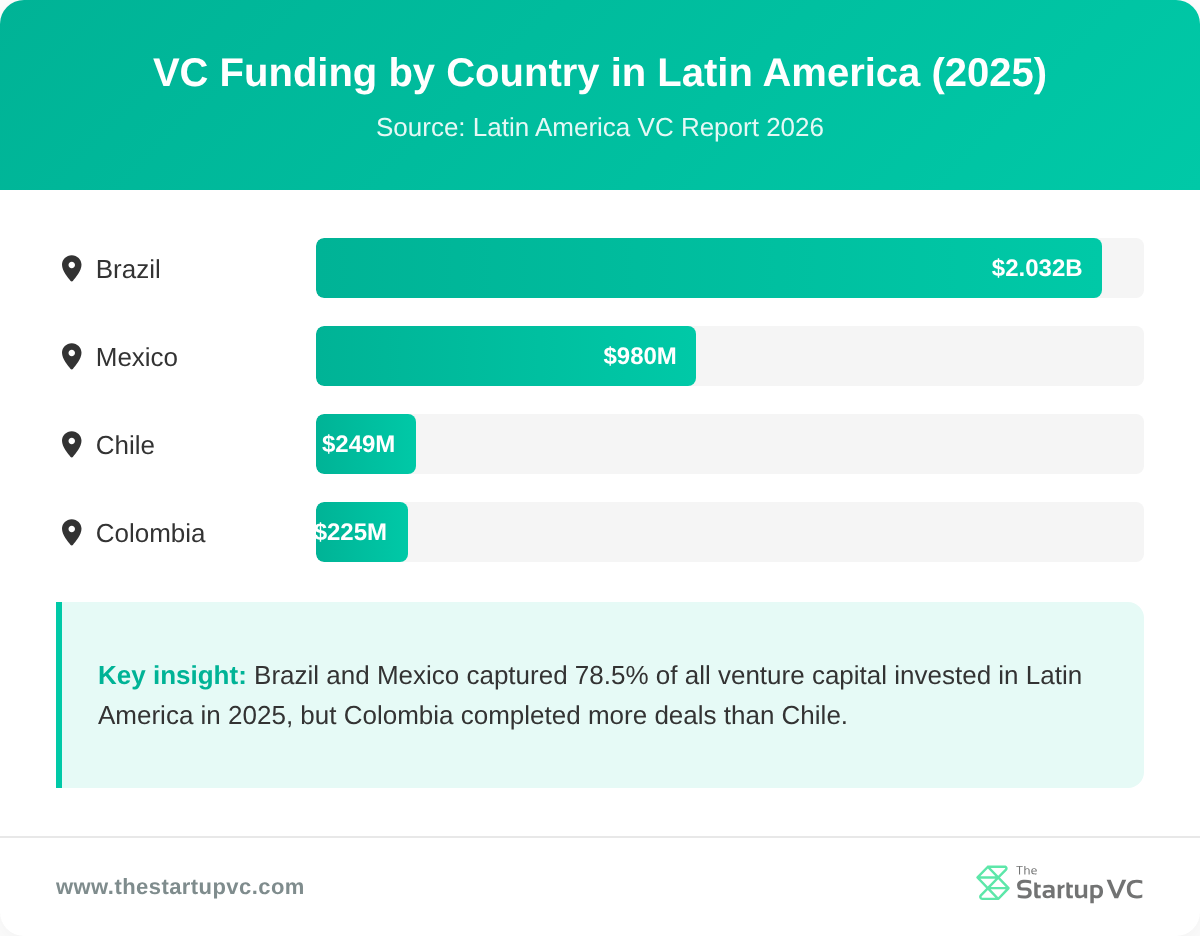
Colombia completed 62 deals in 2025, compared to Chile’s 53. However, Colombia’s average ticket size is $3.6M versus Chile’s $4.7M. This means Colombia has more activity but smaller deals.
| Country | Deals (2025) | Funding (2025) | Average Ticket | Regional Share |
|---|---|---|---|---|
| Brazil | 363 | $2.032B | $5.6M | 52.9% |
| Mexico | 86 | $980M | $11.4M | 25.5% |
| Colombia | 62 | $225M | $3.6M | 5.9% |
| Chile | 53 | $249M | $4.7M | 6.5% |
Brazil and Mexico captured 78.5% of all venture capital invested in Latin America in 2025. Brazil also accounted for nearly 70% of all tech M&A transactions by September 2025.
What Are Colombia’s Advantages for Startup Exits?
Colombia’s advantages for startup exits include a founder-friendly SAS structure, lower operating costs, and a growing buyer base.
The SAS structure allows fast share transfers with minimal regulatory friction. Colombia’s 15% capital gains tax is competitive in the region. The government program INNpulsa provides grants and seed funding for tech startups.
Colombia also offers a 30% R&D tax credit for qualifying investments. This credit can boost pre-exit valuations by reducing tax obligations on innovation spending. For a full picture of the market, read our overview of startups in Colombia.
Where Does Colombia Fall Short?
Colombia falls short in average deal size and international buyer awareness.
Most Colombian exits are below $5M. Brazil and Mexico attract larger strategic buyers. Colombia’s ecosystem is younger, which means fewer large-scale exits to date. Founders targeting exits above $10M may need to expand operations into larger markets first.
What Questions Do Founders Ask Most Often About Startup Exits in Colombia?
How long does a startup exit take in Colombia?
A startup exit in Colombia takes 6 to 18 months from preparation to closing. The timeline depends on deal complexity and buyer due diligence. Simple share transfers close faster than asset sales or mergers.
How much does it cost to sell a startup in Colombia?
Selling a startup in Colombia costs 3% to 7% of the deal value in fees. These fees cover legal, tax, and advisory services. Notarial fees add 0.3% for real estate transactions.
Can foreign companies acquire 100% of a Colombian startup?
Yes, foreign companies can acquire 100% of a Colombian startup. The SAS structure places no limits on foreign ownership. Buyers must register the investment with the Central Bank of Colombia (Banco de la Republica).
What happens to employees after a startup acquisition in Colombia?
Employees retain their existing labor rights after a startup acquisition in Colombia. Colombian labor law protects workers by requiring mandatory severance and notice periods. The buyer typically assumes all employment contracts in a share sale.
Do minority shareholders have protections during a startup exit?
Yes, minority shareholders have protections during a startup exit. Colombian law requires fair treatment of all shareholders. SAS bylaws often include tag-along rights that let minority holders sell on the same terms as majority holders.
What is the biggest tax mistake founders make during an exit?
The biggest tax mistake founders make is selling shares held for less than two years. This triggers the standard 35% corporate tax rate instead of the 15% capital gains rate. Proper holding period planning can save 20 percentage points in taxes.
Ready to Plan Your Startup Exit in Colombia?
The Startup VC is Craig Dempsey’s family office and company builder. We create, back, and guide scalable ventures across Latin America. Our team has hands-on experience with M&A, corporate structuring, and cross-border transactions in Colombia and 16 other countries.
Whether you are preparing for acquisition or exploring exit options, we can help you build a strategy that protects your proceeds. Contact us today to start planning your exit.