Forming a tech company in Colombia costs under $2,000 USD, compared to $1,000 to $5,000 in Mexico and Brazil.
Colombia incorporates in 5 to 10 days for under $2,000 USD. Mexico registers digitally in 1 to 3 days at 30% corporate tax. Brazil takes 60 to 90 days with developer salaries reaching $104,000 USD.
The Startup VC has operational experience across all three markets through Biz Latin Hub. Biz Latin Hub operates in 17 Latin American countries. This guide covers incorporation costs, salaries, tax rates, and incentives. It is written for tech founders choosing between Colombia, Mexico, and Brazil.
What Does It Cost to Register and Incorporate a Tech Company in Each Country?
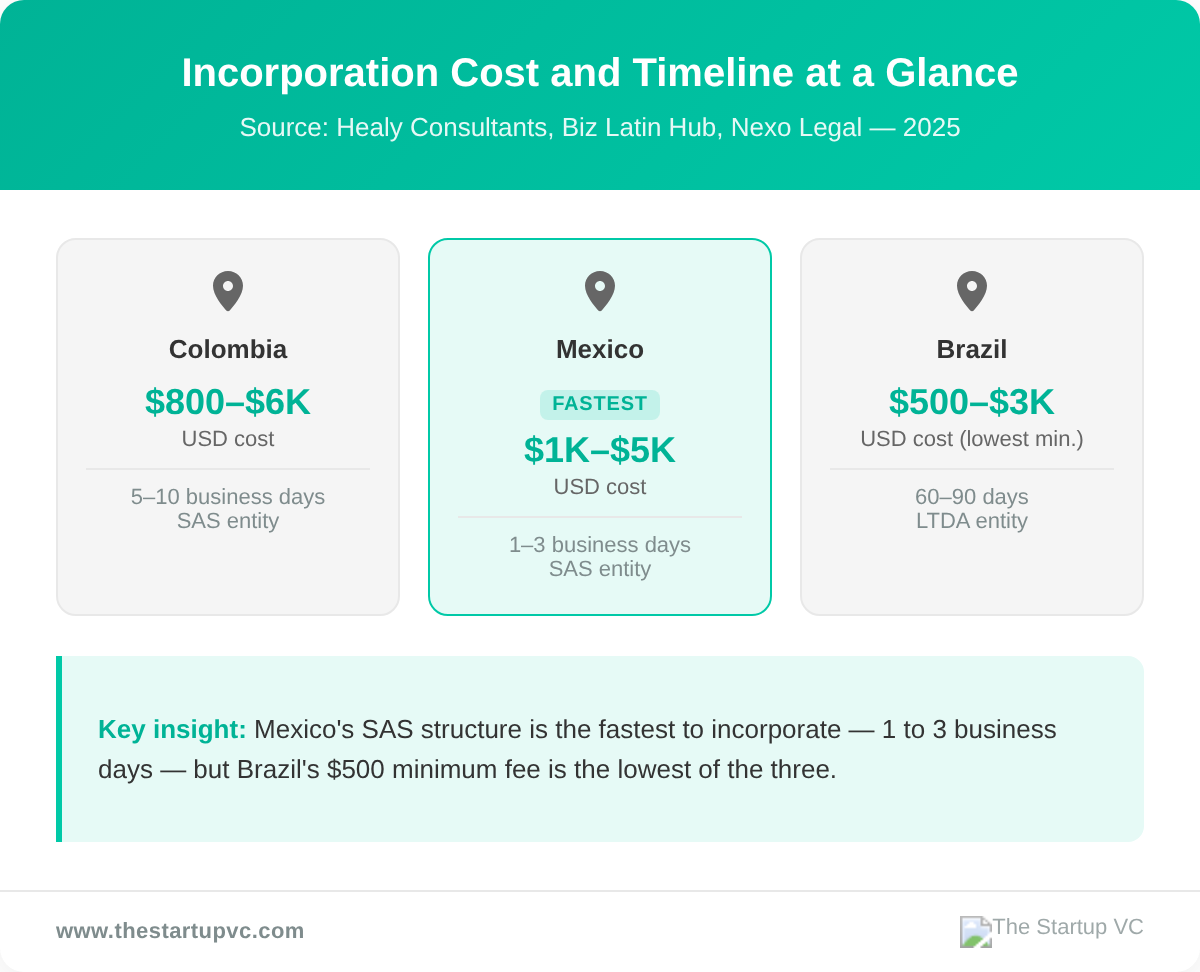
It costs $800 to $6,000 USD in Colombia and $1,000 to $5,000 USD in Mexico. Brazil costs $500 to $3,000 USD in government and professional fees. Colombia is the fastest. Brazil takes the longest.
How Much Does It Cost to Incorporate in Colombia?
Incorporating an SAS (Sociedad por Acciones Simplificada) in Colombia costs $800 to $6,000 USD. This total includes Chamber of Commerce fees, a 0.7% registration tax on capital, and legal fees. Government fees alone range from $500 to $1,200 USD for startups with capital between $30,000 and $100,000 USD. The DIAN tax registration (RUT and NIT) is free.
The SAS is the standard entity choice for tech founders. It allows single-person formation with no minimum capital. The full process completes in 5 to 10 business days.
How Much Does It Cost to Incorporate in Mexico?
Incorporation in Mexico costs $1,000 to $5,000 USD depending on the entity type. The SAS (Sociedad por Acciones Simplificada) is the fastest option. It allows digital incorporation without a notary and completes in 1 to 3 business days. The SAS caps annual revenue at MXN 5 million, making it suitable for early-stage ventures.
The traditional SA de C.V. structure requires a notary. Notary fees run MXN 15,000 to 20,000 ($880 to $1,175 USD). Public Registry fees add MXN 1,200 to 2,000. The SA de C.V. process takes 4 to 8 weeks.
How Much Does It Cost to Incorporate in Brazil?
Incorporating an LTDA (Limitada) in Brazil costs $500 to $3,000 USD in government and professional fees. The Junta Comercial (Board of Trade) filing costs BRL 1,000 to 2,000. Legal fees for drafting the Articles of Association range from BRL 3,000 to 15,000.
The timeline is the key cost. The full process takes 60 to 90 days. Registration must clear the Receita Federal (federal tax authority), the CNPJ system, state agencies, and the municipality. Annual accounting and compliance for a Brazilian LTDA costs BRL 5,000 to 10,000 per year.
The table below compares key incorporation metrics across all three countries.
| Factor | Colombia (SAS) | Mexico (SAS) | Brazil (LTDA) |
|---|---|---|---|
| Total cost | $800–$6,000 USD | $1,000–$5,000 USD | $500–$3,000 USD |
| Minimum capital | None | None | None |
| Timeline | 5–10 business days | 1–3 business days | 60–90 days |
| Foreign ownership | 100% allowed | 100% allowed | 100% allowed |
| Best for | Fast, lean setup | Digital-first speed | Large market entry |
For entity types and ownership rules, see The Startup VC’s guide on foreign-owned startups in Colombia.
How Do Salaries and Talent Costs Compare for Tech Teams in Colombia, Mexico, and Brazil?
Salaries and talent costs compare by placing Brazil at the top, Mexico in the middle, and Colombia as most affordable. Developer salaries across all three markets are well below US rates. Employer tax burdens add 30 to 40% on top of gross pay.
What Do Developers Earn in Colombia?
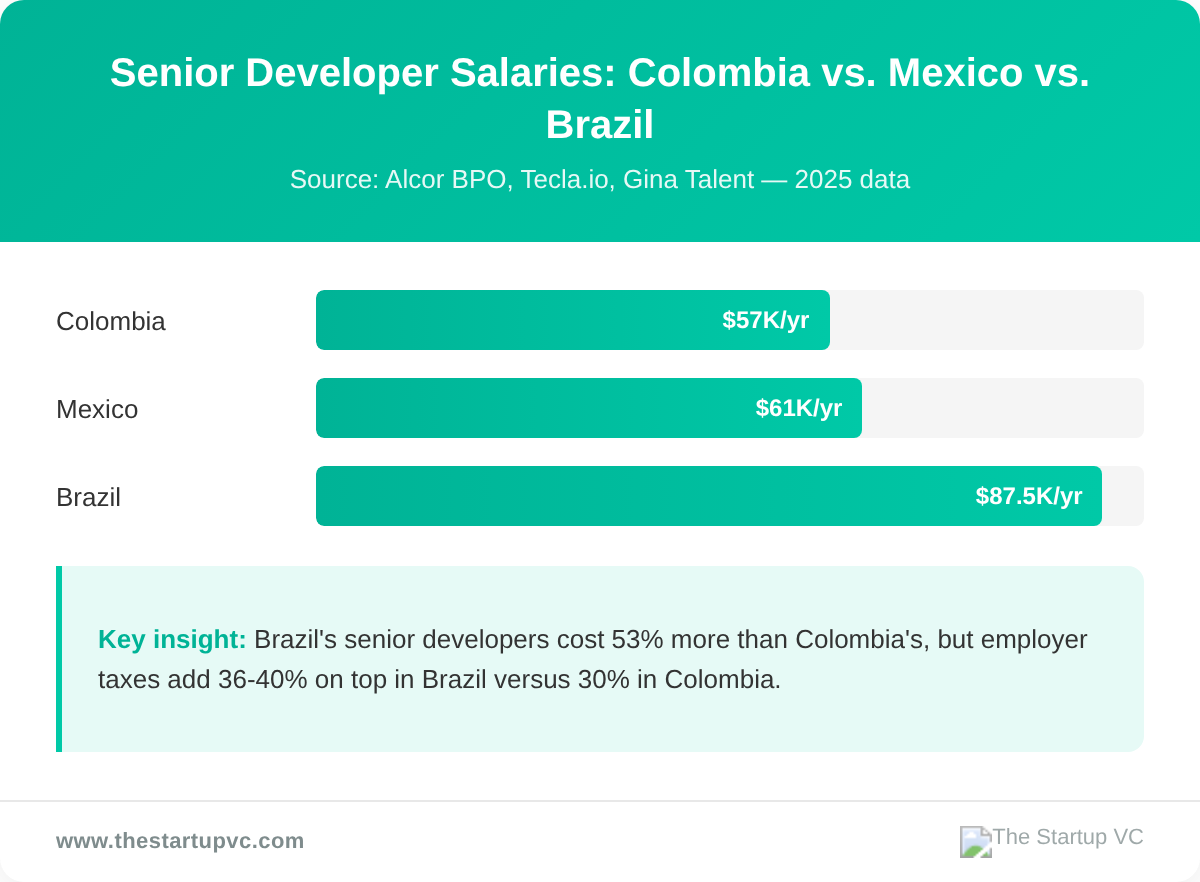
Developers in Colombia earn $28,000 to $54,000 USD per year at mid-level. Senior developers earn up to $72,000 USD annually. These salaries are 30 to 50% below US equivalents.
Employer contributions add approximately 30.02% on top of gross salary. This covers health insurance, pension, work risk insurance (ARL), and parafiscal contributions. A senior developer earning $57,360 USD per year costs the employer roughly $74,550 USD in total.
What Do Developers Earn in Mexico?
Mid-level developers in Mexico earn approximately $42,000 USD per year. Senior developers average $57,000 to $61,680 USD annually. Mexico City pays the highest salaries in the country. Guadalajara and Monterrey pay slightly less.
Employer payroll taxes total 25 to 30% of gross salary. This covers IMSS (social security), INFONAVIT (housing fund), and SAR (retirement). Mexico City added a state payroll tax (ISN) of 4% in 2025. Other states range from 1 to 3%.
Founders must also budget for mandatory benefits. These include a 15-day Christmas bonus (Aguinaldo), a minimum 6 days vacation, and a 10% profit-sharing obligation (PTU).
What Do Developers Earn in Brazil?
Developers in Brazil earn $47,000 to $75,800 USD per year at mid-level. Senior developers earn $71,000 to $104,000 USD annually. Brazil has the highest tech salaries in the region.
Brazil’s CLT (labor law) adds the highest employer burden of the three markets. Employer social security contributions (INSS) total approximately 28% of monthly salary. An additional 8% FGTS (severance fund) and 3.3% S System contributions add further. Total employer costs reach 36 to 40% above gross salary.
Brazil also mandates a 13th salary (a full extra month’s pay at year-end). Minimum vacation is 30 days, plus a one-third vacation premium. These obligations make Brazil the most expensive market for local tech hiring.
Learn more about how Latin America has the talent to support your digitization in this overview from The Startup VC.
The table below compares total employer cost for a mid-level developer at $45,000 USD annual salary.
| Country | Base salary | Employer taxes | Mandatory benefits | Total annual cost |
|---|---|---|---|---|
| Colombia | $45,000 | ~30% | Parafiscal contributions | ~$59,000 |
| Mexico | $45,000 | ~28% | PTU, Aguinaldo, vacation premium | ~$62,500 |
| Brazil | $45,000 | ~40% | 13th salary, FGTS, vacation | ~$68,000 |
What Are the Tax Rates and Ongoing Compliance Costs for Tech Startups in Each Country?
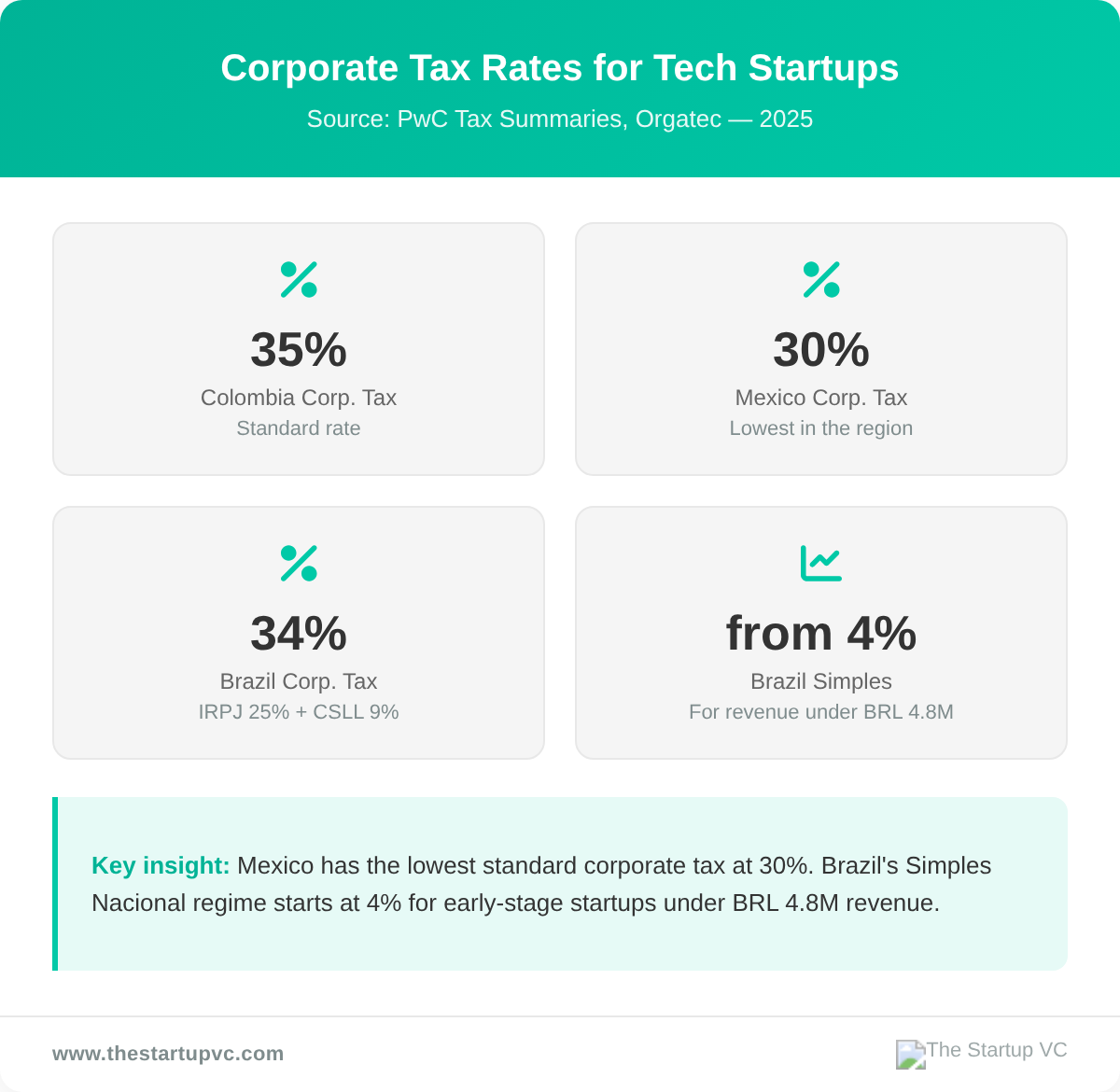
The tax rates are 35% in Colombia, 30% in Mexico, and 34% in Brazil for standard corporate income. Each country also has different compliance requirements and startup-friendly regimes that can reduce effective rates.
What Are the Corporate Tax Rates in Colombia?
Colombia’s corporate income tax rate is 35% for most businesses. The standard VAT rate is 19%. A reduced 5% VAT applies to certain goods and services. Tech startups must file monthly tax returns and issue electronic invoices for all transactions. Non-compliance can lead to fines and business closure.
Foreign tech companies earning over $364,000 USD from Colombian users must register under SEP (Significant Economic Presence) rules. These rules became effective January 2024.
What Are the Corporate Tax Rates in Mexico?
Mexico’s corporate income tax (ISR) rate is 30%. The standard VAT rate is 16%. Businesses in the northern border region benefit from a reduced 8% VAT rate.
Tech companies can claim a 30% refund on R&D costs above a fixed threshold. The ceiling is 7% of combined payroll and investment. Mexico also introduced “Plan Mexico” incentives in January 2025. These allow immediate deduction of 35% to 91% on new fixed asset investments made through September 2030.
What Are the Corporate Tax Rates in Brazil?
Brazil’s corporate tax rate is 34%. This consists of 25% IRPJ (income tax) plus 9% CSLL (social contribution on net income). For most early-stage tech startups, the Simples Nacional regime offers relief.
Startups with annual revenue under BRL 4.8 million can use Simples Nacional. Combined tax rates under this regime start at 4%. The catch: foreign shareholders generally disqualify a company from Simples Nacional. Most foreign-founded startups use the Lucro Presumido regime instead. Under Lucro Presumido, a 32% margin applies to service revenue before tax. The effective rate for most tech services comes to approximately 13 to 15%.
Monthly accounting under Lucro Presumido costs BRL 300 to 800 per month. Lucro Real companies incur higher accounting fees due to detailed profit tracking.
The table below compares the main tax factors for each country.
| Factor | Colombia | Mexico | Brazil |
|---|---|---|---|
| Standard corporate tax | 35% | 30% | 34% |
| Standard VAT | 19% | 16% | Multiple (PIS/COFINS/ISS vary) |
| Startup tax regime | Standard rate (35%) | Standard ISR (30%) | Simples Nacional from 4% (local shareholders only) |
| Monthly compliance | Electronic invoicing + monthly returns | Monthly SAT filings | Monthly accounting filings + eSocial |
| Monthly accounting cost | ~$50–$150 USD | ~$100–$300 USD | BRL 300–800 (~$60–$155 USD) |
How Do Office, Infrastructure, and Operational Costs Differ Across the Three Countries?
Office costs differ across the three countries. Bogotá starts at $100 USD per month for coworking desks. Mexico City prime offices average $24 USD per square meter. São Paulo is the most expensive market.
What Does Office Space Cost in Colombia?
Office space in Colombia costs approximately $100 to $370 USD per person per month for coworking desks. Regus hot desks in Bogotá range from COP 409,000 to COP 1,519,000. Private offices in Medellín are also competitive. Both cities attract cost-conscious startups seeking flexible space.
What Does Office Space Cost in Mexico?
Office space in Mexico City costs an average of USD $24.40 per square meter per month for prime locations. This makes it the most expensive of the three capital cities. Mexico City’s vacancy rate fell to 17.6% at the end of 2025, showing a tightening market. IOS Offices and WeWork both operate across Mexico City, Guadalajara, and Monterrey.
Mexico City still offers coworking options below prime office pricing. The city’s coworking market grew by 163% year-over-year at its peak. This shows strong demand from tech startups and nearshoring teams.
What Does Office Space Cost in Brazil?
Office space in Brazil costs BRL 799 per month and up for a WeWork hot desk in São Paulo. This equals approximately $140 to $155 USD at 2024-2025 exchange rates. Regus desks range from BRL 299 to BRL 1,999 per month.
São Paulo holds 15% of total coworking supply across Latin America’s five largest markets. It ranks as the region’s largest startup hub, with a market valued at $113 billion.
The Latin America coworking market is valued at USD 1.84 billion in 2025, growing at 10.64% annually. Beyond rent, founders should factor in internet connectivity, cloud infrastructure, and local software tool costs. All three countries have strong internet penetration in major cities.
The following list summarizes key operational cost differences:
- Bogotá and Medellín. Lower office costs and a large pool of English-speaking developers. Good for lean product teams.
- Mexico City and Guadalajara. Higher office costs but timezone alignment with US markets and strong nearshoring demand.
- São Paulo and Belo Horizonte. Highest costs, but access to Latin America’s largest tech talent pool. Brazil has over 500,000 active developers.
Which Country Offers the Most Startup-Friendly Incentives and Programs for Tech Companies?
The most startup-friendly incentives are found in all three countries, but they differ in scope and accessibility. Colombia leads on government grants for early-stage startups. Brazil leads on institutional funding volume. Mexico offers the strongest tax deductions.
What Startup Programs Does Colombia Offer?
The startup programs Colombia offers include iNNpulsa Colombia, Bancoldex, and the Youth Startup Academy. iNNpulsa is the main government agency. It sits under the Ministry of Commerce, Industry and Tourism. In 2024, iNNpulsa allocated over COP 150 billion ($36 million USD) to strengthen 20,000 startups nationwide.
Key programs include:
- ALDEA Program. Supports innovative startups through access to productive capital, technical support, and investor connections. Strengthened 1,049 startups in 2024.
- Youth Startup Academy. Targets 800 young entrepreneurs and 100 tech startups in Bogotá and Medellín by 2026. This $4 million program is the first of its kind in Latin America.
- Bancoldex. Provides loans and early-stage financial incentives to startups in their growth phase.
What Startup Programs Does Mexico Offer?
The startup programs Mexico offers include ProSoft, Plan Mexico tax incentives, and a state-level accelerator network. Mexico dissolved INADEM (its main startup agency) in 2019. Support now flows through state governments and private accelerators in Mexico City, Guadalajara, and Monterrey. For a full overview of the Mexican startup market, see The Startup VC’s guide to startups in Mexico.
Key programs include:
- ProSoft. Offers non-repayable funds covering up to 50% of project costs for IT companies seeking CMMI or MoProSoft certification.
- Plan Mexico (2025). Allows immediate deduction of 35% to 91% on qualifying new fixed asset investments through September 2030. An additional 25% deduction applies to increases in registered worker training costs.
- R&D Tax Refund. Tech companies can recover 30% of qualifying R&D costs. The ceiling is 7% of combined payroll and investment.
What Startup Programs Does Brazil Offer?
The startup programs Brazil offers include FINEP, BNDES, and SEBRAE. These institutions provide the largest pool of innovation funding in Latin America. BNDES and FINEP together approved R$14 billion for innovation financing in 2025 under the Nova Indústria Brasil program.
Key programs include:
- SEBRAE. Grants benefits exceeding BRL 250,000 to qualifying startups. It also offers discounts of up to 90% on tools like Slack, Notion, and HubSpot.
- FINEP. Provides innovation credit contracts and co-funding for R&D projects, often partnered with state research foundations.
- BNDES. Offers subsidized credit for tech and innovation projects, typically for companies with a track record or institutional backing.
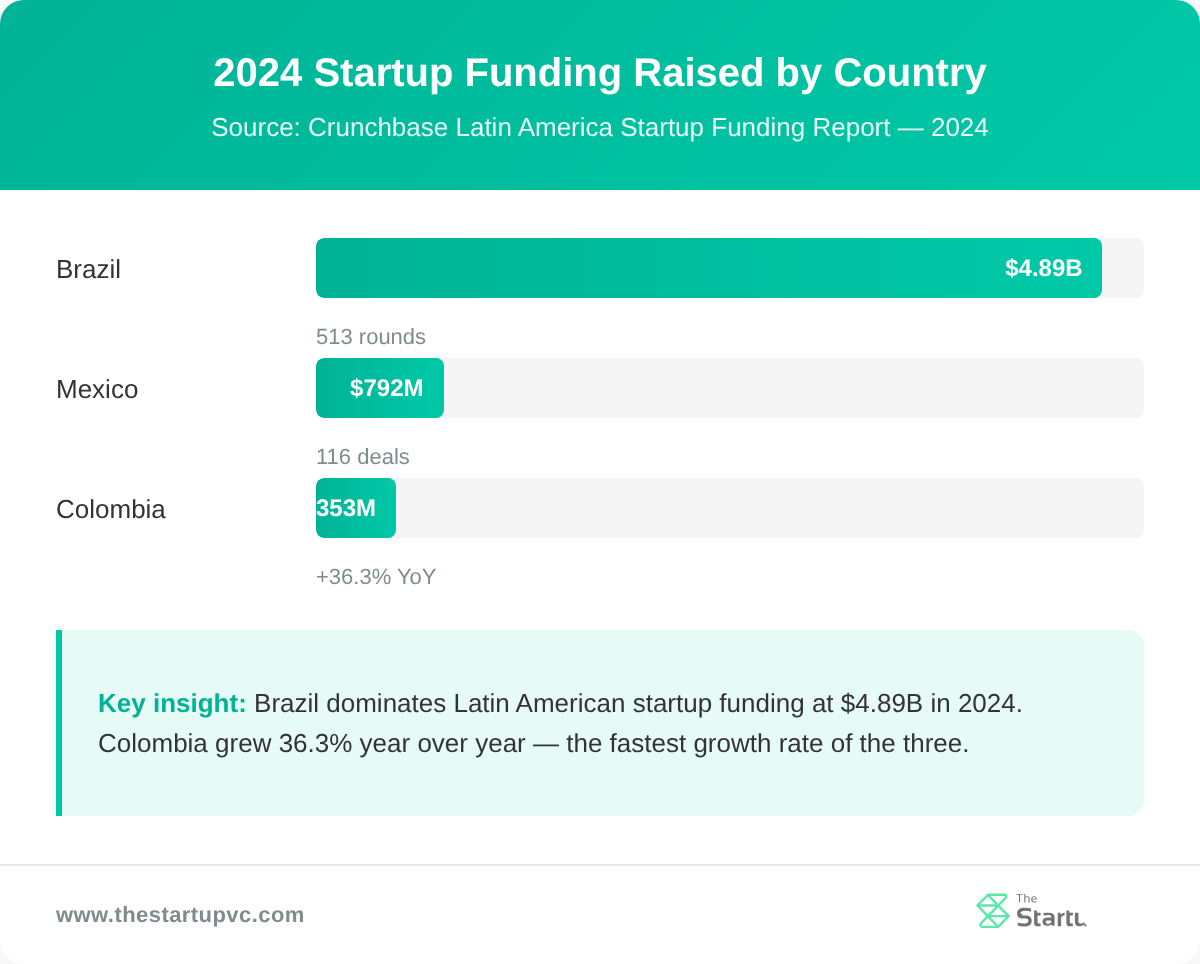
Brazil’s advantage is scale. The country raised $4.89 billion in venture funding in 2024. Mexico raised $792 million. Colombia attracted $353 million, though at the fastest growth rate of the three, up 36.3% year-over-year.
What Questions Do Startup Founders Ask Most Often About Starting a Tech Company in LatAm?
How long does incorporation take in each country?
Incorporation timelines vary significantly. Colombia’s SAS takes 5 to 10 business days. Mexico’s SAS takes 1 to 3 business days, while the traditional SA de C.V. takes 4 to 8 weeks. Brazil’s LTDA takes 60 to 90 days. Brazil requires registration with the Receita Federal, CNPJ, state agencies, and the municipality.
Can a foreign founder own 100% of a tech company in these countries?
Yes, all three countries allow 100% foreign ownership. Colombia’s SAS, Mexico’s SA de C.V. and SAS, and Brazil’s LTDA all permit full foreign shareholding. No local partner is required.
Which country is the cheapest overall for a tech startup?
Colombia is the cheapest for early-stage setup. Incorporation costs start at $800 USD. Developer salaries are 30 to 50% below US rates. Monthly compliance costs are lower than in Brazil or Mexico. Mexico is mid-range with stronger nearshoring opportunities. Brazil is the highest-cost market but offers access to the largest talent pool and VC network in the region.
Is there a minimum capital requirement to register a tech company?
No. Colombia’s SAS, Mexico’s SAS, and Brazil’s LTDA all have no legal minimum capital requirement. You can incorporate with any amount. The registration tax in Colombia is 0.7% of whatever capital you declare, so many founders declare a modest initial capital.
What hidden costs do founders miss when starting in these countries?
The most common hidden costs are:
- Brazil: The mandatory 13th salary, 8% FGTS contributions, and the 60 to 90-day setup timeline that delays revenue.
- Mexico: Profit-sharing (PTU) at 10% of taxable profits, Aguinaldo (Christmas bonus), and the state ISN payroll tax. Rates vary by state.
- Colombia: Parafiscal contributions (SENA, ICBF, family compensation funds) and mandatory electronic invoicing compliance.
How does VC funding availability differ across the three markets?
Brazil leads the region in venture funding. It raised $4.89 billion across 513 deals in 2024. Mexico ranked second with $792 million. Colombia attracted $353 million in 2024, a 36.3% increase from the prior year. In Q2 2025, Mexico surpassed Brazil in venture dollars for the first time in over a decade.
Ready to Launch a Tech Company in Latin America?
The Startup VC is Craig Dempsey’s family office and company builder. We create, back, and guide ventures that are built to grow across Latin America. Our portfolio includes Biz Latin Hub, operating in 17 countries with deep expertise in entity formation, compliance, and local hiring.
Whether you are weighing Colombia, Mexico, or Brazil, we bring hands-on experience with incorporation, local talent sourcing, and tax structure. We do not offer generic advice. We operate in these markets.
Contact us today to discuss your launch strategy.