
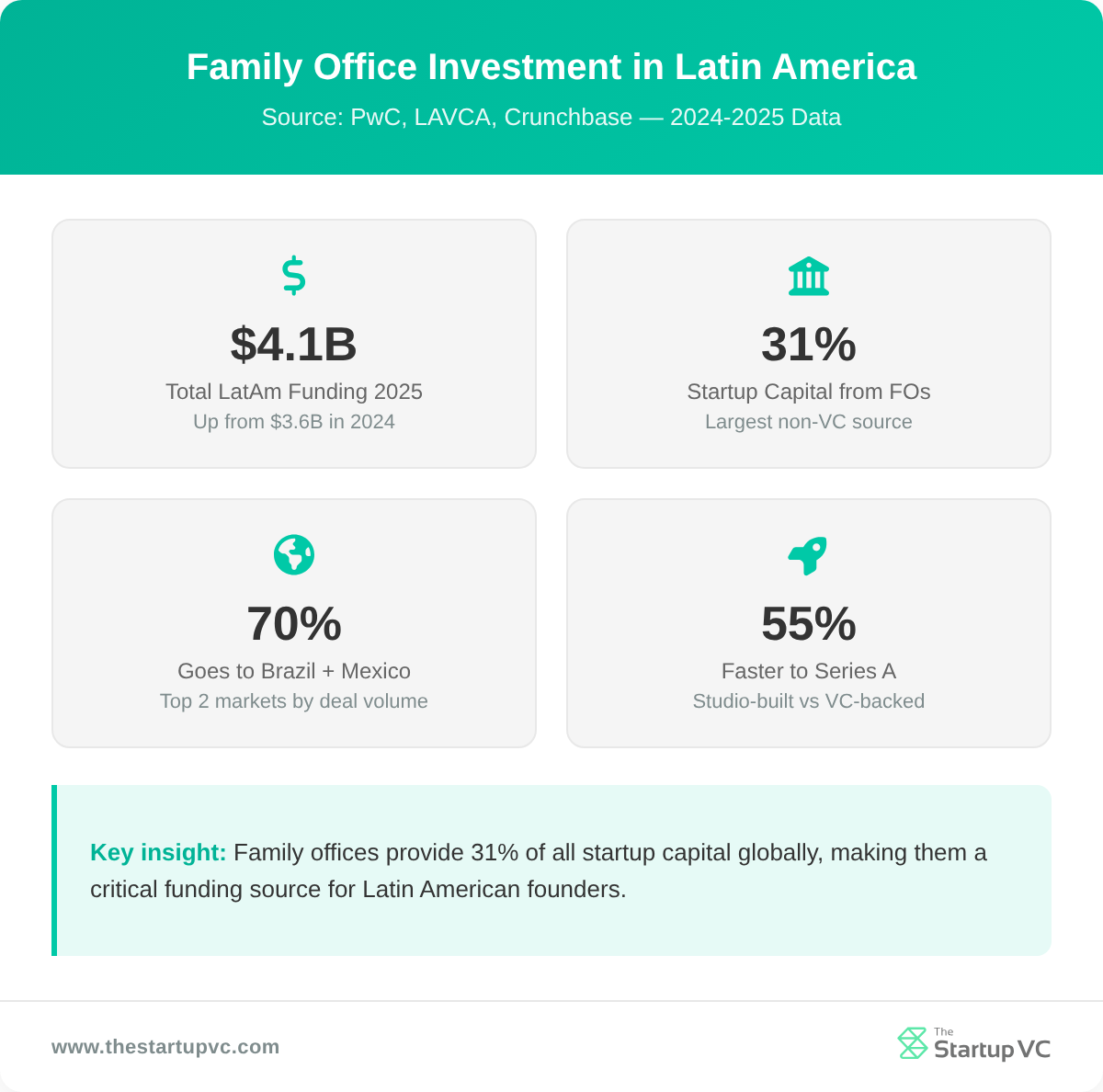
Family offices now account for 31% of all startup capital, with Latin America’s funding reaching $4.1 billion in 2025.
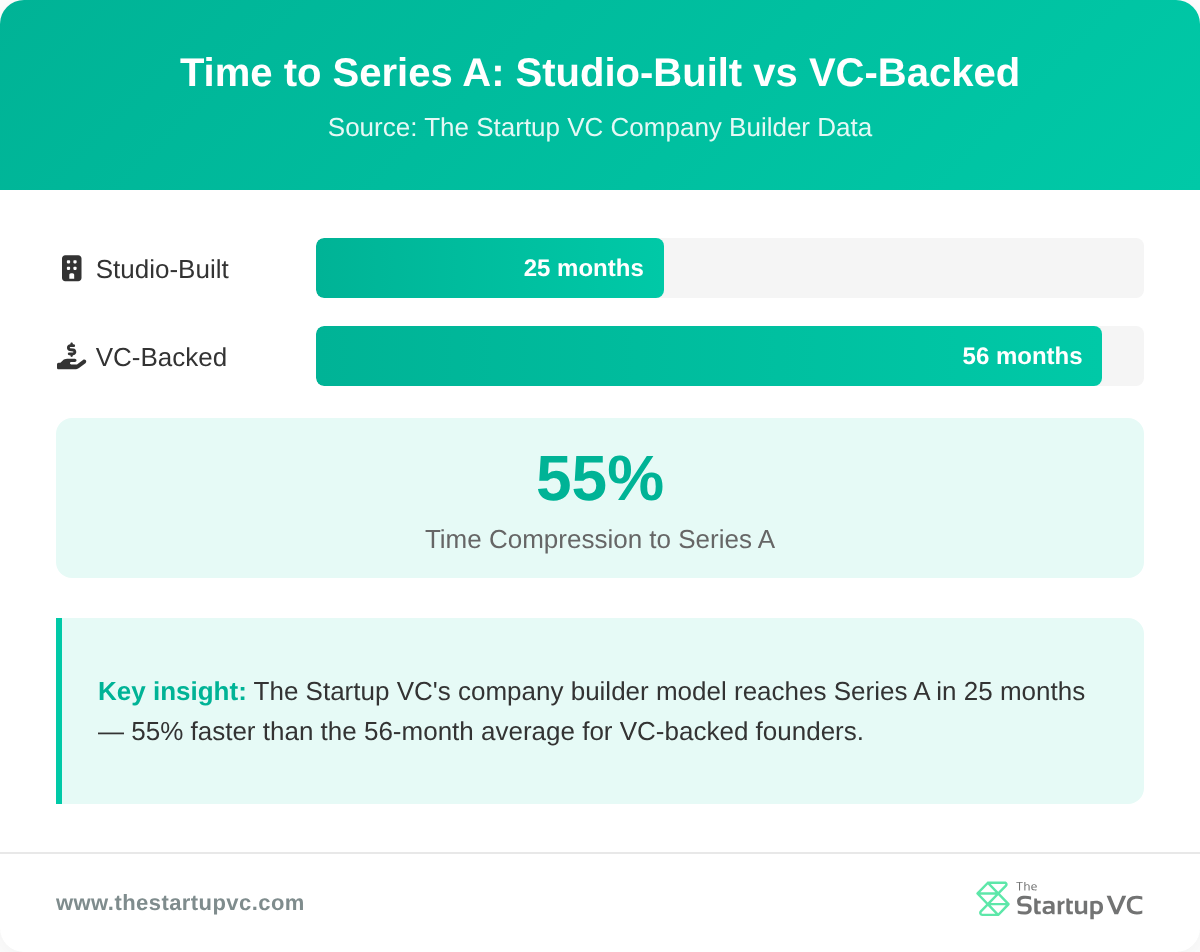
Latin American family offices deploy $1 million to $25 million per deal into startups across Brazil, Mexico, and Colombia. Craig Dempsey’s The Startup VC combines a family office with a company builder. Its ventures reach Series A 55% faster than VC-backed startups.
The Startup VC’s model comes from building Biz Latin Hub across 17 Latin American countries. Vistra acquired Biz Latin Hub in 2025. Below you will find how family offices invest, why Latin America attracts private capital, and what founders need to prepare before seeking family office funding.
What Is a Family Office and How Does It Invest in Startups?
A family office is a private investment firm that manages wealth for a single family or small group of families. It handles investing, tax planning, estate strategy, and philanthropy. Many family offices now invest directly in startups.
Family offices account for 31% of all capital invested into startups globally. About 83% of those deals happen as club deals with other investors. This makes family offices one of the largest sources of startup capital today.
How Do Family Offices Deploy Capital?
Family offices deploy capital into startups by using three main approaches:
- Direct seed investments. The family office invests its own capital directly into a founder’s company.
- Early-stage VC fund commitments. The family invests as a limited partner in venture capital funds.
- Incubator and accelerator programs. Some family offices run or back startup programs that build companies from scratch.
What Sectors Do Family Offices Prefer?
The sectors family offices prefer include fintech, biotech, and AI. According to Camden Wealth research, 61% of family offices invest in fintech. Another 64% invest in biotech. About 49% focus on artificial intelligence.
The key advantage for founders is patient capital. Family offices do not face the same pressure as VC funds to return capital on a fixed timeline. They can invest early, hold longer, and support founders through multiple growth stages.
Why Are Family Offices Investing in Latin America?
Family offices are investing in Latin America because the region offers fast-growing startup markets, large consumer bases, and rising deal flow. Latin America startup funding reached $4.1 billion in 2025. That figure rose from $3.6 billion in 2024.
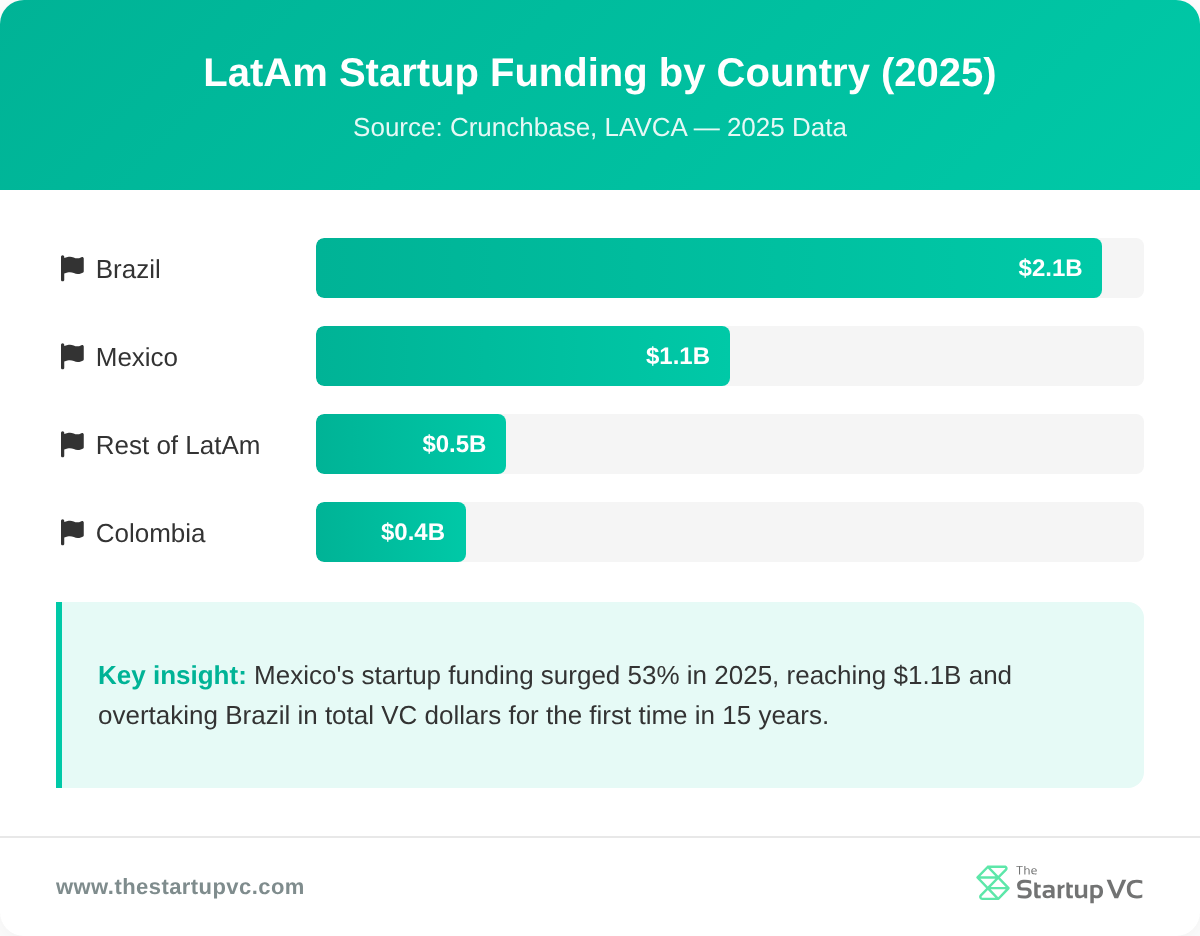
Brazil and Mexico attract 70% of all venture capital dollars in the region. Brazil is the 8th largest economy in the world. Mexico is the 12th largest. These two markets create strong deal flow for family offices looking at Latin America.
What Is Driving Capital Into the Region?
The factors driving capital into Latin America include economic scale, impact investing growth, and fintech adoption:
| Driver | Detail |
|---|---|
| Market size | Brazil (8th largest GDP) and Mexico (12th largest GDP) anchor the region |
| Funding growth | Total VC funding grew 14% from $3.6B in 2024 to $4.1B in 2025 |
| Mexico surge | Mexican startups raised $1.1B in 2025, up 53% year over year |
| Impact investing | Two dozen Latin American families with $2B in combined assets now back impact ventures through The ImPact network |
| Fintech boom | Digital payments, lending platforms, and crypto drive investment in Brazil, Mexico, and Colombia |
Family offices in Latin America provide patient capital and regional expertise. Many have built businesses in the region. They understand the challenges founders face in local markets like Bogota, Mexico City, and Sao Paulo. Learn more about how private capital flows into the region on our investment focus page.
How Does Craig Dempsey’s Private Capital Model Work?
Craig Dempsey’s private capital model works by combining a family office with a company builder. His firm, The Startup VC, creates, backs, and scales B2B service companies across Latin America.
Craig co-founded Biz Latin Hub in Bogota, Colombia in 2014. He scaled the company to operations in 17 Latin American countries. In December 2025, Vistra acquired Biz Latin Hub. This exit proved the model works at scale.
What Makes This Model Different From Traditional VC?
The Startup VC’s model differs from traditional VC by building companies from the inside. Studio-built startups reach Series A in 25 months. VC-backed founders take an average of 56 months. That is a 55% time compression.
The Startup VC’s playbooks come from scaling Biz Latin Hub across 18 countries. Portfolio companies share infrastructure, hiring frameworks, and compliance systems. This reduces the cost and risk of building in Latin America.
What Is Craig Dempsey’s Background?
Craig Dempsey’s background spans military leadership and international business. He served as a commissioned officer in the Australian Army. He completed deployments to Central Asia and the Middle East. He later held executive roles in mining across Australia, Canada, Peru, and Colombia.
This experience shapes how The Startup VC operates. The focus is on disciplined execution, proven systems, and long-term value creation across Latin American markets. Read more about Craig’s journey on the Meet Craig Dempsey page.
What Should Founders Know Before Seeking Family Office Investment?
Founders should know that family offices value alignment, clarity, and speed. Seven out of 10 family offices made direct investments in private companies in the 12 months through mid-2025. The opportunity is real, but preparation matters.
How Should Founders Prepare Their Pitch?
You can prepare your pitch by focusing on three areas:
- Research the family. Study the family office’s history, past investments, and focus sectors. Tailor your pitch to their goals.
- Lead with strategy. Family offices prefer concise pitches. Emphasize high-level strategy and key differentiators.
- Show value alignment. Many family offices invest in sectors tied to personal values, legacy, or social impact. Emotional alignment strengthens your case.
What Does Family Office Due Diligence Cover?
Family office due diligence covers financial health, team strength, and market opportunity. Expect reviews of these areas:
| Due Diligence Area | What They Review |
|---|---|
| Financial statements | Revenue history, projections, and key metrics |
| Burn rate and runway | Monthly cash spend and months of funding remaining |
| Cap table | Ownership structure and existing investor agreements |
| Market opportunity | Total addressable market and competitive position |
| Team | Founder experience, key hires, and advisory board |
Family offices move faster than pension funds or foundations. They can make investment decisions in a few months. Founders who prepare their data room early will close faster.
How Does Family Office Funding Compare to Venture Capital and Angel Investing?
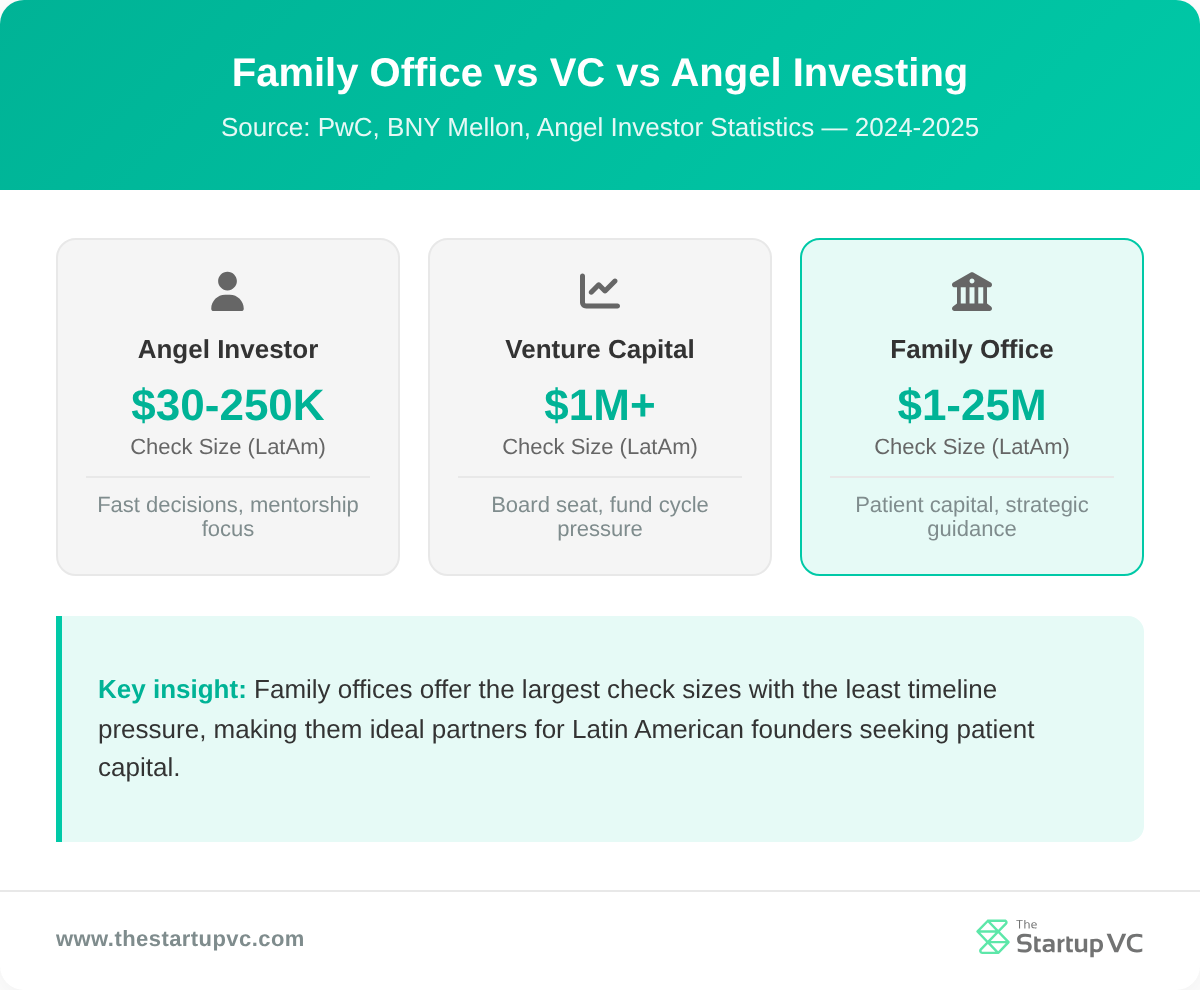
Family office funding compares to venture capital and angel investing by differing in check size, timeline, and involvement. Each source serves a different stage and founder need.
In Latin America, angel investors write checks between $30,000 and $250,000. VC firms invest $1 million or more. Family offices typically deploy $1 million to $5 million per deal as limited partners. Some invest $5 million to $25 million directly.
| Factor | Angel Investors | Venture Capital | Family Offices |
|---|---|---|---|
| Check size (LatAm) | $30K – $250K | $1M+ | $1M – $25M |
| Equity stake | 5% – 25% | Significant + board seat | Varies, often flexible |
| Timeline pressure | Low | High (fund cycle) | Low (patient capital) |
| Decision speed | Fast (weeks) | Slow (months) | Moderate (few months) |
| Involvement | Mentorship | Board seat + governance | Strategic guidance |
| Latin America share | 5% of global market | Concentrated in Brazil, Mexico | Growing rapidly |
VC funds must return capital to their investors within a set fund cycle. Family offices face less pressure on returns. They can hold investments longer and support founders through multiple rounds. Angel investors move fastest but write the smallest checks.
Latin America accounts for only 5% of the global angel investment market. North America holds 45%. Europe holds 30%. This gap means Latin American founders often turn to family offices and VC firms for larger rounds.
What Questions Do Founders Ask Most Often About Family Office Investment in Latin America?
How much do family offices typically invest in a startup?
Family offices typically invest $1 million to $5 million per deal as fund investors. Direct investments can range from $5 million to $25 million. The exact amount depends on the family’s total assets and risk appetite.
How long does it take to close a family office deal?
A family office deal takes a few months to close. This is faster than pension funds or foundations. Founders who have a prepared data room can speed up the process.
Do family offices take board seats?
Some family offices take board seats, but many do not. They tend to be more flexible than VC firms. Many prefer advisory roles or strategic guidance over formal governance.
What industries do Latin American family offices prefer?
Latin American family offices prefer fintech, logistics, B2B services, and impact-driven ventures. Many also invest in real estate and energy. The choice often reflects the family’s own business background.
Can early-stage startups get family office funding?
Yes, early-stage startups can get family office funding. About 31% of all startup capital comes from family offices. However, many family offices now favor growth-stage investments over seed rounds.
How is family office investment different from angel investing?
Family office investment differs from angel investing by offering larger check sizes and longer time horizons. Angels invest $30,000 to $250,000 in Latin America. Family offices invest $1 million or more. Family offices also provide operational support and strategic networks.
Ready to Explore Family Office Investment for Your Startup?
The Startup VC is Craig Dempsey’s family office and company builder. It creates, backs, and scales ventures across Latin America. The Startup VC offers founders hands-on support, shared infrastructure, and patient capital. Its playbooks come from building Biz Latin Hub across 17 countries. If you want a partner with real operating experience, Contact us today to start the conversation.